D-Serine: Food Sources & Daily Intake
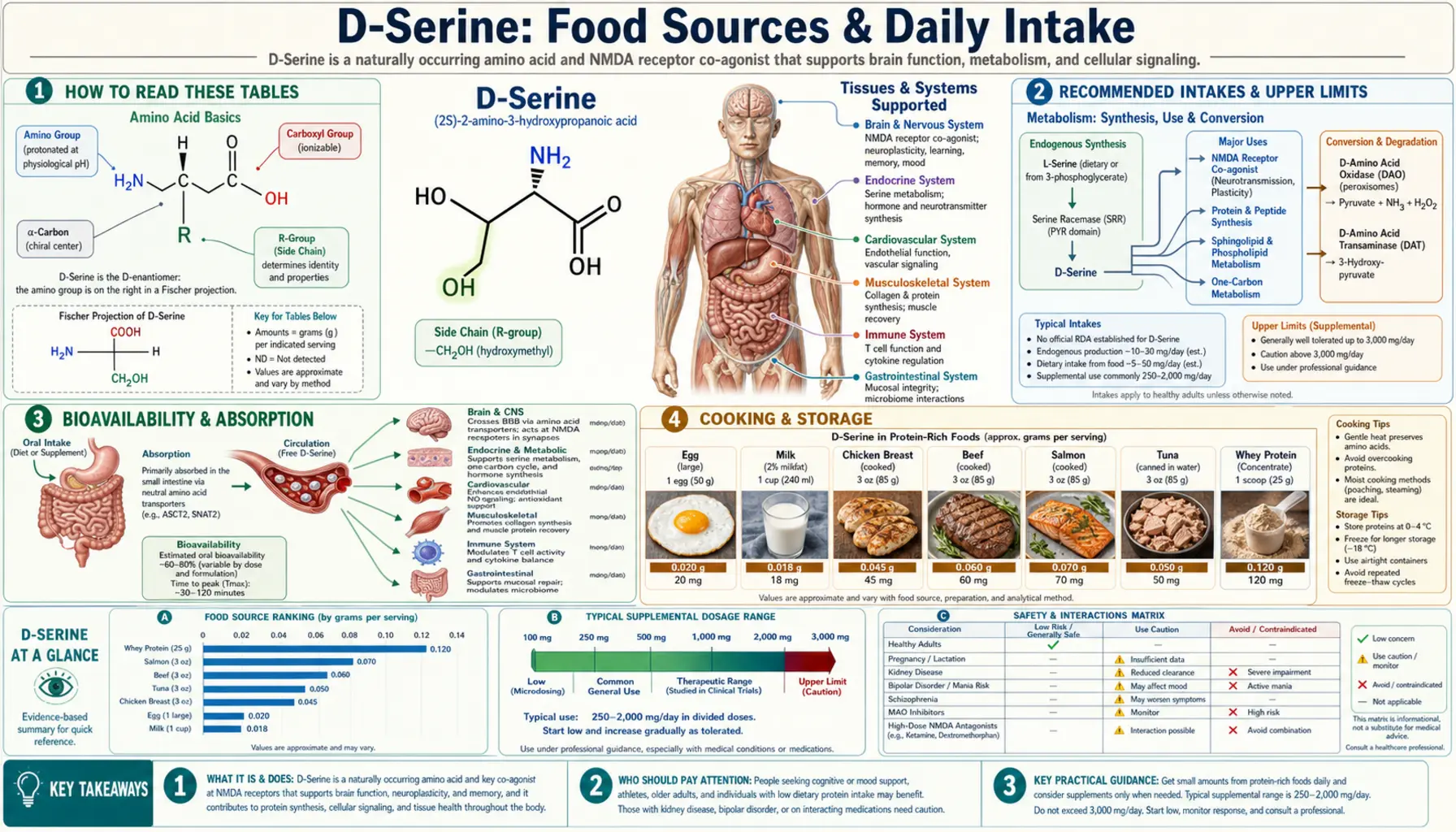
D-serine is unlike every other amino acid on this site: it is a brain-signaling molecule that your body makes for itself, not something you get from food. It is the mirror-image (stereoisomer) of ordinary serine — chemically the same atoms arranged as a left-hand-versus-right-hand reflection. The serine in meals, plants and supplements is almost entirely L-serine; the body then uses an enzyme called serine racemase to flip a small portion of that L-serine into D-serine, mostly inside the brain. There, D-serine works as a co-agonist at the NMDA glutamate receptor — in plain terms, it is one of the two keys the brain needs to switch that receptor on, which is essential for learning, memory and synaptic plasticity. The honest bottom line for diet is simple: food contributes almost no D-serine. A few fermented foods (some vinegars, aged cheese), certain shellfish, and freshly pressed fruit and vegetable juices carry trace amounts, but only as a tiny percentage of their serine, and the absolute milligrams are negligible. The short table below lists the few foods where any D-serine has actually been measured; the numbers are rough estimates from limited research values. If you are looking for the everyday dietary amino acid, see L-Serine.
| D-Serine: Food Sources & Daily Intake | |||||
|---|---|---|---|---|---|
| Rank | Food (serving) | Per 100 g | Glucose | Fructose | Notes |
| 1 | Lactic-Fermented Foods (E.g. Some Vinegars, Pickles) 1 Tbsp / ~15 g | 🟢 5.0 mg | — | — | Highest dietary D-serine, but still trace. Lactic-acid bacteria racemize a little serine into the D-form during fermentation; absolute amounts are tiny and the value shown is a rough, study-based estimate, not a published food analyses figure. |
| 2 | Sherry / Wine Vinegar 1 Tbsp / ~15 g | 🟢 4.0 mg | — | — | In one analysis D-serine reached about 4.7% of total serine in Sherry wine vinegar — a relative figure; the absolute milligrams are very small (estimate only). |
| 3 | Balsamic Vinegar 1 Tbsp / ~15 g | 🟢 3.0 mg | — | — | Reported to contain measurable D-serine among several D-amino acids; trace absolute amount, approximate. |
| 4 | Oysters & Other Shellfish 3 oz / 85 g | 🟢 3.0 mg | — | — | Marine invertebrates carry relatively more D-amino acids than most foods; the D-serine fraction is still small and per-100 g values are not well established (approximate). |
| 5 | Aged / Fermented Cheese 1 oz / 28 g | 🟡 2.0 mg | — | — | Long microbial fermentation produces small amounts of various D-amino acids including D-serine; trace, study-based estimate. |
| 6 | Tomato (And Tomato Juice) 1 medium / ~123 g | 🟡 1.0 mg | — | — | Free D-serine measured as a native plant constituent at roughly 0–1.7% of serine in pressed fruit/vegetable juices — a tiny relative amount (approximate). |
| 7 | Grapes / Citrus Juice ~1 cup / 150 g | 🟡 1.0 mg | — | — | Freshly pressed fruit juices contain free D-serine at about 0–1.7% of total serine; absolute amount is minimal (estimate). |
| 8 | Most Other Foods (Raw, Unfermented) 100 g | ⚪ 0.0 mg | — | — | Ordinary unfermented foods contain essentially only L-serine; any D-serine is negligible. For the everyday dietary amino acid, see L-Serine. |
Table of Contents
- How to Read These Tables
- Recommended Intakes & Upper Limits
- Bioavailability & Absorption
- Cooking & Storage
- Vegetarian & Vegan Sources
- Who Needs to Pay Attention
- Data Sources & References
- Connections
- Featured Videos
How to Read These Tables
- This is endogenous, not dietary. D-serine is made inside the body (mainly the brain, by serine racemase converting L-serine). It is a neuromodulator, not a nutrient — there is no requirement to eat it, no Daily Value, and no deficiency you can develop from a low-D-serine diet. Unlike the other amino acids listed on this site, you do not meaningfully obtain it from food.
- Values are from limited research. D-serine is not catalogued in standard nutrient databases. The few numbers shown come from specialized food-chemistry and chiral amino-acid studies, often reported as a percentage of total serine (for example, ~0–1.7% in fruit and vegetable juices, or ~4.7% in Sherry wine vinegar). The absolute milligram figures here are rough estimates converted from those relative amounts and should be read as approximate, not exact.
- For the dietary amino acid, see L-Serine. If you came here for the amino acid you actually get from protein in food, that is L-serine — see the L-Serine page. L-serine is widespread in everyday foods and is the precursor the brain converts into D-serine. This page covers only the D-form neuromodulator, which is a research compound rather than a dietary target.
Recommended Intakes & Upper Limits
Your personal target depends on age, sex and pregnancy. The Daily Value used for the %DV column above is a single label figure; the table below is the age-specific guidance.
| Reference | Adult value | Notes |
|---|---|---|
| Status | Endogenous neuromodulator — made in the body | It is not a dietary nutrient. The body synthesizes it itself, so there is no “intake” to track from food. |
| Dietary requirement | None (not a dietary nutrient) | There is no RDA, no Daily Value, and no deficiency state defined for dietary D-serine — you do not need to obtain it from food. |
| Main source | Synthesized in the brain from L-serine | The enzyme serine racemase converts ordinary L-serine into D-serine, mostly in neurons and astrocytes of the brain (the “serine shuttle”). |
| What it does | Co-agonist at the NMDA glutamate receptor | D-serine binds the glycine site of the NMDA receptor and is required to switch it on; it is central to synaptic plasticity, learning and memory, and is a major focus of schizophrenia and cognition research. |
Bioavailability & Absorption
Because there is so little D-serine in food, dietary “bioavailability” is largely beside the point — the brain’s D-serine comes from internal synthesis, not from what you eat. What you obtain from food is mostly L-serine, which is well absorbed as part of dietary protein; the body then makes its own D-serine from that L-serine using serine racemase, predominantly in the brain. In research settings, purified D-serine taken in concentrated doses can be absorbed and can raise blood and brain levels, but that is a pharmacological intervention studied in clinical trials, not something achieved through normal eating. From the diet alone, the trace D-serine in a few fermented foods or juices has no meaningful effect on brain D-serine levels.
Cooking & Storage
Ordinary cooking does not create meaningful D-serine. Most heat and processing leaves serine in its usual L-form; the small conversion of L-serine to D-serine in foods is driven mainly by microbial fermentation (lactic-acid bacteria), not by the heat of a stove. Very harsh, prolonged heat or strong alkaline treatment can racemize a little of any amino acid into its D-form, but in everyday cooking the amount of D-serine produced is negligible. There is no kitchen technique that turns a normal meal into a useful D-serine source — and there is no reason to try, since dietary D-serine is not a nutrient you need.
Vegetarian & Vegan Sources
This question is essentially moot for D-serine, because it is made by the body rather than obtained from food — so no diet, plant-based or otherwise, needs to supply it. The brain manufactures its own D-serine from L-serine, and L-serine is abundant in both animal and plant proteins, so anyone eating adequate protein provides the raw material regardless of diet. The handful of foods with measurable trace D-serine includes both plant items (fermented vegetables, vinegars, fruit juices) and animal items (shellfish, aged cheese), but none contribute a meaningful amount, so the vegan-versus-omnivore distinction does not matter here.
Who Needs to Pay Attention
D-serine is best understood as a research compound, not a dietary target — there is nothing to “get more of” from food, and a low-D-serine diet causes no deficiency. Scientific interest is high: because D-serine controls the NMDA receptor, it is studied in schizophrenia (where boosting NMDA signaling is a long-running therapeutic strategy) and in learning, memory and cognitive aging. Those studies use purified D-serine at controlled doses under medical supervision, and high doses have raised kidney-safety questions in animal work, which is exactly why it is not a casual supplement. The practical takeaway: do not try to chase D-serine through diet — eating fermented foods or shellfish for their trace D-serine will not change brain levels, and anyone considering D-serine for a health condition should do so only through a clinician or a formal clinical trial, not the grocery aisle.
Data Sources & References
- Wolosker & Balu (2020) — D-Serine, the Shape-Shifting NMDA Receptor Co-agonist (Neurochemical Research)
- Marcone et al. (2024) — D-Amino acids from foods and gut microbiota and their effects in health and disease (Food Reviews International)
- PubMed — D-serine NMDA receptor co-agonist brain neuromodulator
- PubMed — D-amino acids content in foods and fermentation
Connections
- All Amino Acids
- D-Serine (Main Page)
- D-Serine History
- L-Serine (the dietary amino acid)
- Psychiatry & Mental Health