Creatine: History and Discovery
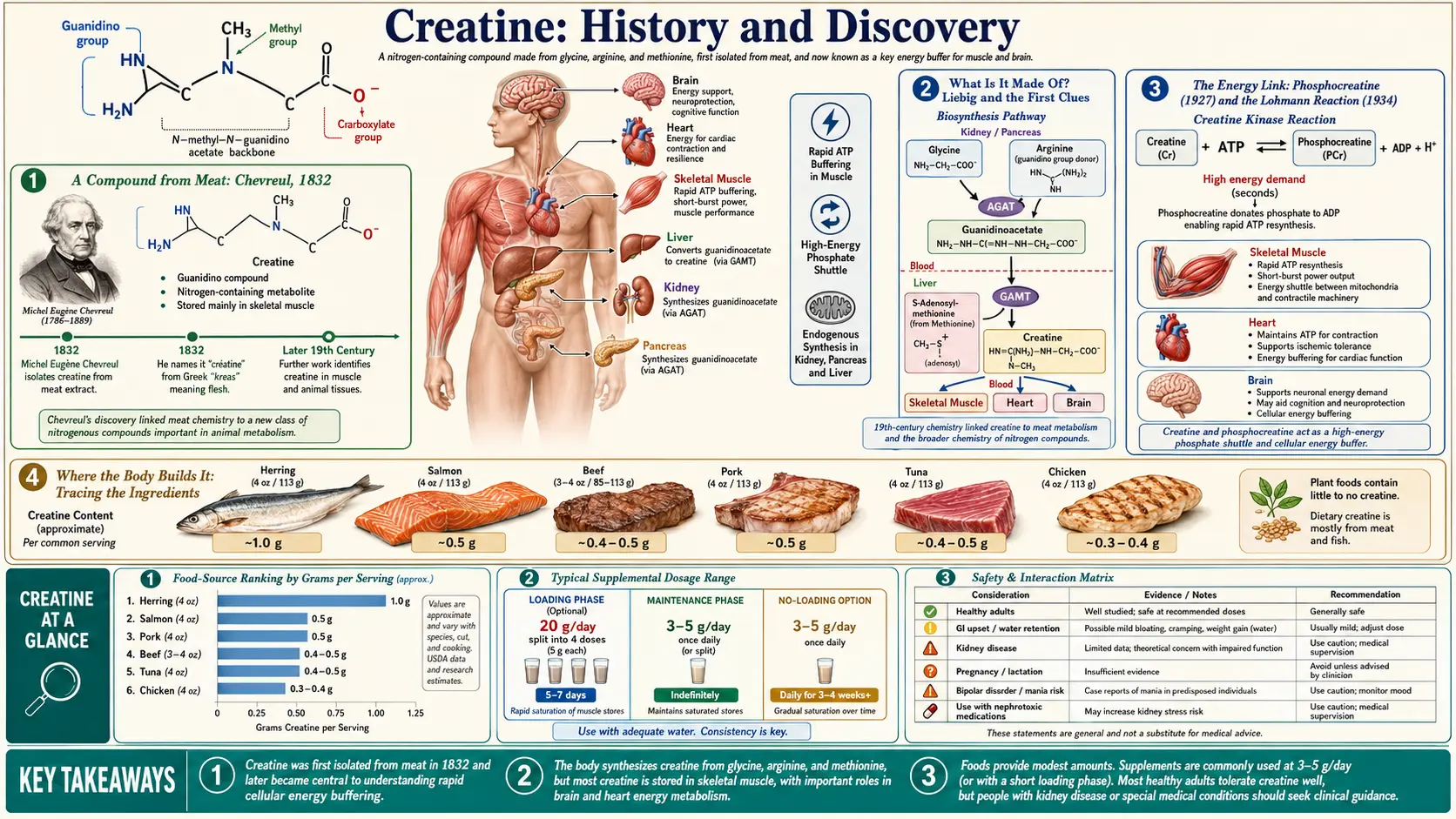
Creatine's story begins not in a gym but in a beaker of meat broth. In 1832, the French chemist Michel Eugène Chevreul boiled down skeletal muscle, treated the liquid, and crystallised out a substance no one had described before. He named it after the Greek word for flesh, kreas — and so the compound now sold in tubs to athletes the world over got its name from raw meat. This article follows what the historical record actually supports: who first isolated creatine and from what, how nineteenth-century chemists worked out what it was made of, the moment its link to muscular energy was discovered (by two laboratories at once), where in the body it is built, and the 1992 study that turned a forgotten meat constituent into one of the most-tested supplements in science. Where the record is firm we say so; where a claim is anecdote, tradition, or still argued over, we name it as such.
Table of Contents
- A Compound from Meat: Chevreul, 1832
- What Is It Made Of? Liebig and the First Clues
- The Energy Link: Phosphocreatine (1927) and the Lohmann Reaction (1934)
- Where the Body Builds It: Tracing the Ingredients
- The Bigger Picture: "Protein" and the Amino-Acid Era
- The Modern Turning Point: Harris, 1992
- From the Lab to the Locker Room: 1992 and the Loading Protocol
- From Sports Supplement to Brain and Longevity Science
- Research Papers and References
- Connections
- Featured Videos
A Compound from Meat: Chevreul, 1832
The discovery of creatine is unusually well documented and unusually tidy: it has a clear discoverer, a clear date, and a clear source. In 1832, Michel Eugène Chevreul (1786–1889) — a French chemist already famous for his work on fats and fatty acids — isolated a new organic compound from the water extract of skeletal muscle. By treating the broth and allowing it to crystallise, he obtained a substance that had never been chemically described, and he named it creatine after the Greek word kreas (κρέας), meaning "flesh" or "meat." The name is therefore a literal label for where the compound was found: in muscle.
It is worth pausing on how early this was. Chevreul isolated creatine years before the macronutrient we call protein was properly understood, and decades before the idea of the "calorie" entered nutrition. For most of the nineteenth century, creatine was simply a curious constituent of meat — a chemical oddity catalogued in the laboratory, with no known job in the living body. Chevreul, who went on to live to the age of 102 and remained a celebrated scientific figure into extreme old age, never knew what the substance he had named actually did. That answer would take almost a century more.
One honest qualification belongs here. Chevreul did not "invent" creatine, and creatine has no inventor: it is a natural compound present in the muscle of essentially all vertebrates, including humans. What Chevreul did — and what the historical record firmly credits to him — is the first isolation and naming of the compound as a distinct chemical entity. That is the milestone this section marks, and it is the secure foundation on which every later chapter of creatine's story is built.
What Is It Made Of? Liebig and the First Clues
Knowing that a substance exists is not the same as knowing what it is. The next chapter belongs to one of the towering figures of nineteenth-century chemistry, the German scientist Justus von Liebig (1803–1873). In 1847, Liebig confirmed creatine as a regular constituent of mammalian muscle and characterised it chemically — it is, in modern terms, methylguanidino-acetic acid, a small nitrogen-rich molecule. Liebig also made an observation that reads as remarkably modern: he reported that the muscle of wild animals contained considerably more creatine than that of their domesticated counterparts, and he reasoned that physical activity drove the accumulation. The intuition that creatine has something to do with muscular work — today a textbook fact — was already there in the 1840s, decades before anyone could explain it.
Liebig's interest was not purely academic. He developed and sold a commercial concentrated meat extract ("Liebig's Extract of Meat"), marketed as a restorative for the sick and the weak. The extract was rich in creatine and related compounds, and although Liebig was not selling a "supplement" in the modern athletic sense — that concept did not yet exist — it is fair to say that a creatine-bearing tonic was on the market well over a century before creatine monohydrate reached health-food shops.
The first real evidence that creatine eaten by mouth could actually raise the body's creatine content came at Harvard in 1912, when Otto Folin and Willey Glover Denis reported that ingesting creatine increased the creatine content of muscle. This is the genuine ancestor of every modern loading study — the first documented hint that supplementation works — even though the precise methods of the era were crude by today's standards. A related question, how creatine relates to creatinine (the breakdown product measured in routine blood and urine tests), was clarified in 1928 by R. K. Cannan and A. Shore, who showed in The Biochemical Journal that creatine and creatinine exist in chemical equilibrium with one another. That relationship matters to this day: because creatinine rises when creatine intake rises, creatine supplements can nudge a routine kidney-function test upward without any actual change in kidney health — a point taken up on the main Creatine page.
The Energy Link: Phosphocreatine (1927) and the Lohmann Reaction (1934)
For nearly a hundred years after Chevreul, no one knew why muscle was full of creatine. The breakthrough came in 1927, and — in one of the genuine coincidences of science history — it came from two laboratories independently and at essentially the same time. In England, Grace Eggleton and Philip Eggleton at the University of Cambridge, and in the United States, Cyrus Fiske and Yellapragada SubbaRow at Harvard Medical School, both identified a phosphate-bearing form of creatine in muscle. Because it appeared to be a store of chemical energy that could be drawn on during contraction, the compound was at first called phosphagen; today we call it phosphocreatine (or creatine phosphate). The discovery showed that phosphocreatine is broken down during a brief muscular effort and rapidly rebuilt afterwards — exactly the behaviour of an energy reserve. This is a real, documented case of simultaneous discovery, and both groups are properly credited.
The picture was completed a few years later by the German biochemist Karl Lohmann, who in 1934 described the enzyme reaction that links phosphocreatine to the cell's universal energy molecule, ATP. In what is still called the Lohmann reaction, the enzyme later named creatine kinase transfers a phosphate group between phosphocreatine and ADP, regenerating ATP almost instantly. This explained, at last, what creatine is for: it is part of a rapid-recharge system that tops up a working cell's energy supply faster than any other pathway. The naming and full characterisation of creatine kinase itself followed over subsequent decades, with its role in regenerating ATP from phosphocreatine firmly established by the 1960s.
With these discoveries the long mystery was solved. Chevreul's curiosity from a meat broth turned out to be a central player in cellular energy — the chemistry underlying everything from a sprinter's first stride to the constant electrical work of the brain. The mechanism and its modern applications are covered on the main Creatine page; here it is enough to mark 1927 and 1934 as the years creatine stopped being a chemical curiosity and became a known cog in metabolism.
Where the Body Builds It: Tracing the Ingredients
A second great question is where creatine in the body actually comes from. We obtain some from food — meat and fish above all — but the body also manufactures its own. Working out how was made possible by a powerful new tool: the use of isotopic tracers, atoms labelled so that chemists could follow them through the living body. The pioneer of that method was Rudolf Schoenheimer (1898–1941), and around 1939–1941 he and his colleague Konrad Bloch — using nitrogen-15-labelled compounds — traced the precursors of creatine, helping to establish that the body assembles it from amino-acid building blocks rather than relying on diet alone.
Modern biochemistry has filled in the details that this isotope work first opened up. Creatine is built from three amino acids — glycine, arginine, and methionine — in a two-step process that runs mainly in the kidneys and liver. The first enzyme (arginine:glycine amidinotransferase, or AGAT) joins parts of arginine and glycine; the second adds a methyl group donated by methionine. The result is that a healthy adult body makes on the order of a gram of creatine a day from scratch, supplementing what comes from the plate. This is also why strict vegetarians and vegans, who eat little or no dietary creatine, rely more heavily on their own synthesis and tend to have lower body stores — a difference explored on the main page.
Schoenheimer's broader legacy reaches well beyond creatine: his isotope-tracer technique transformed the whole of biochemistry and overturned the old idea that the body's tissues were largely static, replacing it with the modern picture of constant turnover — what he called the "dynamic state" of body constituents. Creatine synthesis was one of the early problems that method helped to crack.
The Bigger Picture: "Protein" and the Amino-Acid Era
Creatine's history is woven into a larger nineteenth- and twentieth-century story: the slow discovery that living tissue is built from amino acids strung together into proteins. It is worth setting creatine's milestones against that backdrop, because the same decades that puzzled over creatine were also defining the very vocabulary of biochemistry. The word protein itself dates to 1838: the Dutch chemist Gerardus Johannes Mulder introduced it on the suggestion of the great Swedish chemist Jöns Jacob Berzelius, who proposed the term — from the Greek prōteios, "of first importance" — in a letter to Mulder dated 10 July 1838, reflecting the belief that these substances were the primary stuff of living matter.
The chemistry of how amino acids actually link together was worked out at the turn of the twentieth century by the German chemist Emil Fischer (1852–1919). From about 1899 onward, Fischer identified the peptide bond — the chemical link that joins one amino acid to the next — and synthesised the first laboratory-made peptides, laying the foundation for all later protein chemistry. A point of accuracy is worth making here, because it is often muddled: Fischer was awarded the Nobel Prize in Chemistry in 1902, but the prize was given for his work on sugar and purine syntheses, not for his peptide research, which was still in progress at the time. His landmark contributions to proteins came alongside and after the prize, roughly between 1899 and 1908.
Where does creatine sit in this? Creatine is not itself one of the twenty amino acids that build proteins, nor is it a protein. It is a small nitrogen-containing molecule made from amino acids (as the previous section describes) and used for energy rather than for building tissue. But its history runs in parallel with the amino-acid era and depends on the same advances — from Berzelius and Mulder naming the field's central molecule, to Fischer explaining how amino acids bond, to Schoenheimer's tracers revealing how the body builds compounds like creatine from those very amino acids.
The Modern Turning Point: Harris, 1992
For most of the twentieth century creatine remained a subject for physiologists, not a product for athletes. The modern era began with a single, now-famous study published in 1992 by Roger C. Harris, Karin Söderlund, and Eric Hultman, working in the Department of Clinical Chemistry at the Karolinska Institute (Huddinge University Hospital) in Sweden. Their paper, "Elevation of creatine in resting and exercised muscle of normal subjects by creatine supplementation," appeared in the journal Clinical Science. Using muscle biopsies, they showed that taking creatine monohydrate by mouth — about 5 grams several times a day — could raise the total creatine content of the thigh muscle substantially, by as much as 50% in some people, and that exercise increased the uptake.
This was the result that changed everything. It took an old, half-forgotten observation (that eating creatine raises muscle creatine, hinted at by Folin and Denis eighty years earlier) and demonstrated it cleanly with modern measurement. There is a small piece of lore attached to the paper that is well attested: the manuscript was reportedly turned down by the journals Nature and the Journal of Physiology before Clinical Science published it — a reminder that even landmark findings can struggle to find a home. Within a few years the same Karolinska group and others had built creatine into the most heavily studied sports supplement in the world.
From the Lab to the Locker Room: 1992 and the Loading Protocol
Science and sport collided in the same year the Harris study appeared. At the 1992 Barcelona Olympics, several British gold medallists — among them the 100-metre champion Linford Christie and the 400-metre hurdles champion Sally Gunnell — openly acknowledged using creatine in their training. Press coverage of that admission did as much as any laboratory result to launch creatine into public awareness. A note of caution is fair here: that elite athletes used creatine and won is a matter of record, but it is not evidence that creatine produced the medals — the real evidence for creatine's effects comes from the controlled trials, not from the podium. The Olympic story is best understood as the moment creatine entered popular culture, not as proof of anything.
The practical recipe most people still follow was pinned down in 1996, when Eric Hultman and colleagues — including Karin Söderlund and Paul Greenhaff — published "Muscle creatine loading in men" in the Journal of Applied Physiology. They compared dosing schemes and established the now-standard two-phase approach: a short high-dose "loading" phase (around 20 grams a day for about a week) saturates the muscle quickly, after which a low "maintenance" dose (a few grams a day) holds the level up. Crucially, they also showed that skipping the loading phase and simply taking a small daily dose reaches the same saturation over about a month — loading is faster, not better. These findings, three decades old, still underpin the dosing advice on the Creatine Benefits pages today.
From Sports Supplement to Brain and Longevity Science
The arc of creatine's history has one more turn, still being written. Once researchers had a reliable way to load the muscle with creatine, attention spread far beyond the weight room. Because the same phosphocreatine energy system runs in the brain, the heart, and other hard-working tissues, scientists began asking whether creatine could help there too — in cognition and sleep deprivation, in mood, in the muscle loss of aging, and even in immune cells. Rare inherited disorders in which the body cannot make or transport creatine, identified from the 1990s onward, dramatically confirmed how essential the compound is for normal brain development.
That broadening story — the modern clinical evidence, mechanisms, dosing, forms, and safety — is the subject of the main Creatine article and its companion Benefits pages, and is not repeated here. What this history is meant to show is the long unbroken thread: from a French chemist crystallising an unknown substance out of meat broth in 1832, through the discovery of its role in cellular energy, to its emergence as one of the best-studied compounds in nutrition. Two honest reminders close any history like this. First, a long pedigree is a reason to take a compound seriously, not proof that it helps in any particular condition — that is what trials are for. Second, the most reliable parts of creatine's story are exactly the ones with names and dates attached; the further a claim drifts from the documented record, the more carefully it should be weighed.
Research Papers and References
The list below gathers key peer-reviewed sources for the documented history of creatine, alongside curated PubMed topic-search links into the historical and biochemical literature. Historical figures whose original nineteenth-century work predates indexed databases (Chevreul, Liebig, Mulder, and Berzelius) are named in the article as historical sources rather than as modern citations. Author names, titles, and journals are given as plain text; only the stable PMID or DOI link is hyperlinked, and each opens in a new tab.
- Harris RC, Söderlund K, Hultman E. Elevation of creatine in resting and exercised muscle of normal subjects by creatine supplementation. Clinical Science. 1992;83(3):367-374. — PMID: 1327657
- Hultman E, Söderlund K, Timmons JA, Cederblad G, Greenhaff PL. Muscle creatine loading in men. Journal of Applied Physiology. 1996;81(1):232-237. — doi:10.1152/jappl.1996.81.1.232
- Cannan RK, Shore A. The creatine-creatinine equilibrium. The apparent dissociation constants of creatine and creatinine. The Biochemical Journal. 1928;22(4):920-929. — doi:10.1042/bj0220920
- Wyss M, Kaddurah-Daouk R. Creatine and creatinine metabolism. Physiological Reviews. 2000;80(3):1107-1213. — doi:10.1152/physrev.2000.80.3.1107
- Brosnan ME, Brosnan JT. The role of dietary creatine. Amino Acids. 2016;48(8):1785-1791. — doi:10.1007/s00726-016-2188-1
- Balsom PD, Söderlund K, Ekblom B. Creatine in humans with special reference to creatine supplementation. Sports Medicine. 1994;18(4):268-280. — doi:10.2165/00007256-199418040-00005
- Creatine history and discovery — PubMed: creatine history and discovery
- Creatine and phosphocreatine metabolism — PubMed: creatine and phosphocreatine metabolism
External Authoritative Resources
- NobelPrize.org — Emil Fischer, Nobel Prize in Chemistry 1902
- MedlinePlus — Creatine
- PubMed — All research on creatine supplementation