Collagen: Food Sources & Daily Intake
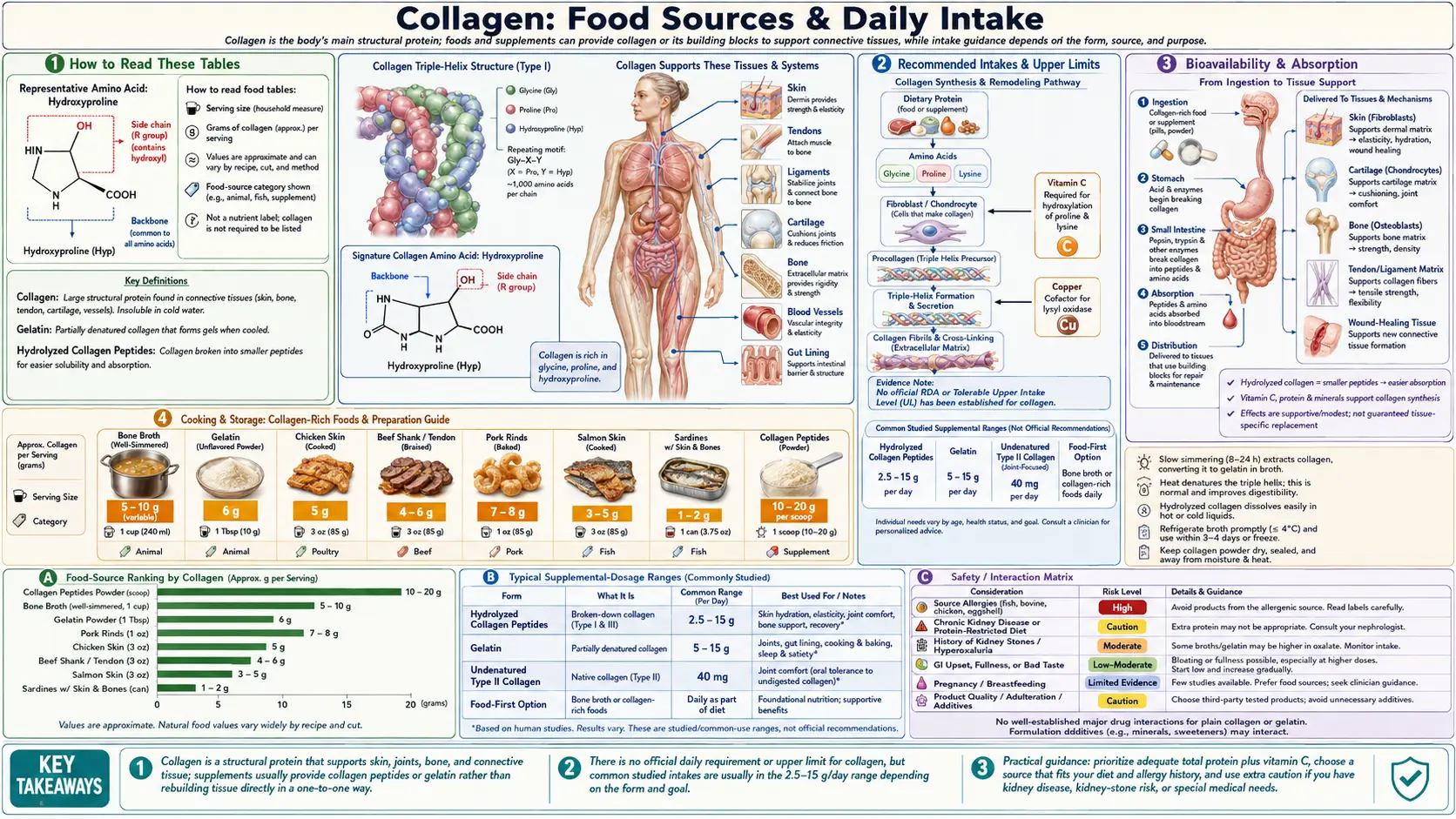
Collagen is the most abundant protein in the body — the structural scaffolding that holds skin, tendons, ligaments, cartilage, bone, the gut lining and blood-vessel walls together. It is built mainly from the amino acids glycine, proline and hydroxyproline, and the body manufactures its own collagen from ordinary dietary protein, provided it also has enough vitamin C, the cofactor the assembly enzymes require. Because collagen is a protein the body makes, there is no “collagen” figure in food databases. Instead this table ranks foods by hydroxyproline — an amino acid found almost only in collagen, which makes it the best dietary marker of collagen content. The richest sources are collagen itself: gelatin and bone broth (made from simmered skin, bone and connective tissue), animal skin, and tough, slow-cooking cuts. Amounts are shown as grams of hydroxyproline per 100 g of food; there is no FDA Daily Value for amino acids, so figures are absolute.
| Collagen: Food Sources & Daily Intake | |||||
|---|---|---|---|---|---|
| Rank | Food (serving) | Per 100 g | Glucose | Fructose | Notes |
| 1 | Bacon 1 oz / 28 g | 🟢 0.6 g | 0 | 0 | Skin-bearing cured pork. |
| 2 | Pork Sausage 3 oz / 85 g | 🟡 0.3 g | 0 | 0 | Ground tougher cuts and connective tissue. |
| 3 | Beef Meat 1 link / 45 g | 🟡 0.2 g | 0 | 0 | Made from connective-tissue trimmings. |
| 4 | Chicken Thigh (With Skin) 3 oz / 85 g | 🟡 0.1 g | 0 | 0 | |
| 5 | Pork Shoulder 3 oz / 85 g | 🟡 0.1 g | 0 | 0 | |
| 6 | Chicken Organ Meats 3 oz / 85 g | ⚪ 0.0 g | 0 | 0 | Nutrient-dense organ meat (giblets). |
Interactive Visualization Vitamin C, Collagen & Why Sailors Fell Apart Zip three protein chains into the strongest rope in biology — then take the vitamin C away and watch the helix unravel, and old healed scars split back open. Launch →
Table of Contents
- How to Read These Tables
- Recommended Intakes & Upper Limits
- Bioavailability & Absorption
- Cooking & Storage
- Vegetarian & Vegan Sources
- Who Needs to Pay Attention
- Data Sources & References
- Connections
- Featured Videos
How to Read These Tables
- Hydroxyproline is the collagen marker. Food databases have no “collagen” value because collagen is a protein, not a nutrient. Hydroxyproline is the workaround: it occurs almost exclusively in collagen, so the foods highest in it — gelatin, skin, bone broth and connective-tissue cuts — are exactly the foods richest in collagen.
- Grams per 100 g, not %DV. There is no FDA Daily Value for individual amino acids, so this table reports the absolute grams of hydroxyproline per 100 g of food and ranks foods by that. A typical serving is shown beside each food.
- The list is shorter than usual — and that is honest. Most foods carry no hydroxyproline at all, so it is only measured in collagen-rich ones; lean muscle meat, dairy, eggs, grains and produce mostly show none. A short list here is not missing data — it reflects that collagen is concentrated in skin, gelatin, bone and connective tissue, not spread evenly across the diet.
Recommended Intakes & Upper Limits
Your personal target depends on age, sex and pregnancy. The Daily Value used for the %DV column above is a single label figure; the table below is the age-specific guidance.
| Reference | Adult value | Notes |
|---|---|---|
| Status | Structural protein (not an essential nutrient) | Collagen is a protein the body builds for itself, not a vitamin or mineral you must obtain in a set amount. |
| Adult requirement | None set | There is no requirement to eat collagen: the body makes its own from glycine, proline and vitamin C, using ordinary dietary protein as raw material. |
| Main role | Holds the body together | Collagen gives strength and structure to skin, joints, tendons, ligaments, cartilage, bone, gut lining and blood vessels. |
| Ranked by | Hydroxyproline (the collagen marker) | Hydroxyproline occurs almost only in collagen, so foods highest in it — skin, gelatin, bone broth and connective-tissue cuts — are the richest sources of dietary collagen. |
Bioavailability & Absorption
Eaten collagen — from bone broth, gelatin or collagen peptides (collagen pre-broken into short, readily absorbed chains) — is digested down to amino acids and small peptides and absorbed well; it does not travel intact to skin or joints. What it provides is a concentrated supply of the exact building blocks (glycine, proline, hydroxyproline) the body uses to make its own collagen. The decisive cofactor is vitamin C: the enzymes that lock collagen's triple helix together cannot work without it, so even an abundant supply of these amino acids builds little sound collagen if vitamin C is low. Adequate total protein, vitamin C, plus copper and zinc, are what actually let the body turn dietary raw material into strong new tissue.
Cooking & Storage
The most collagen-dense food of all is created by cooking. Simmering bones, skin, tendons and other connective tissue in water for hours dissolves their tough collagen into soft, soluble gelatin — this is precisely what bone broth is, and why broth, gelatin and slow-braised meats carry so much hydroxyproline, glycine and proline. Slow, moist heat — braising, stewing, stock-making — is the way to release collagen from tough cuts (shank, oxtail, brisket, chuck) and from skin and bone; the long cook that breaks collagen down into gelatin is also what makes those cuts tender.
Vegetarian & Vegan Sources
Plants contain no collagen at all — collagen is exclusively an animal tissue, so there is no plant-based gelatin, bone broth or collagen peptide. That does not mean a plant-based eater cannot have healthy collagen, because the body builds its own collagen rather than depending on eating it. The raw materials — the amino acids glycine and proline — come from ordinary plant protein (beans, lentils, soy foods, peanuts, seeds and whole grains), and the body assembles collagen from them as long as total protein is adequate and, critically, vitamin C intake is good, since vitamin C is the limiting cofactor for collagen synthesis. Copper and zinc help too. So the plant-based route to strong skin, joints and connective tissue is: enough varied protein, plus plenty of vitamin-C-rich produce — not a collagen food, which plants cannot supply.
Who Needs to Pay Attention
You cannot become “collagen deficient” from diet the way you can run short of a vitamin — the body continuously makes its own. What declines is collagen production: it falls with age (driving thinner skin, wrinkles, weaker joints and slower healing) and is impaired by low protein, smoking, high sugar intake and especially low vitamin C — severe vitamin C deficiency (scurvy) is essentially a collapse of collagen synthesis, causing fragile skin, bleeding gums and poor wound healing. People with high connective-tissue demand — recovering from surgery, wounds or burns, athletes loading tendons and joints, and older adults — benefit most from concentrated collagen sources (bone broth, gelatin or collagen peptides). In every case the practical rule is the same: supply the building blocks and the vitamin C, since collagen-rich food without vitamin C cannot be turned into strong new tissue.
Data Sources & References
- NIH MedlinePlus — Collagen
- Linus Pauling Institute — vitamin C and collagen synthesis
- PubMed — oral collagen peptides, skin and joint outcomes
- PubMed — vitamin C as a cofactor in collagen biosynthesis
Connections
- All Amino Acids
- Vitamin C, Collagen & Why Sailors Fell Apart — interactive animation
- Collagen (Main Page)
- Collagen Benefits
- Collagen History
- Proline
- Glycine
- Bone Broth
- Vitamin C