Collagen: History and Discovery
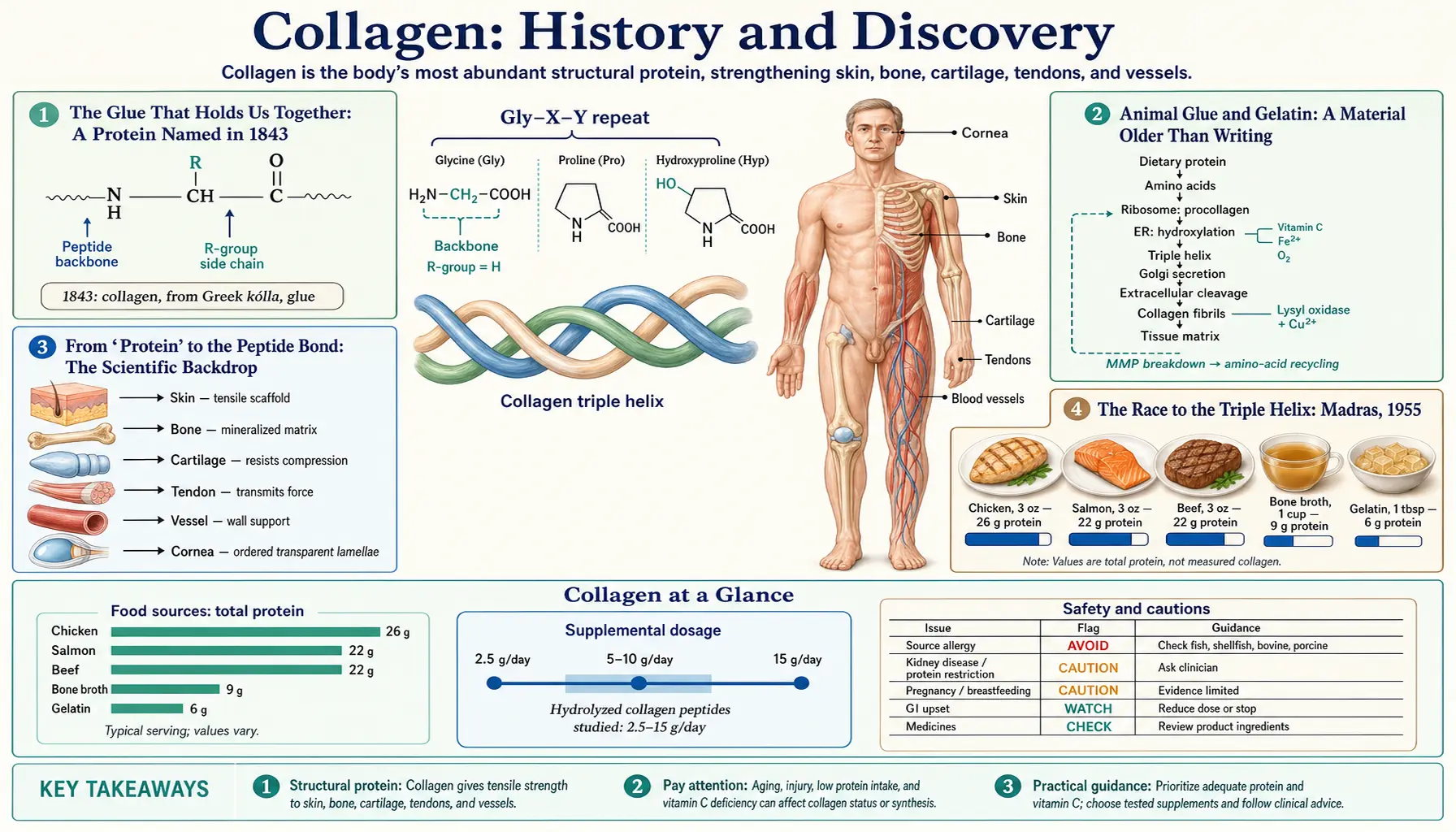
Collagen is unusual among the substances covered on this site: it is not a single amino acid that someone isolated from a plant or an animal tissue and gave a name. It is a protein — in fact the most abundant protein in the human body — and humans were using it for thousands of years before anyone knew what it was. The word itself records that long practical history: "collagen" was coined in 1843 from the Greek for "glue," because boiling animal skin and sinew yields glue. This article tells two stories that meet in the nineteenth and twentieth centuries: the ancient story of glue and gelatin made from connective tissue, and the modern scientific story of how chemists worked out what protein was, and finally how, in 1955, a group in Madras led by G. N. Ramachandran proposed the famous triple-helix structure of collagen — a result reached at almost the same moment by Alexander Rich and Francis Crick in Cambridge, in one of the genuine priority contests of early structural biology. Where the record is firm we say so; where a date or a claim is debated or uncertain, we mark it as such.
Interactive Visualization Vitamin C, Collagen & Why Sailors Fell Apart Zip three protein chains into the strongest rope in biology — then take the vitamin C away and watch the helix unravel, and old healed scars split back open. Launch →
Table of Contents
- The Glue That Holds Us Together: A Protein Named in 1843
- Animal Glue and Gelatin: A Material Older Than Writing
- From "Protein" to the Peptide Bond: The Scientific Backdrop
- The Race to the Triple Helix: Madras, 1955
- A Real Priority Dispute: Ramachandran, Rich, and Crick
- After the Helix: Types, Disease, and Modern Collagen Science
- Research Papers and References
- Connections
- Featured Videos
The Glue That Holds Us Together: A Protein Named in 1843
The first thing to understand about collagen's history is that collagen is a protein, not a single amino acid. The amino acids covered elsewhere on this site — glycine, proline, lysine, and the rest — were each isolated, one at a time, from some natural source and given a name. Collagen is different: it is a large, fibrous structural protein built from those amino acids, and its history is the history of a material long before it became the history of a molecule.
The name itself is a clue to that material history. The word collagen was coined in 1843, entering both French (as collagène) and English in that year. It is built from two Greek pieces: kolla, meaning "glue," and the suffix -gen, meaning "producing" or "giving birth to." Read literally, then, collagen means "the glue-producer" — the stuff in skin, bone, and sinew that yields glue when you boil it. This is one of the rare cases where a substance was named not for who discovered it but for what it had always been used to make. There is no single "discoverer" of collagen and no founding isolation paper to point to, because people were boiling connective tissue into glue and gelatin for millennia before the word existed.
That practical, glue-first origin sets collagen apart from the classic amino-acid discovery stories. When asparagine was isolated from asparagus in 1806, or glycine from gelatin in 1820, there was a named chemist, a named source, and a moment of first isolation. Collagen has none of those. Instead it has an etymology that points backward to the workshop and the cooking pot, and a scientific history that runs forward from the nineteenth century — first to the realization that this glue-yielding material was a protein, and finally, in the mid-twentieth century, to the discovery of the elegant molecular architecture that gives it its strength.
Animal Glue and Gelatin: A Material Older Than Writing
Long before chemistry, humans had learned a simple, powerful trick: simmer the skin, bones, tendons, and hides of animals in water, and the result is a sticky liquid that sets into a strong adhesive as it cools and dries. What they were extracting, we now know, was collagen — broken down by heat and water into the substance we call gelatin, and used as animal glue. This is the deep prehistory of collagen, and it is genuinely ancient. Archaeological finds of collagen-based glue have been carbon-dated to thousands of years old, and historical accounts describe collagen adhesives in use in ancient Egypt several thousand years ago, where they were used in woodworking and furniture. The precise ages assigned to individual artifacts vary between sources, so this page treats the practice as "many thousands of years old" rather than fixing a single date; the broad point — that collagen glue is one of humanity's oldest manufactured materials — is not in doubt.
The relationship between collagen, gelatin, and glue is straightforward once the chemistry is understood, even though that understanding came much later. Collagen is the intact structural protein in living tissue. When it is heated in water (or treated with acid or alkali), its tightly wound triple-helix strands come apart and partially break down — an irreversible change — producing gelatin, which dissolves in hot water and sets into a jelly as it cools. Further processing and drying yields animal glue. In other words, gelatin and traditional glue are simply collagen that has been cooked apart. The same kitchen process that made hide glue for a cabinetmaker also made the gelatin of aspics, jellied broths, and, much later, the gelatin desserts of the modern supermarket.
This long material history matters for collagen's story in two ways. First, it explains the name: by the time chemists in the 1840s needed a word for the protein, "the thing that makes glue" was the obvious description, and so "collagen" was born. Second, it is the direct ancestor of the way collagen is most often consumed today. The slow-simmered bone broth that traditional cooks have always valued, and the hydrolyzed collagen peptides and gelatin sold as modern supplements, are not new inventions — they are refinements of a practice older than writing. The food and supplement side of that story is told on the main Collagen page and in the Collagen Benefits articles; here it is enough to mark that collagen reached the laboratory already carrying thousands of years of practical use.
From "Protein" to the Peptide Bond: The Scientific Backdrop
Collagen could only become a scientific subject once there was a science of proteins at all, and that science was very young when the word "collagen" was coined. The concept of a protein as a distinct class of biological substance dates to 1838. In that year the Dutch chemist Gerardus Johannes Mulder, who was carrying out elemental analyses of substances like albumin and fibrin, worked out a shared composition for them, and the great Swedish chemist Jöns Jacob Berzelius supplied the name. In a letter to Mulder, Berzelius proposed the word "protein," drawing on the Greek proteios — meaning roughly "of the first rank" or "primary" — because these substances seemed to be the primary, foundational material of living tissue. Collagen, named just five years later in 1843, took its place as one member of this newly defined family of "first-rank" substances.
But naming proteins was not the same as understanding them. The crucial question — how the amino acids in a protein are actually joined together — was not answered until the turn of the twentieth century, and the answer is owed above all to the German chemist Emil Fischer. Between roughly 1899 and 1908, Fischer established that amino acids in proteins are linked by a specific chemical bond, which he called the peptide bond, and he proved it by synthesizing chains of amino acids — dipeptides, tripeptides, and longer polypeptides — in the laboratory. In 1901, with the chemist Ernest Fourneau, he reported the synthesis of the simple dipeptide glycyl-glycine, and by 1907 he had built a chain of eighteen amino acids and shown that enzymes broke it down just as they would a natural protein. This peptide-bond chemistry is the foundation on which all later protein structure, including collagen's, would be built.
A point of accuracy is worth making here, because it is often garbled. Emil Fischer did receive the Nobel Prize in Chemistry in 1902 — but the prize was awarded for his earlier work on sugars and purines, not for his protein and peptide research, much of which came afterward. It is correct to say Fischer was a Nobel laureate and the founder of peptide chemistry; it is a common error to say he won the Nobel Prize "for" the peptide bond. We state it the accurate way. Taken together, Mulder and Berzelius's naming of protein in 1838 and Fischer's peptide-bond work in the following decades set the stage: by the mid-twentieth century, chemists knew that collagen was a protein and that proteins were chains of amino acids linked by peptide bonds. What they did not yet know was the three-dimensional shape into which collagen's chains were folded — and that was the prize that the 1950s would claim.
The Race to the Triple Helix: Madras, 1955
The single most important event in collagen's scientific history is the discovery of its triple-helix structure in the mid-1950s — and the central figure in that discovery worked not in Cambridge or California but in Madras (today Chennai), India. The physicist and structural scientist Gopalasamudram Narayana Ramachandran (1922–2001), working with his colleague Gopinath Kartha, used X-ray fiber-diffraction data — the same kind of technique that had helped reveal the structure of DNA — to deduce how collagen's polypeptide chains are arranged in space.
By documented accounts, the idea took root after a 1953 conversation in Madras with the eminent crystallographer J. D. Bernal, who suggested to Ramachandran that the structure of collagen remained unsolved and was worth pursuing. Within about two years, Ramachandran and Kartha had their answer. They proposed an early model in 1954 and then published their landmark coiled-coil triple-helix structure in the journal Nature in 1955 ("Structure of Collagen," Nature, volume 176, pages 593–595). Their model described collagen as three polypeptide chains wound around one another into a rope-like supercoil, held together by a regular pattern of hydrogen bonds — specifically, two interchain hydrogen bonds for every three amino-acid residues.
This was a profound insight, and it explained features of collagen that had long been puzzling — above all why the amino acid glycine, the smallest of all, must occupy every third position along each chain. Only glycine is small enough to fit at the crowded centre of the three-stranded coil, which is why collagen sequences run in the repeating pattern of glycine–X–Y. The model became so closely identified with its birthplace that researchers in Europe and America nicknamed it the "Madras helix" or "Madras triple helix." It is the conceptual ancestor of every modern picture of collagen, including the triple-helix description summarized on the main Collagen page. The episode also had a lasting personal consequence for Ramachandran: the scrutiny his collagen model attracted (described in the next section) pushed him to work out the fundamental geometric rules of protein chains, producing the celebrated Ramachandran plot that is still taught to every structural biology student today.
A Real Priority Dispute: Ramachandran, Rich, and Crick
Collagen's structure was not solved in calm isolation. It was solved in 1955 by more than one group at almost the same time, and the result was a genuine priority contest — the kind that recurs throughout the history of science. This page reports it as a documented dispute, not as a tidy single triumph.
The competing proposal came from the Cavendish Laboratory in Cambridge, where Alexander Rich and Francis Crick — the same Crick who, with James Watson, had described the double helix of DNA just two years earlier — published their own triple-helix model of collagen in Nature later in 1955 ("The Structure of Collagen," Nature, volume 176, pages 915–916, dated 12 November 1955). A third contribution, from the British workers Cowan, McGavin, and North, also appeared in 1955. The broad picture — collagen as a coiled coil of three chains — was shared by all of them. The disagreement was over the details, and in particular over the hydrogen bonding: Ramachandran and Kartha's model had two interchain hydrogen bonds for every three residues, while the Rich–Crick model had only one. There was also a quieter question of priority and credit, since the Madras group had reached and published their structure first.
Two things are well documented about how this played out. First, Crick himself publicly credited the Madras work: in the November 1955 issue of Nature, he wrote that "very recently Ramachandran and Kartha have made an important contribution by proposing a coiled-coil structure of collagen" — an acknowledgment from one of the most famous scientists of the age that the key idea had come first from Madras. Second, the technical objection to Ramachandran's two-hydrogen-bond model — essentially that it required atoms to sit implausibly close together — was answered by his colleague V. Sasisekharan, who showed from the crystal structures of real amino acids and small peptides that such short interatomic distances do in fact occur. The dispute over the exact number and geometry of the hydrogen bonds, and over the precise helical parameters, continued for decades; later high-resolution work (for example, structural studies reviewed in the 2000s) refined and in places revised the original models. That ongoing refinement is normal science, and it does not diminish the 1955 achievement.
The honest summary is this: the triple-helix concept of collagen emerged in 1955 from independent, near-simultaneous work by the Madras group and by Rich and Crick, with Ramachandran and Kartha generally credited with priority for the coiled-coil triple helix and Crick himself acknowledging their contribution. Anyone who attributes collagen's structure to a single laboratory is simplifying a story that was, in reality, a contested and collaborative milestone of early structural biology.
After the Helix: Types, Disease, and Modern Collagen Science
Once the triple helix was understood, collagen science expanded rapidly along several fronts, and the broad outlines of that expansion are well established. Researchers discovered that collagen is not one molecule but a large family of related proteins: at least twenty-eight distinct types of collagen have now been described, each built on the same triple-helix principle but specialized for a different tissue — Type I dominating skin, bone, and tendon; Type II in cartilage; Type III in blood vessels and skin; and many more. The detailed roles of these types are covered on the main Collagen page; for the history, the important point is that the single "Madras helix" of 1955 turned out to be the master design behind a whole protein family.
The decades that followed also revealed how collagen is made inside the body, and why that synthesis can go wrong. A major thread of twentieth-century work showed that the amino acids proline and lysine in collagen must be chemically modified — hydroxylated — for the triple helix to be stable, and that this modification requires vitamin C as an essential cofactor. This finally gave a molecular explanation for one of the oldest documented nutritional diseases, scurvy: without vitamin C, collagen cannot be built properly, and the body's connective tissue literally fails. (The site's Vitamin C page covers that link in depth.) Other research traced inherited disorders — such as the brittle bones of osteogenesis imperfecta and the fragile, overly stretchy connective tissue of some Ehlers–Danlos syndromes — to specific mutations in collagen genes, confirming just how central this one protein family is to the integrity of the entire body.
From the late twentieth century onward, attention turned increasingly to collagen as something that could be supplemented and studied clinically — hydrolyzed collagen peptides for skin, joints, and bone, and the slow-cooked broths that are the direct descendants of the ancient glue-making practice with which this history began. That modern, evidence-focused story — what the clinical trials actually show, the dosing, and the cautions — belongs to the companion Collagen Benefits articles rather than to this history. What the historical record gives us is a clear and rather satisfying arc: a glue-making material older than writing, named in 1843 for exactly that use, recognized as a protein in the wake of Mulder, Berzelius, and Fischer, and finally resolved in 1955 into the triple helix that explains how the most abundant protein in our bodies actually holds us together.
Research Papers and References
The list below combines the primary mid-1950s structural papers with authoritative modern reviews of collagen's structure and history. The historical naming of "protein" (Mulder and Berzelius, 1838), the coining of "collagen" (1843), and Emil Fischer's peptide-bond work are discussed in the article as historical background. Author names, titles, and journals are given as plain text; only the stable DOI, PMID, or archive link is hyperlinked, and each opens in a new tab.
- Ramachandran GN, Kartha G. Structure of Collagen. Nature. 1955;176(4482):593-595. — doi:10.1038/176593a0
- Rich A, Crick FHC. The Structure of Collagen. Nature. 1955;176(4489):915-916. — doi:10.1038/176915a0 ( — Search PubMed)
- Bhattacharjee A, Bansal M. Collagen structure: the Madras triple helix and the current scenario. IUBMB Life. 2005;57(3):161-172. — doi:10.1080/15216540500090710 (PMID: 16036578)
- Shoulders MD, Raines RT. Collagen structure and stability. Annual Review of Biochemistry. 2009;78:929-958. — doi:10.1146/annurev.biochem.77.032207.120833 ( — Search PubMed)
- Okuyama K. Revisiting the molecular structure of collagen. Connective Tissue Research. 2008;49(5):299-310. — doi:10.1080/03008200802325110 (PMID: 18991083)
- Brodsky B, Persikov AV. Molecular structure of the collagen triple helix. Advances in Protein Chemistry. 2005;70:301-339. — doi:10.1016/S0065-3233(05)70009-7 (PMID: 15837519)
- Collagen structure and triple helix — history and discovery PubMed: collagen triple helix structure and history
- Collagen biosynthesis, vitamin C, and connective-tissue disorders PubMed: collagen biosynthesis and vitamin C
External Authoritative Resources
- Nature — Ramachandran & Kartha, "Structure of Collagen" (1955)
- Nature — Rich & Crick, "The Structure of Collagen" (1955)
- PubMed — All research on collagen structure
Connections
- All Amino Acids
- Vitamin C, Collagen & Why Sailors Fell Apart — interactive animation
- Collagen
- Collagen Benefits
- Glycine
- Proline
- Lysine
- Vitamin C
- Bone Broth