Folate (Vitamin B9) Deficiency: Mouth Sores and Sore Tongue
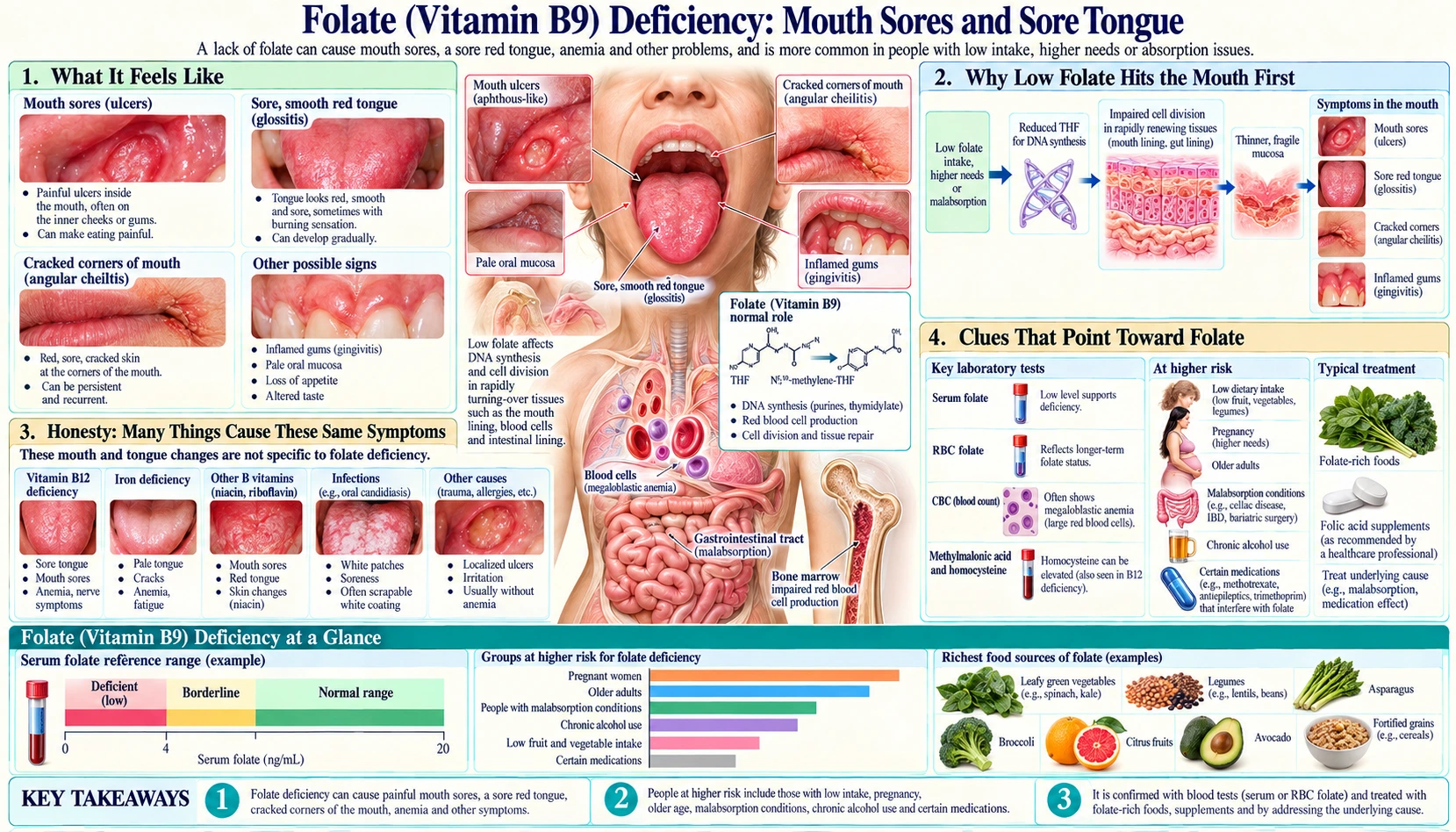
For some people, the first sign that their folate is running low isn't tiredness or a blood result — it shows up in the mouth. The tongue turns smooth, red, and tender; eating something acidic or spicy stings; the corners of the lips crack and split; and small, recurring ulcers keep appearing on the inside of the cheeks and lips. The reason is simple once you know it: the lining of your mouth is one of the fastest-renewing tissues in the body, and rebuilding it constantly requires folate (vitamin B9) to make new cells. When folate is in short supply, the mouth is one of the first places to show the strain. This page explains what folate-related glossitis (a sore, smooth tongue), angular cheilitis (cracked mouth corners), and mouth ulcers actually feel like and why they happen — and, just as importantly, why these same signs are not proof of folate deficiency, since identical symptoms come from low vitamin B12, low iron, and several ordinary oral conditions.
Table of Contents
- What It Feels Like
- Why Low Folate Hits the Mouth First
- Honesty: Many Things Cause These Same Symptoms
- Clues That Point Toward Folate
- What Lowers Folate in the First Place
- Getting Tested
- Correcting Folate — and Healing the Mouth
- Red Flags and Warning Signs
- Key Research Papers
- Connections
- Featured Videos
What It Feels Like
Folate-related mouth changes tend to arrive together as a small cluster, because they all share the same cause — a tissue that can't renew itself fast enough. People describe three overlapping problems:
- A sore, smooth, red tongue (glossitis). The healthy tongue is covered in a faintly rough carpet of tiny bumps called papillae. As folate falls, these papillae flatten and are lost, leaving the tongue looking unusually smooth, shiny, and often beefy-red. It can feel raw or burning, and many people first notice it because hot coffee, citrus, tomatoes, salt, or spicy food suddenly sting where they never used to. Taste can seem dulled. The medical name for a smooth, atrophied tongue is atrophic glossitis.
- Cracks at the corners of the mouth (angular cheilitis). The folds where the upper and lower lips meet become red, cracked, sore, and sometimes crusted or weepy. Opening the mouth wide to yawn or eat can split the corners and make them bleed. This is angular cheilitis (also called angular stomatitis or perlèche), and it is a classic accompaniment of B-vitamin and iron shortfalls.
- Recurring mouth ulcers. Small, round, painful sores — often pale or yellowish with a red rim — appear on the soft, movable lining of the mouth: the inside of the cheeks and lips, the floor of the mouth, and the sides or underside of the tongue. They look and behave like ordinary canker sores (recurrent aphthous stomatitis), but in some people who get them again and again, a low folate, B12, or iron level is quietly part of the picture. The evidence on folate conflicts. A 2015 meta-analysis of nine studies found folic acid deficiency more common in people with these ulcers (odds ratio 7.55, 95% confidence interval 3.91-14.60). A 2024 meta-analysis found no significant link for folic acid (odds ratio 1.51, 95% confidence interval 0.53-4.29), while vitamin B12 deficiency did show one (odds ratio 2.93, 95% confidence interval 2.28-3.78). A 1982 study of 90 patients and 23 healthy controls found no abnormal folate or B12 result in anyone.
What ties these together for the person living with them is that the mouth becomes a sore, fragile place. Eating loses its pleasure; meals are planned around what doesn't hurt; and the constellation — smooth burning tongue plus cracked corners plus repeated ulcers — is more telling than any single one alone. None of these symptoms is, by itself, a diagnosis of folate deficiency; together with the rest of the picture, they are a reason to check.
Why Low Folate Hits the Mouth First
To understand why the mouth is an early casualty of low folate, you have to know what folate actually does inside a cell. Folate — vitamin B9 — is the carrier of single carbon atoms in a series of reactions collectively called one-carbon metabolism. Its single most important job is helping build the raw materials for DNA. Specifically, folate is required to make thymidine, one of the four chemical "letters" of the DNA code. Without enough folate, a cell cannot copy its DNA properly, and so it cannot divide.
Now think about which tissues divide the most. Bone marrow churning out red blood cells is one (that's why megaloblastic anemia is the headline consequence of folate deficiency). But the lining of the mouth and tongue is another. The surface cells of the oral mucosa live only a few days before they wear away and are replaced from a layer of dividing cells beneath. The entire lining turns over roughly every one to two weeks — far faster than skin. It is, in effect, a tissue under constant construction.
An analogy. Imagine a busy road crew that has to repave a stretch of highway every couple of weeks just to keep up with the traffic that grinds it down. Folate is their asphalt. Cut the asphalt supply and the road doesn't fail everywhere at once — it fails first on the busiest stretch, where the wear is heaviest and the resurfacing has to happen most often. In the body, the mouth is that busiest stretch. When folate runs low, the dividing cells underneath can't keep producing fresh surface fast enough, the papillae on the tongue aren't rebuilt (so it goes smooth and red), the lining grows thin and fragile (so it ulcerates and the lip corners crack), and the tissue becomes inflamed and sore. The very feature that normally protects the mouth — its ability to rapidly renew itself — is exactly what makes it vulnerable when the building block runs short.
This is also why the same cell-division problem produces a telltale finding in the blood: when folate is low, dividing cells grow larger than normal because they keep building their contents but stall before they can split. In the bone marrow this yields oversized red blood cells (macrocytosis) and the abnormal precursors that give megaloblastic anemia its name. The smooth red tongue and the oversized red cells are two faces of the same underlying event — a body trying to make new cells without enough folate to finish the job.
What is not known. This explanation is reasoning from how fast these cells turn over. The studies of atrophic glossitis listed on this page measured blood levels, not how the lining of the mouth renews itself. In the 2012 study of 176 patients and 176 matched healthy controls, folate deficiency was no more common in the patients than in the controls, so that study did not tie a smooth tongue to low folate.
Honesty: Many Things Cause These Same Symptoms
This is the most important section on the page, and it cuts against the temptation to self-diagnose. A sore tongue, cracked mouth corners, and recurring ulcers are not unique to folate deficiency. In fact, folate is rarely the most likely cause. The same oral signs are produced by several other conditions, and the only honest approach is to treat them as a prompt to investigate, not as proof of any one thing.
The most important overlaps are with two other nutrients that share folate's role in building cells and red blood:
- Vitamin B12 deficiency. This is the big one. Vitamin B12 works hand-in-hand with folate in DNA synthesis, so a B12 shortfall produces an almost identical smooth red tongue, angular cheilitis, mouth ulcers, and the same megaloblastic anemia. Clinically you often cannot tell folate-related glossitis from B12-related glossitis by looking — which is precisely why both are tested together. Studies of patients with atrophic glossitis repeatedly find that vitamin B12 (and iron) deficiency, not folate alone, is the most common nutritional culprit. The numbers vary widely between studies. In the 2012 study of 176 patients, 26.7% were short of iron, 7.4% of B12 and 1.7% of folate. In 1,064 patients described in a 2020 review, the figures were 16.9% for iron, 5.3% for B12 and 2.3% for folate. A 2022 study of 236 patients found B12 deficiency in 68.22%. Sorting folate from B12 matters enormously, because B12 deficiency can also damage nerves, and treating it as "just folate" can leave that nerve damage to progress.
- Iron deficiency. Low iron — the most common nutrient deficiency worldwide — is itself a leading cause of a smooth sore tongue, angular cheilitis, and mouth ulcers, with or without outright anemia. Iron-deficiency oral signs are arguably more common than folate's, simply because iron deficiency is so much more common. (See iron deficiency for its own constellation of symptoms.)
Beyond the nutrient trio, plenty of ordinary, non-nutritional conditions cause these exact symptoms:
- Ordinary canker sores (recurrent aphthous stomatitis) — the majority of people who get recurring mouth ulcers have no vitamin deficiency at all. Triggers include minor trauma (biting the cheek, a hard toothbrush, braces), stress, certain foods (some people react to sodium lauryl sulfate in toothpaste), and family tendency.
- Angular cheilitis from saliva and yeast — the cracked-corner picture is very often driven by saliva pooling in the lip folds (from ill-fitting dentures, age-related changes, drooling at night, or a habit of lip-licking) and a secondary infection with Candida yeast or bacteria — entirely independent of any vitamin level.
- Other vitamin shortfalls — deficiency of riboflavin (vitamin B2), niacin (B3), or pyridoxine (B6) can also cause a red sore tongue and cracked lip corners; riboflavin deficiency in particular is a textbook cause of angular cheilitis and a magenta tongue.
- Dry mouth, infections, and irritation — oral thrush, geographic tongue, burning mouth syndrome, dehydration, dentures, sharp teeth, smoking, alcohol, and reactions to medications or mouthwashes all produce a sore mouth or tongue.
- Other diseases — recurring oral ulcers can be a feature of celiac disease, inflammatory bowel disease, and other systemic conditions (some of which also cause folate or B12 deficiency through malabsorption, tangling cause and effect further).
The honest bottom line: oral symptoms are a real and well-documented consequence of low folate, but they are non-specific. A sore mouth on its own does not show that B9 is low, and starting folic acid on that guess can hide a B12 problem. Simple blood tests tell folate, B12, and iron apart, and the treatments and the stakes are different.
Clues That Point Toward Folate
While no symptom proves folate deficiency, certain features make a nutritional cause — and folate specifically — more plausible and worth chasing down:
- The symptoms cluster. A smooth red tongue and cracked mouth corners and recurrent ulcers appearing together is more suggestive of a nutritional shortfall than any one symptom alone, which could easily be a local problem.
- There are matching whole-body signs. Folate deficiency rarely stays confined to the mouth. If the sore tongue comes with the fatigue, breathlessness on exertion, and pallor of megaloblastic anemia, or with the mood and cognitive changes folate shortfall can cause, the nutritional story gets stronger.
- There's a plausible reason to be low. A diet very short on leafy greens, legumes, and citrus; heavy alcohol use; pregnancy; certain medications (see below); or a gut condition that impairs absorption all raise the prior probability that folate is genuinely depleted.
- The blood count fits. Macrocytosis — large red blood cells — on a routine blood count is a strong hint pointing at folate or B12. Sorting which one requires the specific vitamin levels.
Even with all these clues lined up, the diagnosis is confirmed by laboratory testing rather than by the appearance of the mouth, because B12 and iron deficiency mimic folate so closely. These clues raise suspicion enough to justify the blood draw; they are not a substitute for it.
What Lowers Folate in the First Place
Folate deficiency develops faster than most vitamin deficiencies because the body's stores are relatively small — typically enough for only a few months — and the demand is constant. The usual causes are:
- Poor dietary intake. Folate is concentrated in leafy green vegetables (the word comes from the Latin folium, "leaf"), legumes, and citrus. A diet thin in these — common with limited variety, food insecurity, "tea and toast" eating patterns in older adults, or heavily processed diets — can deplete folate within weeks to a few months. Overcooking is a factor too: folate is fragile and a large fraction is destroyed by prolonged boiling.
- Alcohol use. Alcohol is a triple hit on folate: it tends to displace nutritious food, it interferes with folate absorption in the gut, and it impairs the body's ability to store and recycle it. Heavy or chronic drinking is one of the most common reasons for folate deficiency in higher-income countries.
- Increased demand. Pregnancy dramatically raises folate requirements (which is why supplementation is advised before and during pregnancy — see neural tube defects). Breastfeeding, rapid growth, and conditions with high cell turnover (such as some chronic anemias) also increase need.
- Malabsorption. Folate is absorbed mainly in the upper small intestine, so diseases that damage it — celiac disease, inflammatory bowel disease, and others — can cause deficiency even with an adequate diet, and may produce mouth ulcers in their own right.
- Medications. Several drugs interfere with folate. Methotrexate (used for cancer, rheumatoid arthritis, and psoriasis) directly blocks the enzyme that activates folate — mouth ulcers are a well-known side effect, and prescribers often add folic acid alongside it. A 2013 Cochrane review of six trials (624 patients with rheumatoid arthritis) found that folic or folinic acid lowered stomach and bowel side effects (risk ratio 0.74), rises in liver enzymes (risk ratio 0.23) and withdrawals from methotrexate (risk ratio 0.39). Mouth sores showed a trend toward fewer cases, but that result was not statistically significant (risk ratio 0.72, 95% confidence interval 0.49 to 1.06). Sulfasalazine, trimethoprim, and some anti-seizure medications (such as phenytoin) can also lower folate.
In many real cases more than one factor is at work at once — for example, an older adult eating a limited diet, drinking regularly, and taking a folate-depleting medication. That overlap is part of why testing tells more than guessing the single cause.
Getting Tested
Confirming folate deficiency — and, crucially, distinguishing it from B12 and iron deficiency — takes a few inexpensive, widely available blood tests:
- Complete Blood Count (CBC). The first step is usually a complete blood count, which reports red-cell size (mean corpuscular volume, MCV). Enlarged red cells (macrocytosis) raise suspicion of folate or B12 deficiency and prompt the specific vitamin tests. A normal blood count does not rule out an early deficiency, because oral and tissue changes can precede the anemia.
- Serum (and sometimes red-cell) folate. A blood folate level measures the vitamin directly. Red-cell folate reflects longer-term stores and is less swayed by a recent meal than serum folate, though serum folate is what most labs run first. The 2014 British haematology guideline states that serum folate offers equivalent diagnostic capability to red cell folate and is the first-line test of choice.
- Vitamin B12 — always alongside folate. Because B12 deficiency mimics folate so closely and can damage nerves, a vitamin B12 test is checked together with folate, essentially every time. Treating apparent folate deficiency without ruling out B12 is a genuine clinical pitfall (explained below).
- Iron studies. Since iron deficiency is such a common cause of the same oral signs, an iron panel (including ferritin) is often added to complete the picture.
- Homocysteine (sometimes). Both folate and B12 deficiency raise blood homocysteine, so it can support a diagnosis, though it doesn't separate the two on its own.
Why "just take folic acid" can be dangerous. This deserves emphasis. Giving folic acid to someone who is actually B12-deficient can correct the anemia and the sore tongue — making it look as though the problem is solved — while the nerve damage of untreated B12 deficiency silently continues and can become permanent. This is the single most important reason the two are always tested and treated together, and it is the concern with using high-dose folic acid bought over the counter for mouth symptoms before B12 is known.
A national survey of 1,459 older U.S. adults (1999-2002) looked at this link. Among those with low B12 status, a high blood folate (above 59 nmol/L) went with more anemia (odds ratio 3.1) and more cognitive impairment (odds ratio 2.6). Among those with normal B12, high folate went with less cognitive impairment (odds ratio 0.4). This was an observational survey, so it shows a link and not a cause.
Correcting Folate — and Healing the Mouth
When testing confirms folate deficiency as the cause, the good news is that the mouth usually heals well and often quickly once folate is restored — because the same fast turnover that made the lining vulnerable now lets it rebuild rapidly. The smooth tongue regrows its papillae, the cracks at the lip corners close, and the ulcers settle, frequently within a couple of weeks of effective treatment.
- Food, where the deficiency is mild and the cause is dietary. The richest natural sources are leafy greens and legumes: spinach and other dark leafy greens, lentils and beans, broccoli, asparagus, avocado, citrus fruit, and (in countries that fortify) breakfast cereals and flour. Liver is exceptionally rich in folate (and B12 and iron). Because folate is heat-sensitive, lighter cooking — steaming or quick sauteing rather than long boiling — preserves more of it. A 2002 UK study measured this: boiling for typical times left 49% of the folate in spinach and 44% in broccoli, while steaming caused no significant loss even at the longest times tested (4.5 minutes for spinach, 15 minutes for broccoli). See the folate food sources page for a fuller list.
- Folic acid (or folate) supplements are the mainstay when the deficiency is established. The adult Recommended Dietary Allowance is 400 µg of dietary folate equivalents per day (600 µg in pregnancy), but treatment of a diagnosed deficiency uses higher doses — commonly around 1 mg (1000 µg) of folic acid daily for a few months — with the B12 question settled first, because folic acid can hide a B12 deficiency.
- The cause matters as well as the level. Replacing folate without addressing why it dropped — cutting back alcohol, managing a malabsorptive condition, reviewing a folate-depleting medication — only buys time. If methotrexate is the cause, the prescriber adjusts the folic acid plan around it rather than the patient stopping the drug.
- Soothing the mouth while it heals. Comfort measures people commonly use in the meantime: staying away from acidic, spicy, salty, very hot, or rough foods that sting; bland, soft, cool foods; plenty of fluids; a soft toothbrush and a mild, non-irritating toothpaste (a paste without sodium lauryl sulfate helps some people with recurrent ulcers); and, for angular cheilitis — which is frequently infected with yeast — an antifungal or barrier cream. These measures manage the discomfort; correcting the underlying deficiency is what actually resolves it. A 2019 systematic review of four double-blind crossover trials (124 people) found that toothpastes without sodium lauryl sulfate reduced the number of ulcers, how long they lasted, the number of episodes and the pain, and said better trials are still needed. One 90-person trial saw only shorter ulcers and less pain, with no fall in the number of ulcers or episodes.
If the mouth does not improve after folate (and any B12 or iron) is corrected, that is an important signal to look again — because it means the real cause was probably something else on the differential list above, such as a local infection, an irritant, or another condition.
Red Flags and Warning Signs
Most mouth ulcers and sore tongues are harmless and self-limited. But clinicians and dentists treat certain features as warning signs rather than something to wait out or self-treat:
- A mouth ulcer or sore patch that does not heal within about three weeks. This is the single most important warning sign. A persistent, non-healing ulcer — especially a hard, raised, or fixed one, or a white or red patch that won't rub off — is the sign clinicians and dentists check for oral cancer, which is unrelated to folate but can look similar at first.
- A sore tongue or ulcers that keep coming back or won't clear — recurring oral problems are what the simple folate/B12/iron blood work is used for, and can occasionally point to celiac or inflammatory bowel disease.
- Mouth symptoms with whole-body signs — marked fatigue, breathlessness, a pale or "lemon-yellow" complexion, a racing heart, or (with B12 in particular) numbness, tingling, or balance and memory problems. These point to anemia or B12 nerve involvement, which blood tests can confirm.
- You are pregnant or planning pregnancy — folate status matters well beyond the mouth here (see neural tube defects).
- Severe pain or trouble eating and drinking — if a sore mouth is bad enough to stop you eating or drinking, or comes with fever and widespread ulceration, that can signal a more serious infection or condition, and hospitals treat these signs as urgent.
- High-dose folic acid taken on your own — as above, it can mask a B12 deficiency that has not been ruled out, and masked B12 deficiency can lead to lasting nerve damage.
The reassuring counterpoint: a sore tongue or a crop of canker sores, on its own and in an otherwise well person, is usually benign and often has nothing to do with folate at all. The point of testing is to find the minority of cases where a correctable deficiency — folate, B12, or iron — is the real driver, and to make sure nothing more serious is being overlooked.
Key Research Papers
- Chiang CP, Chang JYF, Wang YP, et al. (2020). Atrophic glossitis: Etiology, serum autoantibodies, anemia, hematinic deficiencies, hyperhomocysteinemia, and management. Journal of the Formosan Medical Association;119(4):774-780. — DOI: 10.1016/j.jfma.2019.04.015. — doi:10.1016/j.jfma.2019.04.015
- Sun A, Lin HP, Wang YP, Chiang CP (2012). Significant association of deficiency of hemoglobin, iron and vitamin B12, high homocysteine level, and gastric parietal cell antibody positivity with atrophic glossitis. Journal of Oral Pathology & Medicine;41(6):500-504. — DOI: 10.1111/j.1600-0714.2011.01122.x. — doi:10.1111/j.1600-0714.2011.01122.x
- Wu YC, Wu YH, Chang JY, et al. (2020). Anemia, hematinic deficiencies, hyperhomocysteinemia, and gastric parietal cell antibody positivity in atrophic glossitis patients with vitamin B12 deficiency. Journal of the Formosan Medical Association;119(3):720-727. — DOI: 10.1016/j.jfma.2019.10.002. — doi:10.1016/j.jfma.2019.10.002
- Chen GY, Tang ZQ, Bao ZX (2022). Vitamin B12 deficiency may play an etiological role in atrophic glossitis and its grading: A clinical case-control study. BMC Oral Health;22(1):456. — DOI: 10.1186/s12903-022-02464-z. — doi:10.1186/s12903-022-02464-z
- Olson JA, Feinberg I, Silverman S, et al. (1982). Serum vitamin B12, folate, and iron levels in recurrent aphthous ulceration. Oral Surgery, Oral Medicine, Oral Pathology;54(5):517-520. — DOI: 10.1016/0030-4220(82)90189-x. — doi:10.1016/0030-4220(82)90189-x
- Scully C, Porter S (1989). Recurrent aphthous stomatitis: current concepts of etiology, pathogenesis and management. Journal of Oral Pathology & Medicine;18(1):21-27. — PubMed PMID: 2664131
- Inamadar AC (2021). Dyssebacia, angular cheilitis, and red tongue: Pointing fingers to riboflavin (Vitamin B2) deficiency. Cosmoderma;1:35. — DOI: 10.25259/csdm_41_2021. — doi:10.25259/csdm_41_2021
- Gupta S, Sinha N, Swarup N, et al. (2017). Atrophic Glossitis: Burning Agony of Nutritional Deficiency Anemia. World Journal of Anemia;1(2):48-50. — DOI: 10.5005/jp-journals-10065-0011. — doi:10.5005/jp-journals-10065-0011
- Morris MS, Jacques PF, Rosenberg IH, Selhub J (2007). Folate and vitamin B-12 status in relation to anemia, macrocytosis, and cognitive impairment in older Americans in the age of folic acid fortification. The American Journal of Clinical Nutrition;85(1):193-200. — DOI: 10.1093/ajcn/85.1.193. — doi:10.1093/ajcn/85.1.193
- Stabler SP (2013). Vitamin B12 Deficiency. New England Journal of Medicine;368(2):149-160. — DOI: 10.1056/NEJMcp1113996. — doi:10.1056/NEJMcp1113996
- Green R (2017). Vitamin B12 deficiency from the perspective of a practicing hematologist. Blood;129(19):2603-2611. — DOI: 10.1182/blood-2016-10-569186. — doi:10.1182/blood-2016-10-569186
- Hunt A, Harrington D, Robinson S (2014). Vitamin B12 deficiency. BMJ;349:g5226. — DOI: 10.1136/bmj.g5226. — doi:10.1136/bmj.g5226
- Chen H, Sui Q, Chen Y, Ge L, Lin M (2015). Impact of haematologic deficiencies on recurrent aphthous ulceration: a meta-analysis. British Dental Journal;218(4):E8. — PubMed PMID: 25720915
- Mousavi T, Jalali H, Moosazadeh M (2024). Hematological parameters in patients with recurrent Aphthous Stomatitis: a systematic review and meta-analysis. BMC Oral Health;24(1):339. — PubMed PMID: 38493289
- Shea B, Swinden MV, Tanjong Ghogomu E, Ortiz Z, Katchamart W, Rader T, Bombardier C, Wells GA, Tugwell P (2013). Folic acid and folinic acid for reducing side effects in patients receiving methotrexate for rheumatoid arthritis. Cochrane Database of Systematic Reviews;2013(5):CD000951. — PubMed PMID: 23728635
- Devalia V, Hamilton MS, Molloy AM; British Committee for Standards in Haematology (2014). Guidelines for the diagnosis and treatment of cobalamin and folate disorders. British Journal of Haematology;166(4):496-513. — PubMed PMID: 24942828
- McKillop DJ, Pentieva K, Daly D, McPartlin JM, Hughes J, Strain JJ, Scott JM, McNulty H (2002). The effect of different cooking methods on folate retention in various foods that are amongst the major contributors to folate intake in the UK diet. British Journal of Nutrition;88(6):681-688. — PubMed PMID: 12493090
- Alli BY, Erinoso OA, Olawuyi AB (2019). Effect of sodium lauryl sulfate on recurrent aphthous stomatitis: A systematic review. Journal of Oral Pathology & Medicine;48(5):358-364. — PubMed PMID: 30839136
- Shim YJ, Choi JH, Ahn HJ, Kwon JS (2012). Effect of sodium lauryl sulfate on recurrent aphthous stomatitis: a randomized controlled clinical trial. Oral Diseases;18(7):655-660. — PubMed PMID: 22435470
PubMed Topic Searches
Connections
- All Vitamins
- Folate Deficiency Hub
- Megaloblastic Anemia & Fatigue
- Folate Deficiency: Mood & Cognitive
- Neural Tube Defects in Pregnancy
- Folate: Too Much (Toxicity)
- Vitamin B9 (Folate) Overview
- Folate Food Sources
- Vitamin B12
- Iron
- Iron Deficiency
- Anemia
- Complete Blood Count
- Vitamin B12 Test
- Iron Panel
- Homocysteine Test
- Spinach
- Lentils
- Beef Liver