How Aspirin Acetylates Cyclooxygenase, and How That Differs From Acetyl-CoA
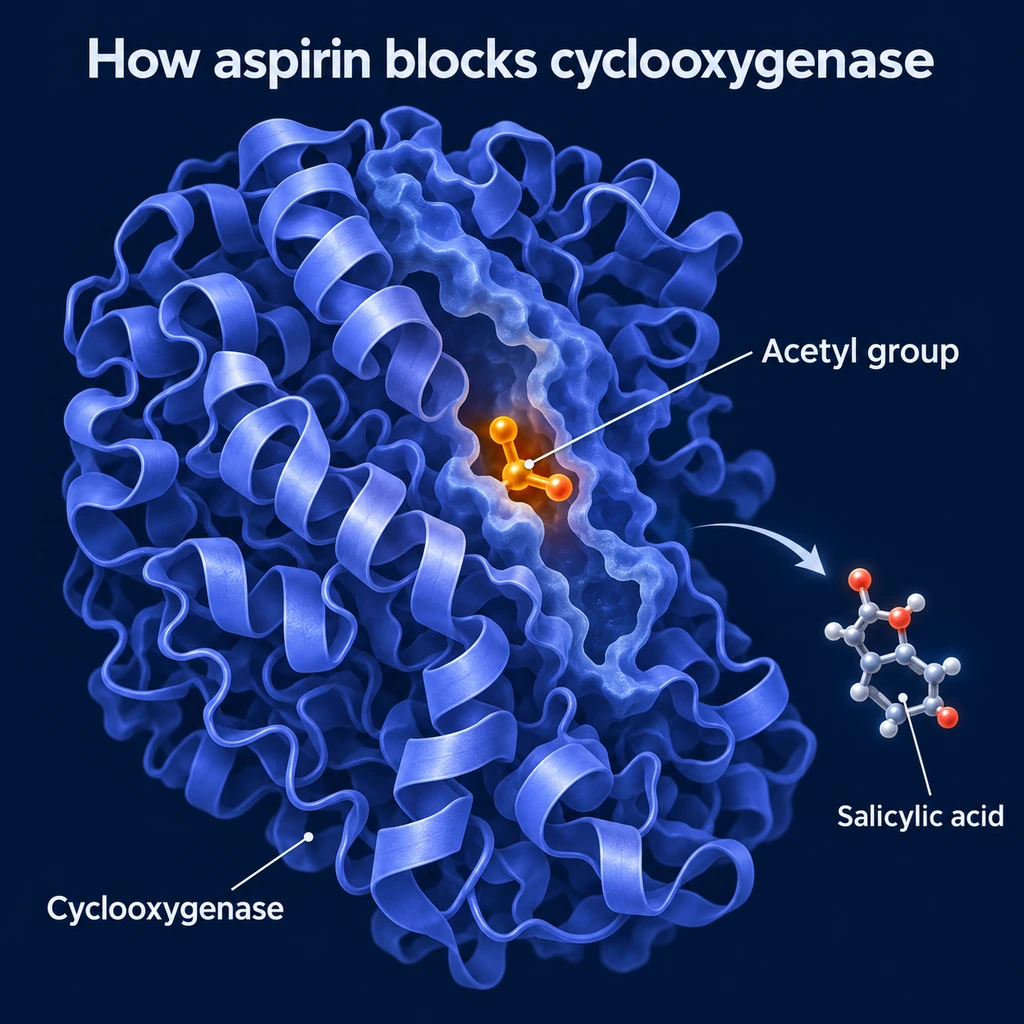
Aspirin works by handing a small chemical tag, an acetyl group, directly to an enzyme called cyclooxygenase (COX). The body also moves acetyl groups around all day, but it does so with a carrier molecule called acetyl-coenzyme A (acetyl-CoA), which is built from vitamin B5. This page explains, step by step, what the research shows about aspirin's own acetyl transfer, what it does to the two forms of COX, which other proteins aspirin tags, and why aspirin's chemistry is a different process from the body's acetyl-CoA system.
What an Acetyl Group Is
An acetyl group is a two-carbon fragment: a carbon joined by a double bond to an oxygen, with a methyl group (CH3) on the other side. Written in chemists' shorthand it is CH3CO–. It is the same piece that makes vinegar (acetic acid) what it is.
When an acetyl group is moved from one molecule onto another, the process is called acetylation. On a protein, an acetyl group usually lands on one of two kinds of building blocks: serine, which carries an –OH group, or lysine, which carries an –NH2 group. Adding the acetyl changes the shape and electric charge of that spot, which can change what the protein does.
Cells need a supplier of acetyl groups. In ordinary metabolism that supplier is acetyl-CoA. Aspirin is unusual because the drug molecule is itself an acetyl donor.
Aspirin Is Acetylsalicylic Acid: Two Active Parts in One Molecule
The chemical name of aspirin is acetylsalicylic acid. It is salicylic acid, the willow-bark type compound, with an acetyl group attached to its –OH group. A 2015 review describes aspirin as unique because it carries two active parts within one molecule: a reactive acetyl group and the salicylate that remains behind (PubMed PMID: 26201059).
The same review states that salicylate has some effects similar to aspirin, but only at higher concentrations, usually in the millimolar range, which are not reached at conventional antiplatelet doses of 100–300 mg/day. At those doses, according to the review, aspirin's actions in the cardiovascular system are largely if not entirely due to acetylation of its target proteins (PubMed PMID: 26201059).
How Vane Linked Aspirin to Prostaglandin Synthesis in 1971
Prostaglandins are short-lived signalling fats made from arachidonic acid. They take part in pain, fever, inflammation, stomach-lining protection and blood clotting. In 1971 the pharmacologist John Vane published the proposal that inhibition of prostaglandin synthesis is a mechanism of action for aspirin-like drugs (PubMed PMID: 5284360).
That finding explained what aspirin blocks, but not how. The "how" came four years later, when researchers followed a radioactive label on aspirin's acetyl group into the prostaglandin-making enzyme itself.
How Aspirin Hands Its Acetyl Group to a Serine in COX-1
In 1975, Roth, Stanford and Majerus incubated membranes from sheep and cattle seminal vesicles (a rich source of the enzyme) with aspirin whose acetyl group was radioactively labelled. A single protein picked up the label. It had a molecular weight of 85,000, and a similar acetylated protein was found in aspirin-treated human platelets (PubMed PMID: 810797).
The acetylation and the loss of enzyme activity went together. At 100 micromolar aspirin, 50% inhibition of prostaglandin synthase and 50% of maximal acetylation were both observed after 15 minutes at 37 degrees. Arachidonic acid, the enzyme's natural fuel, blocked the acetylation (50% inhibition at 10–30 micromolar). The authors concluded that aspirin acts as an active-site acetylating agent for cyclooxygenase (PubMed PMID: 810797).
In 1978, Roth and Siok broke the labelled enzyme into fragments and identified the labelled piece as N-acetylserine: the acetyl group was sitting on a serine (PubMed PMID: 418070). Later work with engineered versions of the enzyme placed that serine at position 530 of COX-1 (also called prostaglandin endoperoxide synthase-1). Acetylating Ser-530 switches off the cyclooxygenase activity, yet a version of the enzyme in which Ser-530 was replaced by the small amino acid alanine still worked. The researchers concluded that aspirin blocks the enzyme by placing a larger-than-normal side chain at position 530, which interferes with arachidonic acid binding, rather than by removing a serine the enzyme needs (PubMed PMID: 1601897).
In plain terms: the acetyl group becomes a plug in the channel that arachidonic acid has to travel down. What is left of the aspirin molecule after the hand-off is salicylic acid (salicylate).
Why the Effect Lasts: A Permanent Bond and Newly Made Enzyme
Most pain relievers in the same family block COX only while the drug is present. Aspirin's acetyl-serine bond is described as irreversible: once a COX molecule is acetylated, it stays inactive (PubMed PMID: 18242581). Activity comes back only as fresh, unacetylated enzyme appears.
A 1989 study noted that, because aspirin has a short half-life in the body, it is likely to inactivate the enzyme that is already present and active in a cell, but not protein made afterwards. The authors suggested this may help explain why COX activity recovers on a different timetable in platelets than in the cells lining blood vessels after low-dose aspirin (PubMed PMID: 2506093).
The platelet side of this is shown clearly in a 2023 review of essential thrombocythemia, a bone-marrow disorder in which very many platelets are made. Low-dose aspirin (81–100 mg) once daily irreversibly inhibits platelet thromboxane A2 production by acetylating COX-1. In most patients with this disorder, however, adequate inhibition did not last 24 hours. The review links this to the number of newly released immature platelets carrying non-acetylated COX-1, a consequence of high platelet production, and reports that twice-daily dosing overcame the problem in small studies (PubMed PMID: 36632735). In other words, the acetylated enzyme stays switched off, and the effect fades only as new platelets with untouched enzyme enter the blood.
How Acetylated COX-2 Switches to New Products
COX-2 is the second form of the enzyme, made in larger amounts during inflammation. Aspirin acetylates it too, but the result is different. In a 1994 study of the human enzymes, aspirin treatment of COX-1 caused a time-dependent loss of its oxygen-adding activity, while aspirin-treated COX-2 kept working but formed exclusively 15-hydroxyeicosatetraenoic acid (15-HETE) instead of the normal prostaglandin precursor, and that 15-HETE was exclusively of the 15R configuration (a mirror-image arrangement at carbon 15). A COX-2 in which the target serine was swapped for alanine (S516A) was not acetylated, which identified Ser-516 as the aspirin site of COX-2, the counterpart of the COX-1 active-site serine (PubMed PMID: 8175750). Papers number this serine differently; a 2019 paper calls the same residue Ser530.
That 2019 study found acetylated COX-2 still makes some prostaglandins, mostly of the 15R type (70 or 62% 15R, depending on the measurement method). Its catalytic efficiency for prostaglandin formation was reduced 10-fold. In isolated human white blood cells, aspirin increased 15R-PGD2, and 15R-PGD2 inhibited human platelet aggregation in the laboratory. The authors concluded that 15R-prostaglandins are novel products of aspirin therapy via COX-2 acetylation and may contribute to aspirin's antiplatelet and other effects (PubMed PMID: 30096040).
The 15R-HETE from acetylated COX-2 can be passed to white-cell lipoxygenase enzymes and turned into "aspirin-triggered lipoxin", also called 15-epi-lipoxin (PubMed PMID: 26201059). So aspirin does not only switch COX-2 off; it re-directs it toward a different set of products.
A Technical Aside: The Heme and Peroxidase Requirements
COX enzymes carry an iron-containing heme group and have a second activity, a peroxidase. Both turn out to matter for aspirin's acetylation.
- In purified enzyme, the heme-loaded form took up about one acetyl group per 70-kDa subunit, while the heme-free protein took up 0.1. The authors concluded that irreversible inactivation by aspirin occurs only when heme is bound (PubMed PMID: 2506093).
- Acetylation at Ser-530 inactivates the cyclooxygenase activity but does not appreciably affect the peroxidase activity (PubMed PMID: 1601897).
- Hydroperoxides, the peroxidase's substrates, cut the rate of COX-1 acetylation by 68%. In cultured cells with high hydroperoxide levels, aspirin was markedly less effective than in cells with low levels (IC50 256 versus 11.0 micromolar). Using purified enzymes, the same study found no evidence that aspirin prefers either COX isoform (PubMed PMID: 18242581).
These findings show that aspirin's acetylation of COX depends on the state of the enzyme, not only on how much aspirin is present.
How Aspirin Acetylates Many Other Proteins Without an Enzyme
The acetyl group on aspirin is reactive enough to be transferred to many proteins by plain chemistry, without an enzyme guiding it. These transfers usually land on lysine rather than serine.
- Acetylome mapping, 2017: using aspirin labelled with heavy hydrogen, researchers identified over 12,000 lysine acetylation sites in cultured human cells. Aspirin amplified acetylation at most detectable sites, yet the fraction of each protein actually carrying the acetyl (site occupancy) stayed very low even after high doses. The authors concluded that in most cases aspirin-mediated acetylations do not build up to levels likely to have biological effects, and that cellular deacetylases act to limit nonspecific chemical acetylation (PubMed PMID: 27913581).
- Alkyne-aspirin reporter, 2013: an aspirin analogue carrying a chemical "handle" detected aspirin-dependent acetylation in living cells and identified 120 proteins, 112 of them not previously reported as aspirin targets, including the core histone proteins that package DNA (PubMed PMID: 23998633).
- Blood plasma proteins, 2015: human plasma incubated with 30 mM glucose and then 500 micromolar aspirin showed increased acetylation, and several proteins showed decreased glycation (sugar attachment) afterwards (PubMed PMID: 25464367).
- The p53 protein, 2016: in colon cancer cell lines, aspirin acetylated the tumour-suppressor protein p53. Aspirin also acetylated purified p53 in a test tube, which the authors took as evidence of a non-enzymatic chemical reaction; 10 acetylated lysines were identified, all on the protein surface (PubMed PMID: 26596838).
The 2020 study that most directly connects aspirin to acetyl-CoA used deuterium-labelled aspirin in mouse immune cells (BV2) and human colon cancer cells (HCT116). It identified 17,003 acetylation sites on 4,623 proteins in the first cell type and 16,366 sites on 4,702 proteins in the second. The authors reported that aspirin acetylates proteins through both acetyl-CoA-dependent and acetyl-CoA-independent pathways, and that accessible lysines on the protein surface are the major targets (PubMed PMID: 31922419). The abstract does not detail how the CoA-dependent route works; it establishes that aspirin's acetylation reaches cells by two routes, only one of which involves coenzyme A.
How Aspirin Acetylation Differs From Acetyl-CoA Acetylation
Coenzyme A (CoA) is built in the body from pantothenate (vitamin B5), the amino acid cysteine and ATP. CoA carries acyl groups, including acetyl groups, for the energy-producing citric acid cycle, fat synthesis and histone acetylation, and its production is tightly controlled by feedback from acetyl-CoA and related molecules (PubMed PMID: 38871981). Acetyl-CoA is the body's own, regulated acetyl donor. Aspirin is an outside, chemical one.
| Feature | Aspirin acetylation | Acetyl-CoA acetylation |
|---|---|---|
| Acetyl donor | The aspirin molecule itself | Acetyl-CoA, made inside cells |
| Link to vitamin B5 | None needed for COX; CoA is not part of the reaction | CoA is built from pantothenate (vitamin B5) |
| How the transfer happens | Direct chemical reaction; at COX it takes place in the enzyme's active site | Mainly catalysed by acetyltransferase enzymes |
| Main COX target | A serine in the COX channel | Not the route by which COX is inhibited |
| Other targets | Many surface lysines, mostly at very low occupancy | Histones and many other proteins, as part of normal regulation |
| Reversibility | COX serine acetylation is permanent for that enzyme molecule; lysine acetylations can be removed by deacetylases | Lysine acetylation is routinely added and removed |
| Control | Set by dose and timing of the drug: one-shot | Tracks the cell's energy and nutrient state |
| By-product | Salicylic acid | Free coenzyme A, reused |
The key point: aspirin does not need to be converted into acetyl-CoA to inhibit COX. In the laboratory, radioactive acetyl groups moved from aspirin directly onto the purified enzyme (PubMed PMID: 2506093), and aspirin's acetylation of membrane-bound COX followed the same time course and concentration as the loss of enzyme activity (PubMed PMID: 810797). Coenzyme A enters aspirin's story elsewhere: through the CoA-dependent part of its wider protein acetylation (PubMed PMID: 31922419), and through the salicylate half of the molecule, which can be attached to CoA as salicyl-CoA. Those routes are covered on the companion pages Salicyl-CoA: How Salicylate Ties Up Coenzyme A and Salicylate, Acetyl-CoA and Protein Acetylation.
No study in the research bank for this page shows that vitamin B5 changes how aspirin acetylates COX, and none shows vitamin B5 to be an antidote for aspirin or salicylate poisoning. Salicylate poisoning is a medical emergency; signs reported include ringing in the ears, rapid breathing, vomiting and confusion.
Key Research Papers
- Vane JR. Inhibition of prostaglandin synthesis as a mechanism of action for aspirin-like drugs. Nat New Biol. 1971;231(25):232-5. PubMed PMID: 5284360
- Roth GJ, Stanford N, Majerus PW. Acetylation of prostaglandin synthase by aspirin. Proc Natl Acad Sci U S A. 1975;72(8):3073-6. PubMed PMID: 810797
- Roth GJ, Siok CJ. Acetylation of the NH2-terminal serine of prostaglandin synthetase by aspirin. J Biol Chem. 1978;253(11):3782-4. PubMed PMID: 418070
- Shimokawa T, Smith WL. Prostaglandin endoperoxide synthase. The aspirin acetylation region. J Biol Chem. 1992;267(17):12387-92. PubMed PMID: 1601897
- Chen YN, Marnett LJ. Heme prosthetic group required for acetylation of prostaglandin H synthase by aspirin. FASEB J. 1989;3(11):2294-7. PubMed PMID: 2506093
- Bala M, Chin CN, Logan AT, Amin T, Marnett LJ, Boutaud O, et al. Acetylation of prostaglandin H2 synthases by aspirin is inhibited by redox cycling of the peroxidase. Biochem Pharmacol. 2008;75(7):1472-81. PubMed PMID: 18242581
- Cattaneo M. Aspirin in essential thrombocythemia. For whom? What formulation? What regimen? Haematologica. 2023;108(6):1487-1499. PubMed PMID: 36632735
- Lecomte M, Laneuville O, Ji C, DeWitt DL, Smith WL. Acetylation of human prostaglandin endoperoxide synthase-2 (cyclooxygenase-2) by aspirin. J Biol Chem. 1994;269(18):13207-15. PubMed PMID: 8175750
- Giménez-Bastida JA, Boeglin WE, Boutaud O, Malkowski MG, Schneider C. Residual cyclooxygenase activity of aspirin-acetylated COX-2 forms 15 R-prostaglandins that inhibit platelet aggregation. FASEB J. 2019;33(1):1033-1041. PubMed PMID: 30096040
- Schrör K, Rauch BH. Aspirin and lipid mediators in the cardiovascular system. Prostaglandins Other Lipid Mediat. 2015;121(Pt A):17-23. PubMed PMID: 26201059
- Tatham MH, Cole C, Scullion P, Wilkie R, Westwood NJ, Stark LA, et al. A Proteomic Approach to Analyze the Aspirin-mediated Lysine Acetylome. Mol Cell Proteomics. 2017;16(2):310-326. PubMed PMID: 27913581
- Bateman LA, Zaro BW, Miller SM, Pratt MR. An alkyne-aspirin chemical reporter for the detection of aspirin-dependent protein modification in living cells. J Am Chem Soc. 2013;135(39):14568-73. PubMed PMID: 23998633
- Finamore F, Priego-Capote F, Nolli S, Zufferey A, Fontana P, Sanchez JC. Characterisation of the influences of aspirin-acetylation and glycation on human plasma proteins. J Proteomics. 2015;114:125-35. PubMed PMID: 25464367
- Ai G, Dachineni R, Kumar DR, Marimuthu S, Alfonso LF, Bhat GJ. Aspirin acetylates wild type and mutant p53 in colon cancer cells: identification of aspirin acetylated sites on recombinant p53. Tumour Biol. 2016;37(5):6007-16. PubMed PMID: 26596838
- Guo L, Gao J, Gao Y, Zhu Z, Zhang Y. Aspirin Reshapes Acetylomes in Inflammatory and Cancer Cells via CoA-Dependent and CoA-Independent Pathways. J Proteome Res. 2020;19(2):962-972. PubMed PMID: 31922419
- Barritt SA, DuBois-Coyne SE, Dibble CC. Coenzyme A biosynthesis: mechanisms of regulation, function and disease. Nat Metab. 2024;6(6):1008-1023. PubMed PMID: 38871981
PubMed Topic Searches
Connections
- Vitamin B5, Aspirin and Coenzyme A: How the Pathways Connect
- Salicyl-CoA: How Salicylate Ties Up Coenzyme A
- Salicylate and Mitochondrial Fatty Acid Oxidation
- Salicylate, Acetyl-CoA and Protein Acetylation
- Can Vitamin B5 Raise Coenzyme A During Aspirin Use? What the Research Shows
- Vitamin B5 (Pantothenic Acid)
- Vitamin B5 and Coenzyme A Synthesis
- Aspirin
- Aspirin Side Effects
- Glycine and Aspirin Metabolism