Vitamin B5, Aspirin and Coenzyme A: How the Pathways Connect
Vitamin B5 (pantothenic acid) is the raw material the body uses to build coenzyme A (CoA), a small carrier molecule that a 2020 review describes as taking part in more than 100 chemical reactions (PubMed PMID: 33260564). Aspirin meets this system at two different points. Its acetyl group goes straight onto the cyclooxygenase (COX) enzyme without any help from CoA, and the salicylate left behind is cleared partly by attaching it to CoA and then to the amino acid glycine. This page explains each step in plain language, shows where the two pathways touch, and reports what the research does and does not show, including the studies that point the other way.
Deep-Dive Articles
How Aspirin Acetylates Cyclooxygenase, and How That Differs From Acetyl-CoA
Aspirin hands its own acetyl group to a serine in the cyclooxygenase enzyme and blocks it for good. Acetyl-CoA plays no part in this step.
Read the deep dive →Salicyl-CoA: How Salicylate Ties Up Coenzyme A
How the liver attaches salicylate to coenzyme A before adding glycine, and what laboratory studies found about coenzyme A being held up along the way.
Read the deep dive →Salicylate and Mitochondrial Fatty Acid Oxidation
Animal and laboratory findings on fat burning at high salicylate levels, including a 2017 cell study that found aspirin increased it.
Read the deep dive →Salicylate, Acetyl-CoA and Protein Acetylation
How aspirin adds acetyl groups to many proteins without acetyl-CoA, and what salicylate does to the enzymes that normally use acetyl-CoA.
Read the deep dive →Can Vitamin B5 Raise Coenzyme A During Aspirin Use? What the Research Shows
What human muscle studies found when extra pantothenic acid was given, and why vitamin B5 is not an antidote for salicylate poisoning.
Read the deep dive →Glycine and Aspirin Metabolism: The Salicyluric Acid Pathway
How glycine is joined to salicylate to form salicyluric acid, the main detoxification route the body uses to clear aspirin.
Read the deep dive →How Vitamin B5 Becomes Coenzyme A
The body cannot make vitamin B5 itself, so it comes from food. Inside cells, it is the starting block for coenzyme A. A 2024 review describes CoA as built from three ingredients: pantothenate (vitamin B5), the amino acid cysteine and the energy molecule ATP (PubMed PMID: 38871981).
The assembly runs in five enzyme steps. In plain terms: a phosphate is added to vitamin B5, cysteine is attached, the cysteine part is trimmed, and two final steps add the pieces that finish the molecule. The first step, carried out by an enzyme called pantothenate kinase, is the one that sets the pace.
That first step works like a thermostat. In bacteria, pantothenate kinase was shown to be the rate-controlling step, held back mainly by free CoA and, to a lesser degree, by acetyl-CoA and other CoA compounds (PubMed PMID: 3029083). In mouse cells, unused vitamin B5 was the most plentiful compound in the pathway (42.8%), a sign that the kinase step, not the supply of the vitamin, limited production. One form of the mouse enzyme was strongly inhibited by acetyl-CoA, and raising the amount of that enzyme increased cellular CoA 13-fold (PubMed PMID: 10625688).
What Acetyl-CoA Carries
Coenzyme A is a carrier. When it picks up a two-carbon acetyl group it becomes acetyl-CoA, one of the busiest molecules in the cell. A 2015 review calls acetyl-CoA a central metabolic intermediate whose levels reflect the energy state of the cell (PubMed PMID: 26039447).
Acetyl-CoA feeds the citric acid cycle that produces energy, supplies the building blocks for fats and cholesterol, provides the acetyl group for the nerve messenger acetylcholine, and donates acetyl groups that are attached to proteins such as histones, which helps control which genes are switched on. The same review links acetyl-CoA levels to energy metabolism, cell division and autophagy, the cell's recycling system (PubMed PMID: 26039447). The 2024 review lists the citric acid cycle, nutrient oxidation, histone acetylation and the making of fats among the processes that require CoA (PubMed PMID: 38871981).
How Aspirin Uses Its Own Acetyl Group
The chemical name of aspirin is acetylsalicylic acid: a salicylic acid molecule carrying an acetyl group. Because aspirin brings its own acetyl group, it does not need acetyl-CoA to act.
Aspirin blocks prostaglandin production by transferring its acetyl group to a serine in the active site of COX. In COX-1 this acetylation stops the enzyme's raw material, arachidonic acid, from getting in. In COX-2 the acetylated enzyme instead makes different products, including 15R-HETE and 15R-prostaglandins (PubMed PMID: 30096040). The transfer is direct, from aspirin to the enzyme, with no carrier in between.
Aspirin is also a strong chemical acetylating agent in general. In a 2017 study it acetylated mitochondrial proteins in cultured cells and was a stronger acetylating agent in a test tube than acetyl-CoA (PubMed PMID: 27856258). Once the acetyl group is gone, what remains is salicylic acid, which is where the second link to CoA begins.
How Salicylate Borrows Coenzyme A on Its Way Out
Salicylate is cleared mainly through glycine conjugation, which a 2024 review describes as the principal pathway for aspirin detoxification. It runs in two steps. First, a mitochondrial enzyme called a xenobiotic ligase (ACSM) attaches salicylate to CoA, forming salicyl-CoA. Then a second enzyme swaps the CoA for glycine, giving salicyluric acid, which leaves in the urine (PubMed PMID: 39092921).
While salicylate sits on CoA, that CoA is not free for other work. The same review notes that the substrate preferences of the activating enzyme are poorly characterized and that impaired glycine conjugation might contribute to the harm seen in Reye's syndrome (PubMed PMID: 39092921).
Animal and laboratory studies point to consequences at high concentrations. In mice given salicylic acid, salicyl-CoA was detected in the liver and brain, and liver levels of both medium-chain and long-chain fatty acyl-CoAs fell (PubMed PMID: 19391105). In mice, a high injected dose of aspirin or salicylic acid (3 mmol per kg body weight) lowered the burning of palmitic acid (a common fat) by 50% and 65%. In isolated mitochondria, salicylic acid at 1.5 mM cut the formation of palmitoyl-CoA by 80%, and adding more CoA prevented the drop. The authors concluded that salicylic acid probably reduces fat activation by sequestering CoA (PubMed PMID: 1941634).
Not every study agrees. A 2017 study in two cell lines found the opposite: aspirin increased long-chain fatty acid oxidation in mitochondria while inhibiting it in peroxisomes. The authors suggested the increase may be a compensatory response to changes in mitochondrial shape and electron transport after 24 hours of exposure (PubMed PMID: 27856258). The direction of the effect appears to depend on the model, the dose and the time point.
The Two Pathways at a Glance
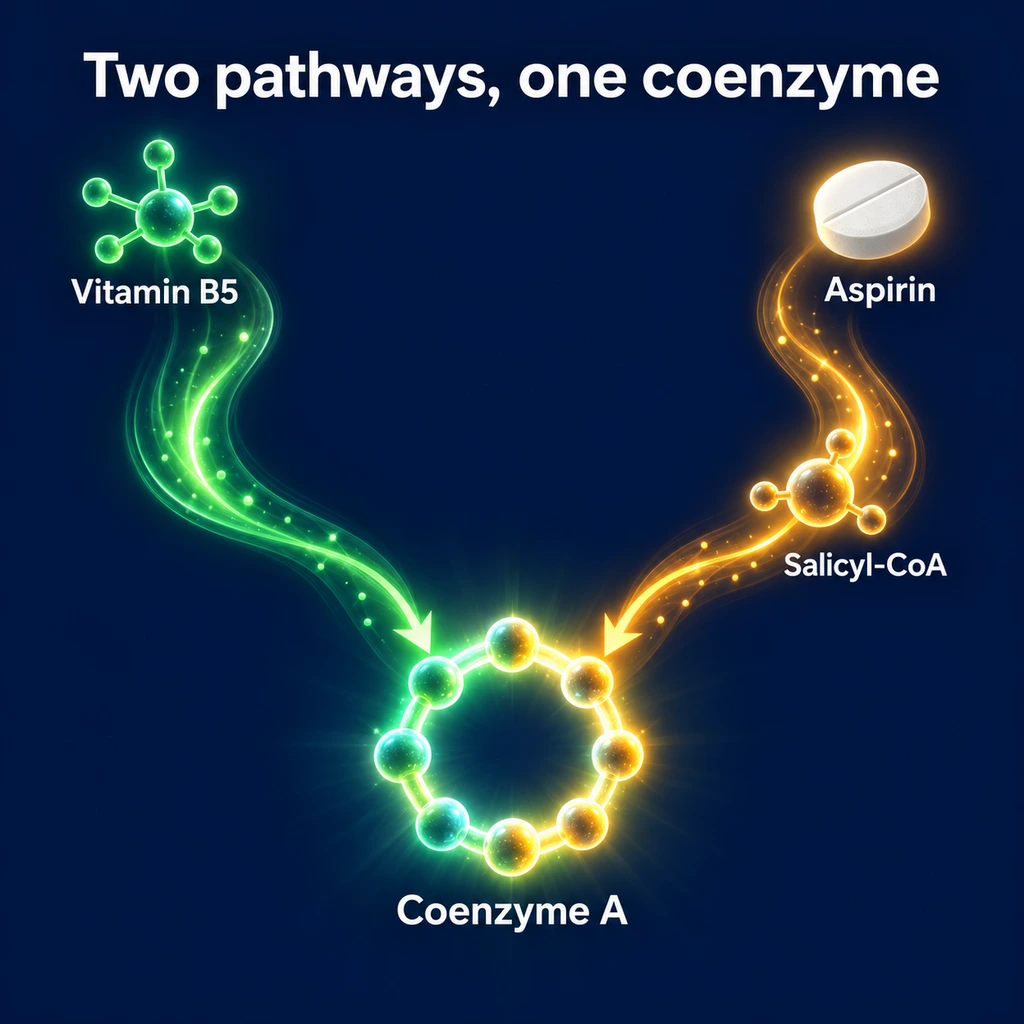
The diagram shows the vitamin B5 pathway on the left and the aspirin pathway on the right. They meet at one point: salicylate uses CoA to form salicyl-CoA. Aspirin's action on COX is a separate branch that does not involve CoA at all.
| Substance | Main role |
|---|---|
| Vitamin B5 (pantothenic acid) | Starting material for coenzyme A; comes from food |
| Coenzyme A | Carrier that holds acetyl and other acyl groups in more than 100 reactions |
| Acetyl-CoA | Feeds energy production, fat and cholesterol making, acetylcholine and protein acetylation |
| Aspirin | Transfers its own acetyl group directly onto COX, blocking prostaglandin production |
| Salicylate | What remains of aspirin after the acetyl group leaves; cleared mainly by glycine conjugation |
| Salicyl-CoA | Short-lived intermediate in which salicylate is attached to CoA before glycine is added |
What Extra Vitamin B5 Does to Coenzyme A Levels
Because CoA is made from vitamin B5, it is tempting to assume that taking more vitamin B5 makes more CoA. The control step described above suggests otherwise: the kinase enzyme, braked by CoA and acetyl-CoA, decides the output.
Two human studies tested this directly in muscle. In a randomized, double-blind trial, eight healthy men took 1.5 g a day each of pantothenic acid and cysteine for one week; resting muscle CoA did not change, and neither did fuel use or exercise performance (PubMed PMID: 22052867). In a second study, 14 trained male cyclists took 6 g a day of pantothenic acid for 16 weeks; muscle CoA and acetyl-CoA contents did not change (PubMed PMID: 33075232).
Neither study involved aspirin, and no study in the research bank for this page tested vitamin B5 in people taking aspirin. Whether extra vitamin B5 changes CoA in the liver, where salicylate is processed, has not been shown in humans.
Vitamin B5 Is Not an Antidote for Salicylate Poisoning
The test-tube finding that adding CoA restored fat activation in isolated mitochondria (PubMed PMID: 1941634) is sometimes read as a reason to use vitamin B5 against aspirin toxicity. No study reviewed for this page shows that vitamin B5 treats or prevents salicylate poisoning.
Salicylate poisoning is a medical emergency. A 2025 review for emergency clinicians describes how, in overdose, salicylates uncouple energy production in mitochondria and lower ATP. Reported signs include nausea, vomiting, ringing in the ears, rapid breathing with respiratory alkalosis, confusion, agitation, seizures, fluid in the lungs and coma. The review lists the treatments used: decontamination of the gut, alkalinizing the blood, fluids, and hemodialysis in severe cases (PubMed PMID: 41049912). Vitamin B5 is not among them.
Reye's syndrome, a rare and dangerous illness of the brain and liver, was linked in surveillance data to aspirin use in children and teenagers during influenza or chickenpox; reported cases fell sharply after warnings about that use were issued from 1980 onward; the overall case fatality rate was 31 percent (PubMed PMID: 10228187). The fatty acid studies above were carried out partly to understand that link.
Key Research Papers
- Czumaj A, Szrok-Jurga S, Hebanowska A, Turyn J, Swierczynski J, Sledzinski T, et al. The Pathophysiological Role of CoA. Int J Mol Sci. 2020;21(23):. PubMed PMID: 33260564
- Barritt SA, DuBois-Coyne SE, Dibble CC. Coenzyme A biosynthesis: mechanisms of regulation, function and disease. Nat Metab. 2024;6(6):1008-1023. PubMed PMID: 38871981
- Vallari DS, Jackowski S, Rock CO. Regulation of pantothenate kinase by coenzyme A and its thioesters. J Biol Chem. 1987;262(6):2468-71. PubMed PMID: 3029083
- Rock CO, Calder RB, Karim MA, Jackowski S. Pantothenate kinase regulation of the intracellular concentration of coenzyme A. J Biol Chem. 2000;275(2):1377-83. PubMed PMID: 10625688
- Pietrocola F, Galluzzi L, Bravo-San Pedro JM, Madeo F, Kroemer G. Acetyl coenzyme A: a central metabolite and second messenger. Cell Metab. 2015;21(6):805-21. PubMed PMID: 26039447
- Giménez-Bastida JA, Boeglin WE, Boutaud O, Malkowski MG, Schneider C. Residual cyclooxygenase activity of aspirin-acetylated COX-2 forms 15 R-prostaglandins that inhibit platelet aggregation. FASEB J. 2019;33(1):1033-1041. PubMed PMID: 30096040
- Uppala R, Dudiak B, Beck ME, Bharathi SS, Zhang Y, Stolz DB, et al. Aspirin increases mitochondrial fatty acid oxidation. Biochem Biophys Res Commun. 2017;482(2):346-351. PubMed PMID: 27856258
- Visagie JL, Aruwajoye GS, van der Sluis R. Pharmacokinetics of aspirin: evaluating shortcomings in the literature. Expert Opin Drug Metab Toxicol. 2024;20(8):727-740. PubMed PMID: 39092921
- Kasuya F, Kazumi M, Tatsuki T, Suzuki R. Effect of salicylic acid and diclofenac on the medium-chain and long-chain acyl-CoA formation in the liver and brain of mouse. J Appl Toxicol. 2009;29(5):435-45. PubMed PMID: 19391105
- Deschamps D, Fisch C, Fromenty B, Berson A, Degott C, Pessayre D. Inhibition by salicylic acid of the activation and thus oxidation of long chain fatty acids. Possible role in the development of Reye's syndrome. J Pharmacol Exp Ther. 1991;259(2):894-904. PubMed PMID: 1941634
- Wall BT, Stephens FB, Marimuthu K, Constantin-Teodosiu D, Macdonald IA, Greenhaff PL. Acute pantothenic acid and cysteine supplementation does not affect muscle coenzyme A content, fuel selection, or exercise performance in healthy humans. J Appl Physiol (1985). 2012;112(2):272-8. PubMed PMID: 22052867
- Whitfield J, Harris RC, Broad EM, Patterson AK, Ross MLR, Shaw G, et al. Chronic pantothenic acid supplementation does not affect muscle coenzyme A content or cycling performance. Appl Physiol Nutr Metab. 2021;46(3):280-283. PubMed PMID: 33075232
- Sidlak AM, Spadaro A, Koyfman A, Long B. Acute Salicylate Toxicity: A Narrative Review for Emergency Clinicians. Cureus. 2025;17(9):e91505. PubMed PMID: 41049912
- Belay ED, Bresee JS, Holman RC, Khan AS, Shahriari A, Schonberger LB. Reye's syndrome in the United States from 1981 through 1997. N Engl J Med. 1999;340(18):1377-82. PubMed PMID: 10228187
PubMed Topic Searches
Connections
- Vitamin B5 (Pantothenic Acid)
- Coenzyme A Synthesis
- Aspirin
- Aspirin Side Effects
- Glycine and Aspirin Metabolism
- Aspirin Acetylation of Cyclooxygenase
- Salicyl-CoA and Coenzyme A Sequestration
- Salicylate and Fatty Acid Oxidation
- Salicylate, Acetyl-CoA and Protein Acetylation
- Vitamin B5 and Coenzyme A Supply During Aspirin Use