Riboflavin (Vitamin B2) Deficiency: Sore Throat and Swollen Tongue
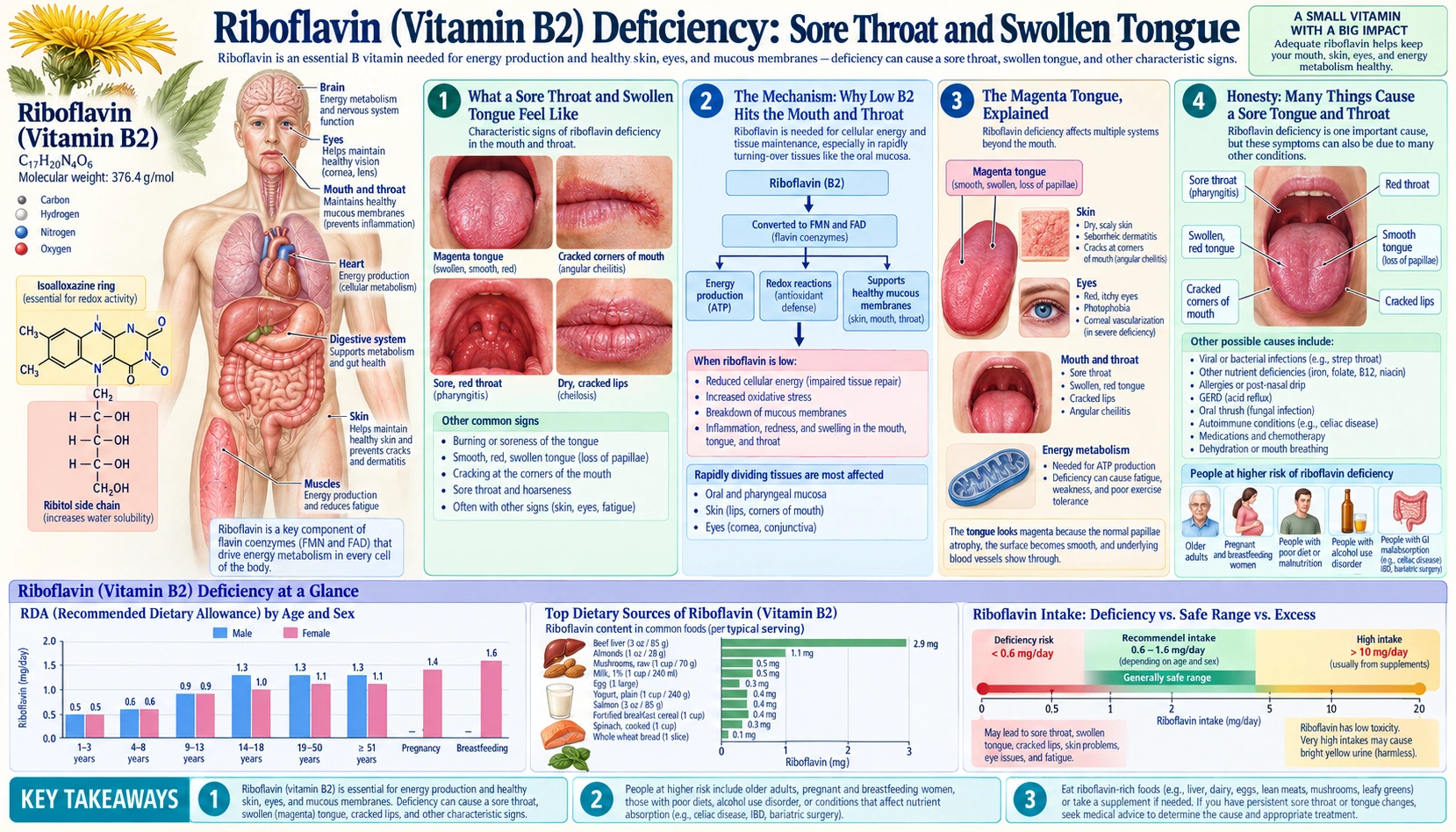
One of the most distinctive signs of long-running riboflavin (vitamin B2) deficiency shows up in the mouth and throat. The tongue can turn a deep, beefy, purplish-red — the classic magenta tongue — and feel swollen, smooth, and sore (a condition doctors call glossitis). The throat feels raw and scratchy, the inside lining of the mouth and pharynx becomes red and tender, and swallowing or talking can be uncomfortable. These changes often arrive alongside cracked lips and corner-of-the-mouth sores as part of a cluster called oral-ocular-genital syndrome. This page explains why a shortage of one B vitamin reaches the soft tissues of the mouth and throat, what the magenta tongue actually is, the many other things that cause a sore tongue and throat, when riboflavin is the likely culprit, and how the deficiency is found and corrected.
Table of Contents
- What a Sore Throat and Swollen Tongue Feel Like
- The Mechanism: Why Low B2 Hits the Mouth and Throat
- The Magenta Tongue, Explained
- Honesty: Many Things Cause a Sore Tongue and Throat
- Clues That Point to Riboflavin
- What Causes Low Riboflavin
- Getting Tested
- Correcting Low Riboflavin Safely
- Red Flags: Signs of Another Cause
- Key Research Papers
- Connections
- Featured Videos
What a Sore Throat and Swollen Tongue Feel Like
The oral and throat changes of riboflavin deficiency build up slowly — usually over weeks to months of low intake — rather than appearing overnight like a cold. People describe a recognizable set of complaints:
- A swollen, “too-big” tongue — the tongue feels thick and puffy, sometimes pressing against the teeth or feeling like it gets in the way when you talk or eat.
- A smooth, shiny, raw surface — the tiny bumps that normally give the tongue its rough, textured look (the papillae) flatten out, leaving a glossy, almost polished surface. This is atrophic glossitis.
- A deep reddish-purple color — the magenta or “beefy” hue that gives this sign its name (covered in detail below).
- Soreness and burning — the tongue may sting or burn, especially with spicy, acidic, salty, or hot foods. Some people find that even toothpaste stings.
- A raw, scratchy throat — the lining of the throat (the pharynx) becomes red and tender, so swallowing feels uncomfortable and the voice may sound rough. This is not the sudden, severe pain of strep throat but a persistent, low-grade rawness.
- Sore corners of the mouth — cracks, redness, and fissures at the angles of the lips (angular stomatitis or cheilosis) very commonly travel with the tongue and throat changes; see Cracked Lips and Mouth Sores.
What ties these together is that they are all mucosal and epithelial problems — troubles with the rapidly renewing surface tissues that line the mouth, tongue, and throat. They tend to be symmetric, slow to develop, and stubborn: a sore tongue that has dragged on for weeks and won't clear up is a very different story from one that flares for a day or two.
The Mechanism: Why Low B2 Hits the Mouth and Throat
Riboflavin's whole job in the body is to become two helper molecules — flavin mononucleotide (FMN) and flavin adenine dinucleotide (FAD). These two flavin coenzymes are the working parts that dozens of enzymes (called flavoproteins) clip onto in order to do their jobs. Most of those jobs come down to one thing: moving electrons during the chemical reactions that release energy from food and that build and repair tissue. In short, riboflavin is a spark plug for energy-producing chemistry in every cell. (The energy side of this is covered in depth on Riboflavin and Energy Production.)
So why does a shortage show up first in the mouth and throat, of all places? Because of which tissues are the most demanding. The cells lining the mouth, tongue, and throat — the epithelium — are among the fastest-renewing in the entire body, turning over completely every one-to-two weeks. Skin and the lining of the gut are the same. Tissues that divide and rebuild this quickly need a constant, heavy supply of energy and of the building blocks for new cells, and they run flavoprotein enzymes hard to get it. When riboflavin runs low, FMN and FAD become scarce, those enzymes stall, and the tissues that depend most on rapid turnover are the first to falter. The lining can no longer renew and repair itself normally, so it becomes inflamed, thin, raw, and slow to heal — which is exactly what a sore, smooth tongue and a raw throat are.
An analogy. Picture the lining of your mouth and throat as a busy road crew that completely repaves its own stretch of road every week. To do that it needs a steady delivery of fuel and asphalt. Riboflavin is part of how the trucks run. Cut the supply and the fastest-working crews are the ones that fall behind first: their patch of road develops potholes and cracks while slower-working crews elsewhere still look fine for a while. That is why a vitamin needed everywhere shows its earliest visible damage in the places that rebuild themselves most furiously — the corners of the lips, the tongue, the throat, and the skin.
There is a second thread to the mechanism. One of riboflavin's flavoprotein enzymes, glutathione reductase, keeps the cell's main internal antioxidant (glutathione) recharged and ready to mop up damaging molecules. When riboflavin is low, this defense weakens, so the metabolically busy mucosal cells also take on more oxidative wear and tear — another reason the tissue becomes inflamed and sore. The activity of this very enzyme, measured in red blood cells, is what laboratories use to test riboflavin status.
The Magenta Tongue, Explained
The single most talked-about sign of riboflavin deficiency is the magenta tongue — a tongue that takes on a deep, purplish-red, almost beefy color, in contrast to the healthy pink of normal tongue tissue. It is worth understanding what is actually happening, because the color is a real clue, not folklore.
Two changes combine to produce it. First, the inflamed mucosa becomes engorged with blood: the small vessels just under the surface dilate and the tissue is congested, which deepens and darkens the red. Second, the surface flattens. The tongue is normally carpeted with tiny projections called papillae that give it texture and a slightly pale, velvety look. In riboflavin deficiency these papillae shrink and disappear (atrophy), leaving a smooth, glossy surface. With the pale, textured top layer gone, the congested deep-red tissue underneath shows through more directly — and the mix of red congestion with a bluish, glassy sheen reads to the eye as magenta rather than ordinary red.
This is a useful distinction from other red tongues. The bright-red, often swollen and beefy tongue of vitamin B12 or folate deficiency tends to be a more fiery scarlet, while the riboflavin tongue is described as purplish or magenta. In practice the two can look similar and frequently overlap, because the diets and the absorption problems that lower one B vitamin tend to lower several at once — which is part of why a sore, color-changed tongue is best worked up by testing rather than judged by color alone. The honest takeaway: a magenta tongue is a meaningful flag for riboflavin deficiency, but it is a flag that calls for a blood test, not a diagnosis you can make by looking in the mirror.
Honesty: Many Things Cause a Sore Tongue and Throat
A sore, swollen, or red tongue and a raw throat are extremely common, and the great majority of cases have nothing to do with riboflavin. It would be misleading to treat these symptoms as proof of a vitamin deficiency. Honest, common alternatives include:
- Other nutrient deficiencies — a sore, smooth, inflamed tongue (glossitis) is classically caused by low vitamin B12, folate, niacin (B3), and iron. These overlap heavily with riboflavin and very often travel together, which is exactly why testing usually checks several at once.
- Infections — a viral sore throat (the common cold), strep throat, oral thrush (a Candida yeast infection, which leaves white patches), or cold sores. Infectious sore throats usually come on quickly, often with fever, and resolve in days.
- Dry mouth and mouth-breathing — reduced saliva (from medications, dehydration, sleeping with the mouth open, or conditions like Sjögren's) leaves the tongue and throat raw.
- Irritants — smoking, alcohol, very spicy or acidic foods, a sharp tooth or ill-fitting denture rubbing the tongue, or a reaction to toothpaste ingredients (such as sodium lauryl sulfate).
- Acid reflux (gastroesophageal reflux disease, GERD) — stomach acid reaching the throat at night can produce a chronic raw, scratchy throat and a sore tongue.
- Burning mouth syndrome and allergies — a burning tongue with no visible cause, or oral allergy reactions to certain foods.
- Geographic tongue — a benign, harmless condition that produces shifting smooth red patches and can cause mild soreness; it is unrelated to nutrition.
Because the list is so long, the right way to think about it is this: a sore tongue or throat is a symptom, and riboflavin deficiency is just one of many possible explanations — and not the most common one. The features in the next section are what nudge the picture toward riboflavin.
Clues That Point to Riboflavin
Riboflavin deficiency becomes a more likely explanation for a sore tongue and throat when the picture has certain features:
- It is part of a cluster, not a lone symptom. The hallmark of riboflavin deficiency is that several mucosal and skin signs appear together — the historic description is oral-ocular-genital syndrome. Alongside the magenta, sore tongue you often see cracked lips and cracked corners of the mouth, a greasy, scaly rash around the nose, eyebrows, and genitals, and red, gritty, light-sensitive eyes. A sore tongue arriving with cracked mouth corners and a scaly facial rash is a far stronger riboflavin clue than a sore tongue by itself.
- It is chronic and slow, not sudden. Riboflavin's oral changes develop over weeks of low intake and do not resolve on their own; a sore throat that came on overnight with fever is almost certainly an infection instead.
- There is a plausible reason for low intake or absorption. A diet very low in dairy, eggs, and lean meat; little or no milk; heavy alcohol use; or a gut condition that impairs absorption (see causes) all raise the odds.
- It clears up with riboflavin. One of the most telling features historically is that the tongue, lip, and throat changes of true ariboflavinosis respond promptly — often within days — once riboflavin is replaced. A rapid response to repletion is itself supportive of the diagnosis.
Even with all these clues, the overlap with low B12, folate, niacin, and iron is so heavy that the practical approach is to confirm with testing rather than assume. The good news is that the test and the treatment are both simple and inexpensive.
What Causes Low Riboflavin
Riboflavin deficiency severe enough to cause oral symptoms is uncommon in well-fed populations, partly because the vitamin is added to many enriched grain products. Low riboflavin on a blood test is far more common than the visible signs, though: a 2026 study that measured riboflavin status with the EGRAC blood test (described under Getting Tested) found deficiency in 48% of Irish and 50% of British women aged 18–45 who took no supplements, and in 72% of women studied in Malaysia, 82% in Cambodia and 90% in Uganda. In the Irish women, riboflavin status fell step by step as the riboflavin in their diet fell (McAnena 2026). When deficiency severe enough to cause symptoms does occur, a handful of situations account for most cases — and they frequently overlap:
- A diet low in dairy and animal foods. Milk, yogurt, eggs, lean meat, and liver are the richest everyday sources. People who consume little or no dairy and few animal products — and who don't replace them with fortified foods — are the most likely to fall short. See riboflavin-rich foods for the full list.
- Alcohol-use disorder. Heavy alcohol use is a classic cause: it tends to displace nutritious food, irritates the gut, and interferes with the absorption and conversion of riboflavin. Multiple B-vitamin deficiencies usually coexist in this setting.
- Malabsorption and gut disease. Conditions such as celiac disease, Crohn's disease, and other causes of poor small-intestinal absorption reduce uptake of riboflavin (which is absorbed in the upper small intestine).
- Pregnancy and breastfeeding. Requirements rise during pregnancy and lactation, and intake doesn't always keep pace, especially on a limited diet.
- Light exposure of milk. Riboflavin is destroyed by ultraviolet light, which is one reason milk is sold in opaque containers; prolonged exposure to sunlight degrades the riboflavin in food.
- Certain medications and conditions. Some drugs and disorders affecting riboflavin metabolism, and rare inherited transporter problems, can lower flavin levels (see the note on riboflavin transporter deficiency below this list).
A note on riboflavin transporter deficiency. Brown-Vialetto-Van Laere syndrome is a rare inherited disease caused by faulty riboflavin transporter genes. Faults in the SLC52A3 gene lower riboflavin in the blood, in line with that transporter's role in taking riboflavin up from food; in one person with faults in the related SLC52A2 gene, blood riboflavin was normal, in line with that transporter's role in moving riboflavin from the blood into cells (Haack 2012). The same paper describes it as starting in infancy with deafness and weakness of the muscles run by the brainstem nerves — the face, speech and swallowing — rather than mouth signs alone. A 2026 report of 23 patients with the SLC52A3 form from the Arabian Peninsula found weakness of both sides of the face in 12 of the 13 patients who had symptoms, and moderate-to-severe hearing loss and slurred speech in 10 of 13. Patients with symptoms were treated with riboflavin at 15–100 mg per kg of body weight per day (median 26 mg/kg/day); 11 of 13 showed significant or near-total recovery with some symptoms remaining, and 2 had complete resolution. Of the 10 patients diagnosed before any symptoms and treated with lower doses (as low as 5 mg/kg/day), 9 stayed symptom-free over follow-up of 6 months to 12 years (median 4 years) (Al Shamsi 2026).
Because these causes — poor diet, alcohol, malabsorption — also lower folate, B12, niacin, and iron, isolated riboflavin deficiency is unusual; it most often shows up as one part of a broader nutritional shortfall.
Getting Tested
If a chronic sore tongue and throat suggest a nutritional cause, the work-up is straightforward and is usually aimed at several B vitamins and iron at once, because they overlap so heavily and a doctor cannot tell them apart by appearance alone.
The most reliable laboratory measure of riboflavin status is the erythrocyte glutathione reductase activation coefficient (EGRAC). This clever test takes the riboflavin-dependent enzyme glutathione reductase from your red blood cells and measures how much its activity jumps when extra FAD (the active form of riboflavin) is added in the test tube. If the cells were starved of riboflavin, the enzyme was running well below capacity and its activity leaps when fed — a high coefficient. If riboflavin status is good, adding FAD barely changes anything. EGRAC is a functional test of how riboflavin-replete your tissues actually are, which is why researchers consider it the gold standard. On a lab report, higher numbers mean lower riboflavin status, and research studies use an EGRAC of 1.40 or higher as the cut-off for deficiency (McAnena 2026). Direct blood and urine riboflavin levels can also be measured.
Alongside any riboflavin testing, a clinician will typically check the things that cause an overlapping picture: a Complete Blood Count (which can reveal anemia and the enlarged red cells of B12/folate deficiency), serum B12 and folate, and iron studies. If the mouth has white patches, a swab may be taken to check for thrush, and a persistent or one-sided tongue lesion warrants direct examination to rule out other causes. The point is that a few inexpensive tests can sort out which deficiency — if any — is behind the sore tongue.
Correcting Low Riboflavin Safely
The reassuring part of this story is that when a sore tongue and throat are genuinely due to riboflavin deficiency, correction is simple, cheap, and fast. The mucosal changes typically begin to ease within days of restoring riboflavin and resolve over a few weeks as the lining rebuilds.
- Food sources. Riboflavin-rich whole foods include milk and yogurt, eggs, lean meat, organ meats such as liver, almonds, mushrooms, and fortified grains and cereals. The full list is on riboflavin-rich foods. The adult Recommended Dietary Allowance is modest — about 1.3 mg/day for men and 1.1 mg/day for women (more in pregnancy and breastfeeding) — an amount that is easy to reach from food.
- Supplements. When diet alone does not cover it, or when alcohol use or malabsorption keeps draining riboflavin, an oral supplement or a B-complex is used. Because the deficiencies travel together, a B-complex also supplies folate, B12, and niacin, while a riboflavin-only product covers just one of them; testing shows which ones are actually low.
- The underlying cause. Replacing riboflavin without addressing why it dropped — reducing alcohol, treating a gut condition, broadening a very restricted diet — is what makes the fix last.
- Riboflavin is very safe. It is a water-soluble vitamin with no established toxicity from food and a wide safety margin; the body simply excretes the excess in urine (which is why high doses turn urine bright yellow). There is no Tolerable Upper Intake Level set for riboflavin. That safety is one reason it is comfortable to correct a suspected deficiency.
A practical note: a long-standing sore tongue is not always “just a vitamin”, and its causes overlap. A glossitis driven by undiagnosed B12 deficiency responds to B12, not riboflavin, and when it is missed nerve damage can progress — which is why knowing which deficiency is present matters.
Red Flags: Signs of Another Cause
A mild, slowly developing sore tongue in someone with an obvious dietary explanation is usually not urgent. Certain features, however, point to a cause other than a simple vitamin gap, and doctors treat them as reasons for prompt examination:
- Trouble breathing or a rapidly swelling tongue or throat — this can signal a severe allergic reaction (anaphylaxis or angioedema) and is an emergency that hospitals treat immediately. This is not how nutritional glossitis behaves.
- A sore throat with high fever, difficulty swallowing, drooling, or muffled voice — possible serious infection (such as a throat abscess or epiglottitis).
- A tongue or mouth ulcer, lump, white or red patch, or sore that does not heal within about two to three weeks — a non-healing, often one-sided lesion is the pattern doctors examine to exclude oral cancer, especially in people who smoke or drink heavily.
- A sore tongue with numbness, tingling, balance problems, or memory changes — raises concern for B12 deficiency with nerve involvement, which riboflavin does not correct.
- Symptoms that don't improve after addressing diet and riboflavin, or that keep coming back — the cause may be something other than a vitamin.
The reassuring reality is that true riboflavin glossitis is benign and quick to reverse; the reason to know these red flags is to make sure a different, more serious cause of a sore tongue or throat isn't being mistaken for a simple vitamin shortfall.
Key Research Papers
- Powers HJ (2003). Riboflavin (vitamin B-2) and health. American Journal of Clinical Nutrition;77(6):1352-1360. — DOI: 10.1093/ajcn/77.6.1352. — doi:10.1093/ajcn/77.6.1352
- Sebrell WH, Butler RE (1939). Riboflavin Deficiency in Man (Ariboflavinosis). Public Health Reports;54:2121-2131. — DOI: 10.2307/4583104. — doi:10.2307/4583104
- Goldsmith GA (1975). Riboflavin Deficiency. In: Riboflavin (Rivlin RS, ed.); pp. 221-244. — DOI: 10.1007/978-1-4613-4419-3_7. — doi:10.1007/978-1-4613-4419-3_7
- Bates CJ (1987). Human Riboflavin Requirements, and Metabolic Consequences of Deficiency in Man and Animals. World Review of Nutrition and Dietetics;50:215-265. — DOI: 10.1159/000414174. — doi:10.1159/000414174
- Oyake H (1961). Salivary lysozyme: its relation to angular stomatitis in ariboflavinosis. II. Lytic action of lysozyme upon Micrococcus lysodeikticus cultured with or without riboflavin. Tohoku Journal of Experimental Medicine;75:197-200. — DOI: 10.1620/tjem.75.197. — doi:10.1620/tjem.75.197
- Northrop-Clewes CA, Thurnham DI (2012). The Discovery and Characterization of Riboflavin. Annals of Nutrition and Metabolism;61(3):224-230. — DOI: 10.1159/000343111. — doi:10.1159/000343111
- Kennedy DO (2016). B Vitamins and the Brain: Mechanisms, Dose and Efficacy—A Review. Nutrients;8(2):68. — DOI: 10.3390/nu8020068. — doi:10.3390/nu8020068
- Haack TB, Makowski C, Yao Y, et al. (2012). Impaired riboflavin transport due to missense mutations in SLC52A2 causes Brown-Vialetto-Van Laere syndrome. Journal of Inherited Metabolic Disease;35(6):943-948. — DOI: 10.1007/s10545-012-9513-y. — PubMed PMID: 22864630
- Al Shamsi B, Al Momen M, Al Kindy F, et al. (2026). SLC52A3-related Brown-Vialetto-Van Laere syndrome: a large cohort from the Arabian Peninsula. European Journal of Human Genetics;34(6):777-782. — DOI: 10.1038/s41431-026-02106-w. — PubMed PMID: 42056474
- McAnena L, Ward M, McCann A, et al. (2026). Riboflavin Deficiency Is Highly Prevalent in Females and Children across High and Low/Middle Income Countries Worldwide. Journal of Nutrition;156(3):101277. — DOI: 10.1016/j.tjnut.2025.101277. — PubMed PMID: 41735095
- National Institutes of Health, Office of Dietary Supplements. Riboflavin — Health Professional Fact Sheet. — NIH Office of Dietary Supplements
PubMed Topic Searches
Connections
- All Vitamins
- Riboflavin Deficiency Hub
- Riboflavin Deficiency: Cracked Lips & Mouth Sores
- Riboflavin Deficiency: Skin Rashes
- Riboflavin Deficiency: Anemia & Eye Problems
- Vitamin B2 (Riboflavin) Overview
- Riboflavin and Energy Production
- Riboflavin-Rich Foods
- Vitamin B12
- Folate (Vitamin B9)
- Niacin (Vitamin B3)
- Iron
- Anemia
- Complete Blood Count
- Milk
- Eggs
- Beef Liver