Thiamine Deficiency (Beriberi): Dry Beriberi (Nerves)
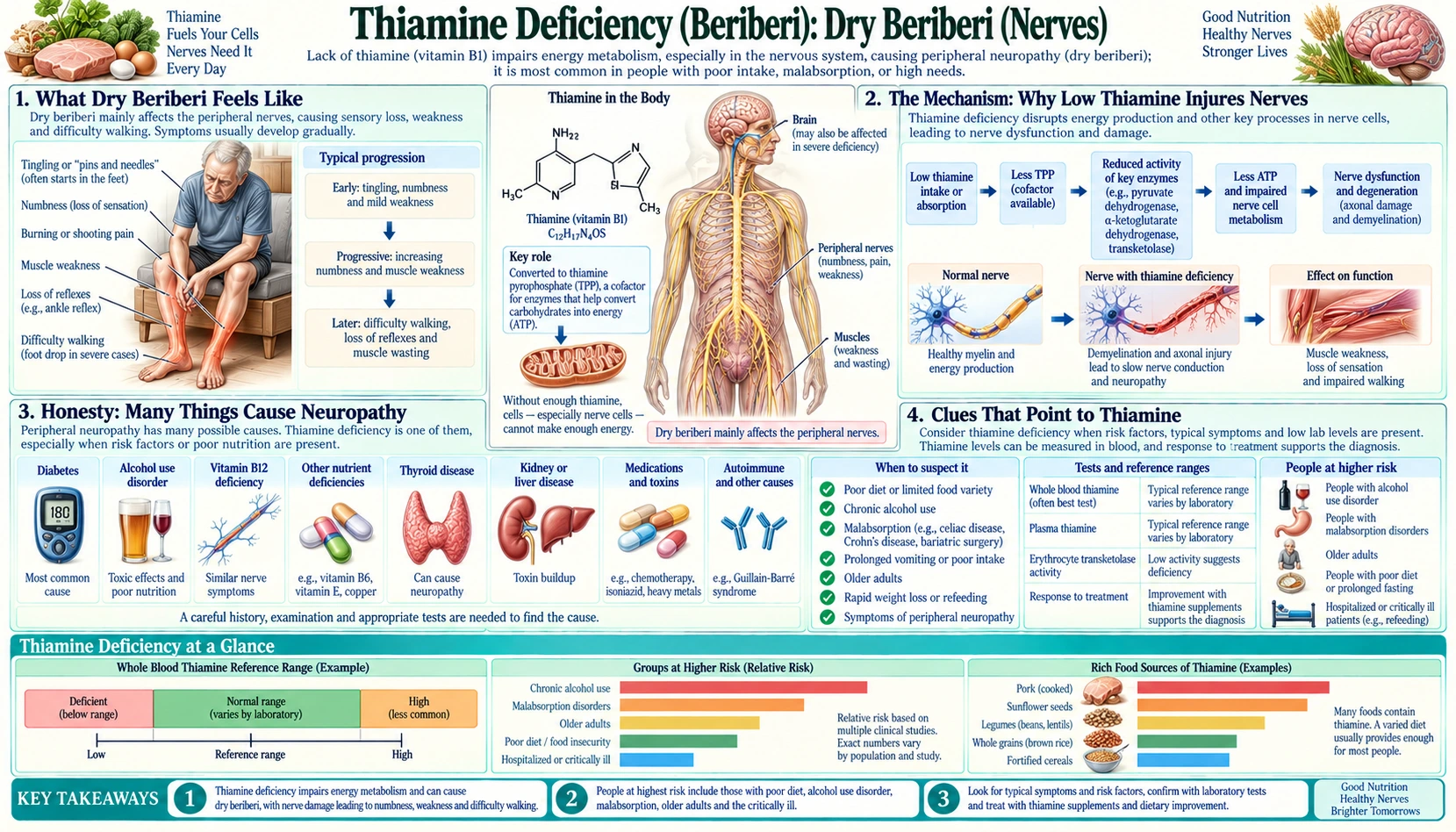
Dry beriberi is what doctors call the form of thiamine (vitamin B1) deficiency that attacks the nerves rather than the heart. It usually begins quietly in the feet — a burning, tingling, “pins-and-needles” feeling, numbness, and a creeping weakness that makes the ankles and calves give out — and it tends to climb slowly up both legs in a symmetrical, mirror-image pattern. The word “dry” simply means there is no fluid build-up or swelling (that is the other form, wet beriberi, which strains the heart). This page explains exactly why low thiamine starves and injures peripheral nerves, what dry beriberi feels like, the many other common causes of the same symptoms, the clues that point specifically to thiamine, and how it is diagnosed and reversed.
Table of Contents
- What Dry Beriberi Feels Like
- The Mechanism: Why Low Thiamine Injures Nerves
- Honesty: Many Things Cause Neuropathy
- Clues That Point to Thiamine
- What Drives Thiamine Low Enough to Damage Nerves
- Getting Diagnosed
- Correcting the Deficiency
- Warning Signs Hospitals Treat as Urgent
- Key Research Papers
- Connections
- Featured Videos
What Dry Beriberi Feels Like
Dry beriberi is a peripheral neuropathy — damage to the long nerves that run out to the hands and feet — and it has a recognizable signature. It is typically length-dependent and symmetrical: it strikes the longest nerves first, so the toes and soles announce the problem long before the fingers, and it affects both sides of the body in a roughly equal, mirror-image way. Doctors describe this as a “stocking-and-glove” pattern, because the affected zone matches where a sock or a glove would sit.
People living with it tend to describe a blend of sensory and motor complaints that build over weeks to months:
- Burning, prickling feet — an uncomfortable burning or “pins-and-needles” sensation in the soles and toes, often worse at night. Some describe it as walking on sand, hot coals, or bunched-up socks that aren't there.
- Numbness and loss of feeling — reduced sensation to light touch, temperature, and vibration, so a person may not feel a pebble in a shoe or notice a blister forming.
- Aching, cramping calves — a deep muscle ache or tenderness in the calves and shins, sometimes with night cramps.
- Weakness that creeps upward — the foot and ankle muscles weaken first. A classic sign is foot drop (the front of the foot slaps the ground or catches on steps because the muscle that lifts the toes is weak), followed later by weakness in the thighs.
- Unsteadiness — because the nerves that report joint position are damaged, balance suffers, and walking in the dark or on uneven ground becomes treacherous. Reflexes at the ankle are usually reduced or absent.
An important and practical point: this is a problem of strength and sensation, not of pain alone, and it is usually painless or only mildly painful in its sensory loss — the burning is real, but the dangerous part is the numbness and weakness people stop noticing. Because the changes are gradual and symmetrical, many people blame aging, tight shoes, or being “run down,” which is exactly why thiamine neuropathy is so often missed.
How it differs from alcohol-related nerve damage. A 2003 study from Nagoya University by Koike and colleagues compared 32 people with thiamine-deficiency neuropathy not caused by alcohol with 64 people with alcoholic neuropathy. In the thiamine-deficiency group, most cases were motor-dominant (weakness stood out more than numbness) and progressed quickly, with loss of both surface feeling and deep feeling (the sense of joint position and vibration); nerve samples showed loss mainly of the large nerve fibres. In alcoholic neuropathy without thiamine deficiency, symptoms were mostly sensory and slowly progressive, with pain or a painful burning feeling, and the loss was mainly in the small fibres. People with both alcohol use and thiamine deficiency showed a mixture. In that comparison, fast-progressing weakness pointed more toward thiamine deficiency, and slowly worsening painful burning more toward the direct effect of alcohol.
The Mechanism: Why Low Thiamine Injures Nerves
To understand dry beriberi you have to understand what thiamine actually does. After it is converted in the body to its active form, thiamine pyrophosphate (TPP), it serves as an essential helper molecule (a coenzyme) for a small set of enzymes that sit at the very center of how cells turn food into usable energy. The three most important are pyruvate dehydrogenase and alpha-ketoglutarate dehydrogenase, which feed the cell's main energy furnace (the citric-acid cycle), and transketolase, which runs a separate pathway the cell uses for maintenance and for making the building blocks of myelin and other structures. Without enough TPP, all three enzymes slow down.
Now consider why nerves are hit so hard. A peripheral nerve cell is built like an extension cord that can be up to a meter long — its cell body sits near the spinal cord, but its working end is all the way down in the toe. That entire length (the axon) has to be supplied with energy and freshly built proteins shipped out from the cell body, and it depends almost entirely on the steady, aerobic burning of glucose to do it. Nerve tissue has very little ability to store fuel and very little reserve. When thiamine runs low and the energy-producing enzymes stall, the parts of the nerve that are farthest from the cell body — the tips of the longest axons, out in the feet — are the first to run out of supply and begin to die back. This “dying-back” from the far end inward, called distal axonal degeneration, is exactly why symptoms begin in the toes and march upward, and why the longest nerves (legs) fail before the shorter ones (hands).
An analogy. Picture a city's water supply during a drought. The reservoir is the cell body; the pipes are the axons. When pressure drops, the houses at the very end of the longest pipes lose their water first — not because there is anything wrong with those houses, but because they are the hardest to reach when supply is short. As the drought deepens, the dry zone creeps back up the line toward the reservoir. Restore the water (the thiamine) and the nearest houses come back quickly; the ones at the far end take the longest to recover, because the pipe to them has to be rebuilt. That is precisely the pattern of dry beriberi: feet first, recovery slowest at the feet, and improvement spreading back down from the trunk.
Pathology studies of people with thiamine-deficiency neuropathy confirm this picture: the nerves show axonal loss (the wire itself degenerates), most severe in the longest fibers, rather than primarily a stripping of the insulating myelin sheath. Both the sensory fibers (which carry feeling) and the motor fibers (which carry movement commands) are affected, which is why dry beriberi produces that mixed picture of numbness, burning, and weakness together.
Honesty: Many Things Cause Neuropathy
It is important to be straight about this: a burning, numb, weak pair of feet is one of the most common neurological complaints there is, and thiamine deficiency is not the usual explanation. The same stocking-and-glove pattern of symptoms can be produced by many different conditions, and thiamine deficiency is often not the most likely of them. The leading causes of a symmetrical peripheral neuropathy include:
- Diabetes — by a wide margin the single most common cause of peripheral neuropathy in wealthy countries. Long-standing high blood sugar damages the same long nerves in the same feet-first pattern. A blood sugar test is a standard part of the work-up for this picture. See Diabetes and Peripheral Neuropathy.
- Alcohol use — heavy drinking causes neuropathy through more than one route. Some of it is thiamine deficiency (drinkers often eat poorly and absorb thiamine badly), but research shows alcohol also has a direct toxic effect on nerves that is clinically and microscopically distinct from pure thiamine-deficiency neuropathy. In a real patient both can be present at once.
- Vitamin B12 deficiency — another classic, treatable cause, which also affects the spinal cord and can cause numbness, imbalance, and weakness. See Vitamin B12 and the B12 blood test.
- Other nutrient issues — deficiency of vitamin B6 (and, confusingly, excess B6 from high-dose supplements) can both injure nerves, as can low vitamin E and low copper.
- Thyroid disease, kidney failure, and certain medications — an underactive thyroid, advanced kidney disease, some chemotherapy drugs, and certain antibiotics and human immunodeficiency virus (HIV) medicines are all recognized causes.
- Autoimmune and inflammatory neuropathies — conditions such as Guillain-Barré syndrome can mimic a rapidly worsening beriberi (and the two have been confused in case reports), which is one reason a careful evaluation matters.
The honest bottom line: burning, numb feet are common and have a long list of causes. Thiamine deficiency belongs on that list, but it is usually not the first thing to look for unless the rest of the story fits. That story is what the next section is about.
Clues That Point to Thiamine
Certain features move thiamine deficiency up the list of suspects. They make it more likely — not certain — and clinicians often test for it and treat it empirically because thiamine is cheap and safe and the consequences of missing it are severe:
- A setting that depletes thiamine. The neuropathy appears in someone with a clear reason to be low: heavy alcohol use, repeated vomiting (including severe morning sickness in pregnancy, called hyperemesis gravidarum), recent bariatric (weight-loss) surgery or other gut surgery, a long illness with poor eating, prolonged intravenous (IV) feeding without vitamins, or a diet built almost entirely on polished white rice or refined carbohydrate.
- It is symmetrical and rapidly progressive. Beriberi neuropathy tends to come on over weeks rather than years, and it is strikingly symmetrical. A neuropathy that is worsening quickly in someone malnourished is a setting in which clinicians raise the question urgently.
- Other thiamine clues are present together. The most important tell is the company it keeps. Thiamine deficiency rarely confines itself to the nerves. If the leg neuropathy is accompanied by signs of wet beriberi (breathlessness, a fast heartbeat, swollen legs, heart strain), or by the brain syndrome Wernicke-Korsakoff (confusion, unsteady gait, abnormal eye movements), then thiamine deficiency jumps to the top of the list. The classic dry-beriberi case is “numb, weak feet plus something else.”
- Early, non-specific warning signs preceded it. Many people had weeks of fatigue, poor appetite, and irritability — the vague early face of thiamine deficiency — before the feet began to burn.
- It responds to thiamine. Improvement after thiamine replacement is itself a strong clue (and the reason doctors often treat first and confirm later).
Where one of these settings is present, clinicians frequently do not wait for a lab result — they give thiamine immediately, because the risk of treating someone who turns out not to need it is essentially zero, while the risk of not treating true deficiency includes permanent nerve damage and, with the brain form, permanent memory loss.
What Drives Thiamine Low Enough to Damage Nerves
The body holds only about a 2–3 week store of thiamine, so deficiency can develop surprisingly fast once intake drops or losses rise. Nerve damage generally requires the deficiency to be fairly deep and to persist for weeks to months. The usual drivers are:
- Heavy alcohol use — the leading cause in high-income countries. Alcohol reduces appetite and food intake, blocks thiamine absorption in the gut, impairs its conversion to the active form, and increases its loss in the urine — a four-way hit.
- Poor or one-sided diet — historically, beriberi swept through populations living on polished (white) rice, because milling strips away the thiamine-rich bran. Modern equivalents include diets dominated by refined carbohydrate, severe eating disorders, food insecurity, and “tea-and-toast” eating in isolated older adults.
- Malabsorption and gut surgery — bariatric surgery (especially when patients skip their vitamins), other gastrointestinal surgery, chronic diarrhea, and inflammatory bowel disease all reduce thiamine uptake.
- Persistent vomiting — including severe pregnancy sickness (hyperemesis gravidarum), which has caused both Wernicke's and beriberi neuropathy in expectant mothers.
- High metabolic demand and intravenous feeding — critical illness, prolonged intravenous nutrition or glucose drips given without added thiamine, and chronic kidney dialysis (which removes the water-soluble vitamin) can all precipitate deficiency. A well-known danger is giving glucose to a thiamine-depleted person, because metabolizing the sugar consumes the last of their thiamine and can trigger an acute crisis — which is why thiamine is given before or with glucose in at-risk patients.
- Diuretics — long-term “water pills” (used for blood pressure and heart failure) increase urinary loss of thiamine and can contribute, especially when diet is already marginal.
For practical, food-first prevention, the most thiamine-dense everyday foods include pork, beans and lentils, whole grains and oats, sunflower seeds, and fortified cereals — the detailed list lives on the Vitamin B1 food sources page.
Getting Diagnosed
Diagnosing dry beriberi is unusual in medicine because the lab test is not the centerpiece — the clinical story and the response to treatment usually are. Still, several tools are used together:
- The clinical picture. A doctor looks for the symmetrical, feet-first sensory-and-motor pattern, reduced or absent ankle reflexes, and — crucially — an at-risk setting and any accompanying signs of heart or brain involvement.
- Thiamine status testing. The most established laboratory measure is the erythrocyte transketolase activation assay — it tests how much the activity of a thiamine-dependent enzyme in red blood cells jumps when extra thiamine is added in the test tube; a big jump means the cells were starved. Many labs now measure thiamine (and thiamine diphosphate) in whole blood directly by a method called HPLC. These tests have real limitations, are not available everywhere quickly, and a result can be falsely affected by recent intake — which is part of why treatment is often started before the number comes back.
- Nerve conduction studies / EMG. These electrical tests confirm a length-dependent axonal neuropathy and help separate beriberi from look-alikes such as a primarily demyelinating neuropathy.
- Ruling out the common causes. Because diabetes, B12 deficiency, thyroid disease, and kidney problems are far more common, a sensible work-up checks blood sugar (or a hemoglobin A1c (HbA1c)), vitamin B12, thyroid function, kidney function, and a comprehensive metabolic panel at the same time.
- The therapeutic trial. Improvement after thiamine replacement supports the diagnosis. Because thiamine is safe and inexpensive, a trial is frequently the most decisive “test” available.
Correcting the Deficiency
The good news is that thiamine replacement is cheap, safe, and often dramatically effective — especially when started early. The general approach:
- Prompt replacement, by injection when it is serious. For established beriberi neuropathy, and certainly if any brain (Wernicke) signs are present, thiamine is given by injection (intravenous or intramuscular) at first, because absorption from the gut may be impaired and the stakes are high. Once the person is stable and eating, treatment is continued by mouth. For Wernicke encephalopathy (the brain form), the 2010 European Federation of Neurological Societies (EFNS) guideline states that thiamine is given before any carbohydrate, 200 mg three times daily, preferably intravenously — far above the everyday requirement of about 1.1–1.2 mg. The same guideline rates the overall safety of thiamine as very good.
- Thiamine is given before glucose in anyone at risk. This is a critical safety rule: feeding sugar (or intravenous glucose) to a thiamine-depleted person can use up their remaining thiamine and tip them into an acute crisis. The EFNS guideline states that thiamine is given before any carbohydrate.
- Food for prevention and mild cases. The everyday adult requirement is roughly 1.1 mg/day for women and 1.2 mg/day for men (more in pregnancy and breastfeeding). Building meals around pork, beans, whole grains, oats, and seeds — see the food sources page — restores and protects thiamine status without any risk of overdose, since the body simply excretes what it doesn't need.
- The underlying cause. Replacing thiamine without addressing why it dropped — cutting back alcohol, adding vitamins after bariatric surgery, treating the vomiting, reviewing diuretics — only buys time. Lasting recovery means correcting the underlying driver, and people who continue heavy drinking, for example, will continue to injure their nerves.
What recovery looks like. The sensory burning and some weakness can improve within days to weeks of replacement, and that early response is encouraging. But because dry beriberi is an axonal (dying-back) neuropathy, the longest, most damaged nerves — the ones out in the feet — regrow slowly, on the order of months, and very advanced damage may not fully reverse. That is exactly why catching it early matters so much: the difference between a few weeks of treatment and a partial, permanent disability is often how soon thiamine was started. A 2001 study by Koike and colleagues followed 17 people who developed thiamine-deficiency neuropathy after stomach surgery (gastrectomy): the nerve problems began anywhere from 2 months to 39 years after the operation, most of the patients did not look malnourished, and some fast-progressing cases mimicked Guillain-Barré syndrome. Most made a substantial functional recovery by 3 to 6 months after thiamine was started, and strength recovered better than feeling. A note about supplementing: oral thiamine itself is remarkably safe (excess is excreted in the urine), and serious problems from thiamine come from missing it, not from taking it — the toxicity side is covered on the Vitamin B1 toxicity hub.
Warning Signs Hospitals Treat as Urgent
Numb, burning feet have many causes, and finding the cause is what stops the damage from getting worse. Certain features are signs doctors treat as urgent, and a few are treated as emergencies:
- Rapidly worsening or ascending weakness — weakness in the feet and legs that is getting noticeably worse over days, or climbing upward toward the trunk, is treated as urgent (it can also signal other serious neuropathies that require emergency treatment).
- Any breathing or heart symptoms — breathlessness, a racing or pounding heartbeat, chest discomfort, or swelling of the legs in someone with neuropathy may mean wet beriberi is developing alongside it. This is an emergency.
- Confusion, double vision, or a staggering, unsteady walk — these point to Wernicke encephalopathy, a brain emergency treated with immediate intravenous thiamine to prevent permanent memory loss.
- A foot injury, blister, or sore you cannot feel — numb feet are vulnerable to wounds that go unnoticed and become infected; a new sore on a numb foot can worsen without being felt.
- Neuropathy in pregnancy or after weight-loss surgery with vomiting — these settings carry a real risk of severe thiamine deficiency; after bariatric surgery, the EFNS guideline recommends follow-up of thiamine status for at least 6 months.
The unifying theme: dry beriberi rarely travels alone. Because the same deficiency that is numbing the feet can also be straining the heart and threatening the brain, any neuropathy appearing in a thiamine-risk setting — together with chest, breathing, or confusion symptoms — is treated as urgent. The evaluation is straightforward, and the EFNS guideline rates the overall safety of thiamine as very good.
Key Research Papers
- Whitfield KC, Bourassa MW, Adamolekun B, et al. (2018). Thiamine deficiency disorders: diagnosis, prevalence, and a roadmap for global control programs. Annals of the New York Academy of Sciences;1430(1):3-43. — DOI: 10.1111/nyas.13919. — doi:10.1111/nyas.13919
- Koike H, Iijima M, Sugiura M, et al. (2003). Alcoholic neuropathy is clinicopathologically distinct from thiamine-deficiency neuropathy. Annals of Neurology;54(1):19-29. — DOI: 10.1002/ana.10550. — doi:10.1002/ana.10550
- Koike H, Misu K, Hattori N, et al. (2001). Postgastrectomy polyneuropathy with thiamine deficiency. Journal of Neurology, Neurosurgery & Psychiatry;71(3):357-362. — DOI: 10.1136/jnnp.71.3.357. — doi:10.1136/jnnp.71.3.357
- Koike H, Iijima M, Mori K, et al. (2004). Postgastrectomy polyneuropathy with thiamine deficiency is identical to beriberi neuropathy. Nutrition;20(11-12):961-966. — DOI: 10.1016/j.nut.2004.08.002. — doi:10.1016/j.nut.2004.08.002
- Koike H, Sobue G (2006). Alcoholic neuropathy. Current Opinion in Neurology;19(5):481-486. — DOI: 10.1097/01.wco.0000245371.89941.eb. — doi:10.1097/01.wco.0000245371.89941.eb
- Sechi G, Serra A (2007). Wernicke's encephalopathy: new clinical settings and recent advances in diagnosis and management. The Lancet Neurology;6(5):442-455. — DOI: 10.1016/S1474-4422(07)70104-7. — doi:10.1016/S1474-4422(07)70104-7
- Galvin R, Bråthen G, Ivashynka A, et al. (2010). EFNS guidelines for diagnosis, therapy and prevention of Wernicke encephalopathy. European Journal of Neurology;17(12):1408-1418. — DOI: 10.1111/j.1468-1331.2010.03153.x. — doi:10.1111/j.1468-1331.2010.03153.x
- Shible AA, Ramadurai D, Gergen D, et al. (2019). Dry Beriberi Due to Thiamine Deficiency Associated with Peripheral Neuropathy and Wernicke's Encephalopathy Mimicking Guillain-Barré Syndrome: A Case Report and Review of the Literature. American Journal of Case Reports;20:330-334. — DOI: 10.12659/AJCR.914051. — doi:10.12659/AJCR.914051
- Warnock LG (1975). Transketolase Activity of Blood Hemolysate, a Useful Index for Diagnosing Thiamine Deficiency. Clinical Chemistry;21(3):432-436. — DOI: 10.1093/clinchem/21.3.432. — doi:10.1093/clinchem/21.3.432
PubMed Topic Searches
Connections
- All Vitamins
- Thiamine Deficiency (Beriberi) Hub
- Wet Beriberi (Heart)
- Wernicke-Korsakoff Syndrome
- Fatigue & Appetite Loss
- Vitamin B1 Toxicity
- Vitamin B1 Overview
- Vitamin B1 Food Sources
- Peripheral Neuropathy
- Diabetes
- Vitamin B12
- Vitamin B6
- Comprehensive Metabolic Panel
- Vitamin B12 Blood Test
- Hemoglobin A1C
- Pork
- Lentils