Choline Toxicity (High-Dose Choline): Fishy Body Odor
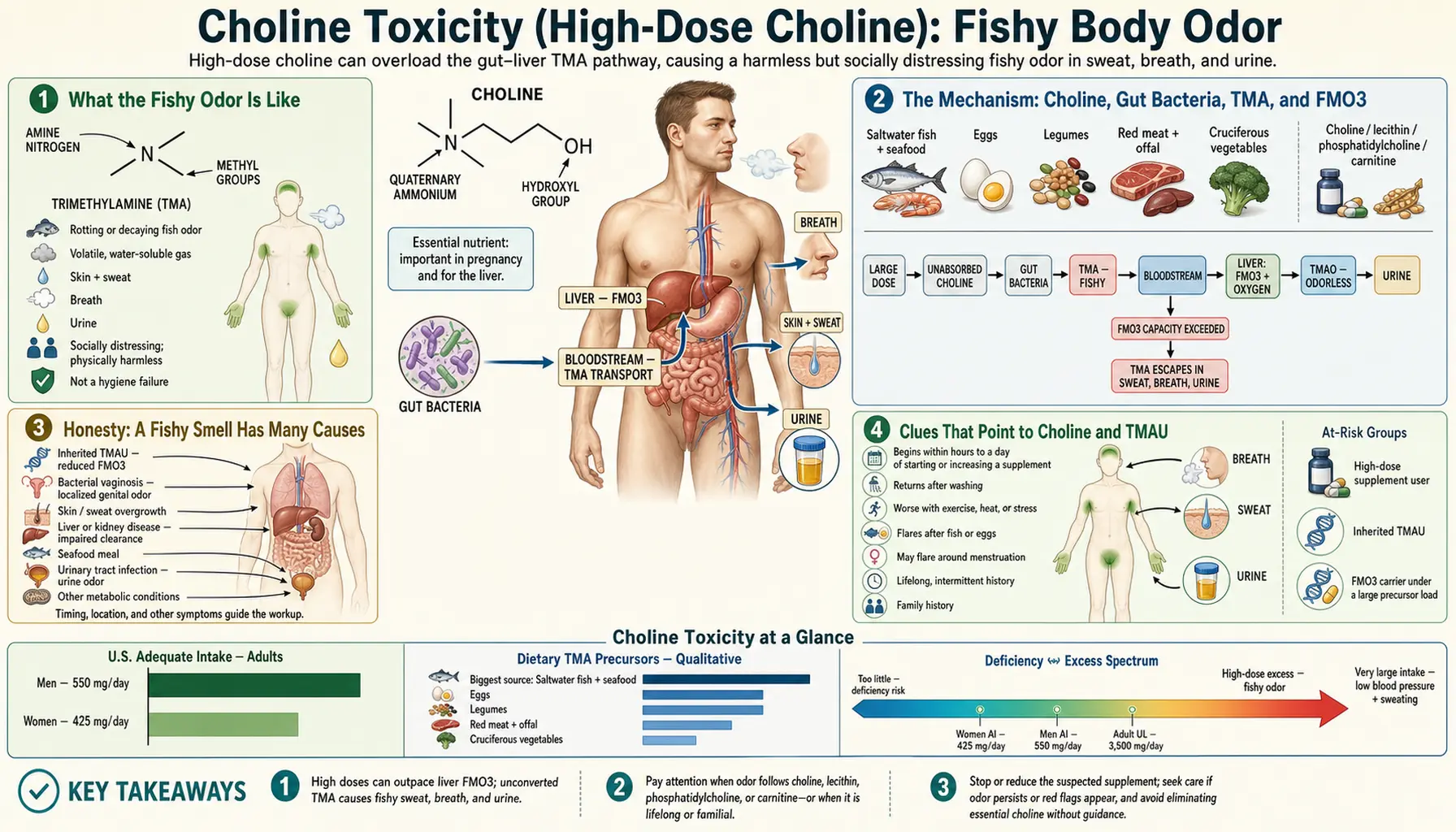
The best-known side effect of very large intakes of choline — usually from high-dose supplements — is a fishy body odor. Choline that escapes absorption is broken down by gut bacteria into trimethylamine (TMA), the volatile compound that smells of rotting fish. Normally a liver enzyme called FMO3 converts TMA into odorless trimethylamine N-oxide (TMAO). In the inherited condition trimethylaminuria (TMAU), or “fish-odor syndrome”, mutations in the FMO3 gene leave the enzyme unable to keep up, and TMA leaves the body in sweat, breath, and urine; some common FMO3 variants cause a milder or transient form. Reviews describe the condition as socially distressing, with isolation and depression reported, rather than as a direct threat to physical health. This page describes why the smell happens, why some people get it and most don't, how it is diagnosed, and what the research reports about managing it.
Table of Contents
- What the Fishy Odor Is Like
- The Mechanism: Choline, Gut Bacteria, TMA, and FMO3
- Honesty: A Fishy Smell Has Many Causes
- Clues That Point to Choline and TMAU
- What Triggers It: Doses, Foods, and Forms
- How It Is Diagnosed
- What the Research Reports on Management
- Signs That Point Beyond Choline Excess
- Key Research Papers
- Connections
- Featured Videos
What the Fishy Odor Is Like
People who experience this describe a smell that is unmistakable and hard to live with: a strong odor of rotting or decaying fish. It is not a faint sweaty smell — it is the same compound (trimethylamine) that gives old fish and certain seafood markets their characteristic reek. The odor can come from several places at once:
- The skin and sweat. TMA is excreted in sweat and other body secretions as well as urine. Reviews describe flares after marine-fish meals, during feverish infections, and (in those who menstruate) around menstruation.
- The breath. Fishy breath can be mistaken for an oral or dental problem, but it persists no matter how carefully someone brushes, flosses, or uses mouthwash, because the source is in the bloodstream, not the mouth.
- The urine. Urine is the main route by which excess TMA leaves the body, and it is what diagnostic tests measure.
What makes this symptom so painful is almost entirely social, not medical. The odor can be intermittent, and reviews note that the person carrying it may not be aware of it themselves, so they may only learn of it from other people's reactions. The condition can go undiagnosed for years; reviews describe social isolation and depression, and the 1997 gene-discovery paper reports reactions ranging up to clinical depression and attempted suicide. It is a real biochemical condition, not a failure of washing.
The odor itself is a byproduct: it reflects TMA escaping faster than the liver can convert it. Very high choline intakes are not only a cosmetic matter, though. When the Institute of Medicine set the adult Tolerable Upper Intake Level in 1998, it chose low blood pressure (hypotension) as the critical effect and fishy body odor as the secondary consideration.
The Mechanism: Choline, Gut Bacteria, TMA, and FMO3
To understand the fishy smell you only need to follow choline through four steps: down into the gut, into a smelly gas, up to the liver, and (normally) into an odorless waste product. The odor appears when the last step fails to keep pace.
Step 1 — choline reaches the gut. Choline and choline-containing compounds (such as phosphatidylcholine and lecithin) are absorbed in the small intestine. But when the dose is large — far more than the body needs at once — a portion is not absorbed and passes deeper into the gut, where it meets the trillions of resident bacteria.
Step 2 — bacteria turn choline into trimethylamine. Certain gut bacteria possess enzymes that strip choline apart and release trimethylamine (TMA). TMA is a small, volatile, water-soluble gas, and it is the actual smell — the pure compound is what chemists and food scientists have long identified as the “rotting fish” odor. The same bacterial pathway acts on other dietary precursors, which is why this is a whole-diet phenomenon, not a choline-only one (more on the food list below).
Step 3 — TMA travels to the liver. The TMA made in the gut is absorbed into the bloodstream and carried to the liver, the body's chemical processing plant.
Step 4 — FMO3 deodorizes it (or doesn't). In the liver, an enzyme called flavin-containing monooxygenase 3 (FMO3) adds an oxygen atom to TMA, converting the smelly gas into trimethylamine N-oxide (TMAO), which is odorless and is excreted in the urine (raised blood TMAO is studied separately as a cardiovascular risk marker). This host–microbiome “TMA–TMAO axis” runs quietly in everyone every day. When FMO3 has enough capacity, even a large choline load is deodorized before it can escape, and there is no smell.
Why the smell appears. The odor occurs when the supply of TMA outruns the FMO3 enzyme's ability to convert it. The unconverted TMA then leaves the body the only ways a small volatile compound can — in sweat, breath, and urine — carrying its fishy smell with it. There are two ways the enzyme gets outrun:
- The genetic form (primary TMAU). People with primary TMAU inherit two non-working or reduced-function copies of the FMO3 gene (an autosomal recessive pattern). Their enzyme works poorly, so ordinary amounts of TMA precursors can overwhelm it, and a choline load raises TMA output further — oral choline loading is used as a diagnostic test. Carriers of one mutation are generally described as symptom-free, but in one family study both carrier parents, who had no odor after a 300 mg oral dose of TMA, developed the fish odor and showed reduced conversion at a 600 mg dose. Some common FMO3 variants, inherited together, cause a mild or transient form.
- The overload form (secondary, in normal enzymes). Even a normal FMO3 enzyme has a finite throughput. Cases of trimethylaminuria have been reported after therapeutic choline doses of 8–20 g/day used in trials for Huntington's disease and Alzheimer's disease, and large carnitine doses are anecdotally reported to provoke a fishy odor in some susceptible people. This is the more relevant scenario for someone who has taken a very large supplement dose.
An analogy. Picture FMO3 as the single deodorizing fan over a kitchen stove. TMA is the fish smell coming off the pan. Cook one fillet (a normal choline intake) and the fan clears the air before the smell escapes the kitchen — no one in the next room notices. Now fry a dozen fillets at once (a megadose of choline or lecithin): the smell pours out faster than the fan can pull it away, and it drifts through the whole house. People with inherited TMAU are working with a fan that runs at a fraction of its rated speed, so even one fillet is enough to leave a smell. In both cases the smell tracks the load on the fan, which is why reducing precursors, rather than more washing, is the main approach the research describes.
Honesty: A Fishy Smell Has Many Causes
A fishy body odor is a real and specific clue, but it is honest to say that choline excess is only one of its causes, and not the most common. Before assuming a supplement is to blame, it is worth knowing the other possibilities, because the right fix depends entirely on the real cause:
- Inherited trimethylaminuria with an ordinary diet. The odor can reflect an underlying FMO3 variation interacting with everyday foods, marine fish above all — a choline supplement may have unmasked a tendency that was already there.
- Bacterial vaginosis. In people with a vagina, a fishy genital odor — often worse after sex or around menstruation — is commonly due to bacterial vaginosis, a shift in vaginal bacteria, and is treated with antibiotics. This is unrelated to choline and is a frequent, easily treatable cause.
- Skin and sweat conditions. Ordinary body odor (bromhidrosis), bacterial or fungal skin overgrowth, and infected sweat can all smell strong, though usually not specifically fishy.
- Liver or kidney disease. Advanced liver disease or kidney failure can cause distinctive breath and body odors because waste products that are normally cleared build up; this is a “secondary” cause of impaired TMA handling and is accompanied by other signs of organ trouble.
- Other foods and infections. A heavy seafood meal can transiently make sweat or breath smell of fish in anyone; some urinary tract infections change urine odor; and rare metabolic conditions produce other characteristic smells (maple-syrup, sweaty-feet, mousy).
Timing matters: a fishy smell that appeared right after starting a high-dose choline or carnitine supplement fits the precursor-overload pattern, while a smell present for years with no supplement, or localized to the genital area, fits other causes. A smell alone does not establish TMAU; diagnosis rests on urine testing (below).
Clues That Point to Choline and TMAU
Several features make it more likely that a fishy odor is coming from the choline–TMA–FMO3 pathway rather than from something else:
- Clear timing with a supplement. The clearest clue is that the smell began (or sharply worsened) soon after starting or increasing choline, lecithin, phosphatidylcholine, or carnitine, and eased after stopping.
- It washes but doesn't wash off. The odor returns after washing and is not explained by oral or dental hygiene — because the source is internal, secreted through sweat and breath, not a film on the skin or in the mouth.
- It tracks with certain foods and with the menstrual cycle. Flares after a marine-fish meal, during a feverish infection, or (for those who menstruate) around their period fit the pattern; a perimenstrual rise in TMA excretion has been measured in people with TMAU and in healthy women.
- A lifelong, on-and-off history. If the person recalls intermittent “unexplained” body or breath odor going back to childhood — especially episodes tied to fish — that points toward an underlying FMO3 variation (TMAU), with the supplement amplifying it.
- A family history of the same complaint. Because primary TMAU is inherited, relatives with similar unexplained odor raise the suspicion considerably.
Two related effects of high-dose choline are covered on sibling pages: high-dose choline can also cause a digestive upset (nausea, loose stools) and, at very large intakes, a drop in blood pressure with sweating.
What Triggers It: Doses, Foods, and Forms
The amount of choline it takes to produce a fishy odor varies enormously from person to person, because it depends on how well an individual's FMO3 enzyme works. For someone with inherited TMAU, a quite ordinary amount can be enough; for someone with a normal enzyme, it usually takes a genuinely large supplemental dose.
The supplement forms most often implicated:
- Choline bitartrate and choline chloride — choline salts. In a small pilot study, about 63% of a 15 mmol oral choline dose appeared in the urine as TMA and its N-oxide, and oral choline bitartrate is the form used in diagnostic choline-load tests.
- Lecithin and phosphatidylcholine — in the same pilot study, an equal molar dose of lecithin did not significantly raise urinary TMA, while a later study detected TMAO made by gut bacteria from the phosphatidylcholine in two hard-boiled eggs plus a labelled phosphatidylcholine dose; see Lecithin and Phosphatidylcholine.
- L-carnitine — a separate supplement (and a natural component of red meat) that gut bacteria also convert to TMA; in the pilot study about 31% of a carnitine dose appeared as TMA and its N-oxide. See Carnitine.
- CDP-choline (citicoline) and alpha-GPC — choline-donor compounds; the sources cited here do not report how often they cause odor compared with choline salts.
For reference, ordinary needs are modest. The U.S. Adequate Intake for choline is 550 mg/day for men and 425 mg/day for women, and the Tolerable Upper Intake Level is 3,500 mg (3.5 g)/day for adults. The 1998 Institute of Medicine report set that limit from a lowest-observed-adverse-effect level of about 7.5 g/day, choosing low blood pressure as the critical effect and fishy body odor as the secondary consideration; it names people with trimethylaminuria, kidney disease, or liver disease, among others, as possibly more susceptible to choline's adverse effects.
The dietary precursors discussed in the research (relevant both for diagnosis and for management of TMAU). In a pilot study of 46 foods, only fish and other seafood significantly raised urinary TMA and TMAO; fruits, vegetables, cereals, dairy produce, and meats had no measurable effect.
- Saltwater fish and seafood — the biggest dietary source, because marine fish contain high concentrations of TMAO, which gut bacteria reduce to TMA.
- Eggs — egg yolks are rich in choline; see Eggs.
- Legumes — peas and beans are dietary sources of choline.
- Red meat and offal (liver) — organ meats supply choline and red meat supplies carnitine, although ordinary meat meals had no measurable effect on urinary TMA in the pilot study.
- Cruciferous vegetables — not a precursor source, but in a small study of healthy men, eating 300 g of cooked Brussels sprouts a day raised the urinary TMA-to-TMAO ratio 2.6- to 3.2-fold, a sign of reduced FMO3 activity.
In short, the odor is the sum of everything entering the TMA pathway — the supplement plus the diet — weighed against how fast FMO3 can clear it. That is why a person can be fine for years on a normal diet and then start to smell after adding a large choline supplement.
How It Is Diagnosed
Where a fishy odor followed a high-dose supplement, its course after the supplement is stopped is itself informative. When the odor persists without supplements, recurs, or has been lifelong, formal testing for trimethylaminuria is used to confirm the underlying cause:
- Urine TMA / TMAO testing. Urine is analyzed for TMA and TMAO, and the result can be expressed as an “oxidizing ratio” — TMAO as a percentage of TMA plus TMAO. A 2011 review gives a ratio below 84% for people with two inactivating FMO3 mutations and above 92% for unaffected people, and stresses that the enzyme must be challenged with enough substrate or a mild deficiency can be missed; the most practical load it describes is a 300 g marine-fish meal followed by urine collection over the next hours. Oral choline loading is an alternative used to estimate residual enzyme capacity. Because the condition can be mild or intermittent, testing may need repeating. This is the practical diagnostic test and is offered by specialized metabolic laboratories.
- FMO3 genetic testing. Sequencing the FMO3 gene can identify the specific reduced-function variants responsible for primary (inherited) trimethylaminuria. It is useful for confirming the diagnosis and for family counseling, and it is usually arranged through a metabolic or genetics clinic.
- Looking for secondary causes. If the picture suggests the smell comes from impaired clearance rather than genetics, a clinician may check liver and kidney function and review medications, and (for a genital fishy odor) evaluate for bacterial vaginosis, which is diagnosed and treated quite differently.
Testing also cuts the other way: in a French metabolic-clinic series, 11 adults who reported an unpleasant body odor that physicians did not confirm all had urine TMA in the normal range, while two children with confirmed recessive TMAU had high TMA. Reviews note that embarrassment often makes people reluctant to raise the problem with a doctor; the condition is usually handled by clinics for inherited metabolic disorders.
What the Research Reports on Management
Reviews describe reducing the load of TMA precursors, so that the remaining FMO3 activity can keep up, as the main approach. A 2011 review adds that no treatment has been systematically appraised and that the options have not worked for everyone, particularly in severely affected people.
- The excess precursor itself. In the overload form, the odor is tied to the excess intake rather than to an enzyme defect. The sources cited here report no trials comparing lower doses, other choline forms, or divided doses for odor; decisions about a prescribed or recommended supplement belong with the clinician involved.
- Diet (in confirmed TMAU). Reviews describe excluding marine fish, the major TMAO source, as the primary dietary measure, with limits on choline-rich foods (egg yolks, legumes, organ meats) as a further step; a 2011 review notes it is unclear whether ordinary intakes of those foods provoke symptoms, and suggests limiting Brussels sprouts may add some benefit because they inhibit FMO3. Choline is also an essential nutrient: the same review warns that dietary deficiency may lead to liver damage and that restricting choline may raise folate needs, so choline restriction carries its own risk of choline deficiency.
- Short courses of gut antibiotics. Brief courses of neomycin and metronidazole have been used to suppress TMA-producing gut bacteria and are described as useful in some but not all cases; the 2011 review calls them unwise as anything more than a short-term measure. In a pediatric study comparing metronidazole, amoxicillin, and neomycin, all reduced TMA production from choline to a limited extent, neomycin most.
- Binding agents. In a small study of seven Japanese people with TMAU, activated charcoal (1.5 g/day for 10 days) and copper chlorophyllin (180 mg/day for 3 weeks) both lowered urinary free TMA and raised TMAO toward normal values, with the chlorophyllin effect lasting longer.
- Skin care. Reviews describe frequent washing with a low-pH soap, to reduce TMA evaporation from the skin, along with antiperspirants and regular laundering of clothing.
- Riboflavin (vitamin B2). FMO3 uses a riboflavin-derived flavin cofactor (FAD), so vitamin B2 has been tried to boost residual enzyme activity. A 2011 review found no clinical literature on it at the time; a 2019 French series reported that vitamin B2 lowered TMA excretion and body odor in two children with confirmed TMAU.
- The emotional toll. Reviews describe consequences for self-esteem and employment, isolation, and depression; support from clinicians, patient organizations, or counseling is part of care as the literature describes it.
Signs That Point Beyond Choline Excess
The odor itself is not described as a danger to physical health. Certain accompanying features, though, point to something other than (or in addition to) simple choline excess:
- A fishy odor with signs of liver or kidney trouble — yellowing of the skin or eyes, swelling, confusion, very dark urine, or markedly reduced urination — point toward impaired organ clearance, a different and more serious cause of the smell; severe liver impairment has been reported to cause trimethylaminuria.
- A persistent fishy genital odor in someone with a vagina, especially with discharge or itching, points toward bacterial vaginosis or another genital infection, which is unrelated to choline.
- An odor that does not resolve after all suspected supplements are stopped is the situation in which urine TMA/TMAO testing is used to look for trimethylaminuria.
- Faintness, lightheadedness, a very fast or pounding heartbeat, or near-collapse after a large choline dose — these are not part of the odor itself and fit the other high-dose effect of choline, a drop in blood pressure, which is the effect the 1998 upper limit was based on; see Choline and Low Blood Pressure & Sweating.
- Severe emotional distress — anxiety, social withdrawal, or low mood tied to the odor (real or feared) is reported in the literature, including in adults whose odor was not confirmed on testing.
Without those features, a fishy smell that clearly followed a high-dose choline supplement and eased when it stopped fits the precursor-overload pattern described above.
Key Research Papers
- Treacy EP, Akerman BR, Chow LML, et al. (1998). Mutations of the flavin-containing monooxygenase gene (FMO3) cause trimethylaminuria, a defect in detoxication. Human Molecular Genetics;7(5):839-845. — DOI: 10.1093/hmg/7.5.839. — doi:10.1093/hmg/7.5.839
- Akerman BR, Lemass H, Chow LML, et al. (1999). Trimethylaminuria Is Caused by Mutations of the FMO3 Gene in a North American Cohort. Molecular Genetics and Metabolism;68(1):24-31. — DOI: 10.1006/mgme.1999.2885. — doi:10.1006/mgme.1999.2885
- Fennema D, Phillips IR, Shephard EA (2016). Trimethylamine and Trimethylamine N-Oxide, a Flavin-Containing Monooxygenase 3 (FMO3)-Mediated Host-Microbiome Metabolic Axis Implicated in Health and Disease. Drug Metabolism and Disposition;44(11):1839-1850. — DOI: 10.1124/dmd.116.070615. — doi:10.1124/dmd.116.070615
- Cashman JR, Camp K, Fakharzadeh SS, et al. (2003). Biochemical and Clinical Aspects of the Human Flavin-Containing Monooxygenase Form 3 (FMO3) Related to Trimethylaminuria. Current Drug Metabolism;4(2):151-170. — DOI: 10.2174/1389200033489505. — doi:10.2174/1389200033489505
- Cashman JR (2000). Human Flavin-Containing Monooxygenase: Substrate Specificity and Role in Drug Metabolism. Current Drug Metabolism;1(2):181-191. — DOI: 10.2174/1389200003339135. — doi:10.2174/1389200003339135
- Al-Waiz M, Ayesh R, Mitchell SC, Idle JR, Smith RL (1988). Trimethylaminuria ('fish-odour syndrome'): A study of an affected family. Clinical Science;74(3):231-236. — DOI: 10.1042/cs0740231. — doi:10.1042/cs0740231
- Mitchell SC (2005). Trimethylaminuria (fish-odour syndrome) and oral malodour. Oral Diseases;11(Suppl 1):10-13. — DOI: 10.1111/j.1601-0825.2005.01081.x. — doi:10.1111/j.1601-0825.2005.01081.x
- Fraser-Andrews EA, Manning NJ, Ashton GHS, et al. (2003). Fish odour syndrome with features of both primary and secondary trimethylaminuria. Clinical and Experimental Dermatology;28(2):203-205. — DOI: 10.1046/j.1365-2230.2003.01230.x. — doi:10.1046/j.1365-2230.2003.01230.x
- Yamazaki H, Shimizu M (2007). Genetic Polymorphism of the Flavin-Containing Monooxygenase 3 (FMO3) Associated with Trimethylaminuria (Fish Odor Syndrome): Observations from Japanese Patients. Current Drug Metabolism;8(5):487-491. — DOI: 10.2174/138920007780866825. — doi:10.2174/138920007780866825
- Humbert JR, Hammond KB, Hathaway WE, et al. (1970). Trimethylaminuria: The Fish-Odour Syndrome. The Lancet;296(7676):770-771. — DOI: 10.1016/S0140-6736(70)90241-2. — doi:10.1016/s0140-6736(70)90241-2
- Wang Z, Klipfell E, Bennett BJ, et al. (2011). Gut flora metabolism of phosphatidylcholine promotes cardiovascular disease. Nature;472(7341):57-63. — DOI: 10.1038/nature09922. — doi:10.1038/nature09922
- Dolphin CT, Janmohamed A, Smith RL, et al. (1997). Missense mutation in flavin-containing mono-oxygenase 3 gene, FMO3, underlies fish-odour syndrome. Nature Genetics;17(4):491-494. — PubMed PMID: 9398858
- Mackay RJ, McEntyre CJ, Henderson C, et al. (2011). Trimethylaminuria: causes and diagnosis of a socially distressing condition. Clinical Biochemist Reviews;32(1):33-43. — PubMed PMID: 21451776
- Zschocke J, Kohlmueller D, Quak E, et al. (1999). Mild trimethylaminuria caused by common variants in FMO3 gene. The Lancet;354(9181):834-835. — PubMed PMID: 10485731
- Zhang AQ, Mitchell SC, Smith RL (1999). Dietary precursors of trimethylamine in man: a pilot study. Food and Chemical Toxicology;37(5):515-520. — PubMed PMID: 10456680
- Zhang AQ, Mitchell SC, Smith RL (1996). Exacerbation of symptoms of fish-odour syndrome during menstruation. The Lancet;348(9043):1740-1741. — PubMed PMID: 8973460
- Chalmers RA, Bain MD, Michelakakis H, et al. (2006). Diagnosis and management of trimethylaminuria (FMO3 deficiency) in children. Journal of Inherited Metabolic Disease;29(1):162-172. — PubMed PMID: 16601883
- Treacy E, Johnson D, Pitt JJ, Danks DM (1995). Trimethylaminuria, fish odour syndrome: a new method of detection and response to treatment with metronidazole. Journal of Inherited Metabolic Disease;18(3):306-312. — PubMed PMID: 7474897
- Yamazaki H, Fujieda M, Togashi M, et al. (2004). Effects of the dietary supplements, activated charcoal and copper chlorophyllin, on urinary excretion of trimethylamine in Japanese trimethylaminuria patients. Life Sciences;74(22):2739-2747. — PubMed PMID: 15043988
- Cashman JR, Xiong Y, Lin J, et al. (1999). In vitro and in vivo inhibition of human flavin-containing monooxygenase form 3 (FMO3) in the presence of dietary indoles. Biochemical Pharmacology;58(6):1047-1055. — PubMed PMID: 10509757
- Bouchemal N, Ouss L, Brassier A, et al. (2019). Diagnosis and phenotypic assessment of trimethylaminuria, and its treatment with riboflavin: 1H NMR spectroscopy and genetic testing. Orphanet Journal of Rare Diseases;14(1):222. — PubMed PMID: 31533761
- Koeth RA, Wang Z, Levison BS, et al. (2013). Intestinal microbiota metabolism of L-carnitine, a nutrient in red meat, promotes atherosclerosis. Nature Medicine;19(5):576-585. — PubMed PMID: 23563705
- Tang WH, Wang Z, Levison BS, et al. (2013). Intestinal microbial metabolism of phosphatidylcholine and cardiovascular risk. New England Journal of Medicine;368(17):1575-1584. — PubMed PMID: 23614584
- Institute of Medicine (1998). Dietary Reference Intakes for Thiamin, Riboflavin, Niacin, Vitamin B6, Folate, Vitamin B12, Pantothenic Acid, Biotin, and Choline. Washington, DC: National Academies Press. — doi:10.17226/6015