Mouth Taping — Benefits Deep Dive
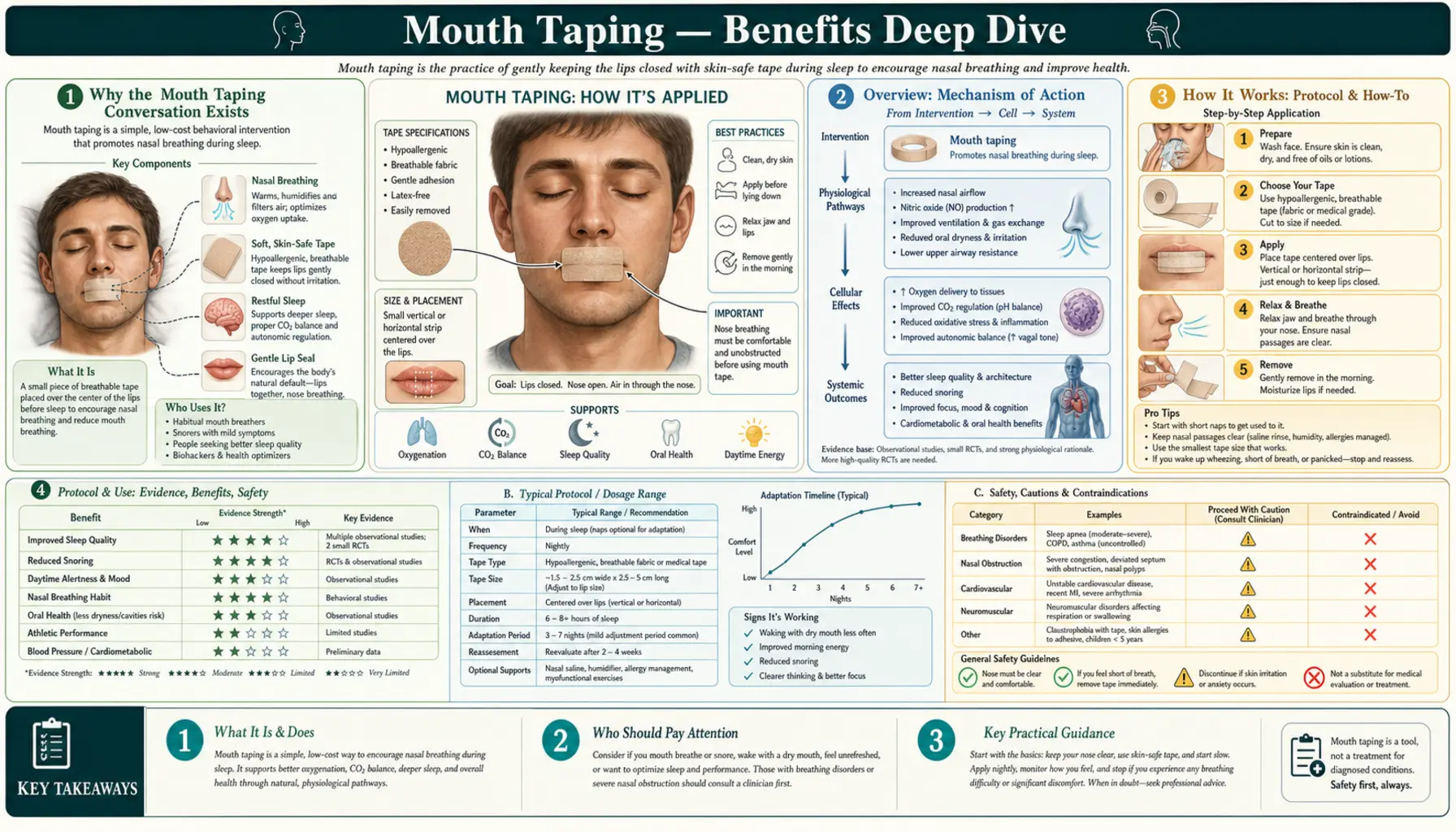
Mouth taping is the practice of holding the lips closed with tape or an adhesive patch during sleep, with the aim of keeping breathing through the nose. Its research base is small: a 2025 systematic review found 10 eligible studies with 213 patients in total, rated all of them poor quality, and concluded that the existing data do not support mouth taping or oral occlusion as a sound clinical intervention for the general population with sleep-disordered breathing. Much of the interest in the practice rests on the physiology of nasal breathing, which is better documented than taping itself. The four deep-dive pages below cover nasal-breathing physiology, the studies of snoring and sleep apnea, daytime breathing habits, and the groups the research raises concerns for.
Deep-Dive Articles
Nasal Breathing Benefits
The functions of the nose in breathing: nitric oxide made in the paranasal sinuses, first reported by Lundberg and colleagues in the mid-1990s; the warming, humidifying and filtering of inhaled air; and the resistance the nose adds to each breath.
Read the deep dive →Snoring and Sleep Apnea
What the studies measured. Two small studies found a lower apnea-hypopnea index with mouth closure, both in mild OSA only: Huang 2015 (a porous oral patch, 30 patients) and Lee 2022 (a retrospective study from Taiwan, 20 patients). A 2025 systematic review rated all ten mouth-taping studies it found poor quality. Also covered: how snoring differs from sleep apnea, what the AASM guidelines say about sleep testing and treatment, and mouth tape used alongside CPAP.
Read the deep dive →Daytime Breathing Habits
Daytime breathing and the methods often discussed alongside mouth taping: resting tongue posture, the Buteyko method and its Control Pause breath-hold measurement, and slow nasal diaphragmatic breathing, with the research on these techniques.
Read the deep dive →Cautions and Adaptation
No study has set out formal contraindications. This deep dive covers the groups the research raises concerns for (nasal obstruction, moderate-to-severe OSA, regurgitation, sedative medicines and alcohol), who the studies excluded, what tape the studies used and how they applied it, what is known about skin reactions and tolerance, and the studies that found no benefit.
Read the deep dive →Table of Contents
- Deep-Dive Articles
- Why the Mouth Taping Conversation Exists
- Research Papers: Nasal Breathing Physiology
- Research Papers: Mouth Taping, Snoring, and OSA
- Research Papers: Daytime Breathing and Buteyko
- Research Papers: Safety, Adaptation, and Contraindications
- Research Papers: Cross-Cutting (Sleep, Oral Health, Posture)
- External Authoritative Resources
- Connections
- Featured Videos
Why the Mouth Taping Conversation Exists
Writing about mouth breathing long predates the current interest in mouth taping: George Catlin published The Breath of Life, or Mal-Respiration in the early 1860s and Shut Your Mouth and Save Your Life later in that decade, and the Buteyko breathing method is named after the physician Konstantin Buteyko. Much of the recent attention has come through social media. A 2025 scoping review of the evidence, which also examined TikTok videos on mouth taping, found that the most commonly proposed advantages there were improved sleep and oral health, that few of the claims made on TikTok have been evaluated, and that the research literature is markedly heterogeneous, with little consensus on the benefits of mouth taping.
The physiology of nasal breathing is better documented than mouth taping itself. Findings from the research papers listed below include:
- Nitric oxide from the paranasal sinuses. In 1994 and 1995 Lundberg and colleagues reported that nitric oxide in nasally exhaled air comes mainly from the paranasal sinuses, where it is produced by epithelial cells and is present in very high concentrations. A 2008 review by Lundberg describes this nitric oxide as having potent vasodilating and antimicrobial activity, and reports that nitric oxide from the nose and sinuses is inhaled with every breath and reaches the lungs, where it enhances oxygen uptake through local vasodilation; a 1996 review notes that the levels reaching the lungs are especially high during nasal breathing. The research is covered in the Nasal Breathing Benefits deep dive.
- Airway resistance during sleep. In a 2003 randomized, single-blind crossover study of 12 healthy adults, upper-airway resistance was similar for nasal and oral breathing while awake, but during sleep it was much higher with oral breathing (median 12.4 versus 5.2 cmH2O/L/s), and obstructive apneas and hypopneas were far more frequent (apnea-hypopnea index 43 versus 1.5).
- Nasal resistance and lung volumes. In a 1988 study, total overnight nasal occlusion with a nasal pack lowered total lung capacity, functional residual capacity and residual volume. The authors concluded that the resistance to expiration provided by the nose helps maintain lung volumes and so may indirectly determine arterial oxygenation.
- Snoring. A 2010 review of the acoustics of snoring describes snoring as vibration of structures in the pharyngeal airway, with flutter of the soft palate accounting for the harsh quality of the sound, and lists the route of breathing among the influences on it, together with body position, sleep stage and the presence or absence of sleep-disordered breathing. The Snoring and OSA deep dive reviews the mouth-taping studies.
What the research does not show is that mouth taping can stand in for established treatment of obstructive sleep apnea (OSA). The two studies that found a lower apnea-hypopnea index with mouth closure enrolled only people with mild OSA, and the authors of one of them (Lee 2022) wrote: “Mouth-taping is not recommended for moderate or severe OSA patients because it may impose dangers rather than benefits in these patients.” The 2025 systematic review found that some studies discussed potential risks, including asphyxiation in the presence of nasal obstruction, and that many excluded anyone with nasal obstruction. The 2019 American Academy of Sleep Medicine (AASM) guideline recommends positive airway pressure, compared with no therapy, to treat OSA in adults with excessive sleepiness, and states that this treatment should be based on a diagnosis established with objective sleep apnea testing.
No AASM position statement on mouth taping was found for this page. In a July 2023 press release on viral sleep trends, the AASM reported that 12% of 2,005 U.S. adults in a survey had tried mouth taping, and quoted a spokesperson: “At best, these viral trends are unproven, but at worst – like mouth taping – they can be extremely dangerous.” No published case report of death or serious injury from mouth taping during sleep was found in PubMed when this page was checked (October 2026). The groups the research raises concerns for, and the people the studies excluded, are set out in the Cautions and Adaptation deep dive.
The Daytime Breathing Habits deep dive covers daytime breathing patterns and the breathing-retraining methods often discussed alongside mouth taping; trials of the Buteyko technique in asthma and research on slow breathing are listed below.
Research Papers: Nasal Breathing Physiology
- Lundberg JO, Rinder J, Weitzberg E, Lundberg JM, Alving K (1994). Nasally exhaled nitric oxide in humans originates mainly in the paranasal sinuses. Acta Physiologica Scandinavica 152(4):431–2 — PubMed PMID: 7701944
- Lundberg JO, Farkas-Szallasi T, Weitzberg E, et al. (1995). High nitric oxide production in human paranasal sinuses. Nature Medicine 1(4):370–3 — PubMed PMID: 7585069
- Lundberg JO (2008). Nitric oxide and the paranasal sinuses. Anatomical Record 291(11):1479–84 — PubMed PMID: 18951492
- Scadding GK (2020). Nitric Oxide in the Airways. (Editorial.) Journal of Allergy and Clinical Immunology: In Practice 8(5):1582 — PubMed PMID: 32389276
- Cole P (1992). Nasal and oral airflow resistors. Site, function, and assessment. Archives of Otolaryngology–Head & Neck Surgery 118(8):790–3 — PubMed PMID: 1642827
- Niinimaa V, Cole P, Mintz S, Shephard RJ (1980). The switching point from nasal to oronasal breathing. Respiration Physiology 42(1):61–71 — PubMed PMID: 7444224
- Saibene F, Mognoni P, Lafortuna CL, Mostardi R (1978). Oronasal breathing during exercise. Pflügers Archiv 378(1):65–9 — PubMed PMID: 569826
- Swift AC, Campbell IT, McKown TM (1988). Oronasal obstruction, lung volumes, and arterial oxygenation. Lancet 1(8577):73–5 — PubMed PMID: 2891980
- Lundberg JO (1996). Airborne nitric oxide: inflammatory marker and aerocrine messenger in man. Acta Physiologica Scandinavica Supplementum 633:1–27 — PubMed PMID: 8876755
- Lundberg JO, Lundberg JM, Settergren G, Alving K, Weitzberg E (1995). Nitric oxide, produced in the upper airways, may act in an ’aerocrine’ fashion to enhance pulmonary oxygen uptake in humans. Acta Physiologica Scandinavica 155(4):467–8 — PubMed PMID: 8719268
- Djupesland PG, Chatkin JM, Qian W, Haight JS (2001). Nitric oxide in the nasal airway: a new dimension in otorhinolaryngology. American Journal of Otolaryngology 22(1):19–32 — PubMed PMID: 11172211
PubMed Topic Searches
Research Papers: Mouth Taping, Snoring, and OSA
- Lee YC, Lu CT, Cheng WN, Li HY (2022). The Impact of Mouth-Taping in Mouth-Breathers with Mild Obstructive Sleep Apnea: A Preliminary Study. Healthcare (Basel) 10(9):1755 — PubMed PMID: 36141367
- Huang TW, Young TH (2015). Novel porous oral patches for patients with mild obstructive sleep apnea and mouth breathing: a pilot study. Otolaryngology–Head and Neck Surgery 152(2):369–73 — PubMed PMID: 25450408
- Meurice JC, Marc I, Carrier G, Sériès F (1996). Effects of mouth opening on upper airway collapsibility in normal sleeping subjects. American Journal of Respiratory and Critical Care Medicine 153(1):255–9 — PubMed PMID: 8542125
- Kim EJ, Choi JH, Kim KW, et al. (2011). The impacts of open-mouth breathing on upper airway space in obstructive sleep apnea: 3-D MDCT analysis. European Archives of Oto-Rhino-Laryngology 268(4):533–9 — PubMed PMID: 20957487
- Lee SH, Choi JH, Shin C, Lee HM, Kwon SY, Lee SH (2007). How does open-mouth breathing influence upper airway anatomy? Laryngoscope 117(6):1102–6 — PubMed PMID: 17464234
- Koutsourelakis I, Vagiakis E, Roussos C, Zakynthinos S (2006). Obstructive sleep apnoea and oral breathing in patients free of nasal obstruction. European Respiratory Journal 28(6):1222–8 — PubMed PMID: 17005578
- Patil SP, Ayappa IA, Caples SM, Kimoff RJ, Patel SR, Harrod CG (2019). Treatment of Adult Obstructive Sleep Apnea with Positive Airway Pressure: An American Academy of Sleep Medicine Clinical Practice Guideline. Journal of Clinical Sleep Medicine 15(2):335–343 — PubMed PMID: 30736887
- Ohki M, Usui N, Kanazawa H, Hara I, Kawano K (1996). Relationship between oral breathing and nasal obstruction in patients with obstructive sleep apnea. Acta Oto-Laryngologica Supplementum 523:228–30 — PubMed PMID: 9082790
- Madronio MR, Di Somma E, Stavrinou R, et al. (2004). Older individuals have increased oro-nasal breathing during sleep. European Respiratory Journal 24(1):71–7 — PubMed PMID: 15293607
- Fitzpatrick MF, McLean H, Urton AM, Tan A, O’Donnell D, Driver HS (2003). Effect of nasal or oral breathing route on upper airway resistance during sleep. European Respiratory Journal 22(5):827–32 — PubMed PMID: 14621092
- Rhee J, Iansavitchene A, Mannala S, Graham ME, Rotenberg B (2025). Breaking social media fads and uncovering the safety and efficacy of mouth taping in patients with mouth breathing, sleep disordered breathing, or obstructive sleep apnea: A systematic review. PLOS ONE 20(5):e0323643 — PubMed PMID: 40397877
- Fangmeyer SK, Badger CD, Thakkar PG (2025). Nocturnal mouth-taping and social media: A scoping review of the evidence. American Journal of Otolaryngology 46(1):104545 — PubMed PMID: 39662104
- Pevernagie D, Aarts RM, De Meyer M (2010). The acoustics of snoring. Sleep Medicine Reviews 14(2):131–44 — PubMed PMID: 19665907
Research Papers: Daytime Breathing and Buteyko
- Bruton A, Lewith GT (2005). The Buteyko breathing technique for asthma: a review. Complementary Therapies in Medicine 13(1):41–6 — PubMed PMID: 15907677
- Cooper S, Oborne J, Newton S, et al. (2003). Effect of two breathing exercises (Buteyko and pranayama) in asthma: a randomised controlled trial. Thorax 58(8):674–9 — PubMed PMID: 12885982
- Bowler SD, Green A, Mitchell CA (1998). Buteyko breathing techniques in asthma: a blinded randomised controlled trial. Medical Journal of Australia 169(11-12):575–8 — PubMed PMID: 9887897
- McHugh P, Aitcheson F, Duncan B, Houghton F (2003). Buteyko Breathing Technique for asthma: an effective intervention. New Zealand Medical Journal 116(1187):U710 — PubMed PMID: 14752538
- Courtney R (2009). The functions of breathing and its dysfunctions and their relationship to breathing therapy. International Journal of Osteopathic Medicine 12(3):78–85 — doi:10.1016/j.ijosm.2009.04.002
- Courtney R, Cohen M (2008). Investigating the claims of Konstantin Buteyko, M.D., Ph.D.: the relationship of breath holding time to end tidal CO2 and other proposed measures of dysfunctional breathing. Journal of Alternative and Complementary Medicine 14(2):115–23 — PubMed PMID: 18315509
- Russo MA, Santarelli DM, O’Rourke D (2017). The physiological effects of slow breathing in the healthy human. Breathe 13(4):298–309 — PubMed PMID: 29209423
- Jerath R, Crawford MW, Barnes VA, Harden K (2015). Self-regulation of breathing as a primary treatment for anxiety. Applied Psychophysiology and Biofeedback 40(2):107–15 — PubMed PMID: 25869930
- Brown RP, Gerbarg PL (2005). Sudarshan Kriya yogic breathing in the treatment of stress, anxiety, and depression: part I-neurophysiologic model. Journal of Alternative and Complementary Medicine 11(1):189–201 — PubMed PMID: 15750381
- Lehrer PM, Gevirtz R (2014). Heart rate variability biofeedback: how and why does it work? Frontiers in Psychology 5:756 — PubMed PMID: 25101026
Research Papers: Safety, Adaptation, and Contraindications
- Georgalas C (2011). The role of the nose in snoring and obstructive sleep apnoea: an update. European Archives of Oto-Rhino-Laryngology 268(9):1365–73 — PubMed PMID: 21340561
- Friedman M, Maley A, Kelley K, et al. (2011). Impact of nasal obstruction on obstructive sleep apnea. Otolaryngology–Head and Neck Surgery 144(6):1000–4 — PubMed PMID: 21493302
- Mickelson SA (2016). Nasal Surgery for Obstructive Sleep Apnea Syndrome. Otolaryngologic Clinics of North America 49(6):1373–1381 — PubMed PMID: 27720463
- Olsen KD, Kern EB, Westbrook PR (1981). Sleep and breathing disturbance secondary to nasal obstruction. Otolaryngology–Head and Neck Surgery 89(5):804–10 — PubMed PMID: 6799913
- Sériès F, St Pierre S, Carrier G (1992). Effects of surgical correction of nasal obstruction in the treatment of obstructive sleep apnea. American Review of Respiratory Disease 146(5 Pt 1):1261–5 — PubMed PMID: 1443882
- Choi JH, Kim EJ, Kim YS, et al. (2011). Effectiveness of nasal surgery alone on sleep quality, architecture, position, and sleep-disordered breathing in obstructive sleep apnea syndrome with nasal obstruction. American Journal of Rhinology & Allergy 25(5):338–41 — PubMed PMID: 22186249
- Yu JL, Rosen I (2020). Utility of the modified Mallampati grade and Friedman tongue position in the assessment of obstructive sleep apnea. Journal of Clinical Sleep Medicine 16(2):303–308 — PubMed PMID: 31992434
- Patil SP, Ayappa IA, Caples SM, Kimoff RJ, Patel SR, Harrod CG (2019). Treatment of Adult Obstructive Sleep Apnea with Positive Airway Pressure: An American Academy of Sleep Medicine Clinical Practice Guideline. Journal of Clinical Sleep Medicine 15(2):335–343 — PubMed PMID: 30736887
PubMed Topic Searches
Research Papers: Cross-Cutting (Sleep, Oral Health, Posture)
- Choi JE, Waddell JN, Lyons KM, Kieser JA (2016). Intraoral pH and temperature during sleep with and without mouth breathing. Journal of Oral Rehabilitation 43(5):356–63 — PubMed PMID: 26666708
- Mummolo S, Nota A, Caruso S, Quinzi V, Marchetti E, Marzo G (2018). Salivary Markers and Microbial Flora in Mouth Breathing Late Adolescents. BioMed Research International 2018:8687608 — PubMed PMID: 29693018
- Harari D, Redlich M, Miri S, Hamud T, Gross M (2010). The effect of mouth breathing versus nasal breathing on dentofacial and craniofacial development in orthodontic patients. Laryngoscope 120(10):2089–93 — PubMed PMID: 20824738
- Lin L, Zhao T, Qin D, Hua F, He H (2022). The impact of mouth breathing on dentofacial development: A concise review. Frontiers in Public Health 10:929165 — PubMed PMID: 36159237
- Trabalon M, Schaal B (2012). It takes a mouth to eat and a nose to breathe: abnormal oral respiration affects neonates’ oral competence and systemic adaptation. International Journal of Pediatrics 2012:207605 — PubMed PMID: 22811731
- Gozal D, Kheirandish-Gozal L (2008). The multiple challenges of obstructive sleep apnea in children: morbidity and treatment. Current Opinion in Pediatrics 20(6):654–8 — PubMed PMID: 19005334
- Brockmann PE, Bertrand P, Pardo T, Cerda J, Reyes B, Holmgren NL (2012). Prevalence of habitual snoring and associated neurocognitive consequences among Chilean school aged children. International Journal of Pediatric Otorhinolaryngology 76(9):1327–31 — PubMed PMID: 22748305
- Bonuck K, Freeman K, Chervin RD, Xu L (2012). Sleep-disordered breathing in a population-based cohort: behavioral outcomes at 4 and 7 years. Pediatrics 129(4):e857–65 — PubMed PMID: 22392181
- Guilleminault C, Huang YS (2018). From oral facial dysfunction to dysmorphism and the onset of pediatric OSA. Sleep Medicine Reviews 40:203–214 — PubMed PMID: 29103943
PubMed Topic Searches
External Authoritative Resources
- American Academy of Sleep Medicine (AASM) — clinical practice guidelines for OSA evaluation and treatment
- PubMed — Research on mouth taping and sleep
- PubMed — Nasal breathing and nitric oxide
- PubMed — Buteyko breathing technique research