Camphor
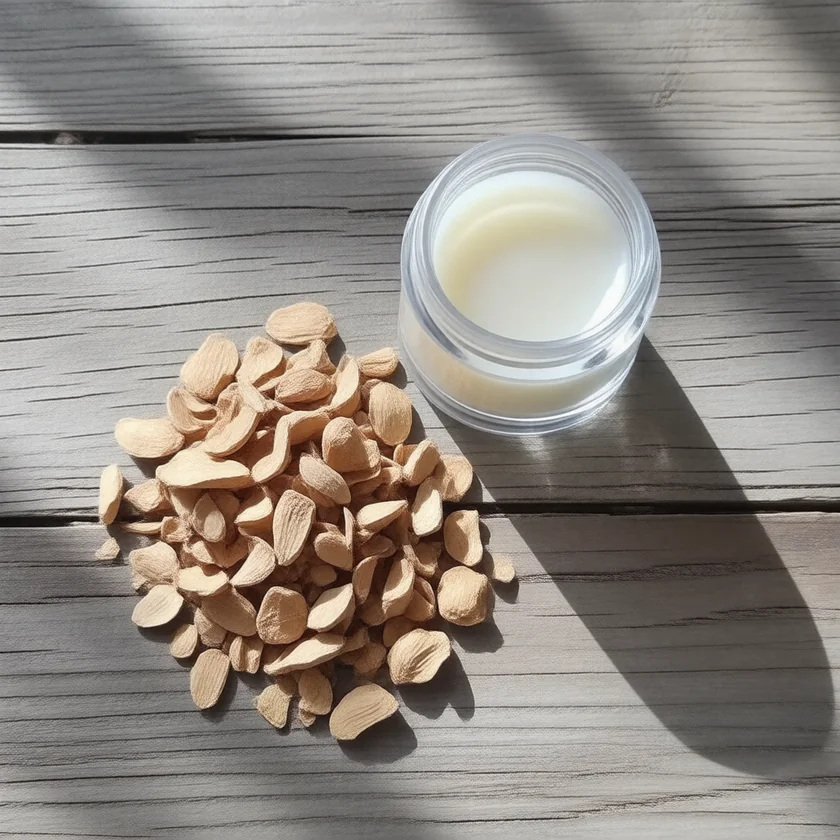
Camphor is the sharp-smelling white compound in chest rubs, muscle balms and anti-itch creams — first distilled from the wood of the camphor laurel tree, and today mostly made synthetically from turpentine. On the skin it does something real but modest: it switches on the skin’s sensors for cold and warmth, and in a 2010 randomized trial parents rated a camphor-menthol-eucalyptus chest rub better than petroleum jelly for one night of their child’s cold-related cough and sleep. Swallowed, camphor is a poison that causes seizures — in young children, about 500 mg, the camphor in a single teaspoon of a 10% liquid, has been linked to deaths — so this page puts safety first: outside of the body only, never by mouth, never in or under a child’s nose, and never on broken skin.
Table of Contents
- First, the Safety Facts
- What Camphor Is
- Traditional, Ritual & Historical Use
- How It Works on the Skin: Cool, Then Warm
- Chest Rubs for Cough and Congestion
- Muscle Aches, Joint Pain & Itch
- US Rules: The 11% Ceiling & the Camphorated-Oil Ban
- How to Use Camphor Products Sensibly
- Myths & Overclaims
- Safety: Poisoning, Who Should Avoid It & What to Do
- Key Research Papers
- Connections
- Featured Videos
First, the Safety Facts
Camphor rubs sit in almost every pharmacy, and camphor tablets and blocks are sold in many grocery and religious-goods shops, so it is easy to forget that camphor is one of the classic household poisons of early childhood. Six facts matter more than anything else on this page:
- Never swallow camphor, in any form or any amount, and never give it to anyone by mouth. In young children, exposure to as little as 500 mg — the amount in one 5-mL teaspoon of a 10% camphor liquid — has been cited as a cause of death, and 750 to 1,000 mg is associated with seizures and death (Love 2004).
- Lock away camphor tablets, cubes and blocks. Sold for worship, for moth control and as folk remedies, these are solid camphor, not a 5% ointment. Imported camphor sold illegally for spiritual use, as a cold remedy and for pest control was behind a cluster of seizures in three young children seen at one New York hospital within two weeks (Khine 2009).
- Nothing in or under a young child’s nose, and no camphor for babies. US labels on camphor chest rubs must say “Do not take by mouth or place in nostrils” and tell parents of children under 2 to ask a doctor. An infant has collapsed immediately after a small amount was applied to the nostrils (reported in Chen 2013), and a 2-month-old developed liver injury after a camphor-containing cold remedy was rubbed on the skin (Uc 2000).
- Intact skin only — no wounds, no tight bandages, no heat. The labeling FDA proposed for camphor muscle rubs reads “Do not apply to wounds or damaged skin” and “Do not bandage tightly,” and chest-rub labels warn never to heat or microwave the ointment or add it to hot water, because it can splatter and burn.
- Avoid it in pregnancy. Swallowed camphor crosses the placenta, and a fetus lacks the enzymes that break it down (Chen 2013).
- If a child swallows camphor, act at once. In the United States, call Poison Help at 1-800-222-1222 even if the child seems fine, and call 911 for a seizure, unusual sleepiness or trouble breathing. Do not try to make the child vomit (Manoguerra 2006).
What Camphor Is
Camphor is a single small molecule — a terpene ketone with the formula C₁₀H₁₆O, ten carbon atoms folded into a compact double ring. It is a waxy white or see-through solid with an unmistakable smell. At room temperature it slowly turns straight from solid into vapour (which is why a camphor block shrinks in a drawer), and it barely dissolves in water but dissolves readily in alcohol and other solvents (Chen 2013). That is why camphor comes in ointments, oils, gels and alcohol-based liniments rather than in watery solutions.
Where it comes from. Natural camphor is distilled from the wood of the camphor laurel (Cinnamomum camphora), a large evergreen native to Japan, Taiwan and China; every part of the tree carries the smell (Chen 2013). Most camphor today, though, is synthetic. Manufacturers start from alpha-pinene, obtained from turpentine oil, and convert it to camphor in several chemical steps; PubChem’s hazardous-substances record describes camphor as “primarily manufactured from pinene” (PubChem: Camphor). Natural camphor is one mirror-image form of the molecule, while the synthetic route produces a 50:50 mix of both forms; how that difference affects biological activity has not been worked out (Chen 2013). For safety purposes, treat them the same: the poison-centre guideline makes no distinction between natural and synthetic camphor.
It is also in common herbs. Camphor is a major component of the essential oils of many aromatic plants. The way plants build it was worked out in garden sage (Salvia officinalis), and some rosemary and sage oils are dominated by camphor (Chen 2013). A pinch of dried rosemary or sage in the cooking pot is a very different thing from a concentrated essential oil; it is the oils that deserve the same caution as any camphor product around children.
What you will find it in. In US pharmacies camphor comes at set strengths (details in US Rules): chest rubs for coughs (about 5% camphor, often combined with menthol and eucalyptus oil), muscle and joint balms (more than 3% and up to 11%), numbing and anti-itch lotions (0.1% to 3%), liquids for hot-steam vaporizers (6.2%), and some cold-sore preparations (Love 2004). Outside pharmacies it is sold as solid tablets, cubes and blocks for religious rituals and for keeping moths out of stored clothes — concentrated camphor with none of the dilution of an ointment.
Traditional, Ritual & Historical Use
Camphor is one of the oldest traded aromatics. A 2013 review traces it as a coveted fragrant wood in ancient Egypt and Babylon, an ingredient in perfumes and embalming fluids, and a fumigant during the Black Death in 14th-century Europe and later during smallpox and cholera outbreaks; rosewater mixed with camphor was sprinkled over the dead before shrouding (Chen 2013).
- China and Japan. In China camphor was used as a circulatory stimulant and a reviving agent; in Japan it went into torches and, in small amounts, into fireworks to make them brighter (Chen 2013). Camphor-and-menthol rubs for pain, cold symptoms and itch have historically been used mostly in East Asia (Hoang 2023).
- India: worship and Ayurveda. In India camphor (karpura in Sanskrit) is burned in temples and home shrines during worship — for example as the small, bright flame offered in the aarti ritual. One review notes that camphor smoke, unlike most aromatic smoke, does not sting the eyes (Chen 2013). Camphor also has a place in traditional Ayurvedic medicine.
- Moths and insects. Camphor has long been kept among stored clothes and linens as an insect repellent, and in laboratory tests it repels or kills several insect pests, from stored-grain beetles to cockroaches (Chen 2013).
- Older medical uses. Camphor was applied to the skin against infection and itch and was even taken by mouth as a stimulant and to relieve gas (Chen 2013) — internal uses that have no place today, for the reasons in the safety sections. “Camphorated oil,” also sold as camphor liniment, was a solution of 20% camphor in cottonseed oil, sold over the counter for generations as a counter-irritant rub until the US Food and Drug Administration pulled it in 1982 (see US Rules).
- Folk remedy today. In many communities camphor is still used for spiritual purposes, as a cold remedy and for pest control, and the imported products sold for these uses have caused childhood poisonings (Khine 2009).
The long history reflects effects people could genuinely feel on the skin. The rest of this page sorts those real effects from the claims — and from the dangers.
How It Works on the Skin: Cool, Then Warm
Camphor belongs to a group of medicines the FDA calls counter-irritants: products applied to the skin that cause “irritation or mild inflammation of the skin” in order to relieve aches in muscles and joints (definition in FDA’s 1983 proposed rules for external pain relievers, 48 FR 5852). The old explanation was simply that one sensation distracts from another. Research since 2005 has identified the actual switches camphor flips — a family of temperature-sensing ion channels in the skin and its nerve endings called TRP channels.
- The cool. Camphor switches on TRPM8, the cold-and-menthol sensor, and makes it more sensitive to cooling (studies in cultured cells and rat nerve cells; Selescu 2013). That is the first chill of a camphor rub.
- The warmth. Camphor activates TRPV3, a warmth sensor that, in mice, sits in the skin cells themselves rather than in the nerve endings. In mice bred without TRPV3, skin cells no longer responded to camphor (Moqrich 2005). That study came from the laboratory of Ardem Patapoutian, who shared the 2021 Nobel Prize for discovering the receptors for temperature and touch — see Julius & Patapoutian.
- The dulling. Camphor also opens TRPV1 — the heat-and-pain receptor that chili’s capsaicin targets — though weakly, and then shuts it down more quickly and completely than capsaicin does. It also blocks TRPA1, a sensor for irritants. The researchers proposed that this shutdown and blockade may explain camphor’s pain-relieving effect (cultured cells and rat nerve cells; Xu 2005). Our animation Why Chili Burns: Capsaicin & the TRPV1 Heat Sensor shows how that receptor works.
What happens in real people. In a small laboratory study, nine adults had petroleum jelly containing 5%, 10% or 20% camphor spread on the forearm. Every strength produced an immediate cold feeling — stronger at higher strengths — that faded within about 10 minutes and was replaced by warmth. Menthol at 2%, by contrast, stayed cold and never turned warm. Both camphor and menthol increased blood flow in the skin and in the muscle beneath it (Kotaka 2014). That matches what people describe — cool, then warm — and it is where the “improves circulation” claim comes from. It shows a sensation and a local blood-flow change in nine people; it does not show that pain eases or injuries heal faster.
In the nose. Breathing camphor, menthol or eucalyptus vapour for five minutes did not change the actual resistance to airflow through volunteers’ noses, yet most felt a cold sensation and reported that air seemed to flow more freely (Burrow 1983). The “opened-up” feeling is real as a sensation — camphor stimulates cold receptors in the nose — but it is not a physically clearer airway. In guinea pigs, breathing camphor vapour at the highest concentration tested cut cough frequency by about a third, an animal finding summarised in Chen 2013.
Evidence tier: the receptor findings are cell and animal studies; the cool-then-warm sensation and the nasal sensation come from small human laboratory studies. They explain why camphor feels the way it does. They are not clinical trials of treatment.
Chest Rubs for Cough and Congestion
The strongest human study of a camphor product we found is a 2010 randomized trial of a chest rub for children, published in Pediatrics (Paul 2010).
- Who and how. 138 children aged 2 to 11 with a cold and a night-time cough were randomly assigned to one of three treatments for a single night: a chest rub containing 4.8% camphor, 2.6% menthol and 1.2% eucalyptus oil; plain petroleum jelly; or nothing. Parents rubbed the ointment onto the chest and neck at bedtime and rated the night’s symptoms the next morning on a 7-point scale.
- What happened. Every group improved on the second night — colds get better on their own. But the camphor rub consistently scored best and no treatment scored worst. The rub beat no treatment for every symptom except runny nose, and beat petroleum jelly for cough severity, the child’s and the parent’s sleep difficulty, and the combined symptom score. Petroleum jelly was no better than nothing.
- The cost. 20 of the 44 children on the rub (46%) had at least one side effect, nearly all mild irritation: parents reported a burning sensation on the skin in 28%, in the eyes in 16% and in the nose in 14%. No child in the other two groups had these.
How much weight to put on it. This was one night, in one study, with parents rather than a measuring device judging the result. Blinding was hard: parents in both ointment groups dabbed the camphor rub under their own noses so the smell would not reveal which ointment their child got, yet 86% of parents in the rub group and 89% in the petroleum-jelly group correctly guessed what their child had received. The study was funded partly by an unrestricted grant from the rub’s manufacturer and partly by the US National Institutes of Health. And because the rub contained three active ingredients, it cannot say how much of the effect came from camphor rather than menthol or eucalyptus oil. The fair summary is modest, short-term relief of night-time symptoms, as rated by parents, in children aged 2 and older. A rub eases how the night feels; it does not treat the virus. (Evidence tier: one randomized trial in humans.)
Children under 2. The trial did not include them, US labels tell parents to ask a doctor first, and the case reports in the safety sections involve babies and toddlers. For an infant, skip camphor entirely. For children over 1, honey has its own evidence for night-time cough (see Honey as a Cough Suppressant); honey must never be given to babies under 1. For the bigger picture see Common Cold, Chronic Cough and Cold and Flu Natural Treatments.
Using a chest rub as labelled. US directions for camphor chest ointments (4.7% to 5.3% camphor) are: adults and children 2 and older, rub a thick layer on the throat and chest, cover with a warm, dry cloth if desired, keep clothing loose so the vapour reaches the nose and mouth, and use up to three times a day (21 CFR 341.74). Never put it in or under the nose, and never heat it.
Muscle Aches, Joint Pain & Itch
Muscle and joint rubs. Camphor at more than 3% and up to 11% is the classic cooling counter-irritant in balms and liniments. FDA’s 1983 proposal describes such products as being “for the temporary relief of minor aches and pains of muscles and joints” associated with simple backache, arthritis, strains, bruises and sprains, and allows camphor to be combined with menthol and other counter-irritants (48 FR 5852).
The trial evidence is thin. The one randomized trial of a camphor-containing cream for joint pain that we found tested a mixture: 63 people with knee osteoarthritis used either a cream containing glucosamine, chondroitin and camphor or a placebo cream, as needed, for 8 weeks. On a visual pain scale measured in centimetres, pain fell by an average of 3.4 cm with the active cream and 1.6 cm with placebo — a difference of 1.8 cm at 8 weeks (Cohen 2003). The authors credited the glucosamine and chondroitin. The published summary does not say whether the placebo cream also contained camphor, so the trial cannot tell us how much of the benefit, if any, came from camphor. (Evidence tier: one small randomized trial of a combination product.)
A 2023 review of camphor- and menthol-containing products found only 15 clinically relevant human studies published between 2010 and 2022. Its authors judged these products “potentially effective” for pain, cold symptoms and itch, but concluded that with so few studies “no definitive recommendation can be made” (Hoang 2023). An earlier emergency-medicine review was blunter, calling camphor’s efficacy in these products “largely unproven” (Love 2004). For approaches that do not rest on a single ingredient, see Pain Management Without a Prescription Pad and Osteoarthritis.
Itch. At lower strengths — 0.1% to 3% — the same 1983 proposal lists camphor as a pain-relieving, numbing and anti-itch ingredient for the temporary relief of pain or itching from problems such as minor skin irritations, insect bites and sunburn, and US rules for hemorrhoid products list camphor, at the same 0.1% to 3% and for external use only, among their pain-relieving, numbing and anti-itch ingredients (21 CFR 346.16). The cooling it produces through TRPM8 is a plausible reason it can take the edge off an itch, but modern trials are scarce (Hoang 2023). It is a comfort measure, not a treatment for the cause — see Itching (Pruritus) for what drives persistent itch. (Evidence tier: regulatory recognition based on older data, plus mechanism; few modern trials.)
US Rules: The 11% Ceiling & the Camphorated-Oil Ban
Camphorated oil came off the market in 1982. For generations US pharmacies sold camphorated oil, or camphor liniment: 20% camphor dissolved in cottonseed oil, used as a counter-irritant rub. It looked like other household oils, and people kept swallowing it by mistake. When FDA acted, poison-control statistics showed 836 accidental ingestions of camphorated oil from 1974 to 1979 alone. In 32 poisonings where the cause was known, 28 came from confusing it with another product — 20 of them with castor oil — and it had also been mistaken for cod-liver oil, mineral oil, olive oil and cough medicine. Warning labels had not stopped the mix-ups. On 21 September 1982 FDA ruled that any camphorated oil product is misbranded and a “new drug” that may not be sold without an approved application, and asked firms to recall it to the retail level (47 FR 41716). That status stands today (21 CFR 310.502), and camphorated oil is on FDA’s list of drug products withdrawn for reasons of safety or effectiveness (21 CFR 216.24).
Where the 11% ceiling comes from. FDA’s expert panel on topical pain relievers concluded in 1979 that camphor at 3% to 11% is safe and effective as a counter-irritant and recommended that such products contain no more than 11% (as summarised in the 1982 rule). FDA’s 1983 proposal adopted that line — camphor 0.1% to 3% as a pain-relieving, numbing and anti-itch ingredient, and “exceeding 3 percent to 11 percent” as a cooling counter-irritant — stating that “the camphor concentration is being limited to 11 percent or lower” (48 FR 5852). The cough-and-cold rules set chest ointments at 4.7% to 5.3% camphor and hot-steam vaporizer liquids at 6.2% (21 CFR 341.74). None of these US over-the-counter standards allows more than 11%.
Required warnings. Camphor chest rubs must state “For external use only. Do not take by mouth or place in nostrils.” Depending on the formula, the label must also warn not to heat or microwave the ointment or add it to hot water, because it “may cause splattering and result in burns,” and flammable versions must say “Keep away from fire or flame” (21 CFR 341.74). In 1983 FDA also urged makers of liquid camphor products to use child-resistant packaging.
The riskiest products sit outside this system. Camphor sold for pest control must be registered with the US Environmental Protection Agency, yet many imported camphor products fail FDA and EPA requirements for labeling and content. Illegally sold imported camphor was behind the cluster of toddler seizures reported from the Bronx, New York, in 2009; the New York City health department then warned families to keep camphor products away from children, and other state health departments followed (Khine 2009). If a camphor product carries no label you can read, no stated strength and no warnings, do not bring it into a home with young children.
How to Use Camphor Products Sensibly
- Buy a labelled product at a known strength and follow its directions. The legitimate range runs from 0.1% to 11% (see US Rules).
- Chest rub (adults and children 2 and older): a thick layer on the throat and chest, up to three times a day, clothing loose, nothing in or under the nose.
- Muscle or joint rub (adults and children 2 and older): apply to the sore area no more than 3 to 4 times a day, keep it away from the eyes, do not bandage tightly, and stop and see a clinician if the problem worsens or lasts more than 7 days (these points follow FDA’s 1983 proposed label).
- Wash your hands afterwards, so camphor does not reach eyes, mouths or a baby’s face.
- If the skin burns, blisters or turns very red, wash the product off with soap and water and do not use it again on that skin.
- Steam: use only a liquid made for hot-steam vaporizers (6.2% camphor), exactly as directed. Never put a chest ointment or a camphor tablet into hot water.
- Storage: keep every camphor product high up, closed and apart from anything taken by mouth, in its original labelled container — never in a food or drink bottle. The camphorated-oil story shows how easily an external liquid gets swallowed by mistake.
- Worship and moth control: keep camphor tablets and blocks in a closed container that children cannot reach or open, burn only small amounts in a well-ventilated room, and never leave a young child alone near the tablets or the flame.
Myths & Overclaims
Popular videos promise a long list of camphor “uses and benefits.” Here is what the evidence says about the most common ones.
- “It clears a blocked nose.” It makes breathing feel easier by stimulating cold receptors; in measurements it did not reduce resistance to airflow through the nose (Burrow 1983). In children’s colds a camphor-menthol-eucalyptus rub eased parent-rated night-time symptoms for one night (Paul 2010). Neither finding means it shortens a cold.
- “Rub it under a child’s nose, or on the soles of the feet.” Putting it in the nostrils is exactly what the label forbids, just under the nose is far too close for a young child, and an infant has collapsed after camphor was applied to the nostrils (Chen 2013). We found no trial of rubbing it on the feet; the one randomized trial applied it to the chest and neck.
- “A little camphor by mouth helps digestion, gas or worms, or ‘purifies’ the body.” Taking camphor internally was abandoned for good reason. Swallowing it is poisoning, and US poison centres logged roughly 10,000 swallowed camphor exposures a year between 1990 and 2003 (Manoguerra 2006). “Natural” or “pure” camphor is still camphor.
- “It cures toenail fungus.” The only human data we found is a pilot study with no comparison group: 18 people applied a camphor-menthol-eucalyptus chest rub to affected toenails and were followed for 48 weeks; 5 (28%) had both a lab-confirmed and a visible cure, 10 (56%) partial clearing and 3 (17%) no change (Derby 2011). That is an interesting pilot, not proof.
- “It grows hair and treats dandruff, lice and acne.” We found no clinical trials of camphor for any of these. Antimicrobial results come from test-tube studies, many of them using camphor-rich essential oils rather than pure camphor (Chen 2013).
- “Burning camphor purifies the air and helps you sleep or relax.” We found no clinical trials. Burning it fills a room with camphor vapour and smoke, and heavy vapour irritates the nose and throat (Chen 2013).
- “It boosts circulation and heals arthritis.” Camphor did raise local skin and muscle blood flow in a nine-person study (Kotaka 2014), but that is not healing. For knee arthritis the only trial we found tested a three-ingredient cream (Cohen 2003).
- “It fights viruses, cancer and diabetes.” Camphor shows antiviral, anticancer and other activity in laboratory and animal studies (Chen 2013). None of it has been shown to treat any disease in people.
- “It keeps mosquitoes away.” Camphor repels or kills several insects in laboratory tests and has a long history against clothes moths (Chen 2013). We found no human trials showing that it prevents mosquito bites, so it is no substitute for a tested repellent where mosquito-borne disease is a risk.
Safety: Poisoning, Who Should Avoid It & What to Do
How common poisoning is
Camphor is a routine call for poison centres. US national data from 1990 to 2003 showed roughly 10,000 swallowed exposures to camphor-containing products every year (Manoguerra 2006). Most turn out mild — in 2001, for example, 89 of 8,505 reported camphor exposures had moderate or severe outcomes and none was fatal (poison-centre data summarised in Chen 2013) — but the serious cases are serious, and young children are especially vulnerable because small amounts can harm them (Love 2004).
What it does, and how little it takes
Camphor acts on the brain. Poisoning brings nausea, vomiting, headache, dizziness, muscle twitching and tremor, confusion or delirium, and seizures; a severe overdose can cause hours of continuous seizures, coma and death from suffocation (Chen 2013).
- In children, exposure to as little as 500 mg has been cited as a cause of death, and 750 to 1,000 mg is associated with seizures and death. A 10% camphor liquid holds 500 mg in a single 5-mL teaspoon (Love 2004).
- An FDA advisory panel recorded a 3-year-old girl who had a seizure after swallowing an estimated 0.7 g of camphor from a product containing about 5% camphor — the strength of today’s chest rubs (47 FR 41716). That works out to roughly 14 grams of product.
- The poison-centre guideline sends anyone who has swallowed more than 30 mg of camphor per kilogram of body weight to an emergency department (Manoguerra 2006). For a 10-kg (22-lb) toddler that is 300 mg — by our arithmetic, the camphor in about 6 grams of a 5% rub (a little more than a teaspoon) or 3 mL of a 10% liquid.
Not only by mouth
- Through the skin. One of the three Bronx toddlers had seizures after camphor was rubbed repeatedly on her skin (Khine 2009), and a 2-month-old developed liver injury from a camphor-containing cold remedy applied to the skin; the liver tests returned to normal once it was stopped (Uc 2000).
- In the nose. An infant collapsed immediately after a small amount was applied to the nostrils (Chen 2013).
- Breathed in. Camphor vapour irritates the nose and throat, and breathing can be depressed (Chen 2013) — one more reason to burn camphor for worship only in small amounts, in a ventilated room.
Who should avoid camphor
- Babies and toddlers. No camphor products for infants, nothing near a young child’s face, and camphor tablets and blocks out of reach and out of sight. US chest-rub labels say to ask a doctor before use under age 2.
- Pregnancy. Swallowed camphor crosses the placenta, and the fetus cannot break it down (Chen 2013). Animal studies found no birth defects even at doses high enough to cause convulsions in pregnant rats (Chen 2013), but there are no good human studies, so the cautious course is to avoid camphor products in pregnancy and never take any by mouth.
- Broken, burned or inflamed skin. The stronger rubs are labelled “Do not apply to wounds or damaged skin.” Damaged skin is a weaker barrier, so keep all camphor products off it.
- People with epilepsy or a history of seizures. Seizures are camphor’s signature poisoning effect; ask your doctor before using camphor products at all. See Epilepsy.
- Breastfeeding. Keep camphor rubs off any skin that a baby’s face, nose or mouth will touch.
- Any household where products get mixed up. Store camphor products apart from medicines and foods taken by mouth, in their original labelled containers.
What to do
These steps follow the American Association of Poison Control Centers guideline (Manoguerra 2006):
- Swallowed any camphor product: call Poison Help (1-800-222-1222 in the US) straight away, even if the person seems well. The guideline sends to an emergency department anyone who has swallowed more than 30 mg/kg, anyone with moderate or severe symptoms — such as seizures, drowsiness, unsteadiness or severe nausea and vomiting — and anyone who may have taken it deliberately, whatever the amount.
- A seizure: call 911 for ambulance transport. Emergency teams use benzodiazepine medicines to stop camphor seizures.
- Do not make the person vomit, and do not give activated charcoal unless a poison specialist advises it for another ingredient — the guideline recommends against both for camphor (see Activated Charcoal).
- Timing: the guideline says someone still free of symptoms 4 hours after the exposure can be safely watched at home — let the poison centre make that call.
- On the skin: wash thoroughly with soap and water. In the eyes: rinse well. Breathed in: move to fresh air.
Key Research Papers
- Chen W, Vermaak I, Viljoen A (2013). Camphor—a fumigant during the Black Death and a coveted fragrant wood in ancient Egypt and Babylon—a review. Molecules. — PubMed PMID: 23666009
- Moqrich A, Hwang SW, Earley TJ, Petrus MJ, Murray AN, Spencer KS, et al. (2005). Impaired thermosensation in mice lacking TRPV3, a heat and camphor sensor in the skin. Science. — PubMed PMID: 15746429
- Xu H, Blair NT, Clapham DE (2005). Camphor activates and strongly desensitizes the transient receptor potential vanilloid subtype 1 channel in a vanilloid-independent mechanism. The Journal of Neuroscience. — PubMed PMID: 16192383
- Selescu T, Ciobanu AC, Dobre C, Reid G, Babes A (2013). Camphor activates and sensitizes transient receptor potential melastatin 8 (TRPM8) to cooling and icilin. Chemical Senses. — PubMed PMID: 23828908
- Kotaka T, Kimura S, Kashiwayanagi M, Iwamoto J (2014). Camphor induces cold and warm sensations with increases in skin and muscle blood flow in human. Biological & Pharmaceutical Bulletin. — PubMed PMID: 25451841
- Burrow A, Eccles R, Jones AS (1983). The effects of camphor, eucalyptus and menthol vapour on nasal resistance to airflow and nasal sensation. Acta Oto-Laryngologica. — PubMed PMID: 6613544
- Paul IM, Beiler JS, King TS, Clapp ER, Vallati J, Berlin CM Jr (2010). Vapor rub, petrolatum, and no treatment for children with nocturnal cough and cold symptoms. Pediatrics. — PubMed PMID: 21059712
- Cohen M, Wolfe R, Mai T, Lewis D (2003). A randomized, double blind, placebo controlled trial of a topical cream containing glucosamine sulfate, chondroitin sulfate, and camphor for osteoarthritis of the knee. The Journal of Rheumatology. — PubMed PMID: 12610812
- Hoang D, Wong A, Olympia RP (2023). Looking back to move forward: the current state of research on the clinical applications of camphor- and menthol-containing agents. Cureus. — PubMed PMID: 37546095
- Derby R, Rohal P, Jackson C, Beutler A, Olsen C (2011). Novel treatment of onychomycosis using over-the-counter mentholated ointment: a clinical case series. Journal of the American Board of Family Medicine. — PubMed PMID: 21209346
- Manoguerra AS, Erdman AR, Wax PM, Nelson LS, Caravati EM, Cobaugh DJ, et al.; American Association of Poison Control Centers (2006). Camphor poisoning: an evidence-based practice guideline for out-of-hospital management. Clinical Toxicology. — PubMed PMID: 16809137
- Love JN, Sammon M, Smereck J (2004). Are one or two dangerous? Camphor exposure in toddlers. The Journal of Emergency Medicine. — PubMed PMID: 15219304
- Khine H, Weiss D, Graber N, Hoffman RS, Esteban-Cruciani N, Avner JR (2009). A cluster of children with seizures caused by camphor poisoning. Pediatrics. — PubMed PMID: 19403490
- Uc A, Bishop WP, Sanders KD (2000). Camphor hepatotoxicity. Southern Medical Journal. — PubMed PMID: 10881777