⚠ Evidence warning: Clinical trials or other evidence do not support the claim that berberine lowers ferritin and iron stores in men with high iron. This page keeps it as a report of what people, websites or other media say.
Berberine and Iron Overload: Lowering Ferritin in Men with High Iron
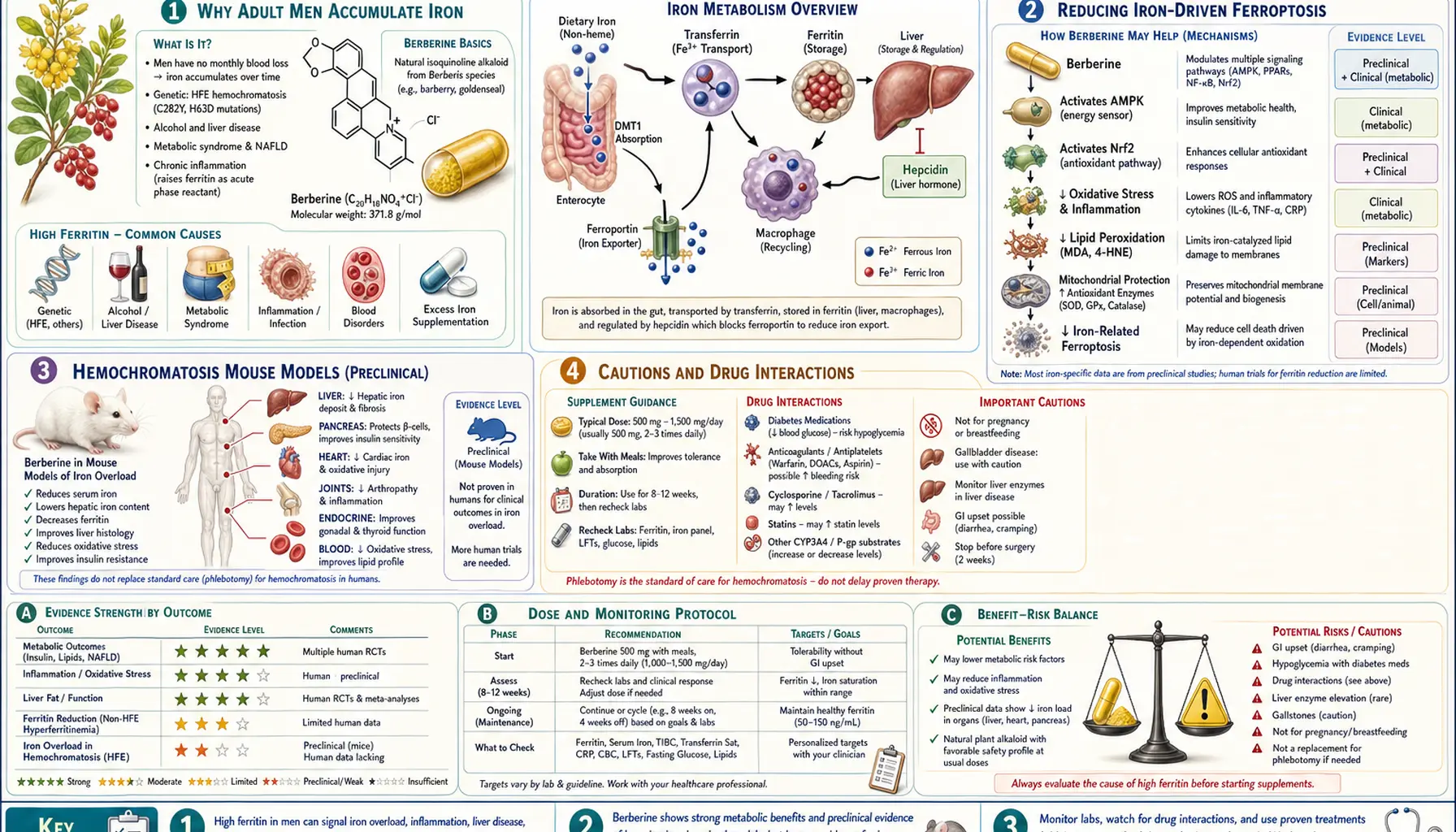
Table of Contents
- Why Adult Men Accumulate Iron
- Hepcidin, the Master Iron Switch, and What Berberine Studies Show
- Iron Binding by Berberine in Test-Tube Assays
- Reducing Iron-Driven Ferroptosis
- Liver Iron, Non-Alcoholic Fatty Liver Disease, and Insulin Resistance
- Human Evidence: No Berberine Ferritin Trial Found
- Hemochromatosis Mouse Models
- What Studies Report on Dose, Diet and Blood Donation
- Lab Markers of Iron Status
- Cautions and Drug Interactions
- Key Research Papers
- Connections
- Featured Videos
Why Adult Men Accumulate Iron
Adult men have a unique iron-loading problem that women of reproductive age do not share: there is no monthly physiological route for offloading excess iron. The female menstrual cycle removes roughly 0.5-1.0 mg of iron per day on average across the cycle, a quiet but consistent excretion pathway. Adult men, by contrast, lose only the small amount of iron sloughed off in skin cells and intestinal turnover — about 1 mg per day — while a typical Western diet supplies 10-20 mg of iron daily.
The result shows in national survey data: in the third U.S. National Health and Nutrition Examination Survey (NHANES III), ferritin rose in the late teens in men, and the median serum ferritin was 112-156 ng/mL in men against 36-40 ng/mL in menstruating women. Postmenopausal women catch up to men within a decade once monthly losses stop. High ferritin in the absence of acute inflammation is increasingly recognized as a marker of metabolic risk: it associates with insulin resistance, fatty liver disease, atherosclerosis, and accelerated biological aging.
Therapeutic phlebotomy (regular blood donation) is the most direct way to reduce body iron, but it is not always practical, accessible, or accepted by patients. Pharmacological iron chelators such as deferasirox and deferoxamine are reserved for transfusion-dependent disease because of cost and side-effect profile. This leaves a group in the middle: people with mildly to moderately elevated ferritin, no anemia, and no obvious chelation indication. Practitioners and websites describe berberine as a dietary-supplement option for this group; the sections below set out what has and has not been measured.
Removing iron has itself been tested in this group. A randomized trial in 274 people without diabetes who had dysmetabolic iron overload (raised iron with insulin resistance) compared one year of bloodletting that held ferritin down, plus diet and lifestyle advice, with the advice alone. Ferritin ended at 71 versus 733 µg/L, yet fasting blood sugar did not differ (5.44 versus 5.49 mmol/L, P=0.57), an insulin-resistance score was worse with bloodletting (3.39 versus 2.40, P=0.002), weight changed by +0.5% versus -0.6%, and fatigue was reported by 25.3% versus 2.3%. The authors wrote that iron depletion by bloodletting "does not improve metabolic and hepatic features". In those who lost weight, blood sugar, insulin resistance, ferritin, lipids and liver tests improved with or without bloodletting.
Hepcidin, the Master Iron Switch, and What Berberine Studies Show
Hepcidin is the 25-amino-acid peptide hormone, produced primarily by the liver, that controls how much iron enters the bloodstream from the diet and from macrophage recycling. High hepcidin binds and degrades ferroportin, the cellular iron-export channel, locking iron inside enterocytes (intestinal cells) and macrophages. The net effect of elevated hepcidin is reduced dietary iron absorption and reduced release of stored iron into circulation.
The laboratory evidence on berberine and hepcidin points in different directions, and no human study was found. In a 2016 screen of natural compounds, berberine strongly raised hepcidin expression in cultured cells, through the STAT3 and Smad1/5/8 signaling pathways, but "it failed to alter hepcidin expression in mice". A yellow catfish study used berberine as a hepcidin agonist (a compound that acts to raise it), and liver iron rose in the treated fish. In rats with diabetic kidney disease, serum hepcidin and ferritin were raised by the disease and berberine partly reversed the rise, the opposite direction. In diabetic mice given ginsenoside Rb1 with berberine, the authors reported that the combination reversed changes in hepcidin gene expression. The idea that berberine reduces the rate at which dietary iron crosses from the gut into the bloodstream by raising hepcidin therefore remains a theory.
The appeal of the theory for men with high ferritin and an iron-rich diet is that it would work upstream: less iron absorbed in the first place, rather than chelating iron that has already entered the body. The same theory raises a concern for people with iron-deficiency anemia, since the mechanism could interfere with iron repletion in deficient women. Neither effect has been measured in people.
Iron Binding by Berberine in Test-Tube Assays
Berberine shows weak iron chelating (iron binding) in test-tube assays. In one comparison at 1 mM, berberine scavenged 23% of hydroxyl radicals against 85% for the related alkaloid berberrubine, and ferrous iron chelating followed a similar pattern; the authors credited hydroxy and methylenedioxy groups on the molecule. A second test-tube study reported iron-chelating activity among other antioxidant assays. No crystal structure of a berberine-iron complex was found, and the binding has not been shown to reduce the free iron pool in people. Its affinity is described as lower than that of pharmaceutical chelators like deferoxamine.
Fenton chemistry — the reaction of Fe2+ with hydrogen peroxide to generate the hydroxyl radical — is one of the principal sources of cellular oxidative damage. Tying up labile iron in less-reactive complexes would reduce the rate at which free radicals are generated in tissues with high iron exposure (liver, heart, brain). This is one proposed reason why berberine displays antioxidant activity in cell-culture and animal models even when it is not directly scavenging reactive species.
In one animal iron-loading study, rats injected with ferrous sulfate for 14 days developed liver and kidney damage, and berberine by mouth (10 mg/kg/day) reversed the rise in malondialdehyde, a marker of oxidative stress, along with liver and kidney markers; the authors credited reduced lipid peroxidation and the ability to chelate iron. No study was found that measured anemia in people taking berberine for iron overload.
Reducing Iron-Driven Ferroptosis
Ferroptosis is a form of regulated cell death distinct from apoptosis or necrosis, characterized by iron-dependent lipid peroxidation. It is now recognized as a major contributor to ischemia-reperfusion injury in the heart and brain, neurodegeneration (Parkinson's and Alzheimer's disease), and the toxicity of iron overload in the liver. The biochemical signature is depletion of the glutathione peroxidase 4 (GPX4) enzyme and accumulation of lipid hydroperoxides driven by free iron.
Berberine has been shown in multiple preclinical models to attenuate ferroptosis. Mechanisms documented in the literature include upregulation of GPX4 expression, increased glutathione synthesis through NRF2 pathway activation, suppression of ACSL4 (a lipid-remodeling enzyme that primes membranes for peroxidation), and reduction of the labile iron pool. The net effect is preservation of cells that would otherwise die from iron-mediated oxidative injury.
Tissues that have benefited from berberine's anti-ferroptotic action in animal models include cardiac muscle after ischemia-reperfusion, hepatocytes under iron loading, dopaminergic neurons in Parkinson's models, and renal tubular cells in acute kidney injury. The work is largely preclinical at this point, but the cellular biology is well-characterized and the pathway-level mechanisms map closely to the human conditions in which iron-driven oxidative damage is implicated.
Berberine does not only block ferroptosis. In mice with chemically induced liver fibrosis, it worked by triggering ferroptosis in the scar-forming stellate cells of the liver, and its benefit was significantly diminished when a ferroptosis blocker (ferrostatin-1) was given. In Alzheimer-model mice given 50 mg/kg by mouth for 7.5 months, it lowered brain iron and ferroptosis markers and the mice performed better on memory tests. All of this is animal work.
Liver Iron, Non-Alcoholic Fatty Liver Disease, and Insulin Resistance
Non-alcoholic fatty liver disease (NAFLD) and its more advanced form, non-alcoholic steatohepatitis (NASH), frequently coincide with hepatic iron accumulation. The clinical entity called "dysmetabolic iron overload syndrome" describes patients with metabolic syndrome features (central obesity, insulin resistance, hypertension, dyslipidemia) and elevated ferritin without a hereditary hemochromatosis genotype. The combination is associated with faster progression of liver fibrosis and higher cardiovascular event rates.
Non-alcoholic fatty liver disease is now also called metabolic dysfunction-associated steatotic liver disease (MASLD). The main human evidence for berberine in it is an open-label randomized trial of 184 people at three centers: over 16 weeks, berberine 0.5 g three times daily plus lifestyle change cut liver fat by 52.7% against 36.4% with lifestyle change alone (p=0.008), with better results for body weight, an insulin-resistance score and blood lipids; side effects were mild and mainly digestive. Neither patients nor doctors were blinded, and the abstract reports no ferritin result. Other reported effects are normalization of transaminases (alanine aminotransferase (ALT) and aspartate aminotransferase (AST)) and improved insulin sensitivity through AMP-activated protein kinase (AMPK) activation. The proposal for dysmetabolic iron overload is that these effects and the iron effects pull in the same direction: reduced fat deposition, reduced iron-driven oxidative damage to liver cells, and reduced inflammation that further raises hepcidin and ferritin. That proposal has not been tested.
The common patient profile described for this idea is a middle-aged man with elevated fasting glucose, elevated alanine aminotransferase, elevated ferritin, and ultrasound or magnetic resonance imaging (MRI) evidence of fatty liver. The theory is that one daily dose would address all three parts of the syndrome at once. No study was found that measured ferritin in such men.
Human Evidence: No Berberine Ferritin Trial Found
No human trial reporting a change in ferritin with berberine was found. A PubMed search for berberine and ferritin returns 10 records, and by their titles and the abstracts read they are animal, cell, fish and review papers. The 184-person fatty-liver trial above reports liver fat, weight, insulin resistance and lipids in its abstract, not ferritin. A 116-person diabetes trial of berberine 1.0 g daily for 3 months reported falls in fasting blood sugar and in hemoglobin A1c (HbA1c), from 7.5% to 6.6%, also with no ferritin result in its abstract. A lower ferritin on berberine is therefore something practitioners and websites report, not a measured trial result.
The closest animal finding is the rat study of diabetic kidney disease above, where berberine partly reversed a disease-driven rise in serum ferritin. By comparison, therapeutic phlebotomy removes a known amount of iron (200-250 mg per session), and its effect on ferritin in people has been measured directly in the 274-person trial described earlier on this page.
Hemochromatosis Mouse Models
The HFE-knockout mouse is the standard animal model of hereditary hemochromatosis. These mice carry a deletion of the HFE gene that, in humans, is responsible for most cases of clinical hemochromatosis, and they progressively accumulate hepatic iron and develop fibrosis if untreated.
No study of berberine in these mice was found. A PubMed search for berberine with hemochromatosis or HFE returns two records. In one, "HFE" stands for a high-fat diet plus exercise group in a fatty-liver study. The other is the 2016 screen described above, in which berberine raised hepcidin in cultured cells but not in ordinary mice; the positive mouse results in that paper came from a different plant compound, icariin. The effect of berberine in hereditary hemochromatosis, including in people carrying C282Y or H63D variants, is unknown.
What Studies Report on Dose, Diet and Blood Donation
No trial has tested berberine as a treatment for high ferritin, so no study-based dose exists for that purpose. What the record does contain:
- Dose — the fatty-liver trial used 0.5 g of berberine three times daily and the diabetes trial used 1.0 g daily; 500 mg two to three times daily with meals (1000-1500 mg total) is the range practitioners commonly describe. None of these set a ferritin goal
- Duration — the fatty-liver trial ran 16 weeks and the diabetes trial 3 months; no study has measured how long any change in ferritin or liver iron would take
- Diet alongside — heme iron comes from red meat, and iron-fortified cereal grains add non-heme iron; tea, coffee and calcium-rich foods eaten with a meal inhibit non-heme iron absorption
- Blood donation — donating whole blood removes iron directly, and donation intervals of 8-12 weeks are commonly described. No study has tested berberine together with donation, so the idea that the two together normalize ferritin faster than either alone is untested. In the 274-person trial, holding ferritin down by bloodletting did not improve blood sugar
- Dihydroberberine — the reduced form of berberine. In high-fat-fed rodents it worked better than berberine, which the authors attributed to better absorption. In a crossover pilot in five young men taking four doses of each, peak blood berberine was 3.76 ng/mL after 100 mg of dihydroberberine against 0.4 ng/mL after 500 mg of berberine, with no differences in blood sugar or insulin. Claims of equivalent effects at lower doses and less stomach upset have not been tested in a trial found here
These points concern adult men who are iron-replete to iron-overloaded. In menstruating women with normal-to-low ferritin, the hepcidin theory predicts a deeper iron deficit, though this has not been measured.
Lab Markers of Iron Status
These blood tests measure iron status and the related liver and blood-sugar conditions discussed on this page:
- Serum ferritin — the primary marker of iron stores; the NHANES III median in men was 112-156 ng/mL
- Transferrin saturation — the ratio of serum iron to total iron-binding capacity; elevated transferrin saturation (above 45 percent) is a more specific marker of iron overload than ferritin alone, which can rise with inflammation
- Complete blood count with differential — shows hemoglobin and red cell indices, the measures of anemia
- Liver enzymes (alanine aminotransferase, aspartate aminotransferase, gamma-glutamyl transferase, GGT) — markers of liver injury; in the 274-person bloodletting trial they did not differ between the two groups
- Hemoglobin A1c and fasting insulin — measures of the blood-sugar effects reported in berberine trials
- High-sensitivity C-reactive protein (hsCRP) — shows inflammation, which raises ferritin apart from iron stores; berberine is described as acting on inflammation through a different mechanism
A genetic test for HFE C282Y and H63D variants identifies hereditary hemochromatosis. Persistently elevated ferritin, a family history of liver disease, and unexplained joint and skin pigmentation findings are the usual reasons it comes up.
Cautions and Drug Interactions
- Iron-deficiency anemia — if berberine does raise hepcidin in people, which is untested, that action would worsen iron deficiency in menstruating women, pregnant patients, or anyone with low ferritin and low hemoglobin; ferritin and a complete blood count (CBC) are the tests that show iron deficiency
- Pregnancy and newborns — two berberine-containing Chinese herbs, Rhizoma coptidis and Cortex phellodendri, have been banned in Singapore for three decades over reports of worsened jaundice and kernicterus (bilirubin brain damage) in newborns with glucose-6-phosphate dehydrogenase (G6PD) deficiency. A 2012 review found the evidence conflicting; among 20 patients with chronic blood disorders given the herbs, there was no organ toxicity, with transient bilirubin rises in three with thalassemia. Placental and neonatal effects are not fully characterized
- Cytochrome P450 (CYP) drug-handling enzymes — in healthy men taking berberine 300 mg three times a day for two weeks, activity of three enzymes fell: CYP2D6 (a urinary test ratio with dextromethorphan rose ninefold), CYP2C9 (a test ratio with losartan doubled) and CYP3A4 (midazolam blood exposure up 40%, clearance down 27%). Berberine can therefore increase plasma levels of statins, calcium-channel blockers, immunosuppressants, and other CYP3A4-cleared drugs
- Hypoglycemic medications — berberine adds to the glucose-lowering action of metformin, sulfonylureas, and insulin, so blood sugar can fall further than with those drugs alone, especially in patients with controlled type 2 diabetes
- Antihypertensives — berberine produces mild blood-pressure reduction that can be additive with prescribed antihypertensives
- Gastrointestinal sensitivity — nausea, cramping, and altered stools are common with berberine HCl, particularly at higher doses; dihydroberberine, divided dosing and taking it with food are described as reducing this
- Liver disease — the metabolism of berberine relies on hepatic conjugation pathways, and this page cites no safety data in active hepatitis or decompensated cirrhosis
Key Research Papers
- Yan HM, Xia MF, Wang Y, Chang XX, Yao XZ, Rao SX, Zeng MS, Tu YF, Feng R, Jia WP, Liu J, Deng W, Jiang JD, Gao X. Efficacy of Berberine in Patients with Non-Alcoholic Fatty Liver Disease. PLoS One. 2015;10(8):e0134172. — PubMed PMID: 26252777
- Zhang Y, Li X, Zou D, Liu W, Yang J, Zhu N, Huo L, Wang M, Hong J, Wu P, Ren G, Ning G. Treatment of type 2 diabetes and dyslipidemia with the natural plant alkaloid berberine. J Clin Endocrinol Metab. 2008;93(7):2559-65. — PubMed PMID: 18397984
- Guo Y, Chen Y, Tan ZR, Klaassen CD, Zhou HH. Repeated administration of berberine inhibits cytochromes P450 in humans. Eur J Clin Pharmacol. 2012;68(2):213-7. — PubMed PMID: 21870106
- Lainé F, Ruivard M, Loustaud-Ratti V, Bonnet F, Calès P, Bardou-Jacquet E, Sacher-Huvelin S, Causse X, Beusnel C, Renault A, Bellissant E, Deugnier Y, Study Group. Metabolic and hepatic effects of bloodletting in dysmetabolic iron overload syndrome: A randomized controlled study in 274 patients. Hepatology. 2017;65(2):465-474. — PubMed PMID: 27685251
- Zhang M, Liu J, Guo W, Liu X, Liu S, Yin H. Icariin regulates systemic iron metabolism by increasing hepatic hepcidin expression through Stat3 and Smad1/5/8 signaling. Int J Mol Med. 2016;37(5):1379-88. — PubMed PMID: 27035325
- Fu M, Kuang R, Wang W, Yu Y, Ai T, Liu X, Su J, Yuan G. Hepcidin Protects Yellow Catfish (Pelteobagrus fulvidraco) against Aeromonas veronii-Induced Ascites Disease by Regulating Iron Metabolism. Antibiotics (Basel). 2021;10(7). — PubMed PMID: 34356769
- Wang Y, Yue S, Cai F, Zhu W, Zhong Y, Chen J, Li C. Treatment of berberine alleviates diabetic nephropathy by reducing iron overload and inhibiting oxidative stress. Histol Histopathol. 2023;38(9):1009-1016. — PubMed PMID: 36861878
- Guo R, Zhang S, Li A, Zhang P, Peng X, Lu X, Fan X. Ginsenoside Rb1 and berberine synergistically protect against type 2 diabetes mellitus via GDF15/HAMP pathway throughout the liver lobules: Insights from spatial transcriptomics analysis. Pharmacol Res. 2025;215:107711. — PubMed PMID: 40147680
- Jang MH, Kim HY, Kang KS, Yokozawa T, Park JH. Hydroxyl radical scavenging activities of isoquinoline alkaloids isolated from Coptis chinensis. Arch Pharm Res. 2009;32(3):341-5. — PubMed PMID: 19387576
- Shirwaikar A, Shirwaikar A, Rajendran K, Punitha IS. In vitro antioxidant studies on the benzyl tetra isoquinoline alkaloid berberine. Biol Pharm Bull. 2006;29(9):1906-10. — PubMed PMID: 16946507
- Gholampour F, Keikha S. Berberine protects the liver and kidney against functional disorders and histological damages induced by ferrous sulfate. Iran J Basic Med Sci. 2018;21(5):476-482. — PubMed PMID: 29922427
- Yi J, Wu S, Tan S, Qin Y, Wang X, Jiang J, Liu H, Wu B. Berberine alleviates liver fibrosis through inducing ferrous redox to activate ROS-mediated hepatic stellate cells ferroptosis. Cell Death Discov. 2021;7(1):374. — PubMed PMID: 34864819
- Li X, Chen J, Feng W, Wang C, Chen M, Li Y, Chen J, Liu X, Liu Q, Tian J. Berberine ameliorates iron levels and ferroptosis in the brain of 3 × Tg-AD mice. Phytomedicine. 2023;118:154962. — PubMed PMID: 37506403
- Zhang X, Cheng Y, Wei Q, Sang L, Li Q. Exercise and Berberine Intervention Ameliorate High-Fat Diet-Induced MAFLD by Regulating Gut Microbiota and Hepatic Fatty Acid Beta-Oxidation. J Inflamm Res. 2025;18:2837-2854. — PubMed PMID: 40046686
- Turner N, Li JY, Gosby A, To SW, Cheng Z, Miyoshi H, Taketo MM, Cooney GJ, Kraegen EW, James DE, Hu LH, Li J, Ye JM. Berberine and its more biologically available derivative, dihydroberberine, inhibit mitochondrial respiratory complex I: a mechanism for the action of berberine to activate AMP-activated protein kinase and improve insulin action. Diabetes. 2008;57(5):1414-8. — PubMed PMID: 18285556
- Moon JM, Ratliff KM, Hagele AM, Stecker RA, Mumford PW, Kerksick CM. Absorption Kinetics of Berberine and Dihydroberberine and Their Impact on Glycemia: A Randomized, Controlled, Crossover Pilot Trial. Nutrients. 2021;14(1). — PubMed PMID: 35010998
- Linn YC, Lu J, Lim LC, Sun H, Sun J, Zhou Y, Ng HS. Berberine-induced haemolysis revisited: safety of Rhizoma coptidis and Cortex phellodendri in chronic haematological diseases. Phytother Res. 2012;26(5):682-6. — PubMed PMID: 22002596
- Zacharski LR, Ornstein DL, Woloshin S, Schwartz LM. Association of age, sex, and race with body iron stores in adults: analysis of NHANES III data. Am Heart J. 2000;140(1):98-104. — PubMed PMID: 10874269
- Kanwal F, Neuschwander-Tetri BA, Loomba R, Rinella ME. Metabolic dysfunction-associated steatotic liver disease: Update and impact of new nomenclature on the American Association for the Study of Liver Diseases practice guidance on nonalcoholic fatty liver disease. Hepatology. 2024;79(5):1212-1219. — PubMed PMID: 38445559
- Institute of Medicine. Dietary Reference Intakes for Vitamin A, Vitamin K, Arsenic, Boron, Chromium, Copper, Iodine, Iron, Manganese, Molybdenum, Nickel, Silicon, Vanadium, and Zinc, chapter 9, Iron. National Academies Press; 2001. — nap.edu chapter 9
PubMed Topic Searches
These PubMed search links are entry points into the published research; some return few or no berberine papers, as the text above explains.
- Berberine and hepcidin regulation — PubMed: berberine hepcidin
- Berberine and iron metabolism — PubMed: berberine iron metabolism
- Berberine iron chelation — PubMed: berberine iron chelation
- Berberine and ferroptosis — PubMed: berberine ferroptosis
- Berberine in NAFLD and dysmetabolic iron overload — PubMed: berberine NAFLD ferritin
- Berberine in HFE-knockout hemochromatosis models — PubMed: berberine HFE hemochromatosis
- Berberine ferritin reduction in clinical trials — PubMed: berberine ferritin clinical
- Berberine, STAT3, and hepcidin signaling — PubMed: berberine STAT3 hepcidin
- Dihydroberberine pharmacokinetics and bioavailability — PubMed: dihydroberberine bioavailability
- Iron overload, ferritin, and cardiovascular risk in men — PubMed: ferritin cardiovascular risk men
- Therapeutic phlebotomy in dysmetabolic iron overload — PubMed: phlebotomy dysmetabolic iron overload
- Hepcidin physiology and ferroportin regulation — PubMed: hepcidin ferroportin regulation
External Authoritative Resources
Connections
- All Remedies
- Berberine Overview
- Berberine (Herb Profile)
- Hemochromatosis
- Iron Overload: Hidden Toxicity
- Copper-Iron Dysregulation
- Ceruloplasmin
- Iron Panel
- Heme vs Non-Heme Iron
- Iron Deficiency Anemia
- Metformin, Berberine, and Glucagon-Like Peptide-1 Receptor Agonists
- Inflammatory Markers
- Hemoglobin A1C
- Iron
- Anemia
- Metabolic Syndrome
- Insulin Resistance
- Blood Sugar Support