Longevity Protocols — Benefits Deep Dive
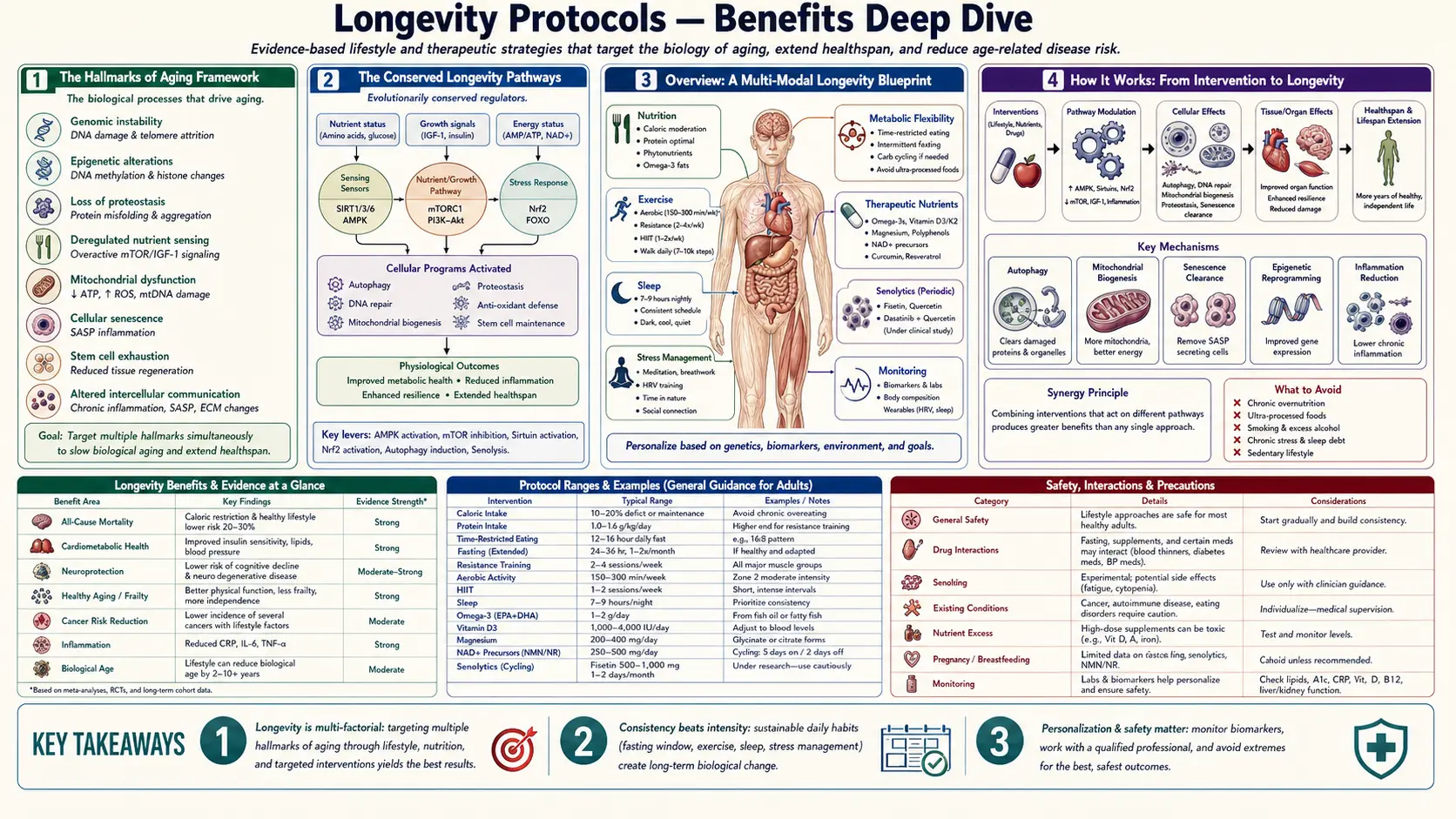
Modern longevity science has converged on a small number of conserved molecular pathways — mechanistic target of rapamycin (mTOR), AMP-activated protein kinase (AMPK), sirtuins, nicotinamide adenine dinucleotide (NAD+) metabolism, autophagy, and senescent-cell clearance — that, when manipulated, extend lifespan in every model organism tested from yeast to mice. The four benefit pages below dissect the most cited and most contested human interventions: caloric restriction and its pharmaceutical mimetics (rapamycin, metformin), the nicotinamide adenine dinucleotide-boosting precursors nicotinamide mononucleotide (NMN) and nicotinamide riboside (NR), the sirtuin-activating polyphenols led by resveratrol and pterostilbene, and the popular "Sinclair Stack" of nicotinamide mononucleotide + resveratrol + metformin + Vitamin D3 + statin alongside a scientific critique of which components are evidence-supported and which are speculative.
Deep-Dive Articles
Caloric Restriction and Mimetics
The 90-year history of caloric restriction (CR) as the single most reproducible lifespan-extending intervention across species, the CALERIE-II human trial (218 non-obese adults aged 21–50; 25% CR prescribed, an 11.9% average cut in calories actually achieved over two years), intermittent and time-restricted eating, the rhesus monkey divergence between Wisconsin and NIA trials, and the leading pharmaceutical CR mimetics — rapamycin (mechanistic target of rapamycin inhibition, ITP data), metformin (AMP-activated protein kinase activation, TAME trial), acarbose, and sodium-glucose cotransporter-2 (SGLT2) inhibitors.
Read the deep dive →Nicotinamide Adenine Dinucleotide Boosters
Why nicotinamide adenine dinucleotide levels decline by approximately 50% between ages 40 and 60, the salvage pathway and CD38-driven nicotinamide adenine dinucleotide (NAD) consumption, the precursor cascade (nicotinamide riboside → nicotinamide mononucleotide → nicotinamide adenine dinucleotide), the David Sinclair vs Charles Brenner debate over nicotinamide mononucleotide versus nicotinamide riboside, the Slc12a8 transporter controversy, human trials showing roughly doubled blood nicotinamide adenine dinucleotide on 1g/day nicotinamide riboside, and what is and is not established about clinical endpoints.
Read the deep dive →Sirtuin Activators
The seven mammalian sirtuins (SIRT1–SIRT7) as nicotinamide adenine dinucleotide-dependent deacylases, their roles in metabolism, DNA repair, and stress response, the resveratrol-SIRT1 controversy (allosteric activation or fluorophore artifact), the more potent pterostilbene, second-generation STACs (SRT2104, SRT1720), the Information Theory of Aging, and what sirtuin activation can plausibly deliver in humans.
Read the deep dive →Sinclair Stack and Critique
The exact David Sinclair daily protocol (1g nicotinamide mononucleotide, 1g resveratrol in yogurt, 1g metformin, Vitamin D3, statin, low-dose aspirin), an unflinching critique of the evidence behind each component, and an evidence-graded view of which components have human trial data and which remain speculative.
Read the deep dive →Table of Contents
- Deep-Dive Articles
- The Hallmarks of Aging Framework
- The Conserved Longevity Pathways
- Recent Human Trial Results for Calorie Restriction and Rapamycin
- Research Papers: Caloric Restriction and Mimetics
- Research Papers: Nicotinamide Adenine Dinucleotide Boosters
- Research Papers: Sirtuin Activators
- Research Papers: The Sinclair Stack and Aging Biomarkers
- Research Papers: Cross-Cutting (Hallmarks, Biomarkers, Senescence)
- External Authoritative Resources
- Connections
- Featured Videos
The Hallmarks of Aging Framework
The most widely used framework for organizing longevity research is the "Hallmarks of Aging" framework first published by Carlos López-Otín and colleagues in Cell in 2013 and updated in 2023. The framework identifies a small number of interconnected cellular and molecular processes that drive biological aging across species. Any intervention that demonstrably extends healthy lifespan does so by modifying one or more of these hallmarks.
The 2023 update lists twelve hallmarks, grouped into three categories. The primary hallmarks (causes of damage) are genomic instability, telomere attrition, epigenetic alterations, and loss of proteostasis. The antagonistic hallmarks (responses to damage) are disabled macroautophagy, deregulated nutrient sensing, mitochondrial dysfunction, and cellular senescence. The integrative hallmarks (consequences at the tissue level) are stem cell exhaustion, altered intercellular communication, chronic inflammation, and dysbiosis. The longevity interventions discussed across these four pages map cleanly onto specific hallmarks: caloric restriction targets deregulated nutrient sensing, nicotinamide adenine dinucleotide boosters address loss of proteostasis and mitochondrial dysfunction, sirtuin activators address epigenetic alterations and genomic instability, and senolytics address cellular senescence.
The hallmarks framework matters because it provides a discipline against the central failure mode of consumer longevity science: trying single compounds in isolation against the integrated biology of aging. Researchers who use the framework judge an intervention by which hallmarks it addresses and through what mechanism; in that view, compounds with no answer to that question (including many in the popular longevity supplement market) stay in the speculative category until they have one.
The Conserved Longevity Pathways
A second organizing principle is the small set of molecular pathways that, when manipulated, extend lifespan across yeast, worms, flies, and mice — the evolutionarily conserved "longevity pathways." These pathways are the targets of essentially every credible longevity intervention.
- mechanistic Target of Rapamycin (mTOR) — a master nutrient-sensing kinase that, when inhibited, suppresses anabolic processes and activates autophagy. Inhibited by rapamycin and indirectly by caloric restriction. Rapamycin extended lifespan in mice in the NIA Interventions Testing Program (ITP) even when started in middle age.
- AMP-activated Protein Kinase (AMPK) — the cellular "low energy" sensor, activated when ATP/AMP ratio falls. Activated by caloric restriction, exercise, metformin, and berberine. Activates autophagy and shifts metabolism toward catabolism.
- Sirtuins (SIRT1–SIRT7) — nicotinamide adenine dinucleotide-dependent deacylases that regulate gene expression, DNA repair, and metabolism. Activated by caloric restriction (via increased nicotinamide adenine dinucleotide/reduced nicotinamide adenine dinucleotide (NADH) ratio), resveratrol, and pterostilbene. Discussed in depth on the Sirtuin Activators page.
- Insulin-like growth factor 1 (IGF-1) / Growth Hormone — loss-of-function mutations in this pathway dramatically extend lifespan in worms (daf-2), flies, and mice (Ames and Snell dwarf mice). Laron syndrome patients (humans with GHR mutations) show very low cancer and diabetes rates.
- Nicotinamide adenine dinucleotide metabolism — the cofactor for sirtuins, PARPs, and CD38. Falls roughly 50% from age 40 to 60. Restored by precursors nicotinamide mononucleotide and nicotinamide riboside. Discussed in depth on the nicotinamide adenine dinucleotide Boosters page.
- Autophagy — the cellular recycling system that clears damaged proteins and organelles. Activated by fasting, caloric restriction, rapamycin, and spermidine. Declines with age.
- Cellular senescence and SASP — senescent cells accumulate with age and secrete inflammatory cytokines (SASP). Cleared by senolytics (dasatinib + quercetin, fisetin). Reduces inflammation when reduced.
The interventions on the four pages below act through one or more of these pathways. Caloric restriction is the most pleiotropic, hitting mechanistic target of rapamycin, AMP-activated protein kinase, sirtuins, autophagy, and insulin-like growth factor 1 simultaneously. Rapamycin and metformin partially mimic CR by targeting subsets of these pathways. Nicotinamide adenine dinucleotide boosters and resveratrol act primarily through sirtuins. Researchers in the field describe no single small molecule as fully reproducing caloric restriction, and many regard moderate lifestyle changes (CR or time-restricted eating) combined with a small number of targeted drugs as the most promising approach.
Recent Human Trial Results for Calorie Restriction and Rapamycin
Calorie restriction and the "pace of aging". A 2023 follow-up analysis of blood samples from the CALERIE trial (220 adults without obesity, randomly assigned to 25% calorie restriction or their usual diet for two years) looked at DNA-methylation tests of biological aging. Calorie restriction slowed the pace of aging as measured by the DunedinPACE test, but it did not significantly change the biological-age estimates from other DNA-methylation clocks, including PhenoAge and GrimAge. The authors describe the effects as small, and note that only long-term trials can show whether this means less chronic disease or longer life.
Low-dose weekly rapamycin in healthy older adults. The PEARL trial (2025) gave healthy, normally aging adults placebo, 5 mg or 10 mg of compounded rapamycin once a week for 48 weeks, in a double-blind, placebo-controlled design. Side effects and serious side effects (adverse events) were similar across all groups, and blood test changes stayed within normal ranges. The main measure, fat around the organs (visceral fat), did not change. Women taking 10 mg gained lean tissue (muscle and other non-fat tissue) and reported less pain, and people taking 5 mg reported better emotional well-being and general health; no other significant effects were seen.
Research Papers: Caloric Restriction and Mimetics
- McCay CM original caloric restriction in rats (1935) and follow-up reviews PubMed: McCay 1935 CR rat
- CALERIE-II trial: two years of calorie restriction in non-obese adults, 25% prescribed and 11.9% achieved (Kraus WE et al., Lancet Diabetes Endocrinol 2019;7(9):673-683) — PubMed PMID: 31303390
- Wisconsin rhesus monkey caloric restriction trial (Colman, Science 2009; updates) — PubMed PMID: 19590001
- NIA rhesus monkey trial showing reduced benefit (Mattison, Nature 2012) — PubMed PMID: 22932268
- Harrison DE et al., Rapamycin extends mouse lifespan (NIA ITP, Nature 2009) — PubMed PMID: 19587680
- Strong R et al., Longer lifespan in male mice treated with a weakly estrogenic agonist, an antioxidant, an α-glucosidase inhibitor (acarbose) or a Nrf2-inducer (Aging Cell 2016) — PubMed PMID: 27312235
- Bannister CA et al., Metformin and survival in type 2 diabetes (Diabetes Obes Metab 2014) — PubMed PMID: 25041462
- Barzilai N et al., Metformin as a tool to target aging (Targeting Aging with Metformin (TAME) trial rationale; Cell Metab 2016) — PubMed PMID: 27304507
- Mitchell SJ et al., Daily fasting improves health and survival in male mice independent of diet composition and calories (Cell Metab 2019) — PubMed PMID: 30197301
- Madeo F et al., Spermidine, autophagy, and longevity (Science 2018) — PubMed PMID: 29371440
- Waziry R, Ryan CP, Corcoran DL, et al., Effect of long-term caloric restriction on DNA methylation measures of biological aging in healthy adults from the CALERIE trial (Nat Aging 2023;3(3):248-257) — PubMed PMID: 37118425
- Moel M, Harinath G, Lee V, et al., Influence of rapamycin on safety and healthspan metrics after one year: PEARL trial results (Aging (Albany NY) 2025;17(4):908-936) — PubMed PMID: 40188830
Research Papers: Nicotinamide Adenine Dinucleotide Boosters
- Trammell SAJ et al., Nicotinamide riboside is uniquely and orally bioavailable (Nat Commun 2016) — PubMed PMID: 27721479
- Martens CR et al., Chronic NR supplementation safety and NAD+ in healthy middle-aged adults (Nat Commun 2018) — PubMed PMID: 29599478
- Mills KF et al., Long-term administration of nicotinamide mononucleotide mitigates age-associated physiological decline in mice (Cell Metab 2016) — PubMed PMID: 28068222
- Grozio A et al., Slc12a8 is a nicotinamide mononucleotide transporter (Nat Metab 2019; controversial) — PubMed PMID: 31131364
- Camacho-Pereira J et al., CD38 dictates age-related NAD decline (Cell Metab 2016) — PubMed PMID: 27304511
- Imai S, Guarente L — NAD+ and sirtuins in aging and disease (Trends Cell Biol 2014) — PubMed PMID: 24786309
- Schmidt MS, Brenner C — Absence of evidence that Slc12a8 encodes a nicotinamide mononucleotide transporter (Nat Metab 2019; critique of the transporter claim) — PubMed PMID: 32694648
- Yoshino M et al., NMN increases insulin sensitivity in prediabetic women (Science 2021) — PubMed PMID: 33888596
- Conze D, Brenner C, Kruger CL, Safety and metabolism of long-term administration of nicotinamide riboside chloride in a randomized, double-blind, placebo-controlled clinical trial of healthy overweight adults (Sci Rep 2019) — PubMed PMID: 31278280
Research Papers: Sirtuin Activators
- Howitz KT et al., Small molecule activators of sirtuins extend Saccharomyces cerevisiae lifespan (resveratrol and SIRT1; yeast; Nature 2003) — PubMed PMID: 12939617
- Baur JA et al., Resveratrol improves health and survival of mice on high-calorie diet (Nature 2006) — PubMed PMID: 17086191
- Pacholec M et al., SRT1720, SRT2183, SRT1460, and resveratrol are not direct SIRT1 activators (J Biol Chem 2010; the "artifact" critique) — PubMed PMID: 20061378
- Hubbard BP et al., Evidence for a common mechanism of SIRT1 regulation by allosteric activators (Science 2013) — PubMed PMID: 23471411
- Kanfi Y et al., SIRT6 overexpression extends lifespan in male mice (Nature 2012) — PubMed PMID: 22367546
- Mitchell SJ et al., The SIRT1 activator SRT1720 extends lifespan and improves health of mice fed a standard diet (Cell Rep 2014) — PubMed PMID: 24582957
- McCubrey JA et al., Effects of resveratrol, curcumin, berberine and other nutraceuticals on aging (Aging 2017) — PubMed PMID: 28611316
- Anderson RM et al., Nicotinamide and PNC1 govern lifespan extension by calorie restriction in Saccharomyces cerevisiae (yeast; Nature 2003) — PubMed PMID: 12736687
- Pearson KJ et al., Resveratrol delays age-related deterioration but does not extend lifespan (Cell Metab 2008) — PubMed PMID: 18599363
- Yang JH, Hayano M, Griffin PT, et al. (senior author Sinclair DA), Loss of epigenetic information as a cause of mammalian aging (the Information Theory of Aging; mice; Cell 2023) — PubMed PMID: 36638792
Research Papers: The Sinclair Stack and Aging Biomarkers
- Sinclair DA — "Lifespan: Why We Age and Why We Don't Have To" protocol discussion (popular framework) PubMed: Sinclair longevity work
- Horvath S — DNA methylation age of human tissues and cell types (Genome Biol 2013, the first epigenetic clock) — PubMed PMID: 24138928
- Levine ME et al., PhenoAge epigenetic clock (Aging 2018) — PubMed PMID: 29676998
- Lu AT et al., GrimAge predicts time-to-death and morbidity (Aging 2019) — PubMed PMID: 30669119
- Belsky DW et al., DunedinPACE pace-of-aging clock (eLife 2022) — PubMed PMID: 35029144
- Fahy GM et al., Reversal of epigenetic age in humans with thymic regeneration cocktail (Aging Cell 2019; TRIIM trial) — PubMed PMID: 31496122
- Justice JN et al., Senolytic dasatinib plus quercetin in idiopathic pulmonary fibrosis (EBioMedicine 2019) — PubMed PMID: 30616998
- Hickson LJ et al., Senolytics in diabetic kidney disease (EBioMedicine 2019) — PubMed PMID: 31542391
- Moqri M, Herzog C, Poganik JR, Biomarkers of Aging Consortium, et al., Biomarkers of aging for the identification and evaluation of longevity interventions (Cell 2023) — PubMed PMID: 37657418
- López-Otín C et al., Hallmarks of aging: an expanding universe (Cell 2023) — PubMed PMID: 36599349
Research Papers: Cross-Cutting (Hallmarks, Biomarkers, Senescence)
- López-Otín C et al., The hallmarks of aging (Cell 2013, original framework) — PubMed PMID: 23746838
- Campisi J — Aging, cellular senescence, and cancer (Annu Rev Physiol 2013) — PubMed PMID: 23140366
- Kirkland JL, Tchkonia T — Senolytic drugs: from discovery to translation (J Intern Med 2020) — PubMed PMID: 32686219
- Fontana L et al., Extending healthy life span: from yeast to humans (Science 2010) — PubMed PMID: 20395504
- Longo VD, Mattson MP — Fasting: molecular mechanisms and clinical applications (Cell Metab 2014) — PubMed PMID: 24440038
- Kennedy BK et al., Geroscience: linking aging to chronic disease (Cell 2014) — PubMed PMID: 25417146
- Olshansky SJ — From lifespan to healthspan (JAMA 2018) — PubMed PMID: 30242384
- Bjedov I, Rallis C — The target of rapamycin signalling pathway in ageing and lifespan regulation (Genes (Basel) 2020) — PubMed PMID: 32899412
- Madeo F, Pietrocola F, Eisenberg T, Kroemer G — Caloric restriction mimetics: towards a molecular definition (Nat Rev Drug Discov 2014) — PubMed PMID: 25212602
- Partridge L, Fuentealba M, Kennedy BK — The quest to slow ageing through drug discovery (Nat Rev Drug Discov 2020) — PubMed PMID: 32467649
External Authoritative Resources
- American Federation for Aging Research (AFAR) — non-profit funding biomedical aging research, sponsor of the TAME trial
- NIA Interventions Testing Program (ITP) — the gold-standard government-run rodent lifespan trial that rigorously tested rapamycin, acarbose, and dozens of other compounds
- GeroScience (journal of the American Aging Association) (Springer Aging title)
- Lifespan.io / Longevity.Technology — advocacy and news, plus rigorous coverage of trial results
- Open Longevity / OurAging open biomarker projects
- PubMed — All longevity pathway research
Connections
- All Remedies
- Longevity Protocols (Main Hub)
- Caloric Restriction and Mimetics
- Nicotinamide Adenine Dinucleotide Boosters
- Sirtuin Activators
- Sinclair Stack and Critique
- Intermittent Fasting
- Autophagy
- Resveratrol
- Nicotinamide Mononucleotide
- Nicotinamide Riboside
- Metformin
- Rapamycin
- Vitamin D3
- Spermidine
- Senolytics