Longevity Protocols: History and Origins
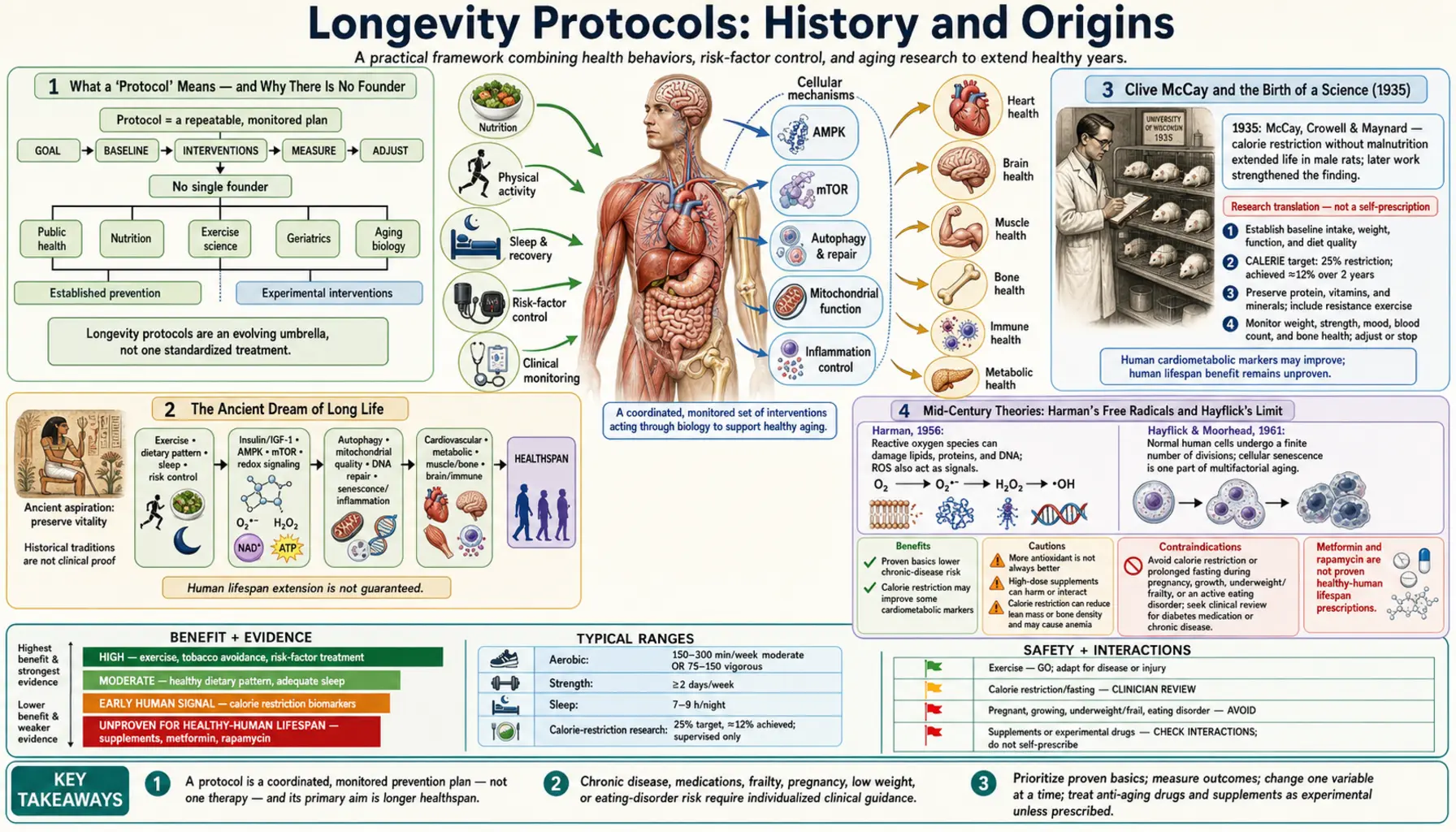
A "longevity protocol" is not a single remedy invented by one person on a particular day. It is a modern bundle of diet, exercise, sleep, supplement, and drug strategies assembled in the hope of slowing aging and extending the years a person lives in good health. The desire behind it is as old as humanity; the science behind it is barely a century old, and most of it is younger than that. This article tells the honest story: the ancient dream of long life, the 1935 rat-feeding experiment that turned aging into a laboratory subject, the mid-century theories of Denham Harman and Leonard Hayflick, the genetic revolution begun by Cynthia Kenyon in 1993, the telomere and "hallmarks of aging" frameworks that gave the field a map, and the recent rush of companies and high-profile biohackers who turned that map into commercial protocols. Throughout, it states plainly which claims are well established, which are promising but unproven in humans, and which remain frankly speculative. There is no single founder to celebrate here — only a long line of contributors, and a body of evidence that is still very much being written.
Table of Contents
- What a "Protocol" Means — and Why There Is No Founder
- The Ancient Dream of Long Life
- Clive McCay and the Birth of a Science (1935)
- Mid-Century Theories: Harman's Free Radicals and Hayflick's Limit
- The Genetic Revolution: Kenyon, Guarente, and the Pathways of Aging
- Telomeres, Senescence, and the Hallmarks Framework
- The Commercial and Biohacker Era
- Evidence and Reception: What Is Proven, What Is Not
- Research Papers and References
- Connections
- Featured Videos
What a "Protocol" Means — and Why There Is No Founder
Before tracing the history, it is worth being clear about what is and is not being described. The phrase longevity protocol is a recent, informal one. It refers to a personalised plan — usually some combination of caloric restriction or fasting, structured exercise, sleep optimisation, stress management, dietary supplements, and sometimes off-label medications — that a person follows in the hope of living longer and, more specifically, of extending healthspan, the years lived free of serious disease and disability. The word "protocol" borrows the authority of clinical medicine, but most published protocols are assembled by individuals from the scientific literature rather than handed down as an approved treatment.
This matters for an honest history, because unlike many entries in this Remedies section — which trace back to a single named physician or inventor — longevity protocols have no sole founder. There was no "Dr. X" who one day created the longevity protocol. What exists instead is a long chain of scientists, each adding a piece: the nutritionist who first slowed aging in rats, the chemist who blamed free radicals, the anatomist who counted cell divisions, the geneticist who doubled a worm's lifespan, and the modern researchers and entrepreneurs who packaged these findings for the public. Anyone who claims to have "invented" the longevity protocol is overstating their role. The history below is therefore a history of contributors and ideas, not of a single origin moment.
The Ancient Dream of Long Life
The wish to live longer is one of the oldest recorded human desires. The Mesopotamian Epic of Gilgamesh, among the earliest surviving works of literature, centres on a king's search for a plant that restores youth — which he finds and then loses. Ancient Chinese alchemists pursued an "elixir of immortality," and the practices of traditional Chinese medicine and Daoist cultivation included dietary, breathing, and herbal regimens intended to nourish vitality and prolong life. In the Indian tradition, Ayurveda preserved an entire branch called rasayana devoted to rejuvenation and the extension of healthy life. European alchemists later chased the "philosopher's stone" and a panacea that would cure disease and prolong existence.
It is important to read these traditions for what they were: cultural and philosophical responses to mortality, mixing genuine observation (that diet, rest, and moderation affect health) with magic, religion, and wishful thinking. None of them constitutes a scientific longevity protocol, and none should be cited as evidence that any particular elixir works. What they establish is only this: the aspiration behind modern longevity protocols is ancient and universal, even though the tools to test it did not exist until the twentieth century. The honest line between the two is the line between hoping to live longer and being able to measure whether a specific intervention actually helps.
Clive McCay and the Birth of a Science (1935)
The scientific study of life extension has a reasonably firm starting point. In 1935, the Cornell University nutritionist Clive Maine McCay, working with Mary F. Crowell and Leonard A. Maynard, published a paper in the Journal of Nutrition titled "The effect of retarded growth upon the length of life span and upon the ultimate body size." McCay's laboratory had fed young rats a diet that supplied adequate vitamins and minerals but markedly fewer calories, restricting their growth. The restricted rats lived substantially longer than rats fed freely. This finding — that simply reducing calorie intake without causing malnutrition could extend maximum lifespan — is widely regarded as the origin of the entire field of caloric restriction research, and with it, of the modern science of longevity interventions.
McCay himself interpreted the result as a consequence of slowed growth, a hypothesis that stood largely unchallenged until 1960, when later researchers proposed that reduced body fat, rather than retarded growth as such, drove the benefit. The debate over why caloric restriction works has continued for decades and is not fully settled even now. What is settled is the robustness of the basic phenomenon: in the ninety years since McCay's paper, caloric restriction has been shown to extend lifespan across an extraordinary range of organisms, from yeast and roundworms to flies and mice. It remains the single most reproducible intervention in the whole of aging biology, and it is the historical and conceptual root of every fasting-based component of a modern longevity protocol. Whether the same lifespan extension occurs in humans, however, is a separate and much harder question, addressed in the Evidence section below.
Mid-Century Theories: Harman's Free Radicals and Hayflick's Limit
If McCay gave the field an experiment, the mid-twentieth century gave it two enduring theories of why we age — theories that still shape the supplement aisles of today's protocols. In 1956, the physician and chemist Denham Harman, then at the University of California, Berkeley, published "Aging: a theory based on free radical and radiation chemistry" in the Journal of Gerontology. Harman proposed that aging is driven by the cumulative damage done to cells by free radicals — reactive molecules generated as a normal by-product of using oxygen for energy. His reasoning drew on the observation that radiation, which generates free radicals, produces effects resembling accelerated aging. The free-radical (later "oxidative stress") theory became one of the most influential ideas in the field and is the direct intellectual ancestor of every antioxidant supplement marketed for "anti-aging" purposes. It is worth noting, in the interest of honesty, that large clinical trials of antioxidant supplements have generally not shown the longevity benefits the theory once promised, and the theory itself has been significantly revised since Harman's day.
A few years later, in 1961, the anatomist Leonard Hayflick, working with Paul Moorhead at the Wistar Institute in Philadelphia, made a discovery of equal weight. Their paper "The serial cultivation of human diploid cell strains" showed that normal human cells grown in culture can divide only a limited number of times — roughly forty to sixty — before they stop dividing and enter a state now called senescence. This ceiling became known as the Hayflick limit. It overturned the then-prevailing belief, associated with Alexis Carrel, that cultured cells were effectively immortal, and it established that aging has a built-in cellular component. The cause of the Hayflick limit was later traced to the progressive shortening of telomeres, the protective caps on the ends of chromosomes — a thread the next sections pick up. Together, Harman's and Hayflick's work moved aging from the realm of vague decline into the realm of specific, testable cellular mechanisms.
The Genetic Revolution: Kenyon, Guarente, and the Pathways of Aging
For most of the twentieth century, many biologists assumed aging was simply wear and tear — a passive running-down that could not be controlled by any single gene, because natural selection had little reason to act on traits that appear after reproduction. That assumption was decisively challenged in 1993. Cynthia Kenyon, then a professor at the University of California, San Francisco, and her colleagues published a paper in Nature titled "A C. elegans mutant that lives twice as long as wild type." They showed that a single mutation in a gene called daf-2 could more than double the lifespan of the roundworm Caenorhabditis elegans — and that the long-lived worms stayed active and youthful rather than merely lingering. This was a watershed: it demonstrated that the rate of aging is biologically programmable, controlled by identifiable genes and signalling pathways. The daf-2 pathway turned out to be the worm's version of the insulin/IGF-1 signalling system, linking aging directly to nutrient sensing.
Kenyon built on earlier groundwork: in the preceding years Michael Klass had found that mutations could lengthen the worm's life, and Thomas Johnson had shown that one such mutation (in a gene named age-1) extended lifespan through the mutation itself rather than through reduced feeding. But it was Kenyon's dramatic doubling that galvanised the field. Around the same time, at the Massachusetts Institute of Technology, Leonard Guarente and his students were dissecting aging in yeast. In 1999, Guarente's laboratory — in work by Matt Kaeberlein, Mitch McVey, and Guarente published in Genes & Development — reported that the gene SIR2 promotes longevity in yeast, with an extra copy extending replicative lifespan. SIR2 belongs to a family of enzymes called sirtuins, present from yeast to humans and dependent on the molecule NAD+. This discovery created the scientific rationale for two of the most heavily marketed pillars of modern longevity protocols: sirtuin activators (such as resveratrol) and NAD+ boosters (such as NMN and NR). One of Guarente's postdoctoral researchers, David Sinclair, would later become the field's most prominent public figure.
Telomeres, Senescence, and the Hallmarks Framework
The cellular clue Hayflick uncovered was finally explained at the molecular level by the biology of telomeres. Elizabeth Blackburn, Carol Greider, and Jack Szostak discovered how telomeres protect chromosomes and identified the enzyme telomerase that can rebuild them — work for which the three shared the 2009 Nobel Prize in Physiology or Medicine. Blackburn, together with the health psychologist Elissa Epel, went on to show that chronic psychological stress is associated with shorter telomeres, connecting lifestyle and cellular aging in a way that directly informs the stress-management components of longevity protocols. In parallel, the recognition that senescent cells — the "retired" cells first implied by the Hayflick limit — accumulate with age and secrete inflammatory signals gave rise, in the 2010s, to the field of senolytics: drugs and compounds intended to clear those cells.
By the early 2010s the field had accumulated many separate mechanisms but no shared map. That changed in 2013, when Carlos López-Otín and colleagues published "The Hallmarks of Aging" in the journal Cell. The paper organised the biology of aging into nine interlocking "hallmarks" — including genomic instability, telomere attrition, epigenetic alterations, loss of proteostasis, deregulated nutrient sensing, mitochondrial dysfunction, cellular senescence, stem-cell exhaustion, and altered intercellular communication. An updated 2023 version expanded the list to twelve. This framework became the intellectual scaffolding of the entire longevity movement: nearly every modern protocol is now justified by reference to which hallmark each intervention is meant to address. It gave a previously scattered field a common language — though it is, importantly, a map of mechanisms, not a proof that targeting any given hallmark in humans extends life.
The Commercial and Biohacker Era
As the science matured, it attracted money and personalities. In 2002, the Cambridge-trained gerontologist Aubrey de Grey articulated a deliberately provocative framework he called SENS (Strategies for Engineered Negligible Senescence), arguing in the Annals of the New York Academy of Sciences that aging should be treated as a set of repairable forms of damage rather than an immutable fate. De Grey became an influential and controversial public advocate for treating aging as a medical problem; many mainstream scientists regarded his timelines as wildly optimistic, while crediting him with widening public discussion. The institutional money soon followed: in 2013, Google founded Calico (the California Life Company) as a longevity-focused biotechnology firm, and in 2022, Altos Labs launched with reported funding of over three billion dollars from backers including Jeff Bezos and Yuri Milner, focused on cellular rejuvenation.
Alongside the institutions came the public faces who did most to popularise the idea of a personal "protocol." David Sinclair, a Harvard geneticist and former member of Guarente's lab, became the best-known proponent of NAD+ boosters and sirtuin activators; his 2019 book Lifespan and his widely publicised personal regimen (including NMN and resveratrol) introduced millions of people to the notion of taking specific molecules to slow aging. The physician Peter Attia, through his 2023 book Outlive and his podcast, shifted emphasis toward exercise, metabolic health, and rigorous risk management, popularising metrics such as VO2 max and ApoB. Other figures, including the researcher Valter Longo (fasting-mimicking diets) and the entrepreneur Bryan Johnson (whose elaborate self-tracking regimen drew enormous attention), pushed the protocol concept further into public view. It is from this recent, media-saturated era — not from any single laboratory — that the modern packaged "longevity protocol" actually emerged. A balanced history must note that several of these popularisers also have commercial interests in the supplements and companies they discuss, which is one reason their specific recommendations should be weighed against independent evidence rather than personality.
Evidence and Reception: What Is Proven, What Is Not
An honest history has to end with an honest accounting of the evidence, because the gap between what is established in laboratory animals and what is proven in humans is the single most important fact about this field. On the firm side, the foundational mechanisms are real and well documented: caloric restriction extends lifespan across many species; single genes and nutrient-sensing pathways genuinely regulate the rate of aging; telomeres shorten with cell division; senescent cells accumulate and drive inflammation; and the hallmarks framework is a respected organising tool. The general lifestyle pillars common to most protocols — regular exercise, adequate sleep, not smoking, managing stress, and a predominantly whole-food diet — are supported by large bodies of evidence for reducing chronic disease and extending healthy life, and are uncontroversial among mainstream clinicians.
The disputed and unproven parts are the specific pharmaceutical and supplemental "hacks." As of the mid-2020s, no drug or supplement has been approved by regulators to slow human aging or extend lifespan, because aging is not currently recognised as a treatable indication. The interventions most associated with longevity protocols are, to varying degrees, investigational. Metformin is approved for diabetes, not aging; the large TAME trial designed to test it as an aging intervention has faced funding and design hurdles. Rapamycin extends lifespan robustly in mice but, as a 2025 review in the journal Aging noted, has not been shown in controlled human studies to extend lifespan or clearly slow aging; it is used off-label without a standardised dose. NMN, NR, and resveratrol raise NAD+ or activate sirtuins in studies, but human evidence for actual lifespan or healthspan benefit remains limited and mixed, and resveratrol's human trials have been notably inconsistent. Senolytics such as dasatinib-plus-quercetin and fisetin are in early human trials, with safety data still accumulating. Many peptides sold in this space are not approved drugs and lack robust human trials. None of this is presented here as endorsement: where a protocol component is experimental, this site says so plainly, and anyone considering off-label drugs or unproven supplements should do so only under medical supervision.
The fair summary is that longevity science is a legitimate and rapidly advancing field built on genuine discoveries, but the commercial "protocol" layered on top of it runs well ahead of the human evidence. Enthusiasts present individual components as breakthroughs; the more cautious mainstream view is that the well-proven gains come from ordinary lifestyle measures, while the headline molecules remain promising hypotheses awaiting the long, expensive trials that would confirm or refute them. Holding both of those truths at once — real science, overstated marketing — is the most accurate way to understand where longevity protocols stand today.
Research Papers and References
The list below gathers the landmark primary papers that built the science behind modern longevity protocols, together with curated PubMed topic-search links into the historical and mechanistic literature. Author names, titles, and journals are given as plain text; only the stable DOI or PMID is hyperlinked, and each opens in a new tab. Books and historical works (such as the Epic of Gilgamesh and the popular works of Sinclair and Attia) are named in the article as sources rather than cited as research.
- McCay CM, Crowell MF, Maynard LA. The effect of retarded growth upon the length of life span and upon the ultimate body size. Journal of Nutrition. 1935;10(1):63-79. — doi:10.1093/jn/10.1.63
- Harman D. Aging: a theory based on free radical and radiation chemistry. Journal of Gerontology. 1956;11(3):298-300. — doi:10.1093/geronj/11.3.298
- Hayflick L, Moorhead PS. The serial cultivation of human diploid cell strains. Experimental Cell Research. 1961;25(3):585-621. — doi:10.1016/0014-4827(61)90192-6
- Kenyon C, Chang J, Gensch E, Rudner A, Tabtiang R. A C. elegans mutant that lives twice as long as wild type. Nature. 1993;366(6454):461-464. — doi:10.1038/366461a0
- Kaeberlein M, McVey M, Guarente L. The SIR2/3/4 complex and SIR2 alone promote longevity in Saccharomyces cerevisiae by two different mechanisms. Genes & Development. 1999;13(19):2570-2580. — doi:10.1101/gad.13.19.2570
- de Grey ADNJ, Ames BN, Andersen JK, et al. Time to talk SENS: critiquing the immutability of human aging. Annals of the New York Academy of Sciences. 2002;959(1):452-462. — doi:10.1111/j.1749-6632.2002.tb02115.x
- López-Otín C, Blasco MA, Partridge L, Serrano M, Kroemer G. The hallmarks of aging. Cell. 2013;153(6):1194-1217. — doi:10.1016/j.cell.2013.05.039
- López-Otín C, Blasco MA, Partridge L, Serrano M, Kroemer G. Hallmarks of aging: an expanding universe. Cell. 2023;186(2):243-278. — doi:10.1016/j.cell.2022.11.001
- History of caloric restriction and aging research — PubMed: history of caloric restriction and longevity
- Genetics of aging and the discovery of longevity pathways — PubMed: genetics of aging and the insulin/IGF-1 pathway
External Authoritative Resources
- National Institute on Aging (NIH) — Aging and Your Body
- NCCIH — Aging and Complementary Health Approaches
- PubMed — Hallmarks of aging
Connections
- All Remedies
- Longevity Protocols
- Longevity Protocols Benefits
- Fasting
- Rapamycin
- Berberine
- NAD and NMN
- Oxidative Stress