The Honest Picture
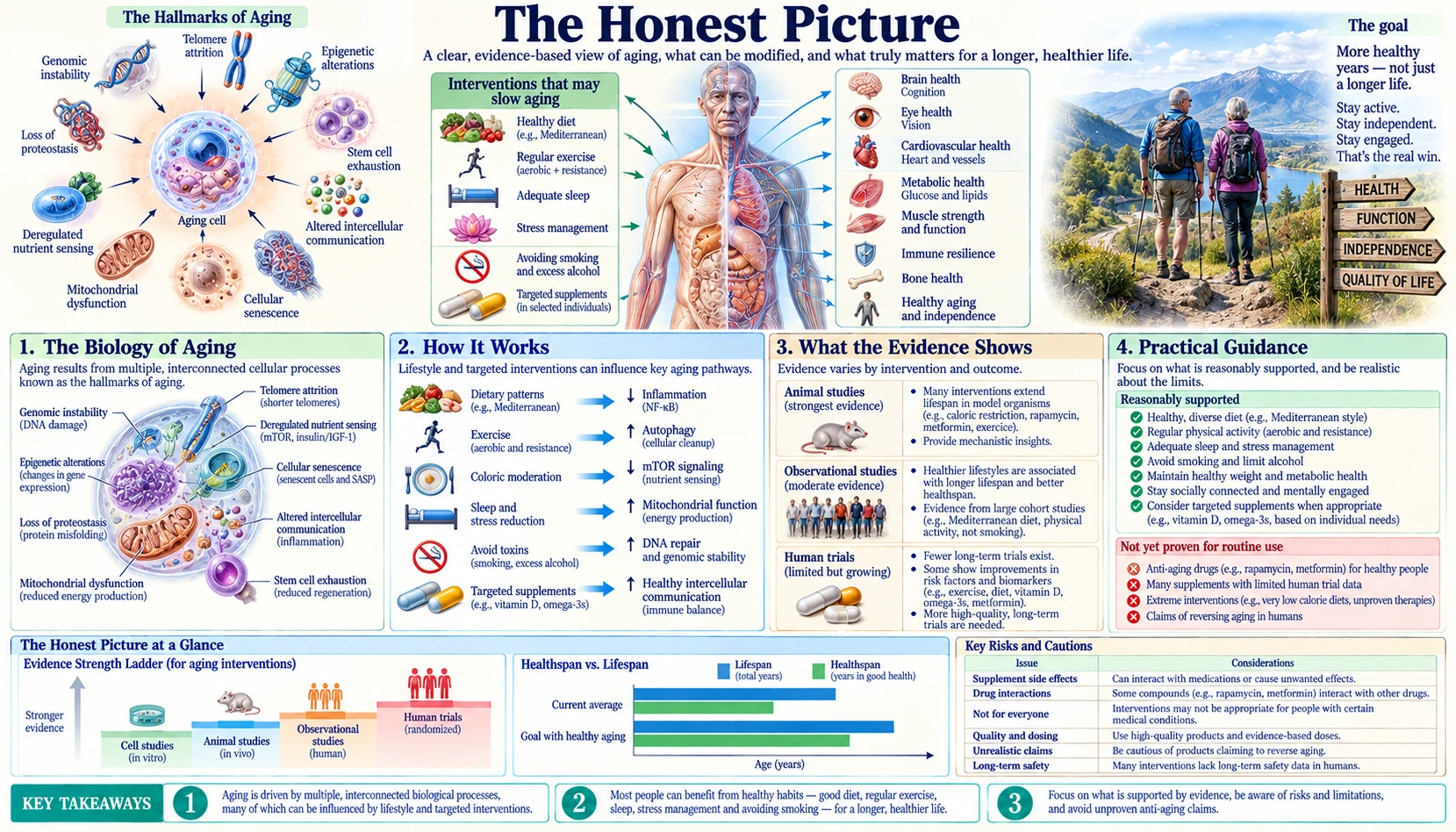
No pill, compound or protocol has been shown to extend human lifespan. What the field has is a hierarchy of evidence, and knowing which tier a claim sits on is most of the skill of reading it.
Tier one — the most consistent human data: regular physical activity (including strength training), adequate sleep, not smoking, maintaining muscle mass, and social connection. Large studies following people for decades link these habits with longer life and better health in later years. Most of that evidence is observational: randomized trials with lifespan as the outcome have not been run for these habits either.
Tier two — human signals, incomplete proof: sauna bathing, Mediterranean-style eating patterns, caloric moderation, and maintaining metabolic health. The sauna evidence comes from a Finnish cohort of 2,315 middle-aged men followed for a median of 20.7 years, in which more frequent sauna sessions were associated with lower cardiovascular and all-cause mortality — an association, not a trial result (Laukkanen 2015). The PREDIMED trial, republished in 2018 after protocol deviations, reported fewer major cardiovascular events with a Mediterranean diet supplemented with extra-virgin olive oil or nuts than with a control diet; it measured cardiovascular events, not lifespan (Estruch 2018). Long-term controlled trials with lifespan itself as the outcome are very difficult to run and have not been done for any of these.
Tier three — animal lifespan results, small early human trials: rapamycin, senolytics, nicotinamide adenine dinucleotide (NAD+) precursors, spermidine, taurine, glycine. The lifespan results in this tier are mouse results. In genetically heterogeneous mice tested at three sites, rapamycin fed from 600 days of age extended median and maximal lifespan in both sexes (Harrison 2009), and an 8% glycine diet gave a small (4–6%) but significant lifespan increase (Miller 2019). Taurine extended lifespan in mice in a 2023 study that also reported falling blood taurine with age in mice, monkeys and humans (Singh 2023); a 2025 study found instead that circulating taurine increased or stayed the same with age in three human cohorts and in monkeys and mice (Fernandez 2025). The human trials in this tier are small and short and measure biomarkers or function, not lifespan: the 48-week PEARL trial of low-dose weekly rapamycin, for example, found no change in its primary outcome, visceral fat (Moel 2025). Mouse results are often presented in longevity marketing as if they were human ones; the individual pages in the Molecules and Protocols sections state which species the key studies used.
Tier four — mechanism only, or failed tests: resveratrol is the cautionary example. It was reported to activate the enzyme SIRT1, but a 2010 study found that resveratrol and several synthetic “sirtuin activators” activated SIRT1 only in assays using a substrate carrying a fluorescent tag, not with native substrates, and concluded that they are not direct SIRT1 activators (Pacholec 2010). In the National Institute on Aging’s mouse lifespan testing program, resveratrol did not significantly change the lifespan of male or female mice in two separate tests (Miller 2011; Strong 2013). A mechanism on its own is a hypothesis, not evidence of benefit.
Rapamycin and metformin are prescription drugs with their own side-effect profiles, and prescribing either for longevity is off-label use: no human trial has shown that either extends lifespan. The TAME trial (Targeting Aging with Metformin) was proposed in 2016 as a test of metformin aimed at aging itself (Barzilai 2016); as of October 2026 no TAME results have been published. Decisions about prescription drugs and supplements belong with a clinician.
Key Research Papers
- Laukkanen T, Khan H, Zaccardi F, et al. Association between sauna bathing and fatal cardiovascular and all-cause mortality events. JAMA Intern Med. 2015;175(4):542-8. — PubMed PMID: 25705824
- Estruch R, Ros E, Salas-Salvadó J, et al. Primary Prevention of Cardiovascular Disease with a Mediterranean Diet Supplemented with Extra-Virgin Olive Oil or Nuts. N Engl J Med. 2018;378(25):e34. — PubMed PMID: 29897866 (republished 2018 after the 2013 report was withdrawn for protocol deviations)
- Harrison DE, Strong R, Sharp ZD, et al. Rapamycin fed late in life extends lifespan in genetically heterogeneous mice. Nature. 2009;460(7253):392-5. — PubMed PMID: 19587680
- Miller RA, Harrison DE, Astle CM, et al. Glycine supplementation extends lifespan of male and female mice. Aging Cell. 2019;18(3):e12953. — PubMed PMID: 30916479
- Singh P, Gollapalli K, Mangiola S, et al. Taurine deficiency as a driver of aging. Science. 2023;380(6649):eabn9257. — PubMed PMID: 37289866
- Fernandez ME, Bernier M, Price NL, et al. Is taurine an aging biomarker? Science. 2025;388(6751):eadl2116. — PubMed PMID: 40472098
- Moel M, Harinath G, Lee V, et al. Influence of rapamycin on safety and healthspan metrics after one year: PEARL trial results. Aging (Albany NY). 2025;17(4):908-936. — PubMed PMID: 40188830
- Pacholec M, Bleasdale JE, Chrunyk B, et al. SRT1720, SRT2183, SRT1460, and resveratrol are not direct activators of SIRT1. J Biol Chem. 2010;285(11):8340-51. — PubMed PMID: 20061378
- Strong R, Miller RA, Astle CM, et al. Evaluation of resveratrol, green tea extract, curcumin, oxaloacetic acid, and medium-chain triglyceride oil on life span of genetically heterogeneous mice. J Gerontol A Biol Sci Med Sci. 2013;68(1):6-16. — PubMed PMID: 22451473
- Miller RA, Harrison DE, Astle CM, et al. Rapamycin, but not resveratrol or simvastatin, extends life span of genetically heterogeneous mice. J Gerontol A Biol Sci Med Sci. 2011;66(2):191-201. — PubMed PMID: 20974732
- Barzilai N, Crandall JP, Kritchevsky SB, et al. Metformin as a Tool to Target Aging. Cell Metab. 2016;23(6):1060-1065. — PubMed PMID: 27304507
Connections
- Longevity — The section hub with all sub-pages
- Antioxidants — The full compound library behind the molecules above
- Natural Medicine — All practices, protocols, and therapies
- Amino Acids — Taurine, glycine, creatine, collagen, and the rest
- Mushrooms — Ergothioneine's richest food source
- Gut Health — The microbiome's role in healthy aging
- Food — Whole-food sources beat capsules where both exist
- Biology — All 137 interactive animations
- Vitamins — Including vitamin D and the B-complex aging essentials
- Notable Doctors — The researchers and clinicians behind the science