Liver Detox
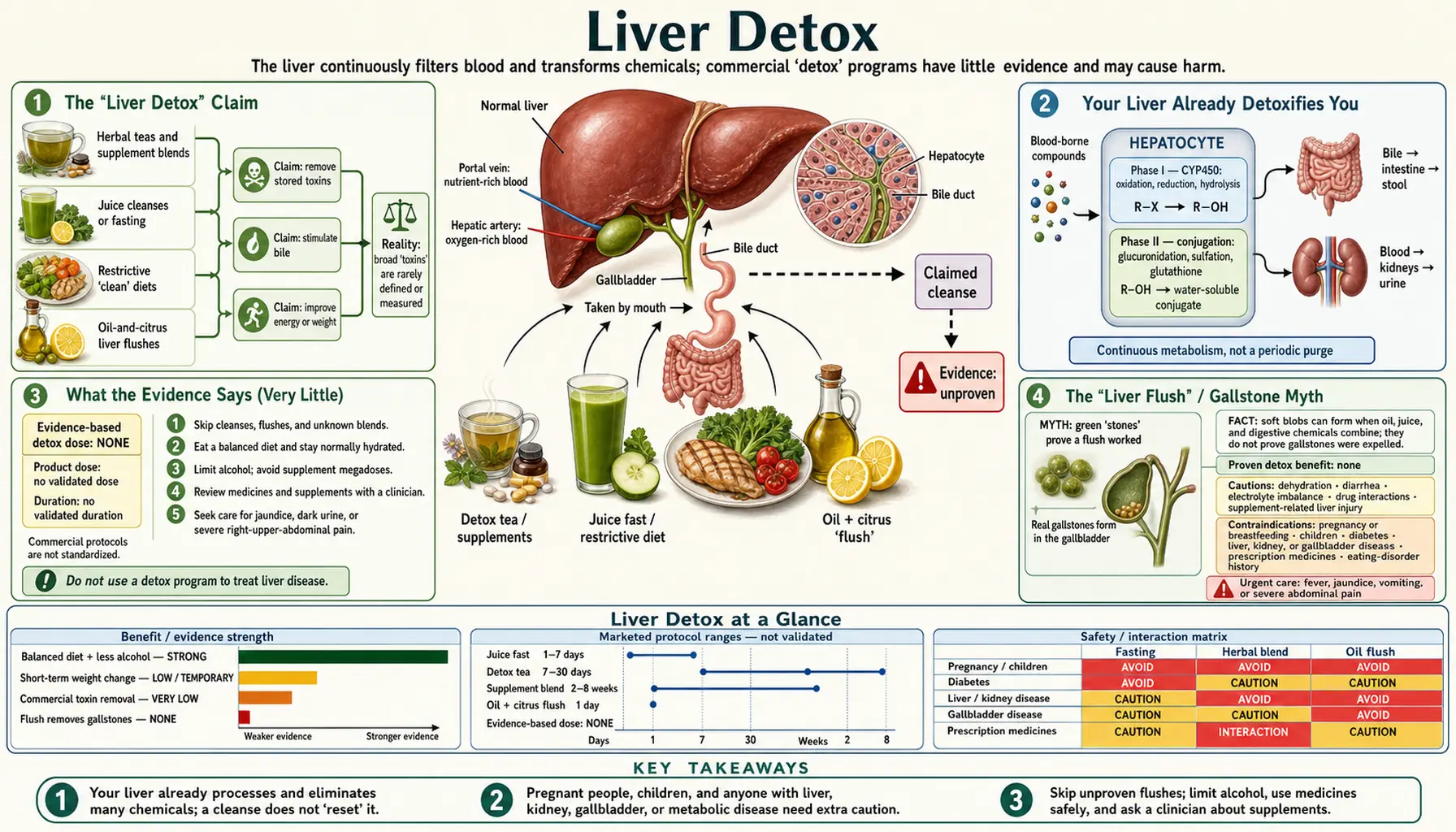
If you have ever walked past a wall of "liver detox," "liver cleanse," or "liver flush" products and wondered whether your liver needs a tune-up, here is the short, honest answer: a healthy liver cleanses itself, around the clock, for free. "Detox" is a marketing word, not a medical one, and the evidence that any commercial cleanse removes toxins or makes a healthy person healthier is essentially missing. Worse, a handful of these very products have been linked to the one thing they promise to prevent — liver damage. This page walks through what the claims are, what the science actually shows, and the boring-but-real ways to protect your liver.
Table of Contents
- The "Liver Detox" Claim
- Your Liver Already Detoxifies You
- What the Evidence Says (Very Little)
- The "Liver Flush" / Gallstone Myth
- A Word on the Ingredients
- The Real Risk: Supplements Can Harm the Liver
- How to Actually Protect Your Liver
- Research Papers
- Connections
- Featured Videos
The "Liver Detox" Claim
"Liver detox" is an umbrella term for a large and profitable category of products and protocols. They come in many forms:
- Pills and capsules blending milk thistle, dandelion, turmeric, artichoke, and similar botanicals.
- "Detox" teas — often containing laxative herbs such as senna.
- Juice "cleanses" and multi-day liquid-only programs.
- "Liver flush" or "gallbladder flush" protocols, typically a regimen of olive oil, citrus juice, and Epsom salts taken over an evening.
The marketing promises are remarkably consistent: flush out toxins, cleanse and "reset" the liver, boost energy, clear up skin, and jump-start weight loss. These messages are appealing and intuitive. They are also, for the most part, not backed by good evidence — and they rest on a misunderstanding of what your liver does and how it does it.
Your Liver Already Detoxifies You
The premise behind every cleanse is that "toxins" build up in your liver and need to be periodically purged. But that is not how the body works. Your liver is, in effect, a continuously running chemical-processing plant, and neutralizing harmful compounds is its everyday job — not a special event that requires a product.
Working alongside the kidneys, the liver constantly:
- Breaks down alcohol and the byproducts of normal metabolism.
- Transforms drugs and other foreign chemicals (via enzyme systems such as cytochrome P450) into forms the body can eliminate.
- Processes the nitrogen waste from protein into urea, which the kidneys then clear in urine.
- Packages waste into bile, which carries it out through the digestive tract.
In other words, detoxification is not something you do to your liver; it is something your liver does for you, every second, without instruction. A healthy liver does not accumulate a backlog of sludge waiting for a juice cleanse to release it. When the liver is genuinely failing — from cirrhosis, hepatitis, or poisoning — that is a serious medical emergency treated by doctors, not a problem a supermarket "cleanse" can fix. For everyone else, the most useful thing you can do is avoid overloading the system in the first place (see below).
What the Evidence Says (Very Little)
Let us be direct about the research, because this is the heart of the matter: there is no good clinical evidence that commercial "detox" or "cleanse" programs remove toxins from the body or improve health in healthy people.
The U.S. government's National Center for Complementary and Integrative Health (NCCIH), part of the National Institutes of Health, has reviewed this question and is blunt about it. It points to research finding no compelling support for "detox" diets either for weight management or for eliminating toxins from the body. Any weight people lose on a juice fast or cleanse is generally water and short-lived — it returns once normal eating resumes.
A few things are worth holding in mind together:
- "Detox" is a marketing term, not a clinical diagnosis. Outside of treating drug overdose, alcohol withdrawal, or poisoning in a hospital, "detoxification" is not something a wellness product meaningfully provides.
- Cleanse products rarely name a toxin. Products that "remove toxins" almost never specify which toxin, in what amount, measured how. That vagueness is a red flag.
- Regulators have pushed back. The U.S. Food and Drug Administration and Federal Trade Commission have taken action against companies making false or unsupported "detox" claims.
Feeling better during a cleanse is real, but it usually has ordinary explanations: people who start a cleanse often also cut alcohol, fast food, and excess sugar at the same time, drink more water, and pay closer attention to their bodies. Those changes — not a proprietary blend — are doing the work.
The "Liver Flush" / Gallstone Myth
One of the most persistent claims deserves its own section, because it comes with dramatic "proof." In the popular "liver and gallbladder flush," a person drinks large amounts of olive oil and citrus juice (often with Epsom salts) over an evening. The next morning, they pass numerous soft, greenish-brown pea-sized lumps in the stool. These are presented — and widely believed — to be gallstones and toxins flushed out of the liver. People photograph them, count them, and credit the cleanse with clearing out their gallbladder.
There is just one problem: those lumps are not gallstones.
When researchers actually analyzed them, the chemistry was clear. In a well-known 2005 report in The Lancet, the green "stones" passed after such a flush were examined and found to have no crystalline structure, no cholesterol, no bilirubin, and no calcium — the things real gallstones are made of. Instead they melted into an oily liquid when gently warmed and were composed mostly of fatty acids. What had happened is straightforward kitchen chemistry: digestive enzymes split the olive oil into fatty acids, which combined with minerals from the juice to form soap — soft saponified clumps manufactured in the gut during the procedure itself.
In plain terms, the "stones" you see are not something that came out of your liver. They are soap-like blobs created by the olive-oil-and-juice mixture inside your digestive tract. Genuine gallstones are a real medical condition diagnosed by ultrasound and managed by a doctor — they cannot be reliably dissolved or expelled by drinking oil.
A Word on the Ingredients
Skepticism about "cleanses" does not mean every ingredient in them is worthless. To be fair and accurate: a few individual components have been studied for specific liver conditions. But "has some evidence for a liver disease" is a very different claim from "detoxes a healthy person," and none of it supports the cleanse-product marketing.
Two honest examples:
- Milk thistle (silymarin) is the most-studied of the bunch and has a long traditional reputation. Yet a rigorous Cochrane systematic review of randomized trials in people with alcohol-related or hepatitis B/C liver disease found that the evidence does not establish a clear benefit on mortality or disease complications, and called for better-quality studies. It appears reasonably safe, but "safe and inconclusive" is not "effective," and it is certainly not a detox.
- Coffee is an interesting case: large observational studies and meta-analyses consistently associate regular coffee drinking with lower rates of liver fibrosis, cirrhosis, and liver cancer. That is a genuine, if still associational, signal — but notice it comes from an ordinary beverage as part of daily life, not from a "cleanse" protocol, and it does not mean coffee "flushes toxins."
The takeaway: a specific ingredient showing modest, condition-specific results in a clinical trial is not evidence that a multi-ingredient "liver detox" product does anything for an otherwise healthy person.
The Real Risk: Supplements Can Harm the Liver
Here is the irony most shoppers never hear. A "liver detox" product is not just unlikely to help — in some cases it can damage the very organ it claims to cleanse.
Herbal and dietary supplements are a real and growing cause of drug-induced liver injury (sometimes called DILI). In a major analysis from the U.S. Drug-Induced Liver Injury Network published in Hepatology, supplements accounted for a striking and rising share of liver-injury cases referred for study — roughly one in five — up sharply over the prior decade. Implicated products have included bodybuilding supplements, weight-loss products, and concentrated green tea extract, among others. Some cases were severe enough to cause liver failure requiring transplant.
Part of the problem is structural: in the United States, supplements are not reviewed for safety and effectiveness before they go on sale the way prescription drugs are. Products can contain more, less, or different ingredients than the label claims, and "natural" does not mean "harmless." So a capsule sold specifically as a "liver cleanse" or "detox" carries the same — sometimes greater — risk to the liver as any other unregulated botanical blend. Asking a struggling or healthy liver to also process an unproven concentrated extract is the opposite of protecting it.
How to Actually Protect Your Liver
The genuinely evidence-based way to "care for your liver" is unglamorous, free of proprietary blends, and actually works. Real liver care looks like this:
- Limit alcohol. Alcohol is the classic liver toxin; less is better, and for some people none is best.
- Reach and keep a healthy weight. Fatty liver disease (now called MASLD, formerly NAFLD) is the most common liver problem in the world, affecting roughly a third of adults, and it is driven by weight, diet, and metabolic health. A balanced diet, less added sugar, and regular movement do more for your liver than any cleanse.
- Be careful with acetaminophen (paracetamol/Tylenol). It is safe at recommended doses but is a leading cause of acute liver failure when overused or combined with alcohol. Mind the total daily dose across all products that contain it.
- Skip unnecessary supplements. Don't take concentrated herbal or "detox" products you don't need — including, especially, ones marketed for the liver.
- Get vaccinated against hepatitis A and B where appropriate, and get tested for hepatitis C if you have risk factors. Viral hepatitis is a major, preventable cause of liver disease.
- Manage diabetes, blood pressure, and cholesterol, which are tightly linked to fatty liver disease.
- Don't smoke.
That list will not sell a bottle of capsules. But it is the real thing — and unlike a "cleanse," it has the evidence behind it.
Research Papers
- National Center for Complementary and Integrative Health (NIH). "Detoxes" and "Cleanses": What You Need To Know. nccih.nih.gov — The U.S. government's plain-language verdict: no compelling evidence that "detox"/cleanse programs remove toxins or aid weight management, plus documented safety risks.
- Sies CW, Brooker J. Could these be gallstones? Lancet. 2005;365(9468):1388. doi:10.1016/S0140-6736(05)66373-8 — Chemical analysis showing the green "stones" from an olive-oil/juice "liver flush" are saponified fatty acids (soap), not gallstones.
- Navarro VJ, Khan I, Björnsson E, Seeff LB, Serrano J, Hoofnagle JH. Liver injury from herbal and dietary supplements. Hepatology. 2017;65(1):363–373. doi:10.1002/hep.28813 — Herbal/dietary supplements (including green tea extract and weight-loss products) account for a large and growing share of U.S. drug-induced liver injury.
- Rambaldi A, Jacobs BP, Gluud C. Milk thistle for alcoholic and/or hepatitis B or C virus liver diseases. Cochrane Database of Systematic Reviews. 2007;(4):CD003620. doi:10.1002/14651858.CD003620.pub3 — Systematic review finding the evidence does not support a clear benefit of milk thistle/silymarin; calls for higher-quality trials.
- Kennedy OJ, Roderick P, Buchanan R, Fallowfield JA, Hayes PC, Parkes J. Coffee and the risk of hepatocellular carcinoma: a systematic review and dose-response meta-analysis. BMJ Open. 2017;7(5):e013739. doi:10.1136/bmjopen-2016-013739 — Higher coffee intake is associated with lower risk of liver cancer — an ordinary-beverage signal, not a "detox" effect.
- Marventano S, Salomone F, Godos J, et al. Coffee and tea consumption in relation with non-alcoholic fatty liver and metabolic syndrome: a systematic review and meta-analysis of observational studies. Clinical Nutrition. 2016;35(6):1269–1281. doi:10.1016/j.clnu.2016.03.012 — Supports the association between coffee consumption and lower risk of fatty liver disease.