Caloric Restriction
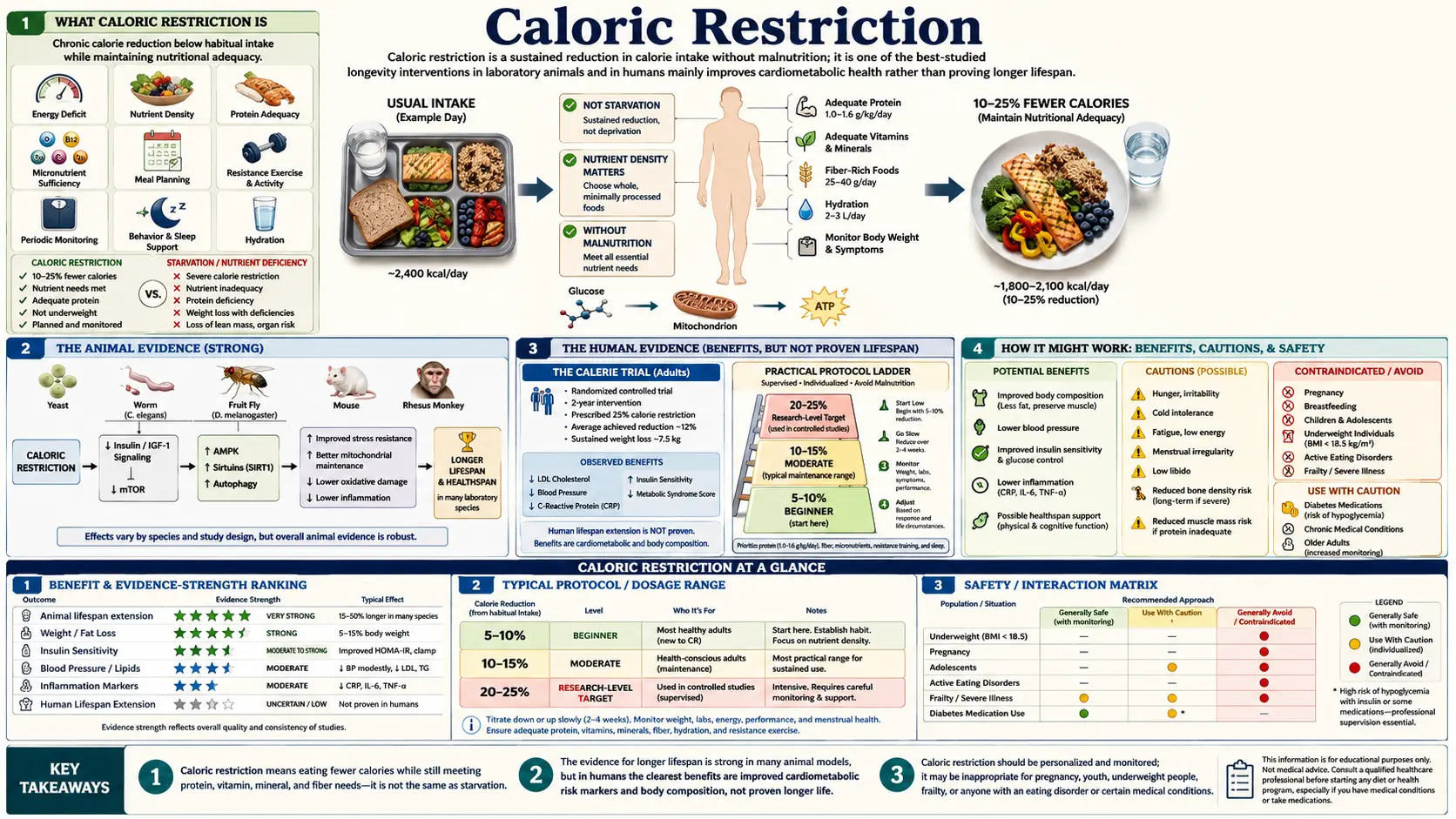
Caloric restriction — eating fewer calories than usual while still getting full nutrition — is the single most studied way scientists have found to slow aging in laboratory animals. In creatures from yeast to mice, it reliably extends lifespan and delays the diseases of old age. The honest caveat is that this has never been shown to extend human lifespan, and proving it would take a trial running for many decades. What human studies do show is that modest, sustained calorie reduction improves the markers tied to healthy aging — cholesterol, blood pressure, blood-sugar control, and inflammation — and may slow at least one measure of biological aging. This page lays out what is genuinely strong, what is only promising, and the real risks of trying it.
Interactive Visualization Hunger, Leptin & Why Diets Fight Back Watch the hunger neurons and the fullness neurons fight it out — then lose weight and see leptin fall, hunger climb and metabolism drop. It isn’t willpower. It’s a defended system. Launch →
Table of Contents
- What Caloric Restriction Is
- The Animal Evidence (Strong)
- The Human Evidence (Benefits, but Not Proven Lifespan)
- How It Might Work
- Caloric Restriction vs. Fasting
- Risks & Who Should Not Do It
- The Bottom Line
- Research Papers
- Connections
- Featured Videos
What Caloric Restriction Is
Caloric restriction (CR) means eating fewer total calories than you normally would — typically a 10–30% reduction — while still getting all the nutrition your body needs. The defining phrase researchers use is "caloric restriction without malnutrition." That last part is the whole point: protein, vitamins, minerals, and essential fats stay adequate; only total energy goes down.
This makes CR very different from two things it's often confused with:
- Starvation. Starvation is a calorie and nutrient deficit that damages the body. CR is the opposite — it deliberately protects nutrient intake. An animal on a proper CR diet is lean and active, not wasting away.
- Just "eating less junk." Swapping soda for water or cutting ultra-processed snacks improves your diet's quality, which is valuable, but it isn't necessarily CR. True CR is a measured reduction in total energy intake below your maintenance needs, sustained over time.
In practice, CR is demanding. It usually requires counting calories, tracking nutrients carefully, and accepting some ongoing hunger — which is why most people find a lighter version (see the Bottom Line) more realistic.
The Animal Evidence (Strong)
Here the science is genuinely impressive. Cutting calories without malnutrition extends lifespan and delays age-related disease across a remarkable range of species: yeast, roundworms, fruit flies, and rodents. In mice and rats especially, CR can lengthen average and maximum lifespan and push back cancers, kidney disease, and other age-related conditions. This is one of the most reproducible findings in all of aging biology — it has held up across many labs and many decades.
But the picture gets more complicated in animals closest to us. Two long-running studies followed rhesus monkeys on CR for decades, and they reached different conclusions:
- The University of Wisconsin study (reported in 2009) found that calorie-restricted monkeys had less diabetes, cancer, and heart disease, and were significantly less likely to die from age-related causes than controls.
- The National Institute on Aging (NIA) study (reported in 2012) found clear health benefits too — better metabolic and immune markers, less disease — but no significant improvement in survival overall.
Why the split? A later joint analysis (2017) concluded the differences came largely down to diet composition and how the control monkeys were fed — the NIA "control" animals were themselves fed fairly modestly and ate a healthier diet, which narrowed the gap. The honest takeaway: CR clearly improves health in primates, but its effect on lifespan is sensitive to the details and does not translate as simply or dramatically as it does in mice.
The Human Evidence (Benefits, but Not Proven Lifespan)
This is the section to read most carefully. There is no proof that caloric restriction extends human lifespan. A definitive trial would need to randomize people to decades of calorie reduction and wait to compare death rates — something no study has ever done, and likely never will.
What we have instead is a rigorous randomized trial of the biology that precedes longevity. The CALERIE trial assigned healthy, non-obese adults to roughly two years of about a 12% calorie reduction (the realistic amount people actually achieved, short of the 25% target). The findings were:
- Better cardiometabolic risk factors: improvements in LDL and total cholesterol, blood pressure, insulin sensitivity, and markers of inflammation such as C-reactive protein.
- A slower pace of biological aging: a follow-up analysis of the participants' DNA found CR slowed one validated measure of aging pace (DunedinPACE) by roughly 2–3%. Other epigenetic "aging clocks" in the same study did not change.
These are real, encouraging results — but they are biomarkers and risk factors, not demonstrated extra years of life. A 2–3% change in an aging-pace algorithm is a promising signal; it is not the same as proving people live longer. The accurate framing is: in healthy adults, modest CR makes the body's metabolic and aging-related markers look better. Whether that ultimately means a longer life in humans remains unproven.
How It Might Work
Scientists are still working out why calorie restriction affects aging, and the explanations below are leading hypotheses, not settled fact. The most discussed mechanisms:
- Less metabolic stress and oxidative damage. Processing fewer calories may mean cells generate fewer damaging byproducts (reactive oxygen species) over a lifetime.
- Improved insulin sensitivity. Lower, steadier blood sugar and insulin reduce the metabolic strain linked to many age-related diseases.
- Autophagy — cellular "cleanup." When energy is scarce, cells ramp up recycling of damaged proteins and worn-out components, which may help maintain healthy tissue.
- Nutrient-sensing pathways. CR shifts the activity of molecular "fuel gauges" the body uses to sense food — notably mTOR (turned down), AMPK (turned up), and the sirtuins. In animal models these pathways are tightly linked to longevity, which is why they dominate the research.
These mechanisms likely overlap and reinforce one another. None has been confirmed as the reason CR works in humans — they are the active frontier of aging research, not a finished story.
Caloric Restriction vs. Fasting vs. Fasting-Mimicking
Several related approaches are easy to mix up. They differ in what you change versus when you eat:
- Continuous caloric restriction (CR): eat fewer total calories every day, indefinitely. This is the approach with the deepest animal-research pedigree, but also the hardest to sustain.
- Intermittent fasting / time-restricted eating: here the focus is when you eat — for example, confining meals to an 8-hour window, or eating very little on certain days. You may or may not end up eating fewer total calories.
- Fasting-mimicking diet: a few days of a specially designed very-low-calorie, plant-based menu, repeated periodically, intended to trigger some fasting-like effects while you still eat something.
For many people the intermittent approaches are easier to stick with than counting calories every single day, and they are being actively studied as more practical alternatives that may capture some of the same metabolic benefits. The evidence base for these patterns is still developing and is largely about metabolic health, not proven lifespan. (See our dedicated page on Fasting for a fuller guide to intermittent and extended fasting.)
Risks & Who Should Not Do It
Caloric restriction is not a gentle, consequence-free intervention, and the risks deserve to be stated plainly. Reported and plausible downsides include:
- Persistent hunger and preoccupation with food — a constant, draining mental load for many people.
- Loss of muscle and bone — eating too little, especially with inadequate protein or no resistance exercise, can erode lean mass and reduce bone density.
- Fatigue, weakness, and cold intolerance — a lower-energy metabolism often feels like being tired and chilly.
- Low libido and hormonal changes, including effects on reproductive and thyroid hormones.
- Malnutrition or disordered eating — done carelessly, CR can tip into genuine nutrient deficiency, and the structure of strict calorie counting can trigger or worsen an eating disorder.
Caloric restriction should NOT be undertaken by:
- People who are underweight or have a low body-fat reserve.
- Older or frail adults, for whom losing muscle (sarcopenia) is a serious threat to strength and independence.
- Anyone who is pregnant or breastfeeding.
- Children and adolescents, who need ample energy to grow and develop.
- Anyone with a current or past eating disorder.
For anyone else considering sustained CR, medical supervision is strongly recommended — to monitor weight, nutrient status, bone and muscle, and hormones, and to catch problems early.
The Bottom Line
Caloric restriction has the strongest basic-science pedigree of any longevity intervention — the animal lifespan data are robust, and human trials clearly show it improves metabolic health markers and may slow one measure of biological aging. But two honest limits remain: human lifespan extension is unproven, and the practice itself is hard to sustain and carries real risks if done carelessly.
For most people, the sensible, lower-risk version of this idea is not strict lifelong calorie counting. It's the achievable habits that capture much of the same benefit with far less downside: avoid chronic overeating, keep a healthy body weight, stay physically active (including resistance training to protect muscle), and eat a nutrient-dense, minimally processed diet. If you do want to try formal CR or a fasting pattern for healthspan, treat it as a medical decision — do it with adequate protein and nutrients, and ideally under a clinician's supervision.
Research Papers
- Colman RJ, et al. Caloric Restriction Delays Disease Onset and Mortality in Rhesus Monkeys. Science. 2009;325(5937):201–204. doi:10.1126/science.1173635 — The Wisconsin primate study: CR reduced age-related disease and death from age-related causes.
- Mattison JA, et al. Impact of caloric restriction on health and survival in rhesus monkeys from the NIA study. Nature. 2012;489(7415):318–321. doi:10.1038/nature11432 — The NIA primate study: clear health benefits but no significant survival benefit — the key "mixed result."
- Mattison JA, et al. Caloric restriction improves health and survival of rhesus monkeys. Nature Communications. 2017;8:14063. doi:10.1038/ncomms14063 — Joint Wisconsin–NIA analysis: diet composition and control-group feeding explain much of the earlier disagreement.
- Ravussin E, et al. A 2-Year Randomized Controlled Trial of Human Caloric Restriction: Feasibility and Effects on Predictors of Health Span and Longevity. The Journals of Gerontology: Series A. 2015;70(9):1097–1104. doi:10.1093/gerona/glv057 — The CALERIE trial: sustained ~12% CR is feasible in healthy adults and improves predictors of health span.
- Kraus WE, et al. 2 years of calorie restriction and cardiometabolic risk (CALERIE): exploratory outcomes of a multicentre, phase 2, randomised controlled trial. The Lancet Diabetes & Endocrinology. 2019;7(9):673–683. doi:10.1016/S2213-8587(19)30151-2 — CALERIE cardiometabolic results: improved cholesterol, blood pressure, insulin sensitivity, and inflammation markers.
- Waziry R, et al. Effect of long-term caloric restriction on DNA methylation measures of biological aging in healthy adults from the CALERIE trial. Nature Aging. 2023;3(3):248–257. doi:10.1038/s43587-022-00357-y — CR slowed one validated pace-of-aging marker (DunedinPACE) by ~2–3%; other aging clocks were unchanged.
- Fontana L, et al. Extending Healthy Life Span—From Yeast to Humans. Science. 2010;328(5976):321–326. doi:10.1126/science.1172539 — Landmark review of dietary restriction and nutrient-sensing pathways across species, from yeast to primates.
Connections
- All Remedies
- Hunger, Leptin & Why Diets Fight Back — interactive animation
- Fasting
- Ketogenic Diet
- Longevity Protocols
- Rapamycin
- Metformin