Modified Gerson Therapy During Chemotherapy
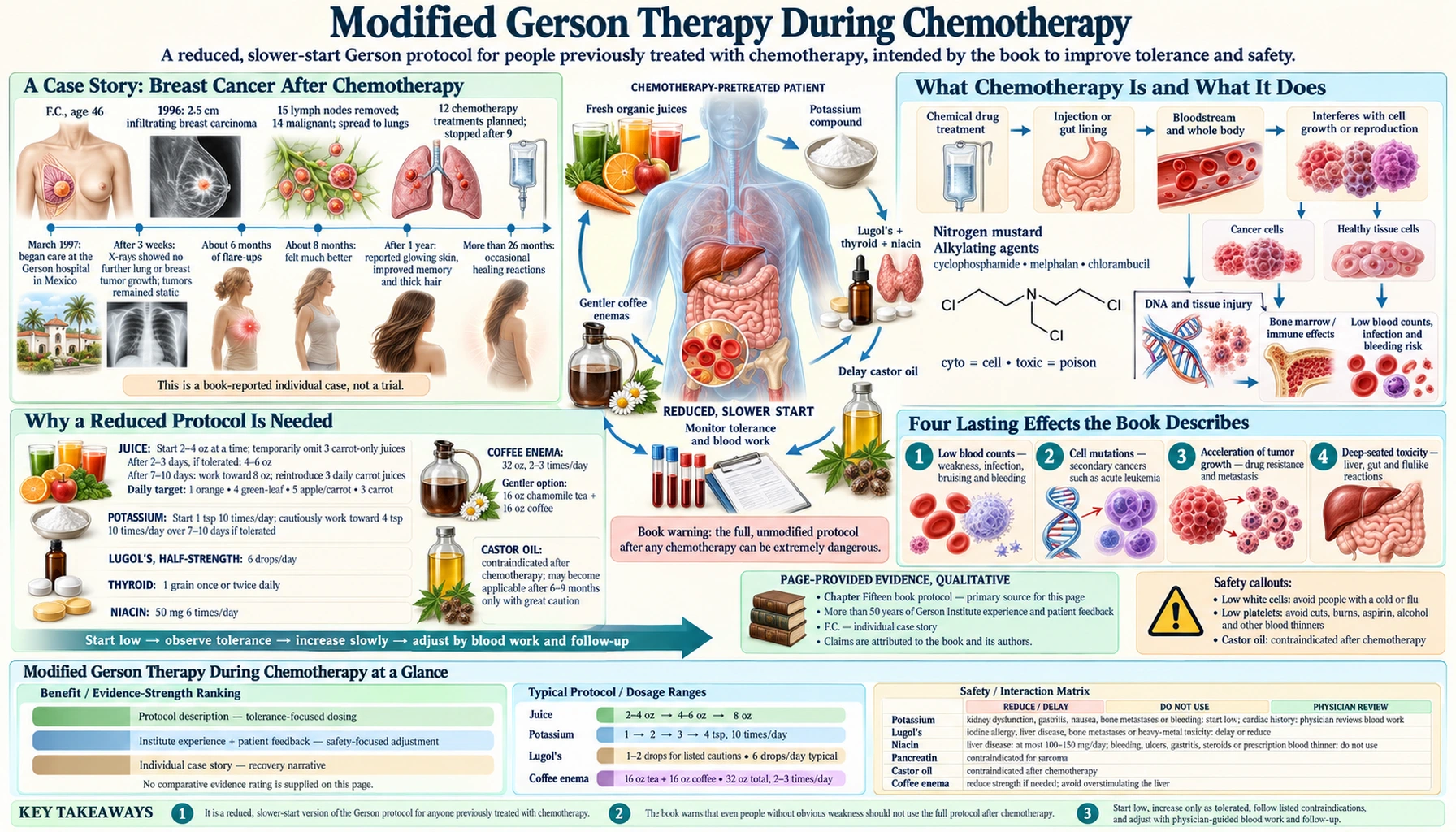
Chapter Fifteen of The Gerson Therapy, “Modified Therapy During Chemotherapy,” is written for one specific group of patients: people who have already received chemotherapy before they begin the Gerson program. The authors call it “another pivotal portion of our book,” because, they state, the full, unmodified Gerson protocol “can be extremely dangerous” for patients whose bodies have been extensively pretreated with cytotoxic (cell-poisoning) drugs.
The chapter explains what chemotherapy is in the authors’ view, the lasting effects they say it leaves behind, and then sets out a reduced Gerson protocol: smaller starting juice portions, lower and slower-rising doses of potassium, Lugol’s solution, thyroid and niacin, a list of contraindications for each medication, gentler coffee enemas, a delay before castor oil, and a follow-up schedule for the first year. Below, each part is summarized as the book presents it.
Table of Contents
- 1. A Case Story: Breast Cancer After Chemotherapy
- 2. What Chemotherapy Is and What It Does
- 3. Why a Reduced Protocol Is Needed
- 4. Four Lasting Effects the Book Describes
- 5. Pretreated Patients Without Outward Weakness
- 6. Juice Consumption on the Reduced Protocol
- 7. Potassium Compound Solution
- 8. Lugol’s Solution and Thyroid
- 9. Niacin, Enzymes, Liver/B12 and CoQ10
- 10. Castor Oil and Coffee Enemas
- 11. Follow-Up Therapy in the First Year
- Key Research Papers
- Connections
- Featured Videos
1. A Case Story: Breast Cancer After Chemotherapy
The chapter opens with the story of F.C., a forty-six-year-old housewife and piano teacher from Stockport, England. In 1996 a mammogram, ultrasound and needle biopsy showed an infiltrating breast carcinoma measuring 2.5 centimeters. During her mastectomy fifteen lymph nodes were removed, and the book reports that fourteen were malignant. X-rays showed the cancer had spread to her lungs.
A twelve-treatment chemotherapy course was planned over a full year. The book describes each month’s treatment leaving her with nausea and vomiting lasting days and nights, steady loss of lean muscle, complete hair loss, and a severe drop in white blood cells (neutropenia). Pneumonia, cold sores and other infections followed each course, and she was hospitalized after each one. Her doctors stopped treatment after nine of the twelve courses; the book states her lungs had not improved and she was sent home classified as “terminal.”
A local naturopath told her about the Gerson Therapy, and in March 1997 she arrived at the Gerson hospital in Mexico. Detoxification, the book says, “was not easy” — she had ongoing nausea and vomiting as reactions to her earlier chemotherapy. After three weeks, her X-rays at discharge showed, in the book’s words, “such vast improvement that there was no further lung and breast tumor growth”; the tumors remained static in size.
She then experienced about six months of flare-ups, which the authors attribute to chemicals lingering in her body. In late 1997 her skin showed shades of gray and she was again vomiting with nausea so severe it kept her awake — “very similar to what I experienced immediately after receiving chemotherapy,” she said. She described it as feeling like flu, yet found it marked the turning point. About eight months into home therapy she felt much better and her friends found her cheerful and vivacious.
After a year she reported: “now, my skin is glowing, my memory is improved, my hair has grown back thick.” A fungal toenail infection acquired during chemotherapy grew out, and varicose veins in her left leg were receding. At the time of writing she was more than twenty-six months into the treatment and still had occasional healing reactions. The authors explain they tell her story because the Gerson Institute is often asked whether chemotherapy-treated patients have recovered: “it takes longer to come back to good health after chemo — but with perseverance, it is entirely possible.”
2. What Chemotherapy Is and What It Does
The book explains the word plainly: chemo refers to chemicals and therapy to treatment, so chemotherapy is cancer treatment with chemical drugs. These drugs destroy the cancer cells they reach by interfering with growth or preventing reproduction. Some act only during certain phases of a cell’s life cycle; others act throughout it.
The authors stress that it would be ideal if a drug spared healthy cells, but state that “nearly every cancer chemotherapeutic agent destroys tissue cells — pathological or physiological, sick or well.” Almost all are cytotoxic: “cyto” meaning cell, “toxic” meaning poison.
The book traces cytotoxic drugs to the 1940s, when researchers at Yale University School of Medicine recognized that nitrogen mustard, a World War I gas, had selectively damaged the lymphatic system and bone marrow of soldiers. The first chemotherapy application followed at Yale in the mid-1940s, and from it came the alkylating agents such as cyclophosphamide, melphalan and chlorambucil, which, the book says, link up with and destroy normal components of all cells, mainly their DNA.
Cancer itself is described as a condition in which an abnormal cell mutates and multiplies uncontrollably because its DNA escapes the mechanisms that normally keep growth orderly. Since the real cause is not fully known, the authors write that anyone with tumor growth would benefit from the standard Gerson Therapy — unless their immune system has been compromised by chemotherapy, in which case “a lessened or reduced Gerson protocol has to be followed.”
3. Why a Reduced Protocol Is Needed
The authors state their opinion that chemotherapy is too often used “as a first resort when it probably should be among the last,” that it further degrades an already impaired immune system, and that all cytotoxic drugs are carcinogens. They write that, as shown in earlier chapters, chemotherapy produces five-year survival in less than 15 percent of all malignancies, though it may temporarily halt growth or relieve pain.
For patients who have received it, the book says, the medication protocol differs from the standard one. Quantities vary considerably and “no absolute guidelines may be given”; the number of courses, the doses and the specific drugs received must all be considered. The key warning is that the more aggressive protocol described in the book’s Chapter 14 could inhibit long-term recovery in these patients, whereas the reduced protocol helps them “respond more quickly and experience better long-term recoveries.” The rules, the authors note, rest on more than fifty years of Gerson Institute experience and patient feedback.
The book contrasts chemotherapy with surgery and radiotherapy: the latter concentrate on one region, while chemotherapy enters the bloodstream, by injection or through the gut lining, to reach cancer cells that may be anywhere in the body. That body-wide reach is why, in the authors’ view, it affects the physical conditioning of everyone who receives it. They cite over sixty-five commercially available cytotoxic drugs, with an equal number in clinical trials.
4. Four Lasting Effects the Book Describes
Beyond the familiar immediate side effects — sleepiness, fatigue, diarrhea, hair loss, sore mouth, low blood counts, nausea and vomiting — the book describes four deeper, longer-lasting effects that it says are rarely discussed between oncologist and patient:
- Low blood counts. Prolonged low blood components bring weakness, lethargy, chronic fatigue, depression and prostration. Low white cells leave the patient open to infection, so the book says avoiding anyone with a cold or flu “becomes absolutely mandatory.” Low platelets cause easy bruising and bleeding: the patient must avoid cuts, burns and injuries and steer clear of aspirin, alcohol and other blood thinners. Very low platelets may require transfusion.
- Cell mutations. Years later, patients may develop secondary cancers such as acute leukemia. The book reports that the International Agency for Research on Cancer has identified twenty commonly used anticancer agents as carcinogens, associated particularly with certain alkylating agents, most hormone-like anticancer chemicals, and drug “cocktails.” It quotes a standard oncology textbook: certain three- and four-drug combinations led to leukemia incidence of 14 percent over four years and up to 17 percent in Hodgkin’s disease, and “radiation further increases the risk.”
- Acceleration of tumor growth. The book states that tumors sometimes become drug-resistant and, paradoxically, better able to grow and metastasize after contact with chemotherapy, citing patient and animal studies.
- Deep-seated toxicity. The body treats cytotoxic agents as “the ultimate pollutants” and tries to release them. The book lists the signs: compromised liver function; ongoing diarrhea flushing irritating bile; cramping lower-abdominal pain; flatulence and gas; and periodic flulike episodes of headache, perspiration, strong body odor, weakness, dizziness, fainting spells, intestinal spasms and muscle aches.
Once the Gerson Therapy begins cleaning these residues out, the authors write, the poisonings flare up as what Gerson Institute staff call “healing reactions,” like those F.C. described.
5. Pretreated Patients Without Outward Weakness
The book notes that not every chemotherapy patient shows obvious weakness. Some keep a normal appetite, stay on their feet and avoid extreme weight loss — “a truly lucky individual.” Even so, the authors say subclinical dysfunction is likely present, and these patients too should follow the reduced protocol.
The warning is stated without exception: pursuing the full, unmodified protocol after any chemotherapy, “regardless of the time elapsed since the last treatment, can be extremely dangerous.” Any health professional advising on the therapy should weigh the number of courses, the doses and the drugs received. Using any part of the more aggressive protocol, the book says, comes “at the expense of safety and long-term recovery.”
6. Juice Consumption on the Reduced Protocol

Citing Max Gerson’s A Cancer Therapy: Results of Fifty Cases, the book calls fresh-pressed organic juice “a potent source of nourishment and an exceedingly powerful detoxifying tool” — which is exactly why it is introduced more gently after chemotherapy:
- Start with only 2 to 4 ounces of fresh vegetable or fruit juice at a time.
- At first, temporarily leave out the three carrot-only juices, because of their strong effect.
- If the small amounts are tolerated, increase after two or three days, typically to 4 to 6 ounces at a time.
- After seven to ten days, work toward the full 8-ounce portions, then reintroduce the three daily carrot juices.
The target daily schedule the book recommends is: one orange juice, four green-leaf juices, five apple/carrot juices, and three carrot juices. Dosage depends on the patient’s condition, tolerance and side effects. The book’s caution is emphasized: care must be taken that the patient tolerates all juices without significant nausea; if side effects appear, cut back on the doses. To reduce nausea and improve tolerance, gruel may be added to the juice up to 50 percent of the volume.
7. Potassium Compound Solution
The suggested starting dose is 1 teaspoon ten times per day — about 500 mg (12.5 mEq) each of potassium acetate, gluconate and monophosphate, for a total of 1.5 grams or 37.5 mEq per day.
- Patients in good condition despite chemotherapy may cautiously reach the normal dose of 4 teaspoons ten times per day in several steps over seven to ten days, if no adverse effects are seen.
- Patients in less than ideal condition go to 2 teaspoons ten times daily, are observed carefully, and very slowly increase to 3 and then 4 teaspoons as tolerated.
Contraindications the book lists: patients with a history of kidney insufficiency or dysfunction, gastritis, nausea, significant bone metastases or any bleeding problems should start at 1 teaspoon ten times daily and increase slowly under observation. Anyone with a history of cardiac insufficiency, heart attack or congestive heart failure should not receive potassium until a physician has analyzed their blood work.
8. Lugol’s Solution and Thyroid
Lugol’s solution (half-strength)
The recommended dose is six drops per day, with contraindications the book spells out:
- A history of iodine allergy: not given at first; it can be cautiously added after three to five days, starting with one drop and increasing as tolerated.
- Liver insufficiency, primary or metastatic liver tumors, hepatitis or cirrhosis: start at one to two drops daily, to avoid bleeding or a fall in platelets.
- Bone metastases: reduced Lugol, to avoid excessive bone deterioration and pain.
- Known heavy-metal toxicity: one to two drops daily initially.
Thyroid
Thyroid hormone is taken as 1 grain once or twice daily, with contraindications similar to Lugol’s. Watch for signs of hyperthyroidism — rapid heartbeat, anxiety, insomnia and tremors — and reduce the dose if they appear. The book adds that a brief rapid heartbeat alone can be a toxic or flare-up reaction. Patients with cardiac insufficiency or other heart problems should be started on a maximum of 2 grains daily.
9. Niacin, Enzymes, Liver/B12 and CoQ10
- Niacin: 50 mg six times per day. Patients with liver insufficiency, liver tumors, hepatitis or cirrhosis receive at most 100 to 150 mg daily. Those with a history of bleeding, ulcers or gastritis, or who are taking prednisone, other steroids or a prescription blood thinner, should not receive niacin.
- Pancreatin (pancreatic enzyme): three 325-mg tablets four times a day; contraindicated for sarcoma patients.
- Crude liver / B12 injection: once daily, intramuscular, 100 mcg of vitamin B12 with 3 cc of crude liver extract. Apart from excessive B12 levels and occasional allergic reactions, the book reports no known contraindication.
- Betaine hydrochloride with pepsin (a digestive aid): two capsules three times a day before meals. Not given to patients with gastric ulcers, gastritis, severe nausea, intestinal bleeding, esophageal problems, or those on a prescription blood thinner.
- Coenzyme Q10: 90 mg on day one; if no rapid heartbeat or arrhythmia, 300 mg on day two and 600 mg on day three, remaining at that dose thereafter.
- Proteolytic gastrointestinal enzyme blends: indicated mainly for severe, excessive gas; the book notes some reports that they may help reduce tumor masses.
- Laetrile (amygdalin): indicated, the book says, for bone metastases and possibly lung cancers, chiefly to reduce pain, generally effective ten days to two weeks after daily use begins; 3 grams (5 cc) intravenously once daily, when available.
- Brewer’s yeast: not recommended in most cases, because of the risk of developing or worsening candidiasis, and frequent reports of severe bloating and gas.
10. Castor Oil and Coffee Enemas

Castor oil
The book states castor oil treatment is contraindicated in patients who have had chemotherapy. It may become applicable after six to nine months on the Gerson Therapy, but only “with great caution”: castor oil is a powerful detoxifier, and long-buried cytotoxic residues coming out of the tissues may produce severe healing reactions.
Coffee enemas
Chemotherapy-pretreated patients take a 32-ounce coffee enema two to three times per day. For some people the strength is halved by mixing 16 ounces of chamomile tea with 16 ounces of coffee. The amount may be increased gradually as needed, but the book warns not to overstimulate the liver and provoke extremely toxic side effects from the release of chemotherapy residues.
11. Follow-Up Therapy in the First Year
The book says follow-up is required, with medication changes during the first year. About one month after discharge from the inpatient center (probably six to nine weeks after starting the therapy), thyroid, potassium and Lugol’s are adjusted:
- Patients on extremely reduced levels may have these three increased by 25 to 50 percent; other supplements generally stay at initial levels.
- Patients on normal levels (for example 40 teaspoons of potassium and eighteen drops of Lugol’s) have them reduced by about 50 percent.
The adjusted levels are generally kept for nine to fourteen months, with changes guided by blood work and other diagnostics. The authors note that this differs significantly from Dr. Gerson’s original A Cancer Therapy: patients now stay on higher doses of the three main medications for longer, because when medications are reduced too rapidly, patients “often have difficulties and experience a slowing of recovery or a recurrence of disease.” The chapter closes with the authors’ statement that following these instructions will “ensure health improvement and potential recovery from disease” for patients who underwent chemotherapy first.
Key Research Papers
- Gerson C, Walker M. The Gerson Therapy: The Proven Nutritional Program for Cancer and Other Illnesses. New York: Kensington; 2001. Chapter Fifteen, “Modified Therapy During Chemotherapy.” — primary source for this page.
- Gerson M. A Cancer Therapy: Results of Fifty Cases. 1958. — the original protocol the chapter’s follow-up schedule is compared against.
- Morra M, Potts E. Choices: Realistic Alternatives in Cancer Treatment. New York: Avon Books; 1980, pp. 174–175. — cited in the chapter.
- Moss RW. Questioning Chemotherapy. Brooklyn, NY: Equinox Press; 1995, p. 173. — cited in the chapter.