Melanoma and the Gerson Therapy
Chapter Six of The Gerson Therapy, “Healing Melanoma with the Gerson Therapy,” is the book’s most detailed look at a single cancer. Charlotte Gerson and Morton Walker describe melanoma — the malignant mole — as the most dangerous of all skin cancers, and they set out to show how patients with even advanced, widely spread disease fared on Dr. Max Gerson’s diet-and-detoxification program.
The chapter rests on two pillars: a 1995 peer-reviewed retrospective review of five-year survival among 153 melanoma patients treated the Gerson way, and a series of patient stories, from stage IV skin melanoma to melanoma of the eye. This page walks through both, in the book’s own terms, together with the book’s explanation of why it believes cancer takes hold in the first place.
Table of Contents
- What Melanoma Is
- A Stage IV Case: Dael M.
- The Regression Timeline
- The 1995 Retrospective Review
- The Protocol the Study Patients Followed
- Five-Year Survival by Stage
- Why Gerson Says It Works
- More Patient Stories
- Melanoma of the Eye and Pregnancy
- The Wider Picture: Chronic Disease
- Cautions and Supervised Care
- Key Research Papers
- Connections
- Featured Videos
1. What Melanoma Is
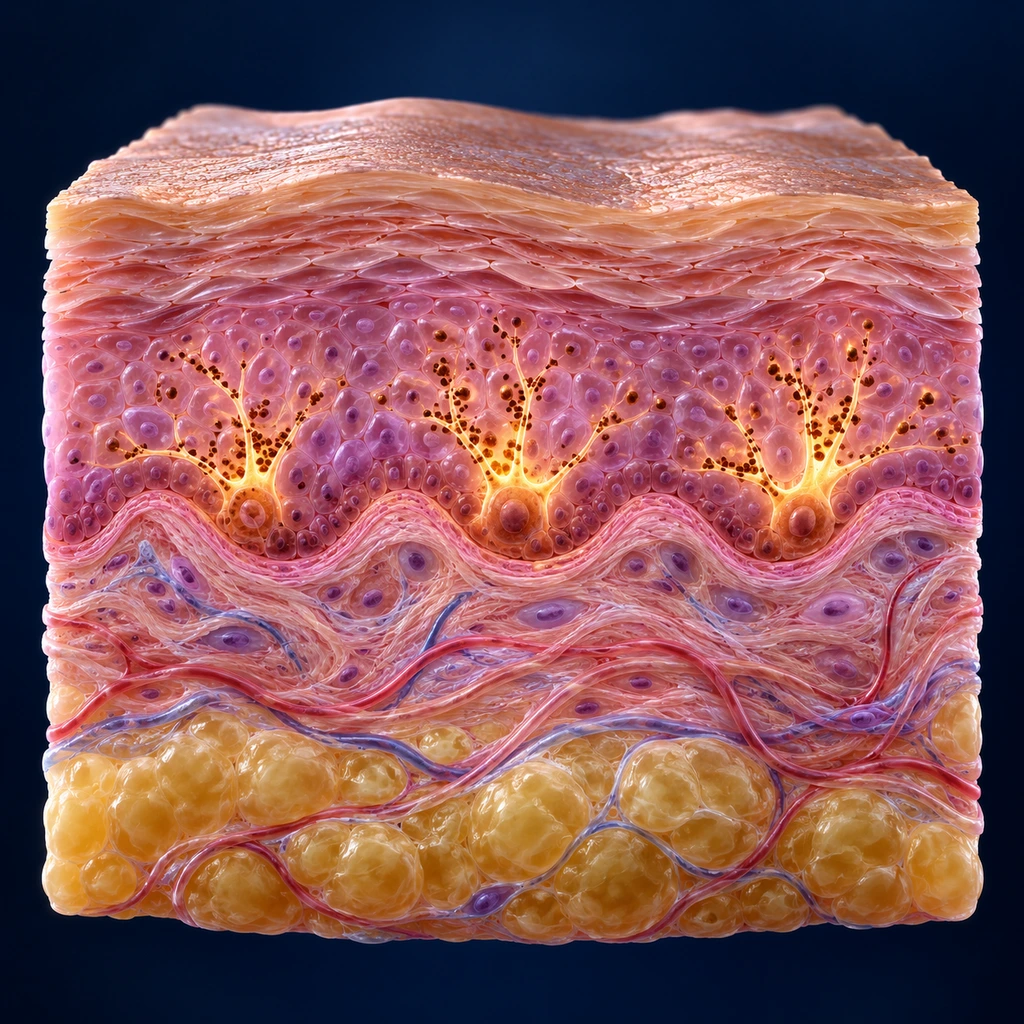
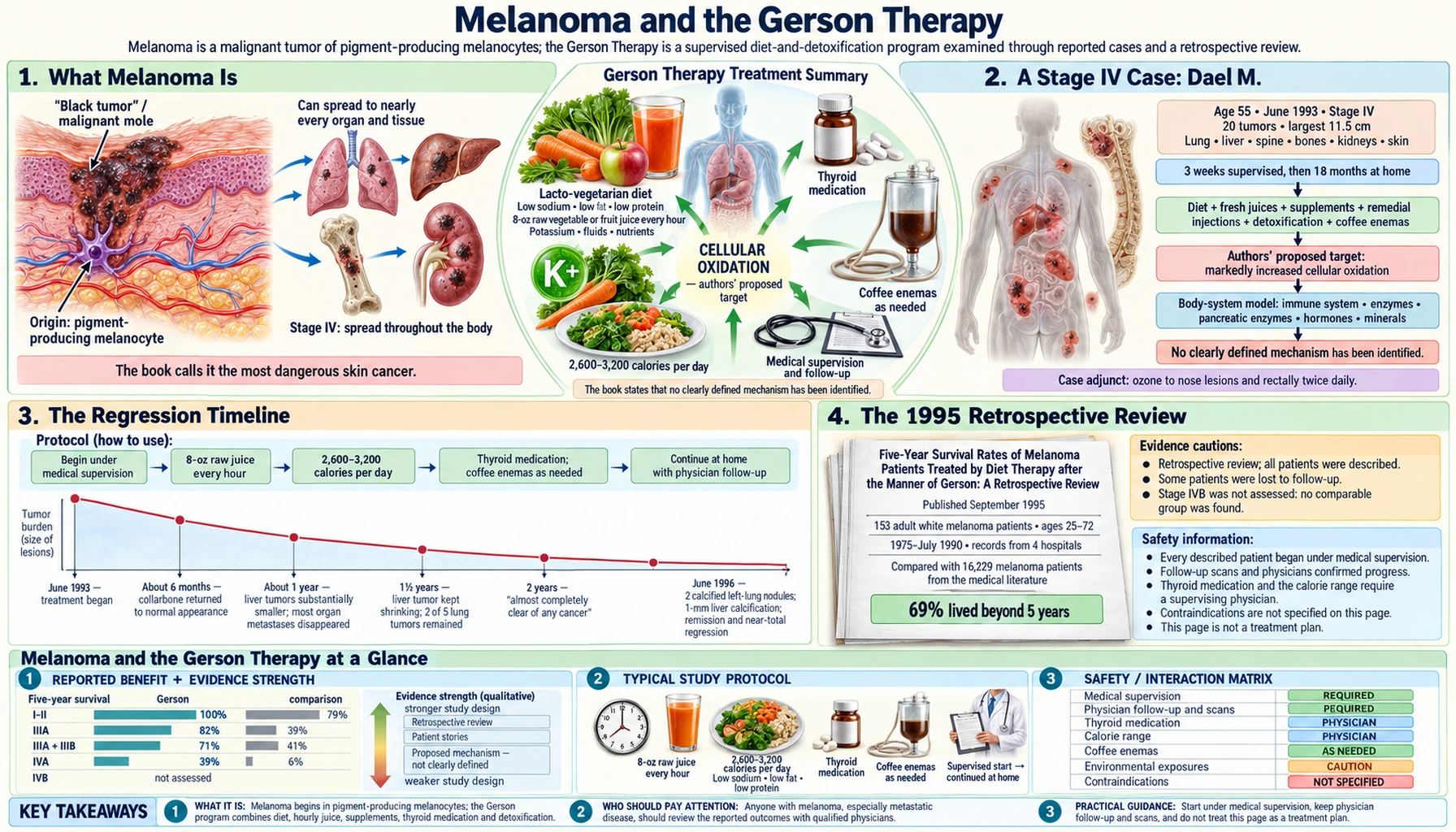
The book explains that the word melanoma literally means “black tumor.” It is a malignant mole, which the authors call the most dangerous of all skin cancers and among the most malignant of all cancers. Melanoma can spread to nearly every organ and tissue, and, the book states, it can lead to death within a year once it recurs in distant sites. When it has spread (metastasized) throughout the body, it is classified as stage IV.
Some further points the chapter makes:
- Melanoma is most common in people in their forties to sixties.
- Its incidence, the authors write, was rising faster worldwide than that of any other cancer; in the United States more than 40,300 cases occurred in 1997, with a higher number counted for 1998.
- All melanomas arise from a single cell type, the pigment-producing melanocyte. There are variants by shape, such as cuboidal or spindle-shaped cells. In skin melanomas they behave much alike; in eye melanomas the shape matters a great deal to behavior.
- Although it is rare for a pregnant woman’s tumor to spread to her unborn child, melanomas lead the list of tumors that do.
The book notes that stage IV melanoma is regarded as resistant to radiation, immunotherapy and chemotherapy, and that it is generally considered among the most difficult cancers to overcome. That is the backdrop against which the authors present their cases.
2. A Stage IV Case: Dael M.
The chapter opens with Dael M., aged fifty-five, of Southern California, who arrived at a Gerson treatment hospital in Tijuana, Mexico, in June 1993 with stage IV melanoma. Her Gerson-trained physician, Dr. Alicia M., is quoted as saying that the staff at first thought her prognosis “rather poor.”
According to the book, her disease included:
- tumor masses in the lungs and liver;
- lesions engulfing and compressing vertebrae in the mid-back and neck;
- a largest tumor measuring 11.5 centimeters across;
- a mass of lumps just under the skin of her chest;
- a tumor on her nose that had returned after surgery and a skin graft and grew to the size of a grape;
- in total, twenty tumors throughout her body, including the hip, spine, liver, bones and kidneys, with a visibly distended collarbone.
Her doctors at home had predicted she had less than six months to live. She spent three weeks at the Gerson facility and then followed the program on her own for eighteen months: the specialized diet, fresh vegetable juices, nutritional supplements, remedial injections, detoxification and coffee enemas. The book adds that she also received ozone applied to her nose lesions and taken rectally twice daily for general detoxification.
At the end of the three weeks she still had lesions, but felt a great deal more energy, and the Gerson doctors judged her “well on the road to recovery.” Dr. M. described her condition on admission as “like a train plummeting down a mountain” that had to be stopped and pushed back up.
3. The Regression Timeline
The book traces Dael M.’s progress step by step:
- About six months in: her collarbone returned to a normal appearance.
- About a year in: CAT scans showed a substantial size reduction in her liver tumors, and most other organ metastases had disappeared.
- A year and a half in: the liver tumor continued to shrink, and only two of an initial five lung tumors remained.
- Two years in: Dr. M. pronounced her “almost completely clear of any cancer.”
- June 1996: only two calcified nodules remained on her left lung and a single 1-millimeter calcification on her liver. The book describes her as in remission and near total regression.
Between 1993 and 1996, the nose tumor flattened out, developed a hollow in its center and lightened in color. The authors note that average life expectancy for stage IV melanoma is under one year in almost all cases, and that she was still alive seven years on. Her results were confirmed, the book says, both through her local oncologist and return visits to the Tijuana center. Her oncologist was described as “thunderstruck and amazed” and encouraged her to stay on the therapy; she continued to see him periodically to confirm the melanoma was staying away.
4. The 1995 Retrospective Review
The authors present Dael M.’s case because, they say, it was even worse than most melanomas in a broad retrospective study — a review that looks back at how past patients fared. The study, “Five-Year Survival Rates of Melanoma Patients Treated by Diet Therapy after the Manner of Gerson: A Retrospective Review,” was published in September 1995 by G. L. Hildenbrand, L. Christeene Hildenbrand, Karen Bradford and Shirley W. Cavin.
Key features as the book describes them:
- It was carried out by members of the Gerson Institute and a cancer prevention and control program at the University of California, both in San Diego.
- It covered fifteen years, from 1975 through July 1990, and 153 adult white melanoma patients aged twenty-five to seventy-two.
- It described all patients, including those who did not respond to therapy.
- It spanned stages I and II (localized), IIIA and IIIB (regionally spread), IVA (distant lymph, skin and under-the-skin spread) and IVB (spread to internal organs).
- A few patients had been treated by private physicians, but almost all had been hospitalized at Gerson facilities in the Tijuana area; records came from four different hospitals.
- Survival was measured at five years, the point regarded as a “cure” by cancer statisticians.
Gerson patients were compared against outcomes for 16,229 melanoma patients drawn from the medical literature who had received other treatments. Overall, the book reports, 69 percent of the Gerson patients lived beyond five years.
5. The Protocol the Study Patients Followed

The book summarizes the treatment the study patients received as follows:
- a lacto-vegetarian diet that is low in sodium, low in fat and low in protein;
- raised amounts of potassium, fluid and nutrients, given as an eight-ounce glass of raw vegetable and/or fruit juice every hour;
- thyroid medication to raise the metabolism;
- a calorie supply limited to 2,600 to 3,200 calories per day;
- coffee enemas as needed for detoxification, pain relief and improved appetite.
The book points out that Dr. Max Gerson first developed this nutrition-based approach while conducting research at the University of Munich, published his results in Europe, and publicized them more widely after he emigrated to the United States in 1936. The patients in the study began the therapy under medical supervision and, like Dael M., then continued it at home.
6. Five-Year Survival by Stage

The heart of the chapter is the stage-by-stage comparison. As the book reports it:
| Stage | Gerson patients | Alive at 5 years (Gerson) | Comparison group | Alive at 5 years (comparison) |
|---|---|---|---|---|
| I and II | 14 | 100% | 15,798 patients, worldwide survey | 79% |
| IIIA | 17 | 82% | 103 patients, a German specialist clinic | 39% |
| IIIA + IIIB | 33 | 71% | 134 patients, the same clinic | 41% |
| IVA | 18 | 39% | 194 patients, a U.S. cooperative oncology group | 6% |
| IVB | Not assessed — no comparable group could be found anywhere | |||
The book also states that a major cancer charity has reported a 39 percent five-year survival rate for stage III melanoma, against 71 percent for the assessable Gerson patients. Survival, the authors found, was clearly linked to stage. Some patients were lost to follow-up because they died of other causes or moved out of contact.
Two further findings are highlighted. First, men and women had identical survival in stages I through IIIB, but in stage IVA women had a strong survival advantage over men. Second, stage IVB was left out not for lack of patients — the review had them, all gravely ill — but because, the book says, no comparable group of such patients anywhere had lived long enough to compare against.
7. Why Gerson Says It Works
The book is candid that various parts of the program have been offered as reasons for patients’ success, but that “no clearly defined mechanism has been identified.” What it does say is that the components of the therapy are aimed at improving the oxidation process of the sick patient’s cells — and that to treat cancer and other degenerative disease properly, oxidation must be increased markedly.
Elsewhere in the chapter, Charlotte Gerson lays out the core Gerson view of how cancer arises. Every malignancy, she writes, shares the same two underlying problems: deficiency and toxicity. In her account:
- A healthy body cannot produce cancer; with all defenses in place, the immune system kills and removes cancer cells wherever they develop.
- Before a cancer becomes evident, the major defenses weaken or disappear: the immune system fails, the enzyme system is damaged, the pancreatic enzymes stop destroying foreign proteins (tumor tissue), the hormone system is depleted and minerals are lacking.
- The therapy, the book says, corrects the body’s internal environmental factors that have gone wrong.
8. More Patient Stories
Julie H. — melanoma in many sites
Julie H. was twenty-two in 1988 when a mole removed from her right shoulder proved to be melanoma. Over the next four years she had seven operations — removing a lump from her neck, a tumor from her brain, a cyst from an ovary, tissue from a tonsil and a foot and a half of colon — and each time biopsies found melanoma. After the colon surgery she began the Gerson Therapy with help from her mother and regular consultations with nearby physicians who use it. Apart from a minor setback in 1993, when she moved into a newly painted and carpeted home and had environmental allergies, she felt “great.” Eleven years after diagnosis, the book reports, she had had no further recurrence and remained on a less intensive version of the program.
Carol A. — melanoma, arthritis and hepatitis C
Carol A. came to the therapy after her father was diagnosed with melanoma. Frightened, she had a lesion biopsied that had been frozen off several times before; it proved to be melanoma. She spent two weeks at a Gerson hospital and continued at home. Both her melanoma and the arthritis that ran in her family disappeared, the book says, and stayed away. In December 1995 a liver biopsy showed stage III hepatitis C; she returned to the therapy and her liver enzymes came back to normal. Her own words, as quoted: “Cancer is a symptom. Treat the cause,” and “On the Gerson Therapy, I feel like I just get better and better.”
Kathleen M. — stage IVB melanoma
After a mole and lymph nodes were removed from her right arm, Kathleen M. was diagnosed with stage IVB melanoma, which the book calls the deadliest known form of skin cancer. Within a year it had spread to her liver and adrenal glands, and her family was told she had thirty days to live. She entered a Gerson facility in Tijuana in October 1993, embraced the program with vigor and, the book reports, immediately felt rejuvenated.
9. Melanoma of the Eye and Pregnancy
The chapter closes with Lana M., who at twenty-six, a year after a pregnancy marked by prolonged poor nourishment, had been diagnosed with ocular melanoma of the left eye. Because she was pregnant she had not received chemotherapy, but by the time her son was a year old she had undergone seven operations to remove melanoma spreading around her left eyeball; the cancer kept returning in the eye socket. Her doctors told her family she would not live five months.
In 1982 she and her mother went to a Mexican cancer clinic using the Gerson Therapy, bringing her baby. At that time her affected eye was totally blind. She followed the therapy faithfully. By 1999, the book reports, she had been completely well for over a dozen years, had given birth to three more healthy children, needed no corrective lenses and had 20/20 vision in the formerly affected eye. The whole family lives by Dr. Gerson’s principles.
Charlotte Gerson on pregnancy and cancer
Charlotte Gerson uses Lana’s story to explain why young mothers may develop cancer. Many young women, she writes, have bodies barely maintaining balance under ordinary conditions. Pregnancy demands that the body build an entirely new person. Nature always provides for the baby, so if the mother’s diet does not supply enough vitamins, minerals and enzymes, they are drawn from her own already marginal reserves. With defenses depleted, illness appears in her weakest system — possibly a malignancy, or toxemia of pregnancy, kidney or genitourinary trouble.
The remedy she describes is food that supplies fresh, raw vitamins, minerals and enzymes in an absorbable form rather than in pharmaceutical preparations — in contrast to a typical modern diet she describes as deficient in live nutrients and burdened with excess fat, protein and salt plus preservatives, dyes and emulsifiers.
10. The Wider Picture: Chronic Disease
The authors place melanoma within a larger rise in chronic illness. They note that chronic disease replaced infectious disease as the dominant public-health issue in the 1920s, before antibiotics. The book cites these figures:
- the first National Health Survey (1935) found 22 percent of Americans living with a chronic condition;
- by 1987 nearly 30 percent — upwards of 90 million people — had one or more chronic conditions;
- based on trends, some 50 percent (perhaps 150 million people) were expected to be chronically ill by the end of 2000;
- in Medicare, more than 10 percent of beneficiaries consumed about 72 percent of medical resources.
The book presents the Gerson Therapy as a main method for eliminating chronic degenerative diseases of all types, and especially the hundred or more types of cancer.
11. Cautions and Supervised Care
The chapter itself shows a consistent pattern that patients should note:
- Every patient described started under medical supervision — at a Gerson hospital or with physicians trained in the method — before continuing at home.
- Patients kept seeing their own doctors and had follow-up scans and return visits to confirm progress.
- Recovery took time: Dael M. followed the program for eighteen months after her hospital stay, and Lana M. for sixteen years.
- Julie H.’s setback in a newly painted and carpeted home is offered as a reminder that environmental exposures matter during recovery.
- The study protocol included thyroid medication and a set calorie range, which are matters for a supervising physician.
This page reports the book’s account; it is not a treatment plan. Anyone with melanoma should make decisions together with qualified physicians.
Key Research Papers
- Gerson C, Walker M. The Gerson Therapy, Chapter Six: “Healing Melanoma with the Gerson Therapy.” Primary source for this page.
- Hildenbrand GL, Hildenbrand LC, Bradford K, Cavin SW. Five-year survival rates of melanoma patients treated by diet therapy after the manner of Gerson: a retrospective review. Altern Ther Health Med. 1995;1(4):29-37. PubMed PMID: 9359807
- Gerson MB. Dietary considerations in malignant neoplastic diseases; a preliminary report. Rev Gastroenterol. 1945;12:419-24. PubMed PMID: 21005988
PubMed Topic Searches
Connections
Featured Videos