Gerson Therapy — Thirteen Glasses: The Juicing Protocol
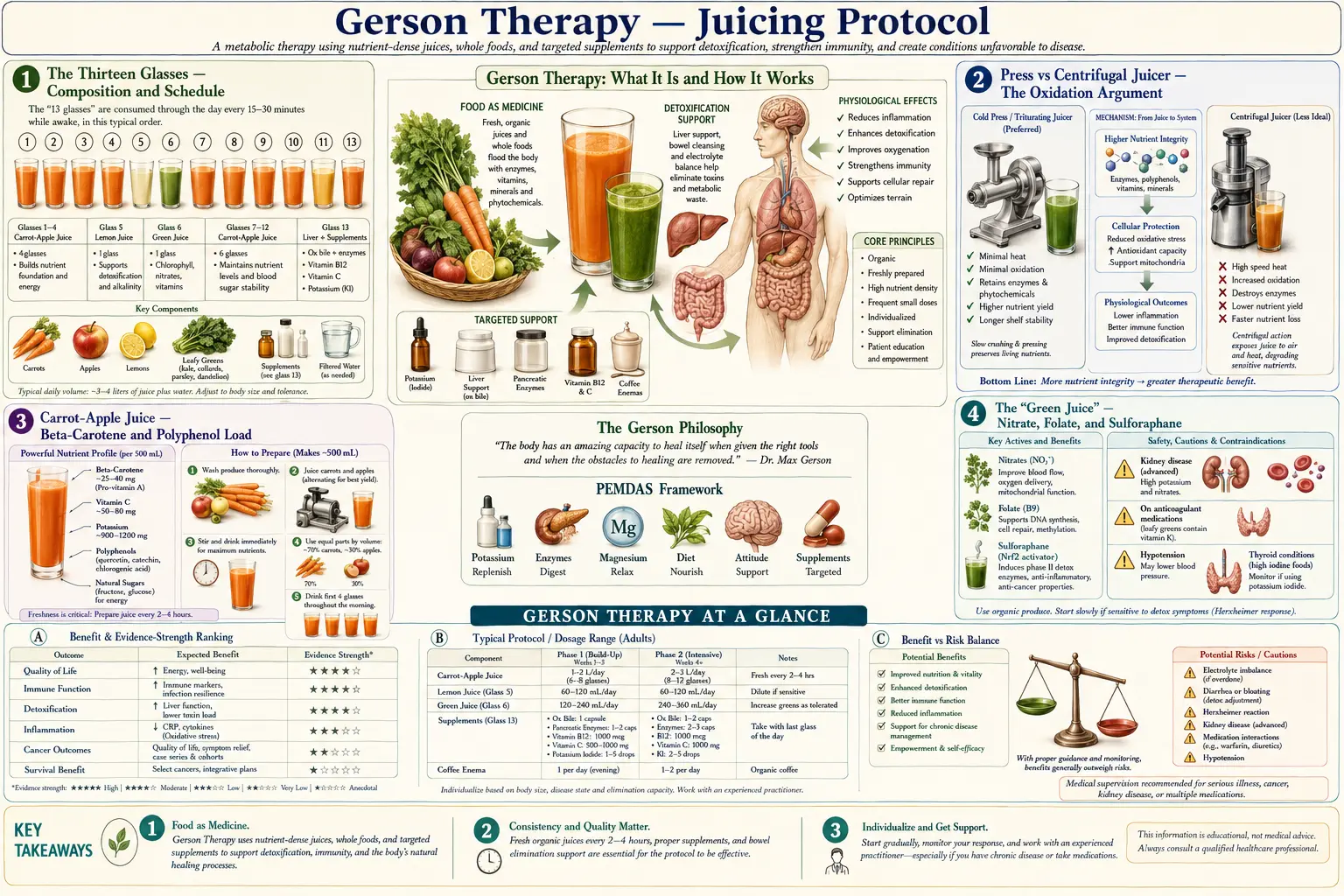
Juice is the backbone of the Gerson Therapy. Dr. Max Gerson prescribed thirteen 8-ounce glasses a day — about 104 ounces — one every waking hour: orange juice at breakfast, four green leaf juices, five apple-carrot juices and three of carrot alone, each pressed from organically grown produce and drunk at once. Drawing on Chapters Eight and Nine of The Gerson Therapy by Charlotte Gerson and Morton Walker, this page sets out the protocol as the book gives it: the composition and schedule, Gerson's reasons for high-dose juice nutrition, why he required a separate grinder and press, the recipe for each juice, the discontinued raw liver juice, the freshness rules, the gentler start for weakened patients, a case the book reports, and the kitchen logistics of three to five hours a day at the juicer.
Table of Contents
- The Thirteen Glasses — Composition and Daily Schedule
- Why Juice — Gerson's Case for High-Dose Nutrition
- Grinder and Press — The Juicer Gerson Required
- Carrot-Apple and Carrot Juice
- The Green Leaf Juice
- Citrus — The Breakfast Glass
- Raw Calf's Liver Juice — The Historical Component
- Freshness Rules and the Questions Patients Ask
- Starting Gently — Juices for the Weakened Patient
- A Case from the Book — Juicing Through Hepatitis
- Juicing Without a Nervous Breakdown — Kitchen Logistics
- Key Research Papers
- Connections
- Featured Videos
The Thirteen Glasses — Composition and Daily Schedule
Chapter Nine of The Gerson Therapy takes its title from the number at the heart of the protocol: thirteen 8-ounce glasses of fresh juice a day, about 104 ounces in all. Dr. Gerson's instruction, as the book restates it, is that an ill person should take 8 ounces at least once every hour of the waking day, each glass pressed from organically grown produce and drunk the moment it is made.
The daily allotment the book gives is fixed by type:
- 1 glass of orange juice — at breakfast. Gerson regarded citrus as the least important juice therapeutically and included it mainly as a pleasant start to the day.
- 4 glasses of green leaf juice — pressed from a short list of leaves, with one apple per glass.
- 5 glasses of apple-carrot juice — the largest single component; the recipe calls for 3 carrots (6 oz) and 1 large green apple (6 oz) per 8-ounce glass.
- 3 glasses of carrot juice alone.
Chapter Eight places the juices inside the day's meals. Breakfast opens with 8 ounces of orange juice alongside a large portion of oatmeal — which, the book explains, provides “a soft cushion in the intestinal tract for the raw juices that follow.” Lunch and dinner each include 8 ounces of apple-carrot juice with the raw salad, at least 8 ounces of warm Hippocrates special soup, a baked potato, and freshly cooked vegetables. The remaining glasses fall hour by hour between meals; the book points readers to its appendix for the full Patient Hourly Schedule.
Plain drinking water is not part of the plan. Dr. Gerson held that water fills the stomach, dilutes its acid and digestive enzymes, and takes up capacity needed for the juices and the soup. “The juices provide adequate fluids,” Chapter Eight states.
Why Juice — Gerson's Case for High-Dose Nutrition
The book frames juicing as Dr. Gerson's answer to the subclinical malnutrition he found in his tubercular, cardiovascular, cancerous, diabetic and arthritic patients — a deficit he observed even in obese patients. Fresh juices, the authors write, furnish nearly all the vitamins, minerals, enzymes and phytochemicals, “including even proteins,” that the body needs to heal itself, and they do so in a form the gastrointestinal tract assimilates more readily than whole food.
The argument is one of volume. Thirteen glasses plus three vegetarian meals, the book calculates, equal 17 to 20 pounds of food a day — more than anyone could chew and swallow as solid produce during waking hours. To show the point, the authors work out what a blender would require to match 104 ounces of pressed juice: at least 6 pounds of carrots, 8 pounds of apples and four heads of lettuce every day, on top of three meals.
Juice matters most, in Gerson's view, for the patient who cannot eat. Degenerative disease, the book explains, often brings decreased gastric acid, poor digestion and loss of appetite — the wasting condition called cachexia — yet such patients “often are able to keep themselves nourished rather well merely by drinking fresh made juices.” The authors add that solid foods must still be part of the total intake.
The book reports that this method of feeding, developed over roughly thirty-five years from 1923 to 1958, produced in the authors' words “the best clinical results ever witnessed in medical practice by that midpoint in the twentieth century.” It also notes that Gerson repeatedly adjusted his “juice prescriptions” in response to each patient's blood tests, healing reactions, allergies and weight — sometimes almost daily in the first weeks — and that the same individual adjustment applies to patients today.
Grinder and Press — The Juicer Gerson Required
Dr. Gerson recommended two separate operations: a triturator, or grinder, that reduces the produce to a fine pulp, and a press that squeezes the juice out of it. All parts touching the ground food were to be stainless steel. The book reports that he chose this method “partly on an intuitive belief but mostly observing results in his patients,” and that later analyses of juices and patients' clinical results supported his original presumption.
The book surveys six machine types, ranked from least to most suitable:
- Masticating juicers — chew and extract in one step; fairly good juice, but much nutrient-bearing pulp is left behind and the grinding chamber heats up, which the authors say damages the juice's enzymatic quality.
- Centrifugal juicers — the most common and least expensive, and the least desirable for a Gerson patient. The produce is not ground finely enough, especially leafy greens, and centrifugal force leaves minerals and phytochemicals behind in the pulp. Gerson himself wrote that when the grinding wheel rotates against resistance with insufficient access of air, “positive electricity is produced and induces negative electricity on the surrounding wall. The exchange of positive and negative [ions] kills the oxidizing enzymes and renders the juice deficient,” and that patients who used centrifugal juicers did not experience healing successes.
- Wheatgrass juicers — not used; most patients find wheatgrass harsh on the stomach, and its desirable components are already in the green leaf juice.
- Citrus juicers — reamer types for oranges and grapefruit only.
- Blender/liquefiers — not juicers at all; they pulverize the produce without extracting the juice, so there is no reduction in bulk.
- The triturator (grinder)/press combination — the authors' preferred type, squeezing the ground pulp under pressure of as much as 2,000 pounds per square inch.
For the grinder/press, the book reports a juice that is fuller-bodied and pulp-free, about 35 percent more juice from the same produce, and still more from green leafy vegetables. Gerson advised mixing the pulps of different vegetables together thoroughly before pressing — possible only when grinding and pressing are separate steps. The authors write that research indicates this machine type yields as much as fifty times more of certain nutrients, such as lycopene in ripe tomatoes. The machine most favored by Gerson patients, the book notes, is the hydraulic press juicer invented about 1936 by Norman W. Walker, D.Sc.; in the authors' own survey, at least four of every five Gerson patients had invested in a grinder/press, and both coauthors use one many times daily.
The book is emphatic on why the choice matters. Gerson Institute staff, it reports, repeatedly observed patients who followed the therapy rigorously with a centrifugal juicer yet saw neither tumor reduction nor healing reactions after many weeks; when they switched to a grinder/press, “their healing reactions occurred rapidly, and many saw dramatic improvements in their conditions.” The authors conclude that the choice of juicer “may be a life-or-death matter,” while adding that any juicer is better than none, and that the costlier press probably pays for itself within a year by producing more juice from less produce.
Carrot-Apple and Carrot Juice
Eight of the thirteen daily glasses are carrot-based: five apple-carrot and three carrot alone. The book's appendix gives the method. Use apples and carrots in approximately equal proportions. Wash the apples but do not peel them; cut out the core. Scrub the carrots with a brush but do not peel or scrape them. Grind the apples and carrots together into a bowl, mix thoroughly, place the pulp in a juicer cloth, and press. The recipe section gives the per-glass quantity as 3 carrots (6 oz) and 1 large green apple (6 oz).
Apple-carrot is the one juice the book allows to be carried. A patient who returns to work may keep apple-carrot juice for 2 to 3 hours in a glass-lined or stainless-steel vacuum bottle filled to the top to limit air exposure. Carrot-only juice and green juice are not to be stored this way.
In nutritional terms, carrot juice is a concentrated source of beta-carotene, the plant precursor of vitamin A, and of potassium; apple contributes pectin and polyphenols such as chlorogenic acid. Carrot also carries the polyacetylenes falcarinol and falcarindiol, compounds studied in laboratory models for chemopreventive activity. The high potassium content fits the protocol's broader aim, discussed on the Mineral Density and Sodium-Potassium page, of restoring tissue potassium while sodium is withdrawn.
For the severely weakened patient, the book directs that the three carrot-only juices be temporarily eliminated at the start (see Starting Gently below).
The Green Leaf Juice
The green leaf juice is pressed from a defined list of leaves — “no others,” the recipe insists. The book's two listings name:
- Romaine lettuce
- Red lettuce
- Escarole
- Endive
- Watercress
- Swiss chard
- Beet tops (young inner leaves)
- Red cabbage (2–3 leaves)
- Green pepper (about a quarter of a small one)
One medium apple is added per glass when grinding. The book acknowledges that in some seasons only two or three of the leaves may be available, and directs patients not to substitute anything that is not on the list. The instruction for this juice is the strictest in the protocol: grind, press, drink immediately. Green juice is never stored or carried for later, because, the authors write, it oxidizes quickly and loses its value.
The book explains that the desirable components of wheatgrass are already present in the green leaf juice, which is “much easier on the digestive tract,” and that is why the Gerson program does not use wheatgrass. Nutritionally, this mix of leafy greens, beet tops and red cabbage supplies chlorophyll, folate, potassium, calcium, carotenoids such as lutein, dietary nitrate, and — from the cabbage and watercress — glucosinolates that give rise to isothiocyanates such as sulforaphane, which activate the body's NRF2 Phase II detoxification pathway.
Citrus — The Breakfast Glass
Orange or grapefruit juice is the first glass of the day. The book specifies how it is made: squeeze it only with a reamer-type juicer of glass, plastic or porcelain, never an aluminum one, and never use a press into which the fruit is inserted with its skin. If the skin is pressed, the book explains, it releases harmful fatty acids and aromatic substances from its surface into the juice.
Dr. Gerson considered citrus the least important juice for the therapeutic effect. The authors add their own opinion that some patients may do better replacing citrus with apple or carrot juice, noting that large quantities of orange juice have been described as promoting mucus formation. The book states that citrus juices should not be used by patients with collagen diseases such as rheumatoid arthritis or lupus erythematosus.
Raw Calf's Liver Juice — The Historical Component
For decades, raw liver juice was an integral part of the Gerson juice-drinking program. As Charlotte Gerson recalls it in the book, the liver “juice” was the liquid from grinding and pressing a calf's liver that had never been frozen, fetched fresh for each day's supply.
The book reports that the practice had to be discontinued in the late 1980s — it gives 1987 in one chapter and 1989 in another — because of repeated bacterial contamination of commercially available calves' livers with Campylobacter fetus subsp. fetus, along with parasitic contamination. The book states that comparisons of patients from different time frames show that those who received uncontaminated calf's liver juice had better survival outcomes overall.
In place of the juice, the book says patients may continue liver injections, and coenzyme Q10 supplementation helps replace some of the raw liver substances.
Freshness Rules and the Questions Patients Ask
Because the therapeutic enzymes in fresh juice “oxidize out of existence” on prolonged exposure to air, the book passes on a two-part rule from the Gerson Institute's telephone advisers:
- If at all possible, freshly prepare each 8-ounce glass and drink it immediately — especially important for the very ill patient.
- Do not prepare the whole day's juices in the morning for storage, because by the day's end you will probably be drinking deficient juice with many nutrients missing.
The chapter's question-and-answer section adds:
- When to drink? At least 8 ounces once every hour, which the authors acknowledge many find difficult.
- What if you cannot keep up? Drink as much as you can and keep trying to drink more: “more is better.”
- How soon after juicing? “At once!”
- May juice be stored? “No!” — but for someone working away from home, apple-carrot juice in a full glass-lined or stainless-steel thermos, or 8-ounce mason jars filled to the top, is acceptable if it is the only way to get the daily allotment. Never store green juice.
- Which combinations? Gerson urged carrot and apple, carrot alone, and the green leaf juice; the authors advise avoiding other juiced produce.
- Where is juice absorbed? Along the length of the intestinal tract, with relatively little absorption in the stomach, large intestine and rectum.
- Do juices flush the kidneys? Yes, the authors say: juices act as cleansing agents and are sometimes truly diuretic, with asparagus and celery juice as examples.
From a quarter century of advising on the therapy, the authors report that patients who make and drink juices throughout the day have a higher rate of healing success than those who regularly prepare juices several hours in advance.
Starting Gently — Juices for the Weakened Patient
The full thirteen-glass load is not where every patient begins. In its chapter on the modified therapy for severely weakened cancer patients, the book advises starting the juice regimen at 4 ounces per dose and temporarily eliminating the three carrot-only juices. If the patient tolerates the smaller amount, the dose may be raised after four to seven days, typically to 5 or 6 ounces per dose. The book directs that increases be carefully monitored to make sure the patient continues to tolerate every juice without significant nausea or other side effects.
To reduce nausea and improve tolerance, gruel may be added to any of the juices, up to 50 percent by volume. The underlying daily pattern stays the same: 1 orange, 4 green leaf, 5 apple-carrot, and 3 carrot juices once the carrot-only glasses are restored.
This follows the principle the book stresses throughout: Gerson tailored juice prescriptions to each patient's blood tests, healing reactions and tolerance. Throughout, the book refers changes in the protocol to the patient's Gerson-trained health professional.
A Case from the Book — Juicing Through Hepatitis
Chapter Nine opens with the account of an Orlando, Florida leatherworker who was struck by acute infectious hepatitis in 1981 at age thirty-eight. He developed fever, jaundice that lasted three weeks, and severe nausea, and had to give up his craft and shop. His physician had no curative treatment to offer and advised rest and fluids. After eight months of this, the book reports, he had not improved.
On a massage therapist's suggestion he read Gerson's A Cancer Therapy: Results of Fifty Cases, bought a hydraulic press juicer, and began the therapy on his own, drinking an 8-ounce glass of carrot-apple or green juice every waking hour — a minimum of thirteen glasses a day, sometimes more. In his own words as the book quotes them: “I immediately began to feel better. My liver enzyme test readings improved. They moved down from a pathological high of 2,400 to the normal range of 20. Within two months, when my physician reexamined me, his verdict was that I no longer remained infectious; my blood counts were normal.”
For several years afterward, he reported, occasional flulike symptoms returned, and each time a week, or sometimes just a few days, back on the full juicing schedule cleared them. “Even after just one day of drinking thirteen glasses of juice my body, especially my liver, felt better.” The book reports that he remains in good health, with the symptoms no longer recurring.
Juicing Without a Nervous Breakdown — Kitchen Logistics
The book is frank about the work involved: the patient or support person will spend three to five hours of each waking day at the juicer. Its practical advice, gathered from patients who prepared their juices at home, includes:
- Set up the station well — somewhere pleasant to look at, near the sink, with the machine on a large cafeteria tray to catch spills. Wear a large apron, and hold a flat hand over the feed tube (fingers clear) to stop pulp splattering, which can reach the ceiling in the first weeks.
- Prep in advance — work out how many carrots, apples, greens, peppers, chard and red cabbage each day needs; scrub, cut and bag them by juicing session.
- Dry and keep greens — spin washed greens in a mesh bag on the washing machine's damp-dry cycle for twenty seconds, then store them in small pillowcases inside a large garbage bag so they don't wilt.
- Buy often, buy organic — shop several times a week, especially for greens; a second refrigerator may be needed. For out-of-season produce such as apples, arrange with a distributor to hold a couple of months' paid-for supply in cold storage (greens will not keep), or install a walk-in cooler if affordable. Avoid any produce exposed to pesticides or herbicides.
- Clean after every juicing — disassemble and wash the parts each time, since bacteria can lodge on food debris; a disposal unit and sprayer hose help.
- Care for the press cloths — rinse, wring, bag and freeze them between uses; boil them in purified water once a week; and replace them when the juice tastes “off” or “pulp explosions” become frequent, a sign the pores are clogged.
- For work or travel — fill a glass-lined or stainless-steel vacuum bottle completely with apple-carrot juice; never store green juice.
The book closes the chapter by pointing readers to its recipe chapter, where Gerson patients and supporters have collected formulations for carrot-apple, carrot, citrus and green leaf juices. See also Gerson Juicing Recipes.
Key Research Papers
- Gerson MB. Dietary considerations in malignant neoplastic diseases; a preliminary report. Rev Gastroenterol. 1945;12:419-24. — PubMed PMID: 21005988
- Gerson M. Effects of a combined dietary regime on patients with malignant tumors. Exp Med Surg. 1949;7(4):299-317. — PubMed PMID: 15396126
- Gerson M. [No cancer in normal metabolism; results of special therapy]. Med Klin. 1954;49(5):175-9. — PubMed PMID: 13144228
- Gerson M. [Cancer a problem of metabolism]. Med Klin. 1954;49(26):1028-32. — PubMed PMID: 13202917
- Gerson M (1978). “The cure of advanced cancer by diet therapy: a summary of 30 years of clinical experimentation.” Physiological Chemistry and Physics 10(5):449–464. — PubMed PMID: 751079
- Cope FW. A medical application of the Ling association-induction hypothesis: the high potassium, low sodium diet of the Gerson cancer therapy. Physiol Chem Phys. 1978;10(5):465-8. — PubMed PMID: 751080
- Hildenbrand GL et al. (1995). Five-year survival in melanoma patients on Gerson diet therapy. Alternative Therapies in Health and Medicine. — PubMed PMID: 9359807
PubMed Topic Searches
Connections
- All Remedies
- Benefits Deep Dive Hub
- Coffee Enema Component
- Mineral Density and Sodium-Potassium
- Documentary Evidence and Critique
- Gerson Therapy Main Hub
- Gerson Juicing Overview
- Gerson Juicing Recipes
- Gerson Diet Protocol
- Celery Juice (Anthony William)
- Anti-Inflammatory Diet
- Carrots
- Kale
- Vitamin A
- Potassium