 — April 6, 2026
· A Machine-Learning Model to Catch Glaucoma Early — and Why the 98.6% Number Deserves a Second Look
— April 6, 2026
· A Machine-Learning Model to Catch Glaucoma Early — and Why the 98.6% Number Deserves a Second Look
Glaucoma is often called the “silent thief of sight.” It is the leading cause of irreversible blindness worldwide; a 2014 meta-analysis estimated that 76 million people aged 40–80 would have it in 2020, rising to 111.8 million by 2040. Because it usually erodes peripheral vision first, slowly and painlessly, many people who have it do not know it: a 2021 meta-analysis of 55 population-based studies found that, on average, more than half of glaucoma cases in every world region had not been detected before the survey. By the time most patients notice a problem, the optic-nerve damage that caused it cannot be undone, which is why so much research targets early detection. A study published on April 6, 2026 in Scientific Reports asks whether a machine-learning model, fed routine blood markers, retinal-imaging measurements, eye pressure and a few patient details, could serve as a risk-assessment tool for the early detection of primary glaucoma. The reported accuracy is striking. The caveats matter just as much.
Table of Contents
1. What the Researchers Actually Did
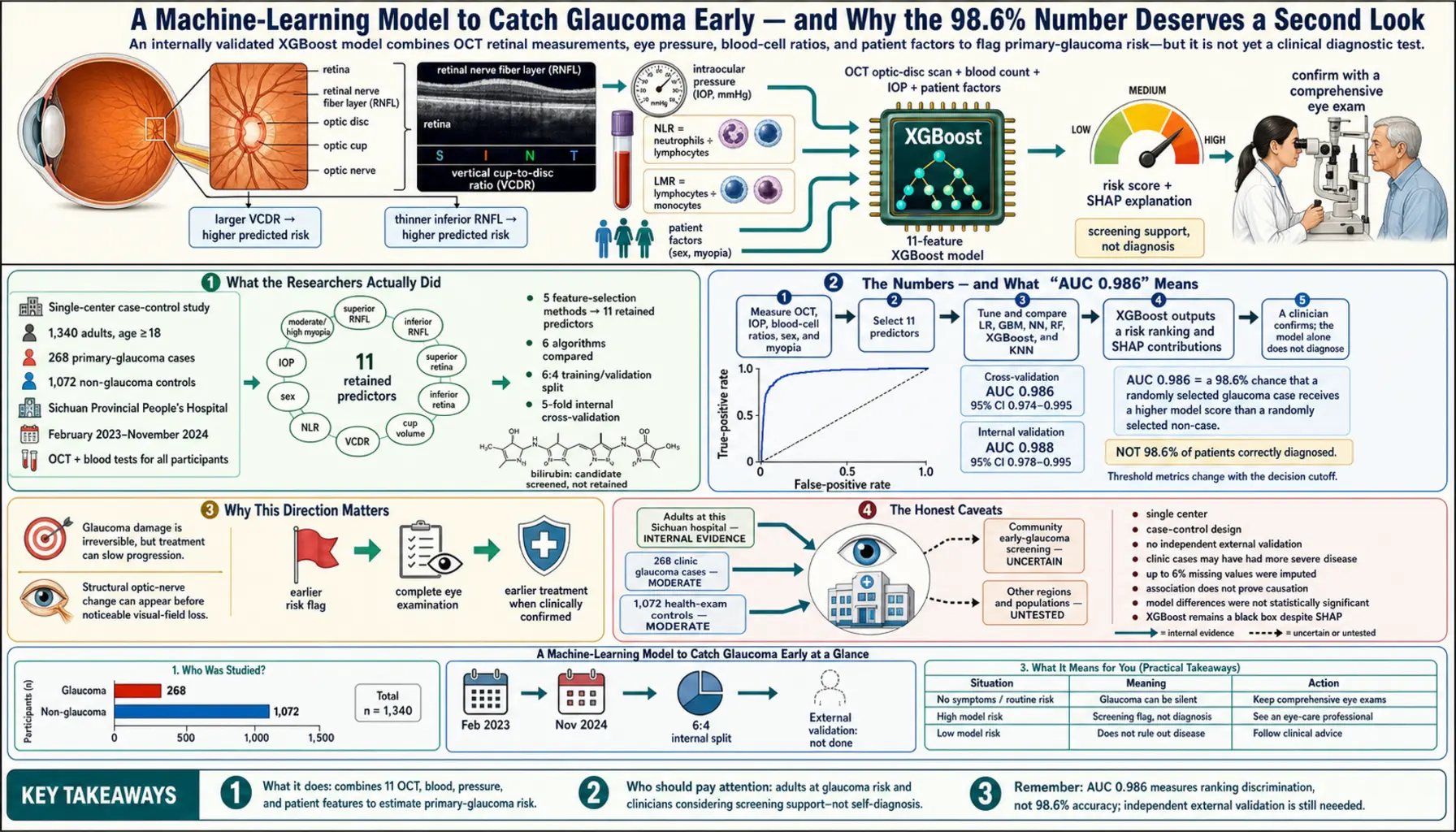
A team at Sichuan Provincial People’s Hospital in Chengdu, China, ran a case–control study of people enrolled at the hospital between February 2023 and November 2024. They compared 268 patients with primary glaucoma, diagnosed in the hospital’s ophthalmology clinic, against 1,072 people without it, recruited from its health-check centre, whose eye pressure, fundus examination and OCT scan were all normal. For every person they gathered questionnaire data (age, sex, medical history, degree of nearsightedness), an eye-pressure reading, blood markers from routine fasting lab work (blood counts, bilirubin and albumin, plus ratios calculated from them), and retinal structural parameters — the anatomical measurements an optical coherence tomography (OCT) scan of the optic disc produces, such as the thickness of the retinal nerve-fiber layer. The imaging was OCT, not fundus photography: one instrument model, one randomly chosen eye per person.
They then applied the modern machine-learning toolkit: five feature-selection methods to decide which variables carried real signal, and six algorithms to see which learned the pattern best. The feature selection narrowed the candidates down to 11 predictors: six OCT measurements (superior and inferior nerve-fiber-layer thickness, superior and inferior retinal thickness, vertical cup-to-disc ratio and cup volume), eye pressure, moderate or high myopia, sex, and two blood-count ratios — the neutrophil-to-lymphocyte ratio (NLR) and the lymphocyte-to-monocyte ratio (LMR). The data were split at random, 60% for training and 40% for validation. The abstract reports that XGBoost (a gradient-boosted decision-tree method) reached a cross-validated area-under-the-curve (AUC) of 0.986 (95% CI 0.974–0.995); on the validation set it scored 0.988 (95% CI 0.978–0.995), with sensitivity 92.8%, specificity 96.6% and a positive predictive value of 85.7%. All six algorithms scored AUCs between 0.964 and 0.988 — plain logistic regression reached 0.985 — and the authors report that the differences between the models were not statistically significant. Their conclusion: combining blood markers with retinal structural parameters produced a model with “relatively better comprehensive predictive performance,” and such models are “of great significance” for predicting and screening for primary glaucoma early.
2. The Numbers — and What “AUC 0.986” Means
AUC is a standard way to score a diagnostic model. It runs from 0.5 (no better than a coin flip) to 1.0 (perfect separation). An AUC of 0.986 means that, within this dataset, if you picked one glaucoma patient and one non-glaucoma person at random, the model ranked the glaucoma patient as higher-risk about 98.6% of the time. On paper, that is close to flawless. For comparison, a 2015 Cochrane review of 106 diagnostic studies found that OCT nerve-fiber-layer measurements detected about 72% of manifest glaucoma at a specificity of about 93% — and warned that even those figures may be overestimates, because 103 of the 106 studies used a case–control design. A number as high as 0.986 is therefore a prompt to ask why it is so high.
The model rests on established glaucoma signs. Optic-disc and nerve-fiber-layer structure is already central to glaucoma diagnosis, and the authors cite work showing that structural changes in the optic disc can precede detectable visual-field loss. The added element is the blood count: blood-cell counts are among the most common laboratory tests, and the authors cite studies linking systemic inflammation to glaucoma. In the model’s own explanation analysis (SHAP), however, the most important predictors were the vertical cup-to-disc ratio and nerve-fiber-layer and retinal thicknesses — OCT measurements — rather than the blood markers.
3. Why This Direction Matters
Glaucoma care has a detection problem, not just a treatment problem. Available treatments — pressure-lowering eye drops, laser, and surgery — can slow the disease but do not restore vision already lost. In the Early Manifest Glaucoma Trial, which randomized 255 patients with newly detected early glaucoma, progression over a median six years occurred in 45% of those treated with laser plus pressure-lowering drops versus 62% of untreated controls. Where specialist eye care is scarce, a risk tool built from routine measurements — a blood count, an OCT scan, an eye-pressure reading and a short history — could in principle help sort out who is referred for a full glaucoma workup. Whether this model can do that has not yet been tested: it was built on people already diagnosed, not on a screening population.
4. The Honest Caveats
Several features of this study mark the 98.6% figure as a research signal, not a clinical result:
- A near-perfect AUC invites scrutiny. The comparison set clinic patients with diagnosed glaucoma against check-up attendees with normal OCT scans, and the two groups were far apart on the OCT measures themselves: median superior nerve-fiber-layer thickness was 85.8 µm in the glaucoma group and 139.9 µm in the controls. The authors note that their glaucoma patients may have had more severe disease than the early cases a population screen is meant to find. A model can separate such groups almost perfectly without showing that it can pick out early or undiagnosed glaucoma, and a single-center dataset also leaves room for overfitting — the model learning quirks of this particular data.
- This was internal validation only. The performance comes from a random split and cross-validation within the same hospital’s data. There was no external test at an independent hospital and no prospective follow-forward cohort; the authors list the lack of external validation as a key limitation. A review of 127 newly developed prediction models found that only 25% had any external validation, and that AUC fell by a median of 0.05 when one was done.
- Case–control designs tend to inflate the score. A 1999 analysis of 218 diagnostic-test evaluations found that studies comparing a diseased group with a separate control group overestimated diagnostic performance (relative diagnostic odds ratio 3.0) compared with studies in clinical populations. Here the cases and controls were enrolled in an exact 1-to-4 ratio, so glaucoma made up 20% of the sample, and the model never faced the real screening challenge, where glaucoma is a small minority — the 2014 meta-analysis put global prevalence at 3.54% among people aged 40–80. Prevalence drives the positive predictive value — the odds that a flagged person actually has glaucoma. The study reported 85.7% in its sample, where glaucoma made up 20%; it did not report the value at screening-level prevalence, which is lower whenever the condition is rarer.
- One hospital, one country, one set of instruments. A model tuned to one population, one OCT device, and one laboratory’s assays has not been tested on other scanners, labs, or ethnic groups; the authors write that the single-center design may limit its generalizability to populations with different demographic characteristics, clinical practices or healthcare systems.
- “Blood markers” is a narrow claim. Only two blood-derived predictors made the final model, NLR and LMR, and they differed far less between the groups than the OCT measures did (median NLR 1.93 in the glaucoma group versus 1.81 in controls). Whether they are a robust biological signal or a statistical artifact of this dataset can only be settled by replication.
None of this makes the work wrong or unimportant. It makes it early. Prediction models are normally judged on external, prospective, multi-site validation, and this one has not been through it yet; the authors write that future multi-center studies will be needed to validate the model in different settings and to test it for early screening.
5. Reading the Evidence
This is a single paper and a proof of concept: in one hospital’s records, a machine-learning model combining OCT measurements, eye pressure, two blood-count ratios and patient details separated people with diagnosed glaucoma from health-check controls with high accuracy. It is not a test offered in clinics, and it is not evidence that any specific blood marker predicts glaucoma. The authors conclude that external validation is still needed to demonstrate the accuracy of the model’s predictions.
Glaucoma diagnosis today rests on the comprehensive eye examination, which measures eye pressure and examines the optic nerve, often with an OCT scan. Risk factors reported in the research include older age, a family history of glaucoma, myopia and raised eye pressure (a 2024 meta-analysis of prospective studies); African ancestry for open-angle glaucoma, and residence in Asia for angle-closure glaucoma (the 2014 meta-analysis); Latino ancestry (the Los Angeles Latino Eye Study, of adults of primarily Mexican ancestry, found an open-angle glaucoma prevalence of 4.74%, with 75% of cases previously undiagnosed); and diabetes, with a pooled relative risk of 1.48 in a 2015 meta-analysis. Because treatment slows the disease but does not restore lost vision, its benefit depends on when glaucoma is found. For now, that detection runs through the eye examination, and this model has not been evaluated outside the hospital where it was built.
Sources
- Prediction of primary glaucoma: development and validation of multiple machine learning models. Scientific Reports (Nature). Published April 6, 2026. nature.com/articles/s41598-026-45340-4 · DOI: 10.1038/s41598-026-45340-4
- Background on the condition — My Healthcare: Glaucoma and Ophthalmology.
Key Research Papers
The primary study, followed by the papers used to check this article’s background figures, in the order they appear in the text. Each entry was checked against its PubMed record.
- Zhang H, Luo Z, Xiong H, Xie M, Shuai P (2026). Prediction of primary glaucoma: development and validation of multiple machine learning models. Scientific Reports 16(1):16469. — PubMed PMID: 41942644
- Tham YC, Li X, Wong TY, Quigley HA, Aung T, Cheng CY (2014). Global prevalence of glaucoma and projections of glaucoma burden through 2040: a systematic review and meta-analysis. Ophthalmology 121(11):2081-2090. — PubMed PMID: 24974815
- Soh Z, Yu M, Betzler BK, Majithia S, Thakur S, Tham YC, et al. (2021). The Global Extent of Undetected Glaucoma in Adults: A Systematic Review and Meta-analysis. Ophthalmology 128(10):1393-1404. — PubMed PMID: 33865875
- Michelessi M, Lucenteforte E, Oddone F, Brazzelli M, Parravano M, Franchi S, et al. (2015). Optic nerve head and fibre layer imaging for diagnosing glaucoma. Cochrane Database of Systematic Reviews 2015(11):CD008803. — PubMed PMID: 26618332
- Heijl A, Leske MC, Bengtsson B, Hyman L, et al.; Early Manifest Glaucoma Trial Group (2002). Reduction of intraocular pressure and glaucoma progression: results from the Early Manifest Glaucoma Trial. Archives of Ophthalmology 120(10):1268-1279. — PubMed PMID: 12365904
- Siontis GC, Tzoulaki I, Castaldi PJ, Ioannidis JP (2015). External validation of new risk prediction models is infrequent and reveals worse prognostic discrimination. Journal of Clinical Epidemiology 68(1):25-34. — PubMed PMID: 25441703
- Lijmer JG, Mol BW, Heisterkamp S, Bonsel GJ, Prins MH, van der Meulen JH, Bossuyt PM (1999). Empirical evidence of design-related bias in studies of diagnostic tests. JAMA 282(11):1061-1066. — PubMed PMID: 10493205
- Shan S, Wu J, Cao J, Feng Y, Zhou J, Luo Z, et al. (2024). Global incidence and risk factors for glaucoma: A systematic review and meta-analysis of prospective studies. Journal of Global Health 14:04252. — PubMed PMID: 39513294
- Varma R, Ying-Lai M, Francis BA, Nguyen BB, Deneen J, Wilson MR, Azen SP; Los Angeles Latino Eye Study Group (2004). Prevalence of open-angle glaucoma and ocular hypertension in Latinos: the Los Angeles Latino Eye Study. Ophthalmology 111(8):1439-1448. — PubMed PMID: 15288969
- Zhao D, Cho J, Kim MH, Friedman DS, Guallar E (2015). Diabetes, fasting glucose, and the risk of glaucoma: a meta-analysis. Ophthalmology 122(1):72-78. — PubMed PMID: 25283061