 — March 18, 2026
· Anti-Parasitic Drugs as Cancer Treatments
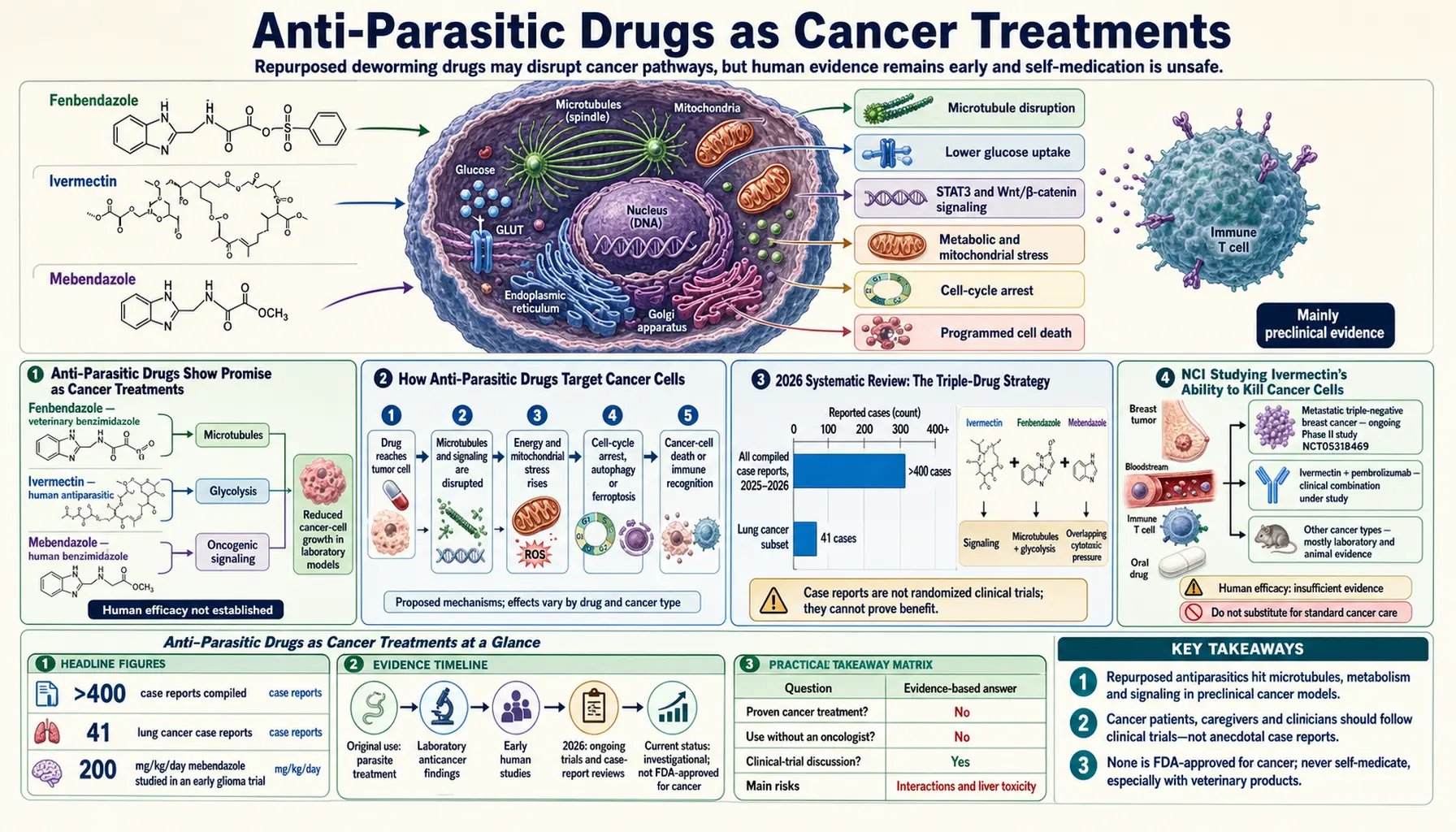
Table of Contents
Anti-Parasitic Drugs Under Study as Cancer Treatments
A growing body of research is exploring the repurposing of common anti-parasitic drugs — originally developed to treat worm infections — as potential cancer therapies. Three drugs in particular have drawn scientific attention: fenbendazole, ivermectin, and mebendazole. None of them is approved as a cancer treatment, and most of the evidence comes from cell and animal studies.
The Drugs Under Investigation
Fenbendazole is a veterinary dewormer belonging to the benzimidazole class; it is not approved by the FDA or the European Medicines Agency for human use, and a 2024 review in Anticancer Research notes that its pharmacokinetics and safety in humans are not well documented. In a 2018 cell-culture and mouse study, fenbendazole acted as a moderate microtubule-destabilizing agent (microtubules are also the target of several established chemotherapy drugs), reduced glucose uptake and the glycolytic enzyme hexokinase II in human cancer cells, and slowed the growth of human tumour grafts in mice fed the drug. A 2025 case series in Case Reports in Oncology described three patients with advanced cancer who self-administered fenbendazole alongside other non-chemotherapy treatments and reported remission; the journal retracted that case series in January 2026.
Ivermectin, whose discovery shared the 2015 Nobel Prize in Physiology or Medicine, has been reported in preclinical (cell and animal) studies to modulate oncogenic signaling pathways including STAT3, PI3K/Akt/mTOR and Wnt/β-catenin; a 2025 review of that work concluded that clinical validation remains limited. A Phase I/II clinical trial (NCT05318469, started October 2023, estimated enrolment 34, listed as recruiting) is evaluating ivermectin combined with the immunotherapy drugs balstilimab or pembrolizumab in people with metastatic triple-negative breast cancer. The registry listed no posted results when this page was last checked (October 2026).
Source: OncoDaily — Ivermectin and Immunotherapy Clinical Trials
Mebendazole, a benzimidazole approved for human worm infections, has been tested in published human cancer trials. A single-centre Phase 1 dose-escalation trial at Johns Hopkins enrolled 24 patients with newly diagnosed high-grade gliomas (brain cancer), giving mebendazole with temozolomide; doses were escalated to 200 mg/kg/day, and 15 patients were enrolled at that highest level. Four of them developed grade 3 liver-enzyme (ALT/AST) elevations after one month, which reversed with lower dosing or stopping the drug. The trial had no control group; median overall survival was 21 months, and the authors concluded that mebendazole showed acceptable toxicity and that further studies are needed to determine efficacy. A later randomised open-label Phase II trial in India (88 patients with recurrent glioblastoma, 44 per arm) added mebendazole to lomustine or to temozolomide; neither arm reached the pre-set benchmark of 55% overall survival at nine months (45% and 36.6%).
Source: Fagron Academy — Antiparasitic Drugs as Emerging Cancer Treatments
How Anti-Parasitic Drugs Target Cancer Cells
A 2021 review in Frontiers in Oncology summarized multiple anticancer mechanisms reported for antiparasitic drugs, almost entirely in cell-culture and animal experiments:
- Microtubule disruption — interferes with cell division, a target shared with some conventional chemotherapy drugs
- Ferroptosis induction — triggers iron-dependent cell death
- Autophagy regulation — alters the cell's self-digestion process
- Mitochondrial disturbance — disrupts energy production in tumour cells
- Immune modulation — changes immune responses to tumours in laboratory models
- Metabolic pathway disruption — interferes with the altered metabolism cancer cells rely on for growth
The review's authors base the repurposing rationale on similarities between parasitic disease and cancer — both evade the immune system and exploit host metabolism — and conclude that current investigations are still insufficient for clinical application.
Source: PMC — Repositioning of Antiparasitic Drugs for Tumor Treatment
The Triple-Drug Combination: An Online Case Compilation
An online compilation posted on a medical blog and described there as a systematic review gathers reports of people combining ivermectin + fenbendazole + mebendazole. It is not a peer-reviewed journal publication; its reports are drawn largely from social-media posts, and the compilation itself states that all of them are uncontrolled observational data subject to reporting bias and confounding by earlier or concurrent treatments. The case counts circulating with it could not be confirmed against a published source and are not repeated here. The reported responses it lists span several cancer types, including:
- Pancreatic cancer — reports of normal CT scans
- Prostate cancer — reports of improvement in metastases
- Endometrial cancer — reports of metastasis shrinkage
- Breast cancer — reports of tumour reduction and resolution of liver metastases
- Lung cancer — reports of various responses
The compilation proposes that the three agents act together — fenbendazole on microtubules and glycolysis, ivermectin on oncogenic signaling, mebendazole through overlapping cytotoxic mechanisms.
Source: Systematic Review: Triple Combination in Cancer (February 2026)
NCI Studying Ivermectin's Ability to Kill Cancer Cells
According to an NPR report from March 2, 2026, the head of the National Cancer Institute (NCI), Anthony Letai, said in February 2026 that the agency was conducting preclinical studies on ivermectin's ability to kill cancer cells. The same report states that there is currently no good evidence that ivermectin is an effective cancer treatment in humans, quotes doctors who say it holds little promise, and describes rising interest in the drug among cancer patients.
Evidence Status and Reported Hazards
- Most evidence remains preclinical (laboratory and animal studies) or based on anecdotal case reports; the one published fenbendazole case series cited for this story was retracted
- Randomised controlled trials in humans are lacking for most uses; the one randomised mebendazole trial described above did not meet its survival benchmark
- These drugs are used off-label for cancer — none is FDA-approved as a cancer treatment, and fenbendazole is not approved for human use at all
- Liver injury: case reports describe severe drug-induced liver injury in people who self-administered fenbendazole — an 80-year-old woman with lung cancer in Japan (2021), whose liver function recovered after stopping it, and a 67-year-old woman in the United States with biopsy-confirmed injury (2024), whose liver tests normalized three months after stopping. In the mebendazole glioma trial, four patients at the highest dose developed grade 3 liver-enzyme elevations
- Ivermectin at high doses: the FDA warns that excessive doses can lead to coma or death; a case report published in May 2026 describes seizures and respiratory failure requiring mechanical ventilation in a 73-year-old woman with metastatic breast cancer who self-administered high doses, with full neurological recovery within 48 hours
- Unsupervised use also carries the possibility of drug interactions with cancer treatments; decisions about off-label medicines belong with a clinician
Reviews of the field point to low cost, wide availability and multi-target mechanisms as reasons the drugs attract research interest, and call for clinical trials to establish efficacy, dosing and safety.
Sources
- PMC — Repositioning of Antiparasitic Drugs for Tumor Treatment
- OncoDaily — Ivermectin and Immunotherapy Clinical Trials
- Fagron Academy — Antiparasitic Drugs as Emerging Cancer Treatments
- Cancer Therapy Advisor — NCI Studying Ivermectin
- NPR — Ivermectin Making a Post-Pandemic Comeback (March 2026)
- Online compilation: Triple Combination in Cancer (blog post, not peer reviewed)
- PMC — Fenbendazole as Anticancer Agent Case Series (retracted January 2026)
- Anticancer Research — Oral Fenbendazole for Cancer Therapy
- ClinicalTrials.gov — NCT05318469, Ivermectin with Balstilimab or Pembrolizumab in Metastatic Triple-Negative Breast Cancer
Key Research Papers
- Li YQ, Zheng Z, Liu QX, Lu X, Zhou D, Zhang J, et al. (2021). Repositioning of Antiparasitic Drugs for Tumor Treatment. Frontiers in Oncology 11:670804. — PubMed PMID: 33996598
- Dogra N, Kumar A, Mukhopadhyay T (2018). Fenbendazole acts as a moderate microtubule destabilizing agent and causes cancer cell death by modulating multiple cellular pathways. Scientific Reports 8(1):11926. — PubMed PMID: 30093705
- Nguyen J, Nguyen TQ, Han BO, Hoang BX (2024). Oral Fenbendazole for Cancer Therapy in Humans and Animals. Anticancer Research 44(9):3725-3735. — PubMed PMID: 39197912
- Makis W, Baghli I, Martinez P (2025). Fenbendazole as an Anticancer Agent? A Case Series of Self-Administration in Three Patients. Case Reports in Oncology 18(1):856-863. RETRACTED January 2026 (retraction notice doi:10.1159/000549387). — PubMed PMID: 40605964
- Robalino KN, Vivanco-Galván O, Romero-Benavides JC, Jiménez-Gaona Y (2025). Ivermectin as an Alternative Anticancer Agent: A Review of Its Chemical Properties and Therapeutic Potential. Pharmaceuticals 18(10):1459. — PubMed PMID: 41155573
- Gallia GL, Holdhoff M, Brem H, Joshi AD, Hann CL, Bai RY, et al. (2021). Mebendazole and temozolomide in patients with newly diagnosed high-grade gliomas: results of a phase 1 clinical trial. Neuro-Oncology Advances 3(1):vdaa154. — PubMed PMID: 33506200
- Patil VM, Menon N, Chatterjee A, Tonse R, Choudhari A, Mahajan A, et al. (2022). Mebendazole plus lomustine or temozolomide in patients with recurrent glioblastoma: A randomised open-label phase II trial. EClinicalMedicine 49:101449. — PubMed PMID: 35747192
- Yamaguchi T, Shimizu J, Oya Y, Horio Y, Hida T (2021). Drug-Induced Liver Injury in a Patient with Nonsmall Cell Lung Cancer after the Self-Administration of Fenbendazole Based on Social Media Information. Case Reports in Oncology 14(2):886-891. — PubMed PMID: 34248555
- Thakurdesai A, Rivera-Matos L, Nagra N, Busch B, Mais DD, Cave MC (2024). Severe Drug-Induced Liver Injury Due to Self-administration of the Veterinary Anthelmintic Medication, Fenbendazole. ACG Case Reports Journal 11(5):e01354. — PubMed PMID: 38706451
- Saperstein Y, Bou Sanayeh E, Boazak P, Itani H, Moussa E, Gut T (2026). Life-threatening neurotoxicity following off-label ivermectin use in metastatic breast cancer: a case report. Postgraduate Medicine 138(4):391-395. — PubMed PMID: 42170801
PubMed Topic Searches
- Clinical trials on fenbendazole and cancer — PubMed search
- Clinical trials on ivermectin and cancer — PubMed search
- Clinical trials on mebendazole and cancer — PubMed search
- Clinical trials on benzimidazole drugs and cancer — PubMed search
- Clinical trials on drug repurposing in oncology — PubMed search
- Clinical trials on ivermectin and glioma — PubMed search