Zinc: Food Sources & Daily Intake
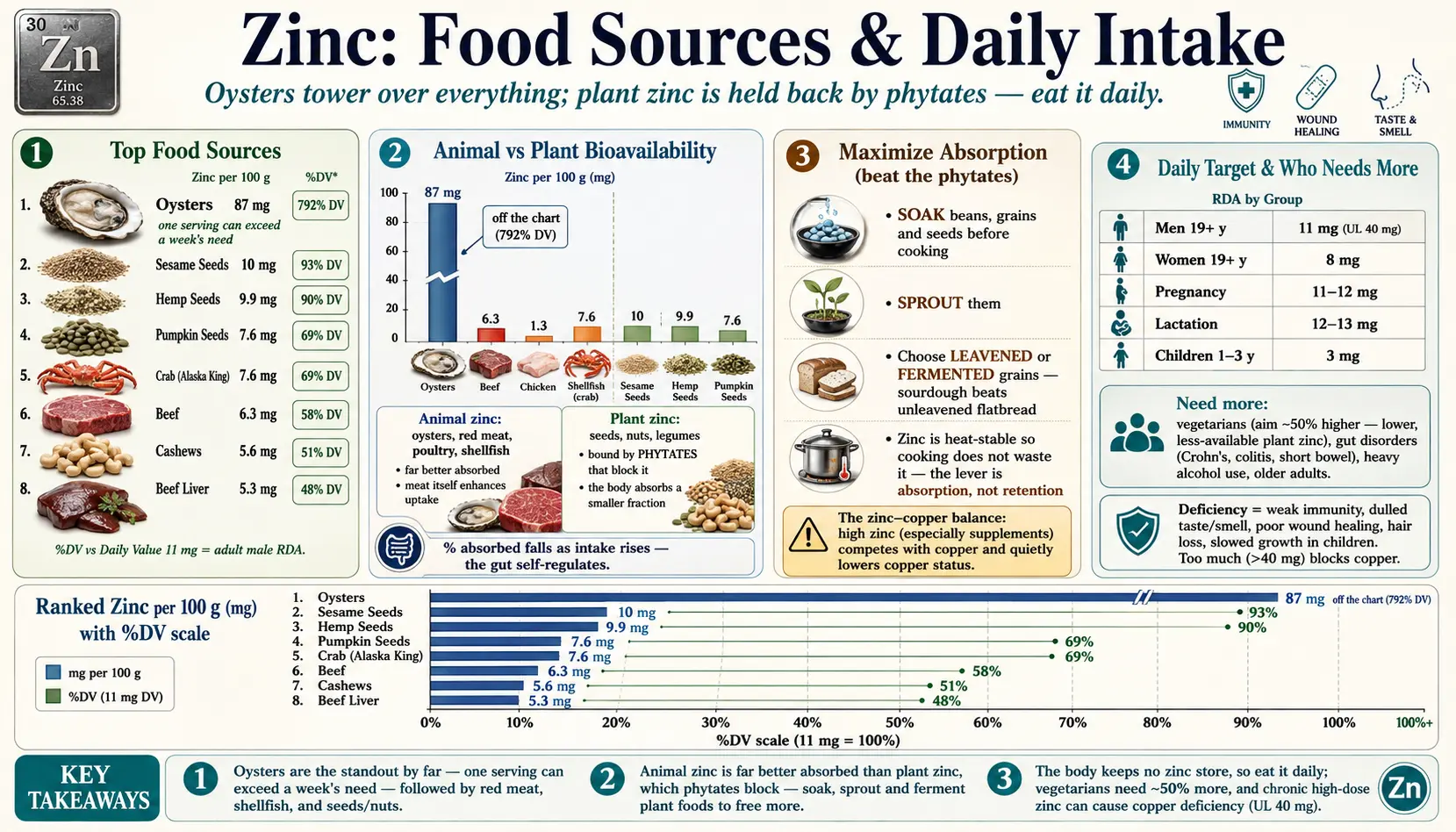
Zinc is an essential mineral. The Institute of Medicine’s 2001 Dietary Reference Intakes report states that nearly 100 specific enzymes depend on zinc for their catalytic activity, and that zinc also helps keep proteins structurally intact and regulates gene expression. Severe deficiency slows growth and impairs immunity, wound healing, appetite and taste. Shellfish, beef and other red meats are rich sources; nuts, seeds and legumes are relatively good plant sources, though phytate in plant foods lowers how much of their zinc is absorbed. Oysters top the table below by a wide margin.
| Zinc: Food Sources & Daily Intake | ||||||
|---|---|---|---|---|---|---|
| Rank | Food (serving) | Per 100 g | %DV / 100g | Glucose | Fructose | Notes |
| 1 | Oysters (Eastern, Wild) 3 oz / 85 g · cooked, moist heat | 79 mg | 🟢 715% | 1.2 | 0 | Zinc varies widely by species: cooked Pacific oysters list about 33 mg per 100 g. |
| 2 | Sesame Seeds 1 oz / 28 g · hulled kernels, toasted | 10 mg | 🟢 93% | — | — | |
| 3 | Hemp Seeds 1 oz / 28 g · hulled | 9.9 mg | 🟢 90% | 0.2 | 0.3 | |
| 4 | Pumpkin Seeds 1 oz / 28 g · hulled kernels, roasted | 7.6 mg | 🟢 69% | 0.1 | 0.1 | |
| 5 | Crab (Alaska King) 3 oz / 85 g · cooked, moist heat | 7.6 mg | 🟢 69% | — | — | |
| 6 | Beef Meat 3 oz / 85 g · composite of retail cuts, lean and fat, cooked | 6.3 mg | 🟢 58% | 0 | 0 | Zinc in meat is relatively well absorbed, with few compounds that inhibit absorption. |
| 7 | Cashews 1 oz / 28 g · dry roasted | 5.6 mg | 🟢 51% | — | — | |
| 8 | Beef Liver 3 oz / 85 g · braised | 5.3 mg | 🟡 48% | 0 | 0 | |
| 9 | Lamb 3 oz / 85 g · ground, broiled | 4.7 mg | 🟡 42% | 0 | 0 | |
| 10 | Chicken Giblets 3 oz / 85 g · broiler-fryer, simmered | 4.2 mg | 🟡 38% | 0 | 0 | |
| 11 | Pork Kidney 3 oz / 85 g · braised | 4.2 mg | 🟡 38% | — | — | |
| 12 | Lobster 3 oz / 85 g · northern, cooked, moist heat | 4.0 mg | 🟡 37% | 0 | 0 | |
| 13 | Cheddar Cheese 1 oz / 28 g · regular (not reduced-fat) | 3.6 mg | 🟡 33% | 0.3 | 0 | |
| 14 | Turkey (Dark Meat) 3 oz / 85 g · roasted | 3.5 mg | 🟡 32% | 0 | 0 | |
| 15 | Almonds 1 oz / 28 g · dry roasted | 3.3 mg | 🟡 30% | 0.0 | 0.0 | |
| 16 | Beef Kidney 3 oz / 85 g · simmered | 2.8 mg | 🟡 26% | 0 | 0 | |
| 17 | Brown Rice 1 cup / 202 g · long-grain, cooked | 0.7 mg | ⚪ 6% | 0 | 0 | Common staple. |
Table of Contents
How to Read These Tables
- How the %DV column is calculated. The %DV column is the zinc in 100 g of the food divided by the FDA Daily Value of 11 mg for adults and children aged 4 and over (21 CFR 101.9), times 100. It describes 100 g of the food, not the serving shown under its name.
- %DV vs RDA. The Daily Value is a single label figure. The RDA is set by life stage: 11 mg/day for men and 8 mg/day for women, higher in pregnancy and lactation — see the second table.
- Per 100 g vs per serving. Ranking per 100 g puts foods on the same footing. The serving size and form (cooked, roasted, hulled) under each food name show the portion and preparation the values refer to.
- How zinc balance is kept. The body holds zinc steady mainly by adjusting how much it absorbs and how much it secretes back into the gut as intake changes.
Recommended Intakes & Upper Limits
Intake targets depend on age, sex, pregnancy and lactation. The Daily Value used for the %DV column above is a single label figure; the table below lists the age-specific Dietary Reference Intakes.
| Life stage | RDA / AI (mg/day) | Upper limit (mg/day) |
|---|---|---|
| Infants 0–6 mo | 2* (AI) | 4 |
| Infants 7–12 mo | 3 | 5 |
| Children 1–3 y | 3 | 7 |
| Children 4–8 y | 5 | 12 |
| Children 9–13 y | 8 | 23 |
| Males 14–18 y | 11 | 34 |
| Males 19+ y | 11 | 40 |
| Females 14–18 y | 9 | 34 |
| Females 19+ y | 8 | 40 |
| Pregnancy | 11–12 | 34–40 |
| Lactation | 12–13 | 34–40 |
Bioavailability & Absorption
How much zinc is absorbed depends heavily on the rest of the meal. Zinc bioavailability is relatively high in meat, eggs and seafood, which contain few absorption inhibitors and supply sulfur-containing amino acids (cysteine and methionine) that improve absorption. Zinc in whole grains and plant proteins is less available because of phytate, the main dietary factor known to impair zinc absorption; a modelling analysis found that dietary zinc and phytate together account for more than 80% of the variability in the amount absorbed. The body also self-regulates: the amount of zinc eaten is the main factor setting how much is absorbed and how efficiently, and intestinal excretion of the body’s own zinc is adjusted to recent absorption and zinc status. A related interaction is the zinc–copper balance: zinc intakes of 50 mg/day or more taken over weeks can interfere with copper absorption, because high zinc induces a copper-binding protein (metallothionein) in intestinal cells; more typical zinc intakes do not affect copper absorption.
Cooking & Storage
Processing changes both how much zinc a food keeps and how much of it is absorbed. Because zinc in grains sits mainly in the germ and bran, the IOM report states that as much as 80 percent of the total zinc is lost during milling. On the absorption side, yeast enzymes acting during the leavening of bread and other fermentations reduce phytate, so leavened whole-grain breads have more bioavailable zinc than unleavened ones; extrusion (used for some breakfast cereals) may not reduce it. A review of traditional household methods lists thermal and mechanical processing, soaking, fermentation and germination (sprouting) or malting as ways to lower phytate and raise micronutrient bioavailability in plant-based diets, and notes that their effect on nutritional status needs broader assessment.
Vegetarian & Vegan Sources
The IOM report states that absorption of zinc from vegetarian diets is lower than from nonvegetarian diets, that cereals are the primary source of dietary zinc for vegetarians, and that “relatively minor changes to the diet can improve zinc absorption.” Its exact wording on the requirement is: “The requirement for dietary zinc may be as much as 50 percent greater for vegetarians and particularly for strict vegetarians whose major food staples are grains and legumes and whose dietary phytate:zinc molar ratio exceeds 15:1.” The highest plant entries in the table above are sesame, hemp and pumpkin seeds, cashews and almonds; legumes such as chickpeas and lentils are further plant sources. Leavening, fermentation, soaking and sprouting, described in the section above, are the preparation methods reported to lower phytate.
Who Needs to Pay Attention
Reported features of zinc deficiency include slowed growth in children, immune dysfunction with more infections, impaired wound healing, diminished appetite and impaired taste, hair loss and diarrhea. Groups listed as at risk include people with inflammatory bowel disease (Crohn’s disease, ulcerative colitis) or malabsorption syndromes such as short bowel syndrome, people with long-term heavy alcohol use (the IOM report notes low zinc status in about 30 to 50 percent of people with alcoholism), older adults, pregnant and breastfeeding women, and vegetarians. Excess matters too: the major consequence of long-term excessive zinc is copper deficiency, and total intakes of 60 mg/day for up to 10 weeks have produced signs of it. The adult UL is 40 mg/day from food, water and supplements combined; prolonged use of zinc lozenges (for example 6 to 8 weeks) is described as likely to cause copper deficiency.
Key Research Papers
- NIH Office of Dietary Supplements — Zinc Fact Sheet (DV, RDA, UL)
- Linus Pauling Institute — Zinc Micronutrient Information Center
- King JC, Shames DM, Woodhouse LR. Zinc homeostasis in humans. J Nutr. 2000;130(5S Suppl):1360S-1366S. — PubMed PMID: 10801944
- Hambidge KM, Miller LV, Westcott JE, Sheng X, Krebs NF. Zinc bioavailability and homeostasis. Am J Clin Nutr. 2010;91(5):1478S-1483S. — PubMed PMID: 20200254
- Institute of Medicine. Dietary Reference Intakes for Vitamin A, Vitamin K, Arsenic, Boron, Chromium, Copper, Iodine, Iron, Manganese, Molybdenum, Nickel, Silicon, Vanadium, and Zinc. Chapter 12, Zinc. Washington, DC: National Academies Press; 2001. — doi:10.17226/10026
- Hotz C, Gibson RS. Traditional food-processing and preparation practices to enhance the bioavailability of micronutrients in plant-based diets. J Nutr. 2007;137(4):1097-1100. — PubMed PMID: 17374686
- U.S. Code of Federal Regulations, 21 CFR 101.9(c)(8)(iv): Reference Daily Intakes (zinc 11 mg for adults and children 4 years and older). — eCFR 21 CFR 101.9