Snake Grass: Anti-Inflammatory and Immune Mechanisms
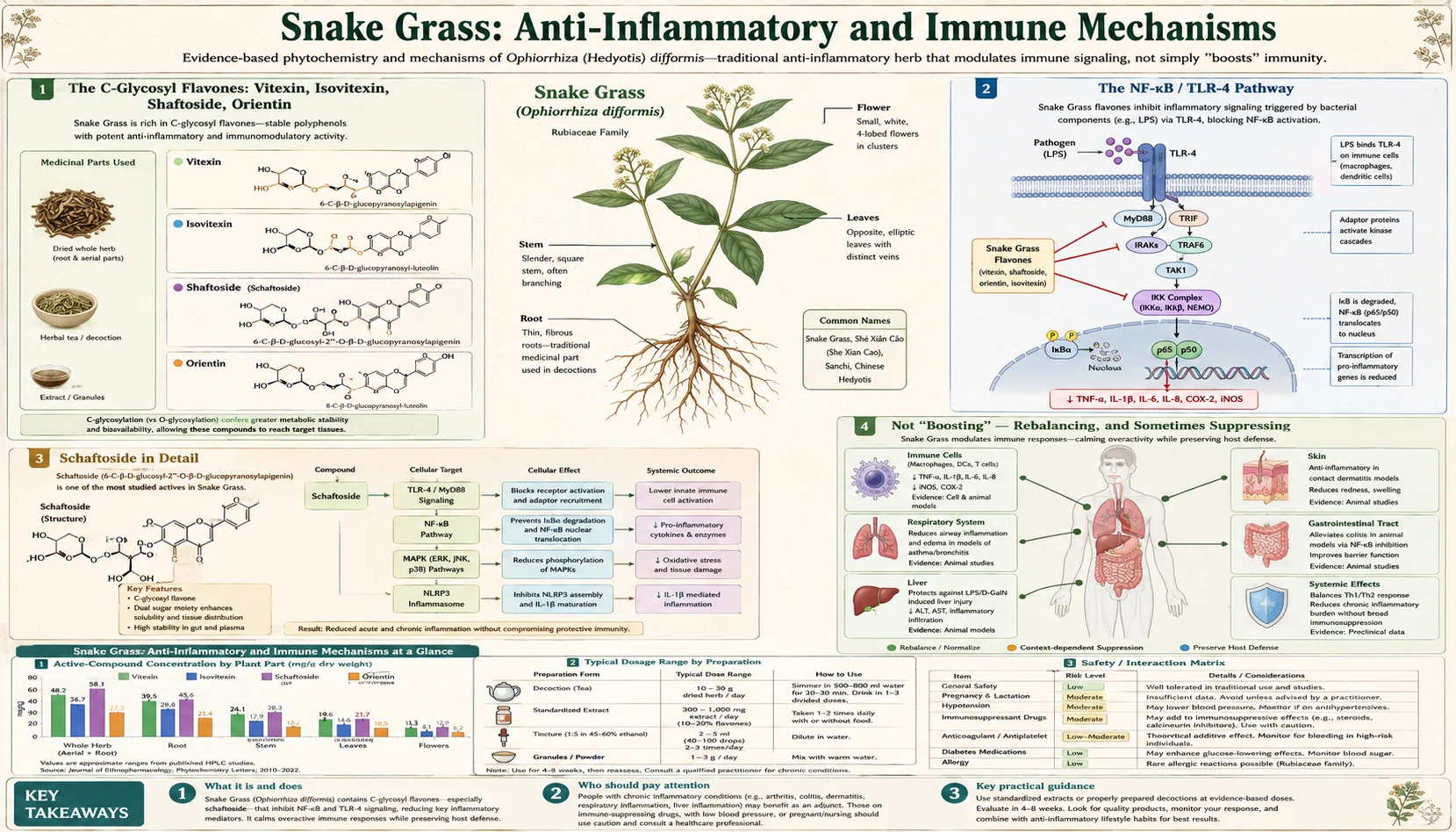
The herpes, cancer and diabetes claims on the other three pages of this set trace back to the same handful of chemical mechanisms, so it is worth walking through the chemistry once, properly, rather than re-explaining it piecemeal. This page also checks a specific piece of internal coherence: snake grass is popularly understood as something that helps the immune system fight disease, and the actual laboratory findings are more specific — and in places more like rebalancing than boosting — than that framing suggests.
Table of Contents
- The C-Glycosyl Flavones: Vitexin, Isovitexin, Shaftoside, Orientin
- The NF-κB / TLR-4 Pathway
- Schaftoside in Detail
- Not “Boosting” — Rebalancing, and Sometimes Suppressing
- A Borrowed-Evidence Check on the Marker Compounds
- Wound Healing and the Chlorophyll Derivatives
- Reading a Drug-Comparator Study Properly
- The Antioxidant-Assay Caveat
- Where This Connects to the Other Two Claims
- Key Research Papers
- Connections
- Featured Videos
The C-Glycosyl Flavones: Vitexin, Isovitexin, Shaftoside, Orientin
Chelyn and colleagues developed and validated high-performance thin-layer chromatography (HPTLC) and high-performance liquid chromatography with ultraviolet/diode-array detection (HPLC-UV/DAD) methods specifically to quantify a group of flavone C-glycosides in C. nutans leaves — principally vitexin, isovitexin, shaftoside (also written schaftoside) and orientin, with isoorientin also reported elsewhere. These compounds are described as C-glycosides rather than the more common O-glycosides, meaning the sugar is attached to the flavone backbone by a carbon-carbon bond rather than through an oxygen atom. That is not a cosmetic distinction: C-glycosidic bonds are considerably more resistant to hydrolysis by gut and colonic-bacterial enzymes than O-glycosidic ones, so these compounds are less readily stripped of their sugar during digestion than most dietary flavonoids. That does not mean they are well absorbed — resistance to breakdown and efficient absorption are different properties — but it is a real, chemically grounded reason this class survives digestion differently than the average plant flavonoid, and it is the reason these four compounds function as the leaf’s practical marker compounds for identification and standardisation.
The NF-κB / TLR-4 Pathway
Mai and colleagues (2016) provided the foundational mechanistic paper for this plant’s anti-inflammatory reputation: C. nutans extracts inhibited pro-inflammatory cytokine production and blocked activation of Toll-like receptor 4 (TLR-4), a cell-surface receptor that detects bacterial and damage signals and, when activated, switches on the NF-κB transcription factor — the master regulator that turns on production of tumor necrosis factor-α, interleukin-1 beta (IL-1β), interleukin-6 (IL-6) and a wide range of other inflammatory mediators. Later work extended this finding into specific tissue contexts: Kao and colleagues (2021) showed the extract blocks this NF-κB-driven interleukin-1β pathway and so reduced nerve-cell death in rat models of ischaemic brain injury (rat brain cells starved of oxygen and sugar in the dish, and rats with a blocked brain artery), and Thongyim and colleagues showed C. nutans extract lowers NF-κB-mediated periodontal inflammation specifically under high-glucose conditions — a detail picked up again on the diabetes page, since gum inflammation under chronic hyperglycaemia is a real clinical problem in people with diabetes. In that 2024 study, gum cells (gingival fibroblasts) were stimulated with a toxin from the gum-disease bacterium Porphyromonas gingivalis (lipopolysaccharide) under high sugar; at 50 µg/mL the extract cut the activity of the inflammation genes IL6, IL8 and CXCL10 to 0.51, 0.6 and 0.09 of the levels in the study’s untreated control and lowered NF-κB activation. This is cell-culture work only.
This single pathway — TLR-4 detection feeding into NF-κB-driven cytokine production, and this plant’s extracts blunting it — is the mechanistic backbone cited across an unusually wide range of this plant’s studied effects: general anti-inflammatory activity, the periodontal finding above, the neuroprotection findings, and part of the proposed explanation for the pancreatic beta-cell protection described on the diabetes page. One mechanism, many downstream contexts — which is a reasonable thing for a single compound class to do, since NF-κB sits upstream of inflammation in nearly every tissue, but it also means these are not eleven independent lines of evidence so much as one plausible mechanism tested in eleven different disease models.
Schaftoside in Detail
Of the four marker flavones, schaftoside has the most specific recent mechanistic work attached to it. Thongyim and colleagues (2025) showed that pure schaftoside (40 µM) lowered the activity of inflammation genes (iNOS, COX2, TNF-α, IL6) in lipopolysaccharide-stimulated RAW 264.7 cells, a mouse macrophage cell line — the standard cell-culture model for testing anti-inflammatory compounds. Across leaf extracts from ten regions of Thailand, however, the extracts’ activity did not track their schaftoside content, so the authors concluded schaftoside is probably not the only active compound; in computer docking, the flavonoids isoorientin and isovitexin also bound the iNOS enzyme. In a separate 2023 paper, the same group identified a related compound (glyceryl 1,3-distearate) from the extract with activity against the bacteria responsible for bovine mastitis, an inflammatory udder infection in dairy cattle used here as a veterinary infection model rather than anything relevant to human use. Yu and colleagues (2024) found schaftoside specifically attenuates acute liver injury in a rodent model by inhibiting ferroptosis — iron-dependent cell death — through activation of the nuclear factor erythroid 2-related factor 2 (Nrf2) / glutathione peroxidase 4 (GPX4) antioxidant pathway, a genuinely distinct mechanism from the NF-κB story above. And Limpanich and colleagues (2025) combined whole extract and isolated schaftoside in a wound-healing model, reporting anti-inflammatory, endothelial-protective and antiviral effects together — directly relevant to the topical antiviral mechanism discussed on the herpes page. In that 2025 study, the leaf extract blocked the inflammation enzyme cyclooxygenase-2 (COX-2) by up to 99.3% and pure schaftoside by up to 86.9% in a test-tube enzyme test; the extract also protected blood-vessel lining cells from death triggered by a bacterial toxin (lipopolysaccharide) and slowed the copying of herpes simplex virus type 2, mainly early in infection. All of this is cell and enzyme work, not people.
Taken together, schaftoside is the single compound with the most consistent, cross-study support in this plant’s chemistry, tested by two research groups (one in Chiang Mai, Thailand, and one in Hainan, China) across three mechanisms (inflammatory gene suppression, ferroptosis/Nrf2-GPX4, and antiviral activity). That is a genuinely coherent picture for one molecule. It remains, without exception, cell-culture and rodent evidence.
Not “Boosting” — Rebalancing, and Sometimes Suppressing
This is the internal-coherence check promised at the top of the page, and it complicates the popular framing in a specific, checkable way. Le and colleagues isolated four compounds from C. nutans hexane fractions — shaftoside, and three compounds unrelated to the flavones above: stigmasterol, β-sitosterol, and the triterpenoid lupeol. Testing these against mitogen-stimulated T and B lymphocytes, they found stigmasterol and β-sitosterol both inhibited T-cell proliferation, and β-sitosterol specifically blocked secretion of the T-helper-2 cytokines interleukin-4 (IL-4) and interleukin-10 (IL-10) while leaving the T-helper-1 cytokines interleukin-2 (IL-2) and interferon-gamma (IFN-γ) untouched — a selective suppression of the Th2 arm rather than blanket immune stimulation, described by the authors as “immunosuppressive” and “immunomodulatory” potential rather than immune-boosting.
That finding is not an isolated oddity. It lines up with the mouse hepatoma study covered on the cancer page, where treated mice independently showed more IFN-γ-producing T cells and fewer IL-4-producing ones — the same Th1-favouring, Th2-suppressing direction, found by a different research group in a different experimental system (a living tumour-bearing mouse rather than isolated cells). Two independent findings pointing the same direction is a more persuasive pattern than either alone, and what it persuasively suggests is immune rebalancing toward a Th1 profile, with a genuine suppressive component, not the undifferentiated “boosts your immune system” story the plant is often sold on. Whether that rebalancing is clinically desirable depends entirely on context: a Th1 shift is plausibly useful against a virus or a tumour and plausibly unhelpful for a Th1-driven autoimmune or inflammatory condition. No study on this plant has tested that second possibility, so this page states the mechanism and leaves the question open rather than resolving it in either direction.
A Borrowed-Evidence Check on the Marker Compounds
Worth flagging directly, in the interest of not overstating what these compounds being “in” snake grass proves. Stigmasterol and β-sitosterol are common plant phytosterols, present in the diet from vegetable oils, nuts, seeds and many other plants; vitexin and isovitexin are widely distributed dietary flavonoids found in numerous other species (passionflower and hawthorn are two well-studied examples). A 2025 review of vitexin and isovitexin’s broader roles in human health draws on that wider literature, not on snake grass specifically. None of that makes the isolation findings above wrong — Le and colleagues did isolate these compounds from this plant’s own leaves and test them directly — but “vitexin has documented pharmacology” is not snake-grass-specific evidence when the pharmacology in question was established in other plants. Schaftoside is the more distinctive marker of the group; it is far less widely distributed and the recent mechanistic work above (Thongyim, Yu, Limpanich) was done directly on this species’ own extract, which is a meaningfully stronger form of evidence than compound-presence alone.
Wound Healing and the Chlorophyll Derivatives
A second compound family, unrelated to the flavones, shows up repeatedly in this plant’s wound and skin literature: chlorophyll breakdown products, principally the phaeophytins covered in mechanistic detail on the herpes page, and purpurin-18 phytyl ester, which Roeslan and colleagues isolated and found to have anti-biofilm, nitric-oxide-inhibiting and wound-healing activity in laboratory testing. Ban and colleagues separately reported wound-healing, antimicrobial and antioxidant properties for whole-leaf extracts. Ng and colleagues found a water extract had anti-angiogenic activity — suppressing new blood vessel formation — in endothelial cells, tested in vitro, ex vivo and in a limited in vivo assay; anti-angiogenic activity is a double-edged mechanistic finding worth naming rather than only celebrating, since new blood vessel growth is exactly what a healing wound also needs, and the practical net effect of an anti-angiogenic compound on an actual healing wound in a person has not been tested for this plant specifically.
Reading a Drug-Comparator Study Properly
Tantowi and colleagues compared an apigenin-glycoside-rich C. nutans extract directly against diclofenac, a real anti-inflammatory drug, in a rat model combining osteoporosis and osteoarthritis, measuring inflammatory markers and the catabolic proteases that break down joint cartilage. The study was small: 30 female rats in five groups of six. Four groups had their ovaries removed (to cause bone loss) and a chemical injected into the right knee (to cause arthritis); the treated groups were given the extract at 200 or 400 mg per kg of body weight, or diclofenac at 5 mg per kg, by mouth every day for 28 days. The authors reported that the 400 mg/kg dose (about 0.2 mg apigenin-equivalent per kg) was comparable to diclofenac in reducing cartilage erosion, bone loss and the inflammation marker interleukin-1β. A real drug comparator arm is more informative than an extract-versus-nothing comparison, and in a study like this the drug arm works as a positive control: a positive control validates that the model responds to a known-active compound; it does not rank the drugs against each other. A result showing the extract performed comparably to diclofenac in this rat model says the model worked as intended and the extract had a measurable effect in it. It does not say the extract is diclofenac’s equal in a person with osteoarthritis, because dose selection for the diclofenac arm in a rodent study is chosen to demonstrate the model is sensitive, not to represent optimal human dosing, and rodent joint-degeneration models are an imperfect stand-in for human osteoarthritis in the first place.
The Antioxidant-Assay Caveat
Antioxidant capacity for this plant has been measured repeatedly using 2,2-diphenyl-1-picrylhydrazyl (DPPH) radical-scavenging and related chemical assays, across many of the papers cited on this page and the other three. This is worth flagging once, plainly: a DPPH assay measures how readily a compound in a test tube donates an electron to a stable synthetic radical. It says nothing about whether that compound is absorbed from the gut, survives first-pass liver metabolism, reaches a relevant tissue at a biologically active concentration, or does anything measurable to oxidative stress inside a living body. A large antioxidant-assay literature is chemistry, not a demonstrated health effect, and this page treats it that way throughout rather than citing a high DPPH score as if it were a clinical finding.
Where This Connects to the Other Two Claims
Pulling the three pages of this set together through the chemistry: the same NF-κB/TLR-4 anti-inflammatory pathway covered here is invoked as part of the proposed mechanism for the pancreatic beta-cell protection on the diabetes page; the chlorophyll-derivative antiviral activity covered here in the wound-healing context is the same compound family proposed to explain the topical antiviral effect on the herpes page; and the Th1-skewing immunomodulatory signature found independently in isolated phytosterols here and in the mouse hepatoma model on the cancer page is the same directional finding showing up twice. This is a plant with a genuinely coherent underlying chemistry touching inflammation, viral defence and immune signalling all at once — which is a real and interesting botanical finding, and a completely different statement from any one of the three headline claims being clinically proven.
A 2026 review of the whole research literature on snake grass counted more than 130 active plant compounds and found low acute toxicity in safety testing, but it noted remaining concerns about toxicity with repeated use over weeks (subchronic toxicity) and a lack of robust clinical trials in people.
Key Research Papers
Each paper links to its PubMed record; the last item is a live PubMed search.
- Chelyn JL et al., “Analysis of flavone C-glycosides in the leaves of Clinacanthus nutans (Burm. f.) Lindau by HPTLC and HPLC-UV/DAD”, The Scientific World Journal, 2014. — PubMed PMID: 25405231
- Mai CW et al., “Mechanisms Underlying the Anti-Inflammatory Effects of Clinacanthus nutans Lindau Extracts: Inhibition of Cytokine Production and Toll-Like Receptor-4 Activation”, Frontiers in Pharmacology, 2016 — the foundational NF-κB/TLR-4 paper. — PubMed PMID: 26869924
- Ong WY et al., “Anti-Inflammatory Effects of Phytochemical Components of Clinacanthus nutans”, Molecules, 2022 — a comprehensive review of the anti-inflammatory chemistry. — PubMed PMID: 35684542
- Thongyim S et al., “Schaftoside contributed to anti-inflammatory activity of Clinacanthus nutans extract in lipopolysaccharide-induced RAW 264.7 cells”, Frontiers in Pharmacology, 2025. — PubMed PMID: 40556767
- Yu Y et al., “Bioactive compound schaftoside from Clinacanthus nutans attenuates acute liver injury by inhibiting ferroptosis through activation the Nrf2/GPX4 pathway”, Journal of Ethnopharmacology, 2024. — PubMed PMID: 38556139
- Le CF et al., “Phytosterols isolated from Clinacanthus nutans induce immunosuppressive activity in murine cells”, International Immunopharmacology, 2017 — the Th2-selective suppression finding. — PubMed PMID: 28119186
- Yan W et al., “Dietary Flavonoids Vitexin and Isovitexin: New Insights into Their Functional Roles in Human Health and Disease Prevention”, International Journal of Molecular Sciences, 2025 — general flavonoid pharmacology, not species-specific; cited here for context only. — PubMed PMID: 40725244
- Roeslan MO et al., purpurin-18 phytyl ester from Clinacanthus nutans: anti-biofilm, nitric oxide inhibition, wound healing, Biomedicine & Pharmacotherapy, 2019. — PubMed PMID: 30877884
- Ban WK et al., “Wound Healing, Antimicrobial and Antioxidant Properties of Clinacanthus nutans (Burm.f.) Lindau and Strobilanthes crispus (L.) Blume Extracts”, Molecules, 2022. — PubMed PMID: 35268823
- Ng CT et al., “Water extract of Clinacanthus nutans leaves exhibits in vitro, ex vivo and in vivo anti-angiogenic activities in endothelial cell via suppression of cell proliferation”, BMC Complementary and Alternative Medicine, 2018. — PubMed PMID: 29980198
- Tantowi NACA et al., “Comparison of diclofenac with apigenin-glycosides rich Clinacanthus nutans extract for amending inflammation and catabolic protease regulations in osteoporotic-osteoarthritis rat model”, DARU, 2020. — PubMed PMID: 32388789
- Kao MH et al., “Clinacanthus nutans Mitigates Neuronal Death and Reduces Ischemic Brain Injury: Role of NF-κB-driven IL-1β Transcription”, Neuromolecular Medicine, 2021. — PubMed PMID: 33025396
- Thongyim S et al., “Clinacanthus nutans extract lowers periodontal inflammation under high-glucose conditions via inhibiting NF-κB signaling pathway”, Frontiers in Pharmacology, 2024. — PubMed PMID: 39193343
- Thongyim S et al., “Anti-Inflammatory Activity of Glyceryl 1,3-Distearate Identified from Clinacanthus nutans Extract against Bovine Mastitis Pathogens”, Antibiotics (Basel), 2023. — PubMed PMID: 36978416
- Limpanich N et al., “Integrative Wound-Healing Effects of Clinacanthus nutans Extract and Schaftoside Through Anti-Inflammatory, Endothelial-Protective, and Antiviral Mechanisms”, International Journal of Molecular Sciences, 2025. — PubMed PMID: 40649808
- Si W et al., “The phytochemistry and pharmacological activities of Clinacanthus nutans (Burm. f.) Lindau: current evidence, mechanistic insights, and future therapeutic perspectives”, Frontiers in Pharmacology, 2026. — PubMed PMID: 42713455
- Clinacanthus nutans, NF-κB and TLR-4 — the complete indexed literature on this pathway. — Search PubMed
Connections
- All Herbs
- Sabah Snake Grass (Clinacanthus nutans) — the main article, with the compound list this page expands on.
- Snake Grass Benefits Deep Dive — the hub, including the evidence ledger for this set.
- Snake Grass for Herpes Zoster and Herpes Simplex — where the chlorophyll-derivative antiviral mechanism is applied.
- Snake Grass: The Cancer Claim — where the Th1-skewing immune finding recurs independently.
- Snake Grass: Diabetes and Metabolic Research — where the NF-κB pathway is applied to pancreatic beta-cell protection.
- Dermatology — skin and wound conditions this mechanism is proposed to help.
- Andrographis Benefits Deep Dive — a related Acanthaceae herb with its own well-studied anti-inflammatory chemistry.
- Immune Boosting — general context on what “immune support” claims actually mean mechanistically.