Horehound: History and Traditional Use
Horehound is a plant most people meet as a taste before they ever meet it as a herb: the dark, bittersweet drop that a grandparent produced from a coat pocket for a scratchy throat. Behind that sweet stands one of the longest continuous medical records of any European herb. The woolly grey plant Marrubium vulgare was written up for coughs and chest complaints by Greek and Roman authors in the first century, glossed in Old English leechbooks, praised by Gerard and Culpeper, boiled into ale in Norfolk and into candy in nineteenth-century American kitchens — and then, in the twentieth century, examined by chemists, regulators and a handful of small clinical trials. This article follows that record. Where a claim is firm we say so; where it is a story that has been repeated rather than a fact that has been checked, we say that too.
Table of Contents
- Origins, Botany and Two Uncertain Names
- Greece, Rome and the Herb of the Chest
- Passover, Horus and the Old English Leechbooks
- Gerard, Culpeper and the Apothecary's Syrup
- Horehound Ale and Horehound Candy
- From Cottage Garden to Noxious Weed: Australia
- The Bitter Principle: Marrubiin, 1842 Onward
- Monographs and Rulings: Germany, Europe, the United States
- The First Clinical Trials, Reported Honestly
- Horehound Today
- Key Research Papers
- Connections
- Featured Videos
Origins, Botany and Two Uncertain Names
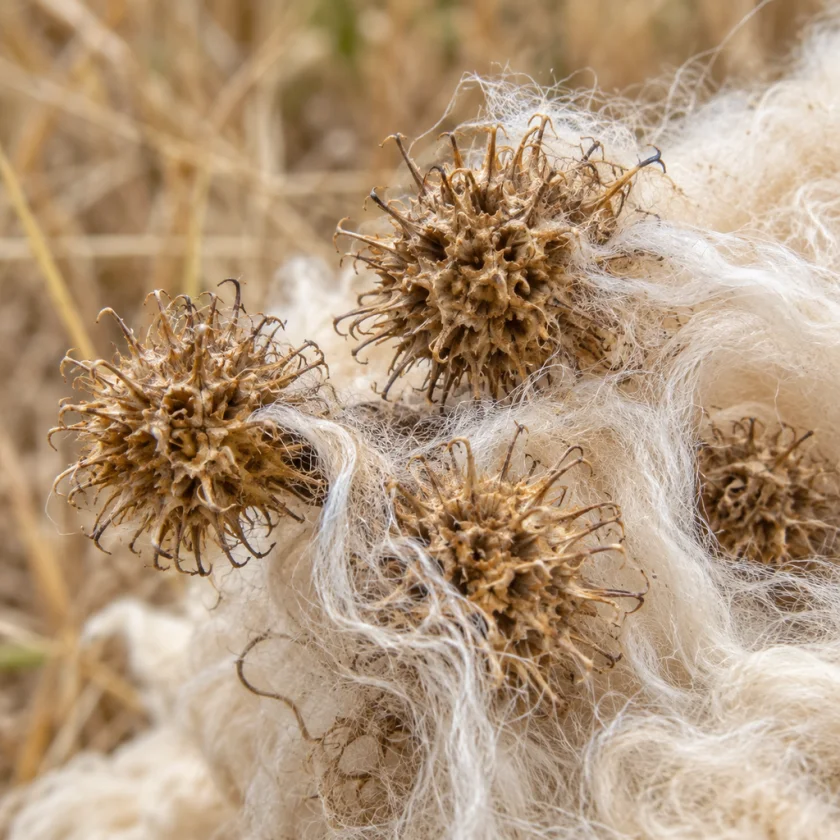
White horehound, Marrubium vulgare, is a hardy perennial of the mint family (Lamiaceae). It has the family's square stems and paired leaves, but the leaves are rounded, deeply wrinkled and covered in white woolly hairs, so that the whole plant looks as if it were dusted with frost. The flowers are small, white and gathered in dense whorls at the leaf joints; the seed heads that follow are rough and hooked, which is one reason the plant travels so well on wool, fur and clothing. Botanists place its home range in the belt between the Mediterranean and Central Asia — southern Europe, North Africa and south-western Asia — from which it has spread until it now grows on every continent except Antarctica, including most of North and South America.
It should not be confused with black horehound, Ballota nigra, a different genus altogether. Black horehound is a coarser, darker, unpleasantly scented plant with purple-pink flowers; older writers knew it as "stinking horehound" and used it for different purposes. Culpeper opened his entry by separating the two — "There are two kinds of Horehound, the white and the black" — and everything on this page concerns the white one.
Both of horehound's names carry a small mystery. The Latin genus name Marrubium is explained in two competing ways in the herbal literature. Maud Grieve's A Modern Herbal (1931) offers either Maria urbs, said to be an ancient Italian town, or the Hebrew marrob, "bitter juice"; the Hebrew derivation is the one most modern reviews repeat. Neither has been demonstrated and the etymological dictionaries leave the question open, so it is honest to say only that the name is old, Latin, and of uncertain origin. The English name is better understood. The Oxford English Dictionary traces "horehound" to Old English hārhūne: hār, "hoary" or grey-white (as in hoar-frost), for the woolly leaves, plus hūne, an Old English plant name of unknown meaning. Folk etymology later reshaped the ending into "-hound," which is why the plant also went by "houndsbane" and why American cookbooks spelled it "hoarhound" into the nineteenth century. The dog in the name is an accident of sound, not a clue to the plant's use.
Greece, Rome and the Herb of the Chest
Horehound enters the written record in the first century CE, and it enters already assigned to the job it would keep for two thousand years. The Greek physician Dioscorides, writing his De Materia Medica around 50–70 CE, describes prasion — a rough, whitish, four-cornered shrub with rounded, wrinkled, bitter leaves that "grows in places near houses and rubbish of buildings" — and recommends the dried leaves and seed boiled in water, or the juice of the green plant, given with honey for consumption of the lungs, for asthma and for coughs. Mixed with dried iris root, he says, it "brings up thick stuff out of the chest." That is an expectorant, described in plain language nineteen centuries before the word was coined. Dioscorides also lists it for bringing on menstruation and the afterbirth, for bites and poisons, for cleaning foul ulcers when smeared on with honey, and, dropped in the ear or nose, for earache and jaundice; he adds the caution that it is "offensive to the bladder."
The Roman encyclopaedist Celsus, in De Medicina (Book IV, first century CE), twice reaches for horehound juice: for ulceration of the throat, alongside leek juice, and again in his chapter on chronic cough, where the patient is to "take juice of leeks or horehound." Pliny the Elder, in the Natural History (Book XX, chapter 89), gives marrubium or prasion a chapter of its own and counts twenty-nine remedies under it; his chapter heading also preserves the plant's other Greek nicknames, linostrophon, philopais and philochares. Three authors within a single century, in two languages, agreeing that the bitter woolly herb by the roadside was a medicine for the chest, is about as firm a foundation as ancient herbal history offers.
Why a bitter herb for the chest? Ancient medicine reasoned in the framework of the four humours: a phlegmy cough was an excess of cold, moist humour that a "hot, dry" herb could cut and loosen, and Gerard was still repeating Galen's classification of horehound as "hot in the second degree, and dry in the third" fifteen centuries later. That is the framework those physicians used, not a modern mechanism; the observation underneath it — that a bitter decoction with honey seemed to help a chesty cough bring things up — is what survived.
Passover, Horus and the Old English Leechbooks
Two traditions about horehound's deep past are repeated in almost every popular account, and both deserve a careful label. The first is that horehound was one of the bitter herbs of Passover. Grieve reports it as "said to be" one of the herbs the Jews were commanded to eat at the feast, and the phrase has hardened into fact by repetition. The rabbinic sources themselves do not name it: the Mishnah's list of five plants acceptable as maror is conventionally identified as lettuce, chicory or endive, and three less certain species, with horseradish a much later northern-European substitute. Horehound is a bitter plant of the eastern Mediterranean, so the tradition is plausible; it is not documented, and we present it as tradition.
The second is that Egyptian priests called horehound the "Seed of Horus," "Bull's Blood" and "Eye of the Star." This one has a traceable source, and it is more interesting than the legend. Copies of Dioscorides carry, attached to many plant entries, lists of alternative names in other languages, and the entry for prasion ends with exactly these: "the Egyptians call it asterope, the Magi sanguis tauri [bull's blood], some genitura Hori [seed of Horus] ... the Romans marrubium, and the Africans atierberzia." Scholars regard these synonym lists as later additions to Dioscorides' text, and nothing independent confirms what Egyptian physicians called the plant. The honest statement is narrower than the legend: a late-antique manuscript tradition recorded exotic names for horehound, one of them invoking Horus, and later herbalists retold them as Egyptian priestly lore.
The Anglo-Saxon record, by contrast, is solid. Horehound appears in Old English glossaries and in the Old English translation of the Herbarium, the Latin herbal that circulated through early medieval monasteries. One gloss preserved in the Bosworth–Toller dictionary reads, in effect, "the Romans call it marrubium, and the English likewise hārhūne" — the plant carrying its Latin medical identity and its native English name side by side. By the medieval period horehound was a standard remedy across Europe for coughs and "tough phlegm," grown in monastery physic gardens and cottage plots alike — which is how it came to be naturalised around old settlements and ruins, the very habitat Dioscorides had described.
Gerard, Culpeper and the Apothecary's Syrup
The great English herbals of the sixteenth and seventeenth centuries handed the ancient uses on almost unchanged. John Gerard's Herball (1597; enlarged by Thomas Johnson in 1633) devotes a chapter to horehound. Boiled in water and drunk, Gerard writes, it "openeth the liver and spleen, cleanseth the breast and lungs, and prevails greatly against an old cough, the pain of the side, spitting of blood, the phthisic, and ulcerations of the lungs." A syrup of the fresh green leaves and sugar he calls "a most singular remedy against the cough and wheezing of the lungs," and he adds the striking claim that the same syrup had eased long-standing consumptives "as hath been often proved by the learned Physicians of our London College" — a glimpse of horehound in professional, not merely folk, use in Elizabethan London. He repeats Dioscorides on poisons and serpent bites, on ulcers dressed with honey, and on the juice for the eyes.
Nicholas Culpeper, in The English Physitian (1652) and its enlarged Complete Herbal, assigns the plant to Mercury in his astrological scheme and gives the same core indication in warmer prose: a decoction of the dried herb, or the juice of the green herb taken with honey, "is a remedy for those that are short-winded, have a cough, or are fallen into a consumption," and "it helps to expectorate tough phlegm from the chest." He records the powder or decoction as a worm remedy, the bruised leaves boiled in hog's grease as an ointment for dog bites and thorn wounds, and — the detail that tells us most about everyday practice — that "there is a syrup made of Horehound to be had at the apothecaries, very good for old coughs, to rid the tough phlegm; as also to void cold rheums from the lungs of old folks, and for those that are asthmatic or short-winded." By the 1650s, in other words, horehound syrup was a stock item at the pharmacy counter, not something you had to make at home.
Read together, these entries show the reputation settling into three uses that carried through to modern monographs: a chest remedy for chronic, phlegmy coughs; a bitter for liver, spleen and digestion; and a women's herb for delayed menstruation and retained afterbirth — which is precisely why modern sources advise against horehound in pregnancy. The extravagant claims (poisons, serpents, eyesight) fell away; the cough syrup did not.
Horehound Ale and Horehound Candy
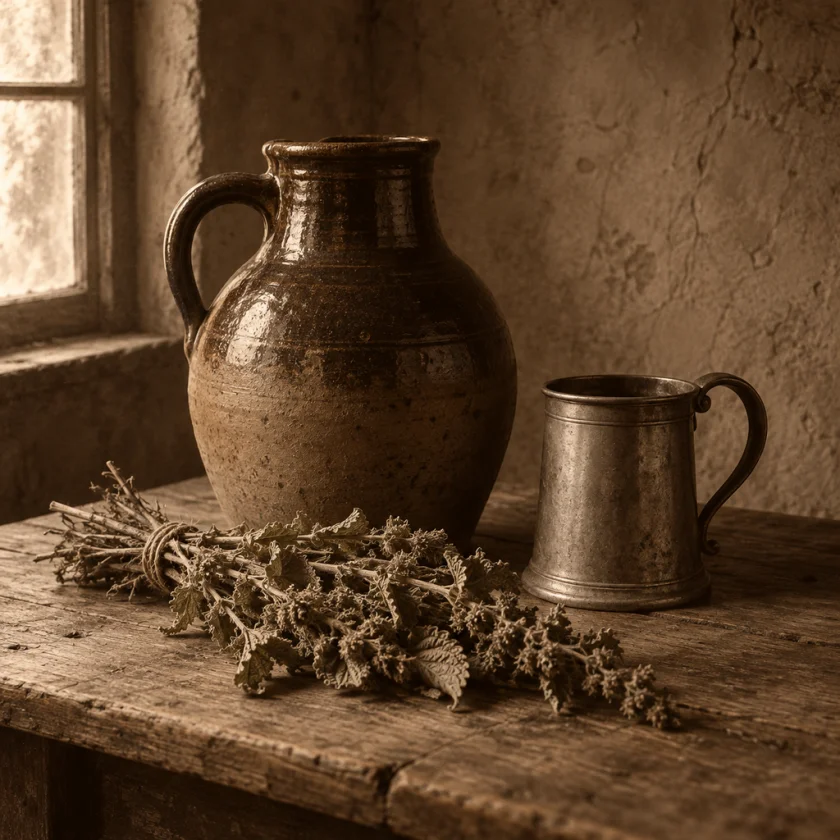
Horehound's second life, as a flavour rather than a physic, is a story of sugar. In the English countryside the herb went into horehound ale, a bittered small beer that Grieve, writing in 1931, could still describe as "an appetizing and healthful beverage, much drunk in Norfolk and other country districts." Horehound beer belongs to the same family of household brews as nettle beer and dandelion-and-burdock, made when hops were dear and every hedgerow bitter was pressed into service; it survives today as a curiosity rather than a staple.
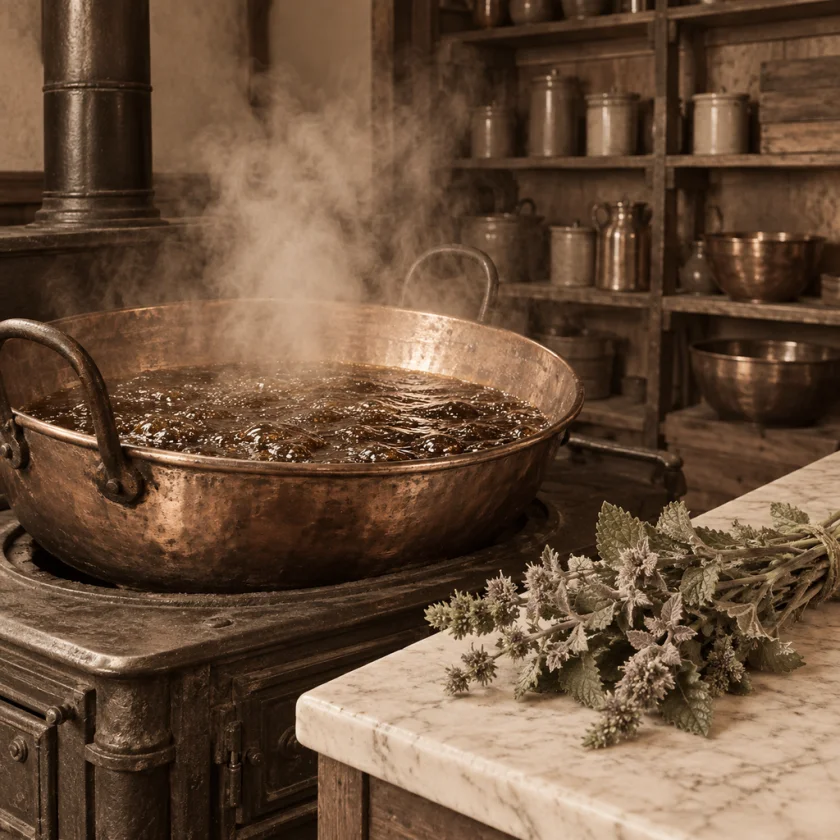
The sweet is the form that conquered the world. The technique is simple and very old: make a strong decoction of the dried herb, dissolve a large weight of sugar in it, boil to the hard-crack stage and pour it out to set. The White House Cook Book of 1887, one of the most widely owned American household manuals of its day, gives it under the older spelling: "Hoarhound Candy. Boil two ounces of dried hoarhound in a pint and a half of water for about half an hour; strain and add three and a half pounds of brown sugar; boil over a hot fire until sufficiently hard; pour out in flat, well-greased tins and mark into sticks or small squares with a knife as soon as cool enough to retain its shape." Grieve's English recipe is the same idea — the juice boiled with sugar "until thick enough to pour into a paper case and be cut into squares when cool." Note the proportions: nearly two pounds of sugar for every ounce of herb. Horehound candy was always more sugar than medicine, and the medicine it delivered was as much the demulcent coating of a slowly dissolving sweet as any property of the plant.
That did not stop it becoming the archetypal cough drop. Through the nineteenth and early twentieth centuries horehound was a standard ingredient in commercially made throat lozenges, often blended with liquorice, wild cherry and balsams, and the dark amber drop sold loose from a jar at the general store became a fixture of American small-town memory. It is still made and sold as an "old-fashioned" candy today, its flavour usually compared to root beer or a bitter, faintly minty molasses. What changed, in the United States, is what the label may promise — the subject of the regulatory section below.
From Cottage Garden to Noxious Weed: Australia
Every plant that people carry round the world for its usefulness risks becoming a pest in its new home, and horehound is a textbook case. It was introduced to southern Australia in the nineteenth century as a medicinal and garden herb, exactly the sort of plant a settler family would bring for the cough syrup and the candy. It escaped almost at once. Its hooked seed heads catch in sheep's wool, it thrives on poor, dry, disturbed ground, and grazing animals avoid its bitter leaves, so on overgrazed pasture it has every advantage over the grasses around it. It spread with the flocks through Victoria, South Australia, New South Wales and Tasmania, was declared under noxious-weed legislation in several states, and is today classed as an environmental weed of native grasslands as well as an agricultural one; it appears to have reached the full extent of the country it can occupy.
Because herbicides are impractical over huge areas of rough pasture, Australian agencies turned to classical biological control — importing, after safety testing, the specialist insects that keep a plant in check in its native range. Two Mediterranean insects were brought in for horehound: the horehound plume moth, Wheeleria spilodactylus (first described by John Curtis in 1827), whose caterpillars strip the leaves, and the horehound clearwing moth, Chamaesphecia mysiniformis, whose larvae bore into the roots. The plume moth was released in Victoria in the 1990s — by 1999 Victorian researchers were already publishing on how to combine it with herbicide in an integrated programme — and the clearwing moth is reported to have followed in Victoria in 1997. The programme is written up in the standard reference Biological Control of Weeds in Australia (2012). New Zealand, facing the same weed in its dry eastern high country, released the plume moth in 2018. It is a small irony of botanical history: the plant Dioscorides found growing on rubbish heaps did so well in its new hemisphere that its own native caterpillars had to be shipped after it.
The Bitter Principle: Marrubiin, 1842 Onward
The scientific chapter opens in 1842, when horehound's bitter principle was first isolated from the plant and named marrubiin. (Several popular sources attach a chemist's name to that date; we could not confirm it and have left it out. The year itself is stated consistently in the modern chemical reviews.) Working out what the molecule actually was took another century. In 1953 Wesley Cocker and colleagues at Trinity College Dublin published "The constitution of marrubiin," establishing its skeleton as a labdane diterpene lactone — a twenty-carbon terpene with a furan ring on its side chain and an internal ester, or lactone, ring — and the stereochemistry was settled by an X-ray crystallographic study in 1983. Marrubiin turned out to be the parent of a whole family of related compounds in Marrubium and other mints, and it has been a target for total synthesis in the laboratory.
A wrinkle discovered along the way still matters for anyone reading horehound research. Fresh plant tissue contains relatively little marrubiin; much of what is measured in extracts forms during drying and extraction from a less stable precursor, premarrubiin. Whether marrubiin is therefore a genuine end product of the plant's metabolism or partly an artefact of the laboratory has been debated for decades, and the 2013 review of the compound describes the relationship as still needing investigation. Werner Knöss and colleagues showed in 1997 that horehound builds marrubiin by the then newly discovered non-mevalonate pathway, the same route bacteria and plant plastids use for their terpenes — one of the early plant examples of that pathway.
Pharmacology followed chemistry. From the 1990s a group at the University of Vale do Itajaí in Brazil, led by Valdir Cechinel-Filho, put horehound through the standard animal models: a hydroalcoholic extract showed analgesic (pain-reducing) activity in mice in 1998; chemically modified marrubiin derivatives did the same in 2005; and marrubiin itself reduced experimentally induced swelling — an anti-oedematogenic, or anti-inflammatory, effect — in 2006. Other laboratories reported that marrubiin and the related marrubenol relax blood vessels, in part by blocking L-type calcium channels, and that whole extracts lower blood glucose and lipids in diabetic rodents. Notably, the one thing tradition is surest of — that horehound loosens a cough — is the one property that has never been measured in a controlled human study. The expectorant claim rests on nineteen centuries of report, a bitter's reflex stimulation of secretions, and animal data on smooth muscle, not on a trial.
Monographs and Rulings: Germany, Europe, the United States
Three regulators have passed judgement on horehound, and they reached three different, defensible answers, because they were asking different questions.
Germany. The German Commission E, the expert panel that reviewed traditional herbal drugs for the federal health agency in the 1980s and 1990s, approved horehound herb (Marrubii herba) for loss of appetite, for dyspeptic complaints such as bloating and flatulence, and for catarrhs of the respiratory tract — the coughs and bronchial complaints of the old herbals. Commission E's standard was plausibility plus long, safe use, not proof by trial, and on that standard horehound passed comfortably.
European Union. The European Medicines Agency's Committee on Herbal Medicinal Products (HMPC) adopted a European Union herbal monograph on Marrubium vulgare L., herba in 2013 (EMA/HMPC/604271/2012). It registers horehound as a traditional herbal medicinal product — a legal category in which efficacy is accepted on the basis of at least thirty years of documented use, fifteen of them in the EU, rather than clinical trials — for three uses that will by now sound familiar: as an expectorant in cough associated with a cold; for mild dyspeptic symptoms such as bloating and flatulence; and for temporary loss of appetite. It restricts use to adults and adolescents over twelve, and advises seeing a doctor if a cough lasts more than a week. The monograph is, in effect, Dioscorides and Culpeper translated into regulatory language, with the honest label "traditional" attached.
United States. The FDA asked a stricter question — not "has it been used?" but "has it been proven?" — in its decades-long review of every over-the-counter drug ingredient on the market. When the agency published its final monograph for OTC expectorant products on 28 February 1989, guaifenesin was the only expectorant ingredient recognised as safe and effective (21 CFR 341.18). Horehound, which had been sold in cough drops for a century, was not included, and it now appears by name in the federal regulation that catalogues cold and cough ingredients "not generally recognized as safe and effective" — 21 CFR 310.545, under expectorant drug products, alongside ipecac, camphor, menthol and pine tar. The practical meaning is narrow but real: in the United States, a product may not be marketed as an over-the-counter drug with horehound as its active expectorant ingredient. Horehound itself was never banned: it sits on the FDA's list of natural flavourings "generally recognized as safe" (21 CFR 182.20), which is why horehound candy is still freely sold — as candy, or as a supplement with a Supplement Facts panel rather than Drug Facts. The 1989 ruling is not a finding that horehound does nothing; it is a finding that no one had shown, to the FDA's standard, that it does something. The difference between those statements is the whole story of this herb.
The First Clinical Trials, Reported Honestly
Human research on horehound is thin, recent, and concerned not with coughs but with metabolism — a direction set by the animal work on blood sugar. The landmark is a Mexican study published in 2004 by Armando Herrera-Arellano and colleagues at the Mexican Social Security Institute's medicinal-plant research centre, which tested a leaf infusion of Marrubium vulgare, and separately a Cecropia obtusifolia extract, in type 2 diabetics whose sugars were poorly controlled on conventional treatment. The horehound infusion produced only trivial changes — blood glucose fell by well under one per cent, total cholesterol by about four per cent and triglycerides by about six per cent — and later reviewers concluded that the glucose-lowering seen in diabetic rodents did not translate to people at tea-strength doses. It was a small study of 22 patients without a placebo arm, and it is the largest human trial of the herb we can find. A 2012 Algerian study often cited beside it was in diabetic rats, not humans.
For the traditional indications the picture is emptier still. We searched PubMed for randomised or controlled trials of horehound for cough, bronchitis, appetite or dyspepsia and found none, which is precisely why the EMA monograph is a traditional-use one. The 2020 review of the plant calls for "novel clinical trials" before any of the metabolic findings can be relied on. That is the honest state of the evidence: a very long tradition, a well-characterised chemistry, consistent animal pharmacology, and a nearly blank page where the human trials should be.
Horehound Today
Horehound is at once one of the best-documented and one of the least-tested herbs in the European tradition: named for the same purpose by Dioscorides, Celsus, Pliny, the Old English Herbarium, Gerard, Culpeper, Commission E and the European Medicines Agency, and never once put through a proper trial for that purpose. In Europe it is sold as a registered traditional medicine — teas, syrups, lozenges and tinctures for coughs and poor appetite — and it remains in the European Pharmacopoeia as Marrubii herba. In the United States it lives on as a flavour and a nostalgia: horehound drops and sticks, old-fashioned horehound sodas, the rock-and-rye of the cocktail revival. In Australia and New Zealand it is a declared weed with its own biological-control programme. And in the laboratory it is a source of labdane diterpenes that chemists synthesise and pharmacologists test for effects on inflammation, pain, blood vessels and blood sugar.
What the reader should take from the history is a sense of proportion. A horehound lozenge or a cup of bitter horehound tea with honey is a low-risk comfort for a cold, with two millennia of use behind it and a mechanism — a bitter stimulating secretions, a demulcent sweet coating the throat — that is at least plausible. It is not a proven expectorant, it is not a diabetes treatment, and its old reputation for bringing on menstruation is reason enough to avoid it in pregnancy. Held that way, horehound is exactly what its history says it is: an honest, bitter, old-fashioned remedy that has outlived most of its rivals without ever quite proving its case.
Key Research Papers
Reviews of horehound's chemistry and pharmacology, the historical chemistry landmarks, the biological-control literature and the one clinical trial discussed above. Historical primary texts (Dioscorides, Celsus, Pliny, Gerard, Culpeper, Grieve) are named in the article rather than cited here.
- Aćimović M, Jeremić K, Salaj N, Gavarić N, Kiprovski B, Sikora V, Zeremski T (2020). Marrubium vulgare L.: A Phytochemical and Pharmacological Overview. Molecules. — doi:10.3390/molecules25122898
- Popoola OK, Elbagory AM, Ameer F, Hussein AA (2013). Marrubiin. Molecules. — doi:10.3390/molecules18089049
- Meyre-Silva C, Cechinel-Filho V (2010). A Review of the Chemical and Pharmacological Aspects of the Genus Marrubium. Current Pharmaceutical Design. — doi:10.2174/138161210793563392
- Cocker W, Cross BE, Duff SR, Edward JT, Holley TF (1953). The constitution of Marrubiin. Part I. Journal of the Chemical Society (Resumed). — doi:10.1039/jr9530002540
- Knöss W, Reuter B, Zapp J (1997). Biosynthesis of the labdane diterpene marrubiin in Marrubium vulgare via a non-mevalonate pathway. Biochemical Journal. — doi:10.1042/bj3260449
- de Souza MM, de Jesus RAP, Cechinel-Filho V, Schlemper V (1998). Analgesic profile of hydroalcoholic extract obtained from Marrubium vulgare. Phytomedicine. — doi:10.1016/S0944-7113(98)80005-6
- Meyre-Silva C, Yunes RA, Schlemper V, Campos-Buzzi F, Cechinel-Filho V (2005). Analgesic potential of marrubiin derivatives, a bioactive diterpene present in Marrubium vulgare (Lamiaceae). Il Farmaco. — doi:10.1016/j.farmac.2005.01.003
- Stulzer HK, Tagliari MP, Zampirolo JA, Cechinel-Filho V, Schlemper V (2006). Antioedematogenic effect of marrubiin obtained from Marrubium vulgare. Journal of Ethnopharmacology. — doi:10.1016/j.jep.2006.05.023
- Herrera-Arellano A, Aguilar-Santamaría L, García-Hernández B, Nicasio-Torres P, Tortoriello J (2004). Clinical trial of Cecropia obtusifolia and Marrubium vulgare leaf extracts on blood glucose and serum lipids in type 2 diabetics. Phytomedicine. — PubMed PMID: 15636168
- Boudjelal A, Henchiri C, Siracusa L, Sari M, Ruberto G (2012). Compositional analysis and in vivo anti-diabetic activity of wild Algerian Marrubium vulgare L. infusion. Fitoterapia. — doi:10.1016/j.fitote.2011.11.005
- Ainsworth N (1999). Potential for Integrated Control of Horehound Marrubium vulgare L. by the Plume Moth Wheeleria spilodactylus (Curtis) and 2,4-D. Biocontrol Science and Technology. — doi:10.1080/09583159929613
- Weiss J, Sagliocco J-L (2012). Marrubium vulgare L. – horehound. Biological Control of Weeds in Australia. — doi:10.1071/9780643104204.marrubium
- De Vos P (2010). European materia medica in historical texts: Longevity of a tradition and implications for future use. Journal of Ethnopharmacology. — doi:10.1016/j.jep.2010.05.035
PubMed Topic Searches
- PubMed: Horehound ethnobotany and traditional use
- PubMed: Horehound history of pharmacology (marrubiin)
- PubMed: Horehound clinical trials
External Authoritative Resources
- European Medicines Agency — Marrubii herba (white horehound) EU herbal monograph, 2013
- 21 CFR 310.545 — OTC drug ingredients not generally recognized as safe and effective (horehound under expectorant products)
- 21 CFR 341.18 — Expectorant active ingredient (final monograph, 54 FR 8509, 28 February 1989)
- 21 CFR 182.20 — Natural flavourings generally recognized as safe (includes horehound)
- Celsus, De Medicina Book IV (Loeb translation, LacusCurtius)