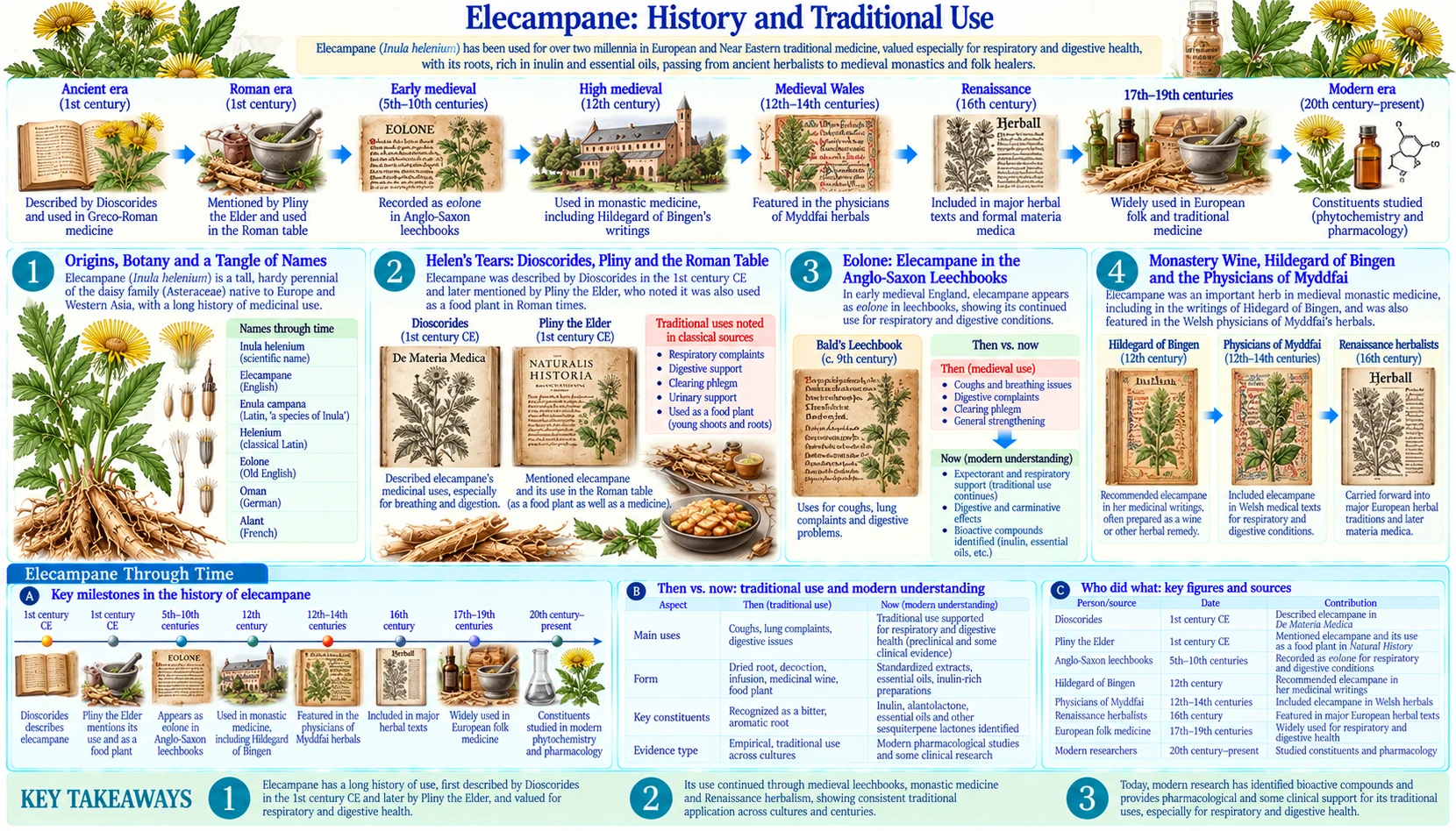
Elecampane: History and Traditional Use
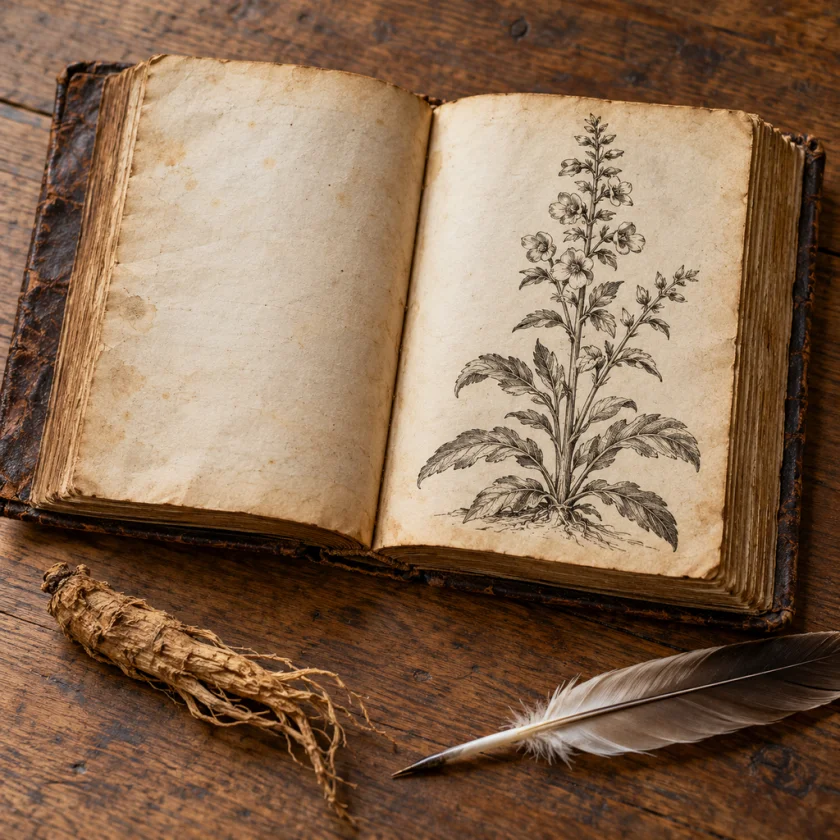
Elecampane is the tall yellow daisy whose bitter, aromatic root Europe kept for the chest. Greeks and Romans wrote it down as helenion and inula; an empress is said to have eaten it daily; Anglo-Saxon healers called it eolone; Hildegard of Bingen steeped it in wine for the lungs; Tudor herbalists candied it; farriers rubbed it into horses. Then, in 1804, a Berlin chemist boiled the root and found a substance no one had described before — the fibre we now call inulin, named after this very plant. This article follows Inula helenium from legend to laboratory. Where the record is firm we say so; where a story is folklore, we call it that.
Table of Contents
- Origins, Botany and a Tangle of Names
- Helen's Tears: Dioscorides, Pliny and the Roman Table
- Eolone: Elecampane in the Anglo-Saxon Leechbooks
- Monastery Wine, Hildegard of Bingen and the Physicians of Myddfai
- Gerard, Culpeper and the Candied Root
- Horseheal, Scabwort and a Root in the Absinthe Still
- 1804: Valentin Rose and the Discovery of Inulin
- From Helenin to Alantolactone: the Chemists of 1873–1895
- Allergy, Regulators and the Laboratory: Tradition Meets Evidence
- Elecampane Today
- Key Research Papers
- Connections
- Featured Videos
Origins, Botany and a Tangle of Names
Elecampane (Inula helenium) is a robust perennial of the daisy family, Asteraceae, that grows head-high or taller, with broad downy leaves and shaggy yellow flower heads in high summer. It is native across a wide belt of Eurasia — from Spain in the west to Xinjiang in western China — favouring the damp, half-shaded ground of meadows, ditches and woodland edges. Europeans carried the root with them and it long ago escaped the garden: it is naturalised in parts of North America, where an 1898 dispensatory already described it growing "in pastures, along roadsides." The part that mattered was never the flower but the thick, branching, aromatic root, dug in autumn from a plant two or three years old, violet-scented when fresh and warm, bitter and camphor-like when dried.
Few herbs carry so many names, and each one is a small piece of history. The Greeks called it helenion; the Romans inula (Dioscorides even records that "the Romans call it" inula campana, among a string of other names). Medieval apothecaries wrote enula campana, roughly "inula of the fields," and it is that Latin phrase, worn smooth by centuries of English mouths, that became elecampane. Old English speakers had their own word, eolone (also spelled elene and elone), which appears in the earliest English medical books. Country names describe what people did with it: horseheal and scabwort from its use on the skin of horses and sheep, elf dock from a folklore linking the plant to the fairy folk. The German Alant survives inside the chemical name alantolactone.
Helen's Tears: Dioscorides, Pliny and the Roman Table
The species name helenium is ancient, and the ancients themselves offered legends to explain it. The best-known says the plant sprang up where the tears of Helen of Troy fell; another, repeated in Gerard's Herball, says Helen "had her hands full of it when Paris stole her away." A third, modern suggestion is that the name recalls not the Homeric Helen at all but an older vegetation goddess of the same name. These are stories, not history. What is certain is that by the first century CE the plant was thoroughly familiar in the Greek and Roman world.
The Greek physician Dioscorides, writing his De Materia Medica around 50–70 CE, gave helenion a chapter in his first book. He describes the "fragrant, great, somewhat sharp" root, dug in summer and dried, and says that taken in a syrup with honey it "helps coughs, asthma, hernias, convulsions, gaseousness, and the bites of venomous creatures, being generally warming." He adds that the root "is good for the stomach preserved in passum" (raisin wine) and, in his fifth book, gives a recipe for nectarites, an elecampane wine made by steeping dried root in must for three months, "good for the stomach and chest." Nearly every later use is already here: cough syrup, digestive conserve, medicinal wine.
The Roman encyclopaedist Pliny the Elder (died 79 CE) treats elecampane twice in his Natural History. In Book 19, among the garden vegetables, he describes inula as a root "very injurious to the stomach" eaten alone but "extremely wholesome" when sweetened — ground to flour, or steeped and combined with boiled grape must, honey, raisins or dates — and says it "has acquired a high reputation from the circumstance that Julia Augusta used to eat it daily" for weakness of the stomach. (Julia Augusta is usually identified as the empress Livia, Augustus's widow, who took that name after his death.) In Book 20, among the remedies, he adds that chewing it strengthens the teeth, that "a confection of it is a cure for cough," that the boiled juice expels tapeworm, and that the powdered root serves "in cases of cough, convulsions, flatulency, and affections of the trachea." The Roman elecampane was as much a preserved sweetmeat as a medicine — a pattern that would last for seventeen centuries.
Eolone: Elecampane in the Anglo-Saxon Leechbooks
When Latin medicine reached England it met a plant the English already had a name for. The Old English eolone is glossed in the early word-lists as inula, and it turns up repeatedly in the medical compilations written before the Norman Conquest — above all in Bald's Leechbook, the tenth-century physician's handbook that is among the oldest surviving medical books in English. Its recipes open with the plain instruction Genim eolonan, "take elecampane," and one directs the healer to wyrc sealfe of eolonan, "make a salve of elecampane." Another remedy, for a scaly skin disease the Anglo-Saxons called hreofl, combines plantain (waybread), elecampane and sulphur. Grieve's Modern Herbal summarised the situation a century ago: elecampane "is frequently mentioned in the Anglo-Saxon writings on medicine current in England prior to the Norman Conquest."
The Anglo-Saxon uses lean toward the skin — salves and washes — as much as toward the chest, the double reputation the later names horseheal and scabwort preserve. When the plant first reached Britain is not recoverable; that it was in use, under an English name, by the tenth century is.
Monastery Wine, Hildegard of Bingen and the Physicians of Myddfai
Through the Middle Ages elecampane was a staple of the physic garden, and German sources describe medieval medicine leaning on it "especially in the form of Alantwein" — elecampane wine, the direct descendant of Dioscorides' nectarites. The clearest medieval voice is Hildegard of Bingen (1098–1179), the Rhineland abbess whose Physica devotes a chapter to Alant (Enula). In the humoral language of her time she calls it "of a hot and dry nature" with "useful powers in it," and gives a precise regimen: keep the root, fresh or dried, steeping in pure wine all year round, replacing it when it has given up its strength; a person "who has pain in the lung" should drink a little of this wine daily before and after food, and it "draws the poison from the lung, suppresses migraine and clears the eyes." She is equally precise about the risk: anyone who drank it too often "would be harmed by its strength," and a stronger draught of figs, elecampane and galangal is for lung disease alone. For a twelfth-century text that is a strikingly modern note of dose caution. (Hot, dry and the balance of humours are the framework of medieval medicine, not a mechanism we endorse.)
The Regimen Sanitatis Salernitanum, the versified health advice of the Salerno school, gave the plant a jingle that outlived the school: Enula campana reddit praecordia sana — "elecampane makes the heart-region healthy." In Wales, the collection known as the Physicians of Myddfai — recipes attributed to a thirteenth-century family of physicians — uses the plant, under its Welsh name marchalan, in remedy after remedy. For "dyspnoea in the chest" the root is boiled in wine vinegar, dried, powdered and worked into honey with pepper; for "pulmonary cough" it joins mallow root and figs in a honey confection; for "scabs and eruptions" it is boiled with celandine as a wash; and, echoing Pliny, the reader is told to scrub the teeth with it to make them "firm, white, and healthy." The medieval indications are the classical ones, passed hand to hand.
Gerard, Culpeper and the Candied Root
The printed herbals of the Renaissance gathered this inheritance up. John Gerard's Herball (1597; enlarged by Thomas Johnson in 1633) lists the plant as "Elecampane and Scab-woort, and Horse-heale," repeats the Helen legend, and ranks it "hot and dry in the third degree." His virtues open with the lungs: it is "good for shortnesse of breath and an old cough, and for such as cannot breathe unlesse they hold their neckes upright," given as a looch ("a medicine to be licked on") or preserved, "to purge and void out thicke, tough, and clammy humours, which sticke in the chest and lungs." The preserved root, "taken after supper," helps digestion, and the boiled juice "driveth forth all kinde of wormes of the belly, as Pliny teacheth" — Gerard cites Pliny by book and chapter, so we know he was reading him directly.
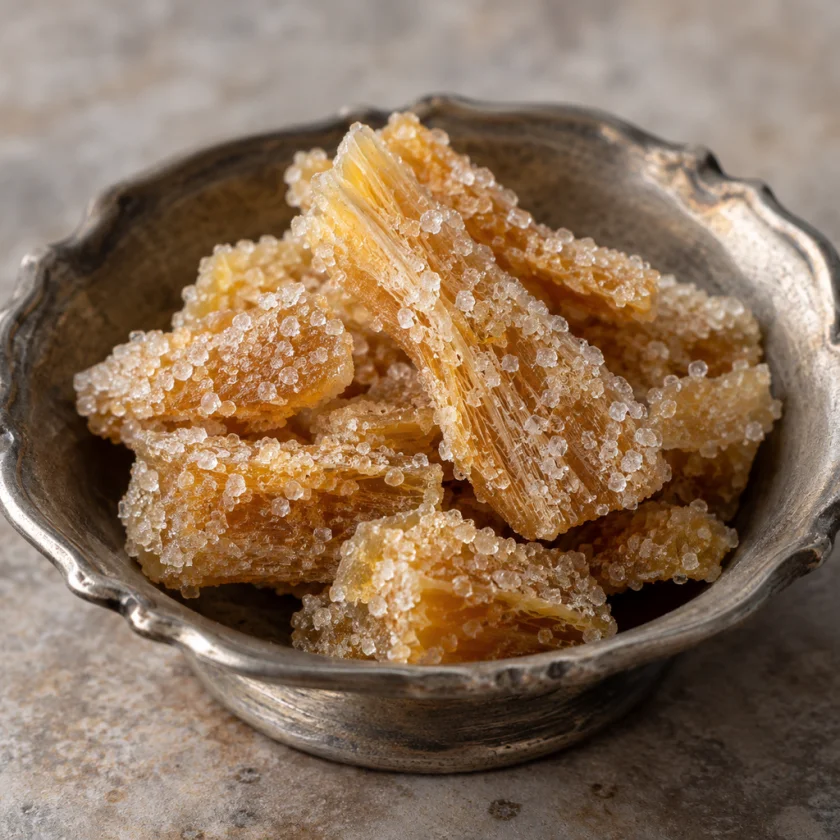
Nicholas Culpeper's English Physician (1652), the herbal that put astrology and plain English on every cottage shelf, placed elecampane "under the dominion of Mercury" and gave the fullest domestic account: "The fresh roots of Elecampane preserved with sugar, or made into a syrup or conserve, are very effectual to warm a cold windy stomach ... and to help the cough, shortness of breath, and wheezing in the lungs." He adds the decoction in wine to "drive forth all manner of worms," the chewed root to fasten loose teeth, and the root boiled in vinegar and worked into hog's suet as "an excellent remedy for scabs or itch in young or old," and his dispensatory lists elecampane among the roots to be candied whole in their own weight of sugar, alongside ginger, angelica and comfrey.
That candying runs from Pliny's honeyed conserve straight to the sweet-shop. Grieve records that "some fifty years" before her 1931 Modern Herbal, elecampane candy "was sold commonly in London as flat, round cakes being composed largely of sugar and coloured with cochineal." For most of its history the ordinary person met elecampane not as a tincture but as a sweet.
Horseheal, Scabwort and a Root in the Absinthe Still
Beside the human pharmacy ran a veterinary one. The name scabwort, Grieve explains, arose because "a decoction of it is said to cure sheep affected with the scab," and horseheal from "its reputed virtues in curing the cutaneous diseases of horses." Farriers and shepherds used the same salves and washes the leechbooks and Culpeper prescribed for human skin. Whether they worked is not recorded in any form we could test; that they were used widely enough to rename the plant is beyond doubt.
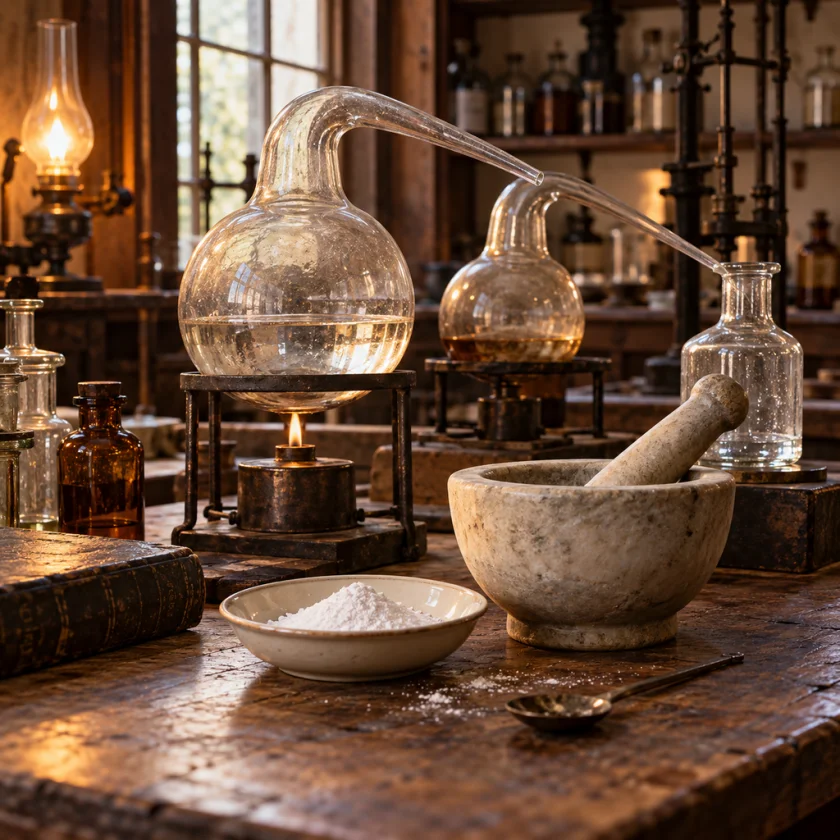
The root's warm bitterness also made it a flavouring. Grieve notes that in Switzerland (she names Neuchâtel) elecampane root was "one of the substances used in the preparation of Absinthe, and it was also used for the same purpose in France," and that it "furnishes the Vin d'Aulnée of the French" — the same medicated wine Dioscorides and Hildegard had made. It is often said to flavour vermouth as well; we did not find that documented, so we leave it as a likelihood rather than a fact. In the United States, King's American Dispensatory (1898) called it "an aromatic stimulant and tonic" for "chronic pulmonary affections" and for "tetter, itch, and other cutaneous diseases" — the classical list, unchanged, on a new continent.
1804: Valentin Rose and the Discovery of Inulin
Elecampane's most lasting contribution to science came not from its medicine but from its starch — or rather, from the discovery that its "starch" was nothing of the kind. In 1804 the Berlin pharmacist-chemist Valentin Rose the younger extracted "a peculiar substance" from elecampane root by boiling it in water and letting the liquid cool, whereupon a white powder settled out. It looked like starch but behaved differently: it dissolved in hot water and precipitated on cooling, and it turned yellow rather than blue with iodine, the classic test that distinguishes it from starch to this day. Rose called it alantin, after the German name of the plant; within a few years chemists were calling it inulin, after the genus Inula, and that is the name that stuck.
What Rose had found was the first known member of the fructans — chains of fructose units rather than the glucose chains of starch — which plants of the daisy family (elecampane, chicory, dandelion, dahlia, Jerusalem artichoke) use to store energy in their roots. Nineteenth-century analysts found autumn-dug root could be more than 40 percent inulin, over twice the spring figure — the chemistry behind every tradition's insistence on an autumn harvest. Heinrich Kiliani argued in 1881 that inulin was built from fructose; James Irvine worked out its structure in the 1920s; and in the 1930s it became the reference substance for measuring kidney filtration, because the body neither digests nor reabsorbs it. That same indigestibility is why inulin is sold today as a prebiotic fibre — though the commercial supply now comes from chicory, not from the plant that gave it its name.
From Helenin to Alantolactone: the Chemists of 1873–1895
The aromatic, bitter, medicinal side of the root took longer to isolate. Apothecaries had long noticed needle-like crystals forming on stored root, and this "elecampane camphor" or helenin was treated as a single substance. In two papers in the Berichte der deutschen chemischen Gesellschaft (1873 and 1876), J. Kallen distilled the root with water and showed that the crystalline product was a mixture, separating an odourless bitter "helenin" from a peppermint-scented "alant camphor." In 1895 Julius Bredt and Wilhelm Posth, in Justus Liebigs Annalen der Chemie, established that the principal substance was a lactone (a ring-shaped ester) and named it alantolactone. Natural "helenin" is now known to be a pair of isomers, alantolactone and isoalantolactone, in the class called sesquiterpene lactones — the bitter, biologically active molecules characteristic of the daisy family.
The 1880s were the decade bacteriology was born, and helenin was tried against the new enemy almost at once. Grieve reports that in 1885 a researcher named Korab showed helenin to be "such a powerful antiseptic and bactericide, that a few drops of a solution of 1 part in 10,000 immediately kills the ordinary bacterial organisms, being peculiarly destructive to the Tubercle bacillus"; King's Dispensatory likewise records that "helenin is accredited with a fatal action upon the tubercle bacillus by Korab, Blocq, and others," and that it was given in tiny doses for the coughs of tuberculosis. We could not trace Korab's original report, so the details rest on these secondary accounts; but the claim gave the ancient chest remedy a scientific rationale at the height of the tuberculosis era, and it is the direct ancestor of the laboratory studies described below.
Allergy, Regulators and the Laboratory: Tradition Meets Evidence
The twentieth century added the one chapter no herbal had written: allergy. Alantolactone proved to be one of the most potent skin sensitisers among the sesquiterpene lactones: it binds to skin proteins and can provoke allergic contact dermatitis, an itchy, sometimes blistering rash, in people who have handled the plant. Dermatologists now use it as a marker allergen: the "sesquiterpene lactone mix" used in routine patch testing is built from alantolactone, dehydrocostus lactone and costunolide, and studies of Compositae-allergic patients show broad cross-reaction across the daisy family — ragweed, chrysanthemum, feverfew, arnica, chamomile and elecampane among them. For the herbalist this is the central modern caution: elecampane is not a herb for anyone with a known daisy-family allergy.
That allergy weighed heavily with regulators. Germany's Commission E, the expert panel that reviewed traditional herbal drugs for the federal health office, issued a negative assessment of elecampane root (Alantwurzel) in the late 1980s, on the grounds that its efficacy for the traditional indications (cough, bronchial catarrh, digestive complaints, worms) was insufficiently documented while its allergenic potential was real. It was declined not because it was shown to be useless, but because the evidence did not meet the bar and the risk was documented. We could not confirm that the European Medicines Agency's herbal committee has published a monograph on the plant, so we make no claim about its EU status.
The laboratory story is livelier than the clinical one. In 1999 Charles Cantrell and colleagues, screening plants for activity against Mycobacterium tuberculosis, isolated alantolactone, isoalantolactone and related eudesmanolides from elecampane root and showed they inhibited the bacterium in vitro — a century after Korab, the tuberculosis claim had a named molecule and a modern assay. A 2008 study found the root's essential oil active against a range of Gram-positive and Gram-negative bacteria and Candida yeasts; a 2009 Irish study showed elecampane extract active in vitro against clinical Staphylococcus aureus strains including MRSA; and a 2020 Polish study found elecampane extracts calming inflammatory signalling in human neutrophils and cultured airway tissue — a plausible mechanism for a cough herb. The old "worm" tradition has attracted very little modern testing. And across all of this there is a gap to hold on to: there are no adequately sized randomised human trials of elecampane for cough, bronchitis or anything else. Two thousand years of use, a coherent laboratory rationale, and no clinical proof — that is the honest state of the evidence.
Elecampane Today
Elecampane is still grown, still dug in autumn, and still sold as dried root, tincture and syrup — usually blended, as it always was, with softer chest herbs such as marshmallow, mullein, thyme and licorice. A modern herbalist reaching for it for a wet, lingering cough is doing what Dioscorides, Hildegard, the Myddfai physicians, Gerard and Culpeper all did. The candy is gone from the sweet-shops, though anyone with a root and a pan of sugar can still make Pliny's conserve.
Its history explains its paradox. The plant that named inulin is now irrelevant to the inulin industry; the molecule that gave it a scientific reputation in 1885 is the one that makes it a textbook contact allergen; and the herb with one of the deepest paper trails in European medicine is one a careful regulator declined to approve, for want of the one kind of evidence — a controlled human trial — that two millennia of admirers never thought to gather. Tradition can tell us that people found the root worth candying, steeping and prescribing for a very long time, and with some precision what they used it for. It cannot tell us whether it works. That question remains open — and the history, at least, makes it worth asking.
Key Research Papers
The list covers the modern review of Inula, the nineteenth-century helenin papers, the first antimycobacterial and antimicrobial laboratory studies, the Compositae-allergy literature and inulin. Historical primary texts are named in the article and linked under External Resources.
- Seca AML, Grigore A, Pinto DCGA, Silva AMS (2014). The genus Inula and their metabolites: From ethnopharmacological to medicinal uses. Journal of Ethnopharmacology. — doi:10.1016/j.jep.2014.04.010
- Kallen J (1873). Ueber Helenin und Alantkampher. Berichte der deutschen chemischen Gesellschaft. — doi:10.1002/cber.187300602184
- Bredt J, Posth W (1895). Ueber das Alantolacton (Helenin). Justus Liebigs Annalen der Chemie. — doi:10.1002/jlac.18952850306
- Cantrell CL, Abate L, Fronczek FR, Franzblau SG, Quijano L, Fischer NH (1999). Antimycobacterial Eudesmanolides from Inula helenium and Rudbeckia subtomentosa. Planta Medica. — doi:10.1055/s-1999-14001
- Deriu A, Zanetti S, Sechi LA, Marongiu B, Piras A, Porcedda S (2008). Antimicrobial activity of Inula helenium L. essential oil against Gram-positive and Gram-negative bacteria and Candida spp. International Journal of Antimicrobial Agents. — doi:10.1016/j.ijantimicag.2008.02.006
- O'Shea S, Lucey B, Cotter L (2009). In vitro activity of Inula helenium against clinical Staphylococcus aureus strains including MRSA. British Journal of Biomedical Science. — PubMed PMID: 20095126
- Gierlikowska B, Gierlikowski W, Bekier K, Skalicka-Woźniak K, Czerwińska ME, Kiss AK (2020). Inula helenium and Grindelia squarrosa as a source of compounds with anti-inflammatory activity in human neutrophils and cultured human respiratory epithelium. Journal of Ethnopharmacology. — doi:10.1016/j.jep.2019.112311
- Paulsen E, Andersen KE, Hausen BM (2001). Sensitization and cross-reaction patterns in Danish Compositae-allergic patients. Contact Dermatitis. — PubMed PMID: 11683829
- Paulsen E (2002). Contact sensitization from Compositae-containing herbal remedies and cosmetics. Contact Dermatitis. — doi:10.1034/j.1600-0536.2002.470401.x
- Paulsen E (2023). The sesquiterpene lactone mix: A review of past, present and future aspects. Contact Dermatitis. — doi:10.1111/cod.14419
- Roberfroid MB (2007). Inulin-Type Fructans: Functional Food Ingredients. The Journal of Nutrition. — doi:10.1093/jn/137.11.2493S
PubMed Topic Searches
External Authoritative Resources
- CABI Compendium — Inula helenium (Elecampane): distribution and biology — doi:10.1079/cabicompendium.28755
- Pliny, Natural History 19.29 (Bostock & Riley translation, Perseus Digital Library)
- Dioscorides, De Materia Medica (Osbaldeston translation, Internet Archive)
- Bosworth–Toller Anglo-Saxon Dictionary — eolone
- Hildegard of Bingen, Physica (Latin text, Internet Archive)
- The Physicians of Myddvai (Pughe translation, 1861, Internet Archive)
- King's American Dispensatory (1898) — Inula
- Grieve, A Modern Herbal (1931) — Elecampane
Connections
Featured Videos