How Tinospora Species Are Told Apart: Identity and Adulteration
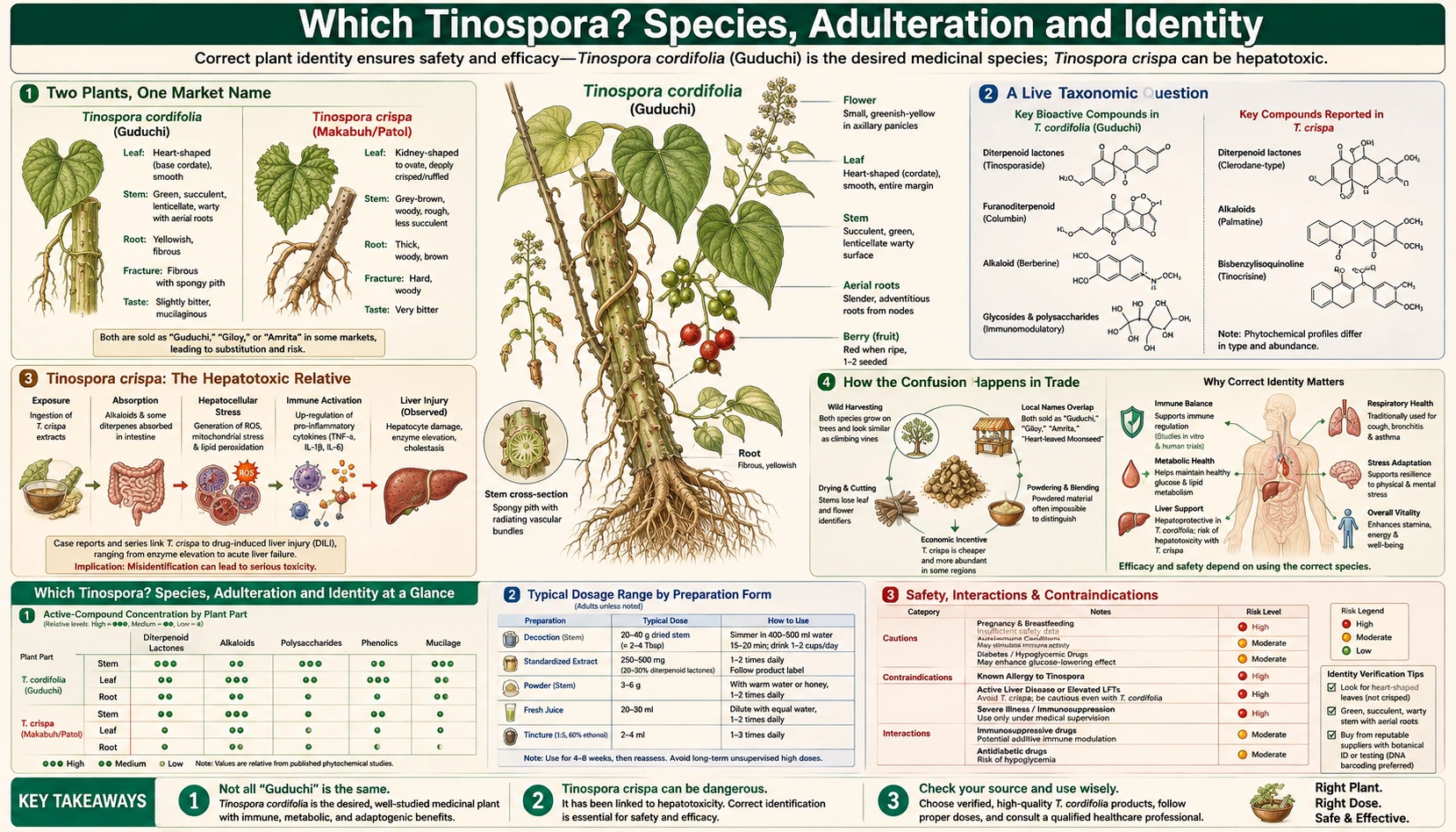
This article exists because of an argument. When Indian hepatologists published case series describing liver injury in people who had been taking giloy, the central scientific objection was not that the patients were imaginary. It was botanical: when the first case series appeared, nobody had tested the plant material those patients consumed, and there is a closely related species — Tinospora crispa — that is documented to damage the liver and is confused with Tinospora cordifolia in trade. If some patients had swallowed the wrong vine, their injuries say nothing about guduchi. (In 2023 one team went back and tested the plant samples its patients had taken; the result is set out in the exoneration section.)
That objection is serious and it is stated here at full strength, because a page that straw-mans it is useless. Everything in it is true: the species really is different, it really is hepatotoxic, the confusion really happens, the material in the first reports really was not authenticated, and at that time the hepatologists really could not exclude it.
And then the objection turns around and bites the hand that raised it. An adulteration defence clears the plant. It cannot clear the bottle. If the reason people were injured is that the market contains an invisible hepatotoxic look-alike, then buying unverified giloy is more dangerous than it would be if authenticated guduchi were simply an idiosyncratic hepatotoxin — because at least in that case you would know what you were taking. The standard exculpation is the strongest available argument against unverified herbal material, and that inversion is what this page is really about.
Table of Contents
- Two Plants, One Market Name
- A Live Taxonomic Question
- Tinospora crispa: The Hepatotoxic Relative
- How the Confusion Happens in Trade
- Why Dried Cut Stem Is Nearly Unidentifiable
- How Identity Is Actually Established
- What the Pharmacopoeias Require, and Cannot Enforce
- The Exoneration Argument at Full Strength
- Why It Makes an Unverified Product More Concerning
- Beyond Species: The Other Things in Herbal Products
- Even the Right Species Is Not One Material
- Questions a Manufacturer Can Answer
- Key Research Papers
- Connections
- Featured Videos
Two Plants, One Market Name
Both plants belong to Menispermaceae, the moonseed family — a family of climbing vines that is notable for alkaloid-rich chemistry and for containing several genuinely toxic members. Within it, the genus Tinospora contains a number of species used medicinally across South and Southeast Asia.
Tinospora cordifolia is guduchi, giloy, amrita. It is the plant of the Ayurvedic tradition, the subject of the immunomodulatory literature, and the species named on Indian giloy products. Its reputation in classical texts includes hepatoprotection, which is part of what makes the modern liver reports so jarring.
Tinospora crispa is a different species with a separate tradition of its own, centred on Southeast Asia rather than India. Its regional names include brotowali in Indonesia, makabuhay in the Philippines, boraphet in Thailand and dây thần thông in Vietnam. It is intensely bitter and has been used traditionally for fever, malaria and diabetes. It contains a distinct set of constituents, including the borapetoside-type clerodane glycosides, and — the point that matters here — there are published clinical reports of hepatitis associated with its use.
Several other Tinospora species and neighbouring Menispermaceae vines circulate in regional herbal trade, and some are recorded as substitutes or adulterants of guduchi. In this genus, telling the species apart is not something an untrained eye can do reliably, and liver function can depend on the distinction.
A Live Taxonomic Question
There is an additional layer that most consumer-facing writing skips, and skipping it is a mistake because it affects what a label even means.
The delimitation of Tinospora cordifolia against Tinospora sinensis has been treated differently by different botanical authorities. Some taxonomic databases have treated the two as synonyms, with T. sinensis as the accepted name; others maintain them as separate species. There is also literature on Tinospora malabarica and other regional names circulating in the same space. This is a genuine, unresolved question in plant systematics, and this page does not attempt to settle it.
What matters for a reader is the consequence, which is concrete: a Latin binomial on a label is not automatically an unambiguous statement about which plant is inside. If two names may refer to one taxon, or one name has been applied to more than one plant across regions and decades, then the research literature written under those names inherits the ambiguity too. A pharmacological paper on “T. cordifolia” from one country and another from a different country may not have studied precisely the same material, and no amount of careful reading of the papers can detect that.
This is a good example of a point worth stating rather than hiding: taxonomic uncertainty is not a technicality that only botanists care about. It is one of the reasons the herbal literature is harder to synthesise than the drug literature, where the molecule is the molecule.
Tinospora crispa: The Hepatotoxic Relative
The hepatotoxicity of T. crispa is the load-bearing fact in the whole argument, so it is worth being clear about what is and is not established.
What is documented. There are published clinical reports of liver injury in people taking T. crispa preparations. In a 2004 Thai randomised trial in people with type 2 diabetes (20 took T. crispa powder, 1 gram three times a day for 6 months, and 20 took a placebo), two patients who received T. crispa showed marked elevation of liver enzymes that returned to normal after they stopped it. Case reports of toxic hepatitis come from France (2007 and 2014), the French West Indies (2018) and Taiwan (2019, two cases of acute fulminant hepatitis). The pattern includes raised transaminases and, in reported cases, resolution after the preparation was stopped. There is also toxicological literature examining the species in animal models. Because it is used specifically for diabetes and fever — conditions where people take it repeatedly and for long periods — the exposure pattern is one in which liver injury has an opportunity to appear.
How the T. crispa cases were confirmed. In the French cases the plant was identified in what the patient had taken. A 49-year-old man in France bought pellets said to be T. crispa at a market in Vietnam and took 10 a day for chronic low back pain; four weeks later he developed dark urine and pale stools, and two months after starting he had jaundice. T. crispa was identified in the pellets by microscopy of the plant tissue combined with chromatographic fingerprints, and he fully recovered without treatment after stopping, with normal liver tests two months after the acute episode (reported in 2014). In a 2018 case, a 57-year-old man in the French West Indies developed toxic hepatitis after drinking two water extracts of fresh T. crispa stems; laboratory analysis found borapetoside C, a marker compound specific to the species, alongside 17 related cis-clerodane furanoditerpenoid compounds. A 2019 Taiwanese report of two cases of acute fulminant hepatitis linked to long-term T. crispa use, in which the two herbs had been mistaken for each other, also searched Google Images for the plants and found that over 35 percent of websites failed to identify the two species correctly.
The largest Indian giloy series. A retrospective study across 13 centres at nine locations in India reported 43 people with liver injury that followed giloy use during the COVID-19 pandemic, more than half of them women. The median time from first taking giloy to the first symptoms was 46 days. The most common presentation was a sudden worsening of liver disease the person already had (acute-on-chronic liver disease); others had acute hepatitis or acute liver failure. Causality assessment rated the liver injury as probable in 67.4%. The most common autoantibody found was anti-nuclear antibody, and liver biopsy in a subset showed liver injury with autoimmune features. The authors concluded that giloy is associated with acute hepatitis with autoimmune features and can unmask autoimmune hepatitis in people who already had silent autoimmune liver disease.
What is not established. The responsible constituent has not been definitively identified. The French analysts of the 2018 case named cis-clerodane furanoditerpenoids (a group of bitter plant compounds) as the probable cause, and wrote that their results support the idea that T. crispa harms the liver by the same mechanism as other plants containing these compounds, such as wall germander (Teucrium chamaedrys) and air potato (Dioscorea bulbifera). The authors of the largest Indian series point out that T. cordifolia also contains clerodane furanoditerpenoids. The incidence is not known, and it has not been shown that T. crispa caused any of the Indian giloy cases. The species-substitution explanation for those cases is a hypothesis with a plausible mechanism and a documented look-alike, which is a serious thing to be. It is not a demonstrated finding. For one series it was tested afterwards: in 2023 the Mumbai team behind a six-patient case series collected the plant samples its patients had taken, and all four were identified as T. cordifolia, not T. crispa (details in the exoneration section).
Why this asymmetry is important. Two hepatotoxic candidates now exist for the same reported syndrome: authenticated T. cordifolia in a susceptible person, and substituted T. crispa in anyone. The published debate is about which one, or in what proportion. From the consumer’s standpoint, both candidates are inside the same jar of powder, and neither can be excluded by looking at it.
How the Confusion Happens in Trade
The substitution is not usually imagined as deliberate fraud, although fraud occurs in herbal supply chains. The more common mechanisms are mundane and therefore harder to fix:
- Wild collection by non-botanists. Much guduchi enters the supply chain through collection from wild or semi-wild vines by gatherers paid by weight. The incentive structure rewards volume, not identification.
- Regional name overlap. Vernacular names travel and drift. A local name applied to one vine in one district may attach to a different vine two hundred kilometres away, and the trade name that reaches a wholesaler is vernacular, not Latin.
- Vines grow together. Menispermaceae climbers occupy the same habitats and often the same host trees. A collector harvesting a tangle of stems from a single tree may be harvesting more than one species.
- Aggregation destroys traceability. Material is pooled at village, wholesaler and processor level. A single contaminated lot at collection becomes an undetectable fraction of a large batch, and the batch that reaches the mill has no meaningful provenance.
- Supply shocks invite substitution. Demand for giloy in 2020–21 rose faster than any legitimate supply of wild-collected stem plausibly could. When demand for a wild-collected botanical spikes, the pressure to fill orders with whatever looks similar rises with it. This is a general feature of botanical markets under shortage, not an allegation about any specific company.
- Cross-border trade mixes traditions. T. crispa is a commercial botanical in Southeast Asia in its own right. It exists in the same regional trade network as Indian botanicals, under its own names, in dried stem form.
Why Dried Cut Stem Is Nearly Unidentifiable
A living guduchi vine is reasonably distinguishable by a competent botanist — heart-shaped leaves, characteristic aerial roots hanging from the stems, particular bark texture and growth habit. Almost none of that survives processing.
The commercial article is dried stem, cut into short pieces or milled to powder. What is lost at each step:
- Leaves are removed. Leaf shape and venation are the most accessible diagnostic features and they are the first thing discarded, because the medicinal part is the stem.
- Growth habit is lost. Aerial roots, climbing pattern and host association cannot be assessed on a cut billet.
- Drying alters colour and texture. Fresh stem colour, moisture and flexibility are among the few remaining sensory cues, and drying flattens them.
- Cutting destroys size and shape information. A 2 cm piece of dried Menispermaceae stem looks broadly like other pieces of dried Menispermaceae stem to anyone without a microscope.
- Milling destroys nearly everything. Once the material is a fine powder, no macroscopic method works. Powder is also the form in which most consumers buy it and the form in which blending is invisible.
- Extraction destroys the rest. A tablet made from a concentrated extract retains no botanical structure at all. Identity is then purely a documentary claim about what went into the extractor.
Bitterness is often offered as a folk test, and it is worth addressing because readers will encounter the suggestion. It is unreliable in both directions: both species are bitter, several unrelated Menispermaceae are bitter, bitterness intensity varies with season and plant age, and T. crispa is generally described as the more intensely bitter of the two — so a strongly bitter sample cannot be read as reassurance. Taste cannot sort a safe sample from a hepatotoxic one.
How Identity Is Actually Established
The methods exist, are validated, and are routine in properly equipped laboratories. Naming them matters because it shows that the identity problem is solvable and was simply not solved for the material in the first reports. There are five main approaches, usually used in combination:
- Macroscopic and organoleptic examination by a trained pharmacognosist against a pharmacopoeial description — useful for cut stem, useless for powder.
- Microscopy of transverse sections and powder. Anatomical features of the stem — the arrangement of vascular bundles, the character of the medullary rays, the form of the starch grains, the presence of particular crystals and cell types — are described in pharmacopoeial monographs and can discriminate between species. This is the workhorse method for powdered material and is genuinely skilled work.
- Chromatographic fingerprinting, usually high-performance thin-layer chromatography or HPLC, comparing a sample’s pattern of constituents against an authenticated reference. This detects both species substitution and gross adulteration, and it is what pharmacopoeial identity tests specify.
- Marker-compound quantification by HPLC or mass spectrometry — measuring specific named constituents. This does double duty: it confirms identity and it tells you the potency of the batch, which is the other thing a consumer cannot know.
- DNA barcoding. Sequencing standard plant barcode regions and matching against reference sequences. This is the most decisive method for species identity in dried material, works when morphology has been destroyed, and has been applied specifically to authenticating Tinospora in trade. Its limitation is that DNA degrades in heavily processed extracts and that it identifies the species present without quantifying how much of each.
Note what this list implies about the case series. Every method above can be applied to a retained sample of the patients’ product, and in 2023 several were: the Mumbai team’s follow-up used a botanist’s examination of shape and microscopic features, high-performance thin-layer chromatography and DNA barcoding on the plant samples its patients had taken. The limits showed too: two multi-ingredient commercial products could not be analysed by chromatography or DNA barcoding, because their other ingredients most likely interfered. The 43-patient multicentre series ran chemical and toxicology analyses of the giloy samples it retrieved from patients, looking for heavy metals, solvents, pesticides and other contaminants; its authors note that many samples were unlabelled and that raw herbs had been used to make extracts at home. What these follow-ups show is that testing depends on material being kept: a retained container is what can be tested.
What the Pharmacopoeias Require, and Cannot Enforce
Guduchi has a pharmacopoeial monograph. The Ayurvedic Pharmacopoeia of India specifies the botanical source, the official part, macroscopic and microscopic identity, thin-layer chromatographic identity, and limits for ash, extractive values, moisture and heavy metals. That is a real quality specification, written by people who understood the substitution problem.
A monograph is a standard, not a guarantee. The gap between the two is where the consumer lives:
- A monograph applies where it is legally binding and enforced. Regulatory regimes for herbal products vary enormously between countries, and enforcement capacity varies more than the rules do.
- Testing costs money and reduces yield. Rejecting a non-conforming lot has a direct financial cost. Manufacturers who test rigorously are competing on price with manufacturers who do not.
- Compliance is usually invisible to the buyer. A retail label does not say which identity tests were run on which lot. “Conforms to API standards” on packaging is an assertion, not a certificate.
- Informal supply is outside the system entirely. Guduchi harvested from a garden fence and boiled at home — a very common pattern during the giloy surge — has passed through no monograph at all. Neither has loose powder from an unbranded shop.
- Cross-border e-commerce evades the strictest link in the chain. A product bought online from another jurisdiction is governed by whichever regime is weakest along the route.
None of this is peculiar to Ayurveda. Western herbal supply has the same structure and has produced the same failures, including well-documented species substitutions in the botanical trade generally. It is a property of markets in dried plant material.
The Exoneration Argument at Full Strength
Set out as its proponents would set it out, because it deserves that:
- The published case series did not botanically authenticate the material the patients consumed. This is a genuine and important methodological gap, correctly identified.
- Tinospora crispa is a distinct species with documented hepatotoxicity in the clinical literature.
- T. crispa and T. cordifolia are demonstrably confused in herbal trade, and the confusion is undetectable in dried, cut or powdered stem.
- Therefore the reported liver injuries cannot be attributed to authenticated T. cordifolia on the published evidence.
- Additionally, patients were frequently taking several products at once, sometimes including conventional medicines with hepatic effects, further confounding attribution.
- And classical Ayurvedic use of guduchi — practitioner-directed, course-limited, generally within compound formulas — does not describe this pattern of injury across a very long documented history.
What was tested in 2023. The Mumbai hepatologists behind a six-patient giloy case series published a follow-up. They collected the four plant samples and two commercial preparations their patients had taken. The plant samples, which included stems and leaves, were examined by a botanist for their shape and microscopic features, and all six samples went through high-performance thin-layer chromatography and DNA barcoding. All four plant samples were identified as Tinospora cordifolia, not T. crispa. The two commercial preparations could not be analysed, because their other ingredients most likely interfered with the tests. The authors concluded that the herb their patients consumed was confirmed to be T. cordifolia.
Points 2, 3 and 5 are correct as stated. Point 1 was correct for the first reports but no longer holds for that six-patient series, whose plant samples were authenticated in 2023; point 4 rests on point 1 and changes with it for that series. Point 6 is weaker than it appears, for the reason given on the rasayana page: the historical pattern of use is not the pattern that occurred in 2020–21, and traditional literature is not a pharmacovigilance system. Idiosyncratic reactions occurring in a small fraction of users are exactly the kind of event that a non-systematic record misses, especially when the population exposed at any one time was a fraction of what it briefly became.
The conclusion the argument supports is precise: the case series published before 2023 did not establish that authenticated T. cordifolia causes autoimmune-like hepatitis. That was a real limitation. The 2023 follow-up confirmed that the herb taken in one six-patient series was T. cordifolia; its authors write that future studies on causality need to focus on finding the active herb or its breakdown products in human tissue.
Why It Makes an Unverified Product More Concerning
Here is the inversion, and it is the most important argument on this page.
The exoneration argument, if entirely correct, does not describe a world in which giloy is safe. It describes a world in which the giloy market is contaminated with a hepatotoxic plant that nobody can see. Compare the two scenarios from the standpoint of a person holding a jar:
- Scenario A — authenticated T. cordifolia is an idiosyncratic hepatotoxin. The hazard is a known property of a known plant. It can be managed the way any such drug risk is managed: a reason to take it, a defined duration, baseline and follow-up liver tests, and awareness of warning symptoms. The exposure is at least identified.
- Scenario B — the market contains substituted T. crispa. The hazard is a plant you did not intend to buy, cannot detect by inspection, taste, smell or price, and whose presence and proportion vary unpredictably from lot to lot. You cannot dose-manage an exposure you cannot identify, and you cannot avoid it by choosing your dose or your duration — only by choosing your supplier, on faith.
Scenario B is worse for the consumer than Scenario A. The argument advanced to defend the plant, taken at face value, indicts the product. And since what people swallow is products, not species concepts, the practical risk is not reduced by the defence — it is relocated and, if anything, made harder to manage.
This same inversion recurs across herbal safety and is worth recognising as a general pattern rather than a one-off: whenever historical harm attributed to a plant is reattributed to a substituted species, an accurate report credits the reattribution — and then adds the observation that most implicated products were never analysed, and that an unidentifiable hazard is a worse hazard than an identified one. The reattribution is a fact about botany. It is not a reassurance about commerce.
The two roads therefore converge on nearly the same safeguards: identity-tested material, a defined reason for taking it, a defined duration, and liver tests during continued use. Which is why the unresolved scientific question changes the practical answer far less than the volume of the argument suggests.
Beyond Species: The Other Things in Herbal Products
Species substitution is the specific issue in the giloy debate, but it is one member of a family of problems in dried botanical products, and the whole family matters to anyone assessing risk. Any of these can be the true cause of a harm that gets attributed to the labelled herb:
- Heavy metals. Lead, mercury and arsenic contamination has been documented in Ayurvedic products sold in multiple countries, sometimes at substantial concentrations. In some cases the metals are incidental contaminants; in rasa shastra preparations, metals are deliberate ingredients, which is a different matter requiring different scrutiny. Either way, a liver or kidney injury in someone taking a herbal product has more than one candidate cause. See Toxins.
- Undeclared pharmaceuticals. Herbal products have repeatedly been found to contain unlabelled conventional drugs — corticosteroids, anti-inflammatories, sedatives, glucose-lowering agents. A corticosteroid hidden in a herbal product would confound the interpretation of a steroid-responsive hepatitis in a particularly awkward way.
- Pesticide residues, from cultivation or from storage treatment.
- Microbial contamination and mycotoxins, especially aflatoxins in poorly dried and poorly stored plant material. Aflatoxins are hepatotoxic and hepatocarcinogenic, which makes them directly relevant here.
- Filler and bulking material, where the labelled botanical is diluted with cheaper plant matter that is not necessarily inert.
- Degradation and age. Constituent profiles change over long storage, so an old product is not simply a weaker version of a fresh one.
The precedent that shows this is not a technicality. In the early 1990s, weight-loss preparations dispensed in Belgium substituted Aristolochia fangchi for Stephania tetrandra — two vines sharing a similar Chinese trade name, and Stephania is itself a member of Menispermaceae, the same family as guduchi. The substituted material contained aristolochic acid. The result was progressive interstitial renal fibrosis in a substantial number of patients, many requiring dialysis or transplantation, and later a markedly raised incidence of urothelial carcinoma. It is the most consequential adulteration episode in the modern history of herbal medicine, it happened in a regulated European setting, and it was invisible to everyone involved until the kidney failures appeared.
Guduchi contains no aristolochic acid, and nothing in that episode is a claim about Tinospora chemistry. It is cited here for one reason: it demonstrates that undetected species substitution in a Menispermaceae medicinal vine is not a theoretical worry raised to score a point in a debate. It has already caused irreversible organ failure and cancer once.
The general principle: when an adverse event follows a herbal product, the labelled species is only one of the hypotheses. That cuts both ways — it is a reason not to convict a plant too quickly, and a reason not to trust a product because the plant is exonerated.
Even the Right Species Is Not One Material
Suppose identity is settled and you have authenticated T. cordifolia stem. You still do not have a defined substance, and this is under-appreciated.
- Season and plant age shift constituent concentrations, and classical texts themselves specify collection timing — which is evidence that the tradition knew the chemistry varied.
- The host tree matters, according to tradition. Guduchi is a climber, and classical Ayurvedic sources hold that vines grown on particular host trees, notably neem, differ in quality. Whether that is pharmacologically real is not established, but it is a traditional claim that the material is not uniform. See neem.
- Geography and soil influence secondary metabolite profiles in essentially every medicinal plant studied.
- Part used. Stem is the official part, but leaf and root are also used and are not chemically identical.
- Preparation. Decoction, fresh juice, precipitated starch (satva), dried powder, water extract and hydroalcoholic extract are chemically different products from the same plant. This is developed further on the immune claims page, where it undermines a good deal of the pharmacology-to-product inference.
Consequence: two authenticated guduchi products can differ severalfold in the content of any given constituent, without either being adulterated. This is the ordinary condition of herbal medicine and it is why marker-compound quantification — not just identity testing — is what separates a controlled product from a plausible one.
Questions a Manufacturer Can Answer
For anyone using guduchi despite the safety literature, the difference between a supplier who can answer these questions and one who cannot is the largest single difference in risk available. A manufacturer that tests its material holds these answers on file.
- Which species, and how was it confirmed? A meaningful answer names a method — microscopy, HPTLC, DNA barcoding — not simply repeat the Latin name printed on the label.
- Is identity confirmed on every incoming lot, or on a sample of lots? Per-lot testing is the meaningful answer.
- Which part of the plant, and is it verified? Stem is the official part; a stem specification with no verification is a claim about the purchase order.
- Is a certificate of analysis available for the lot I am buying, identified by the lot number on my container?
- What marker compounds are quantified, and at what content? This is the difference between knowing the species and knowing the strength.
- What are the heavy-metal results for this lot? Specifically lead, mercury, arsenic and cadmium.
- Is the product tested for aflatoxins, microbial load and pesticide residues?
- Where was the raw material sourced, and is it cultivated or wild-collected? Cultivated material under contract is more traceable than aggregated wild collection.
- What extraction solvent was used, and what is the extract ratio? Needed to compare a product against any study at all.
- Is there any independent third-party verification, or is all testing in-house?
Two closing notes. The container and its lot number are the only physical evidence of what was consumed, during use and afterwards, and if anything goes wrong they are the only thing that can be tested; in the 2023 follow-up, the plant samples the patients had kept were what allowed the species to be confirmed. And informally sourced material cannot answer any of these questions: a vine from a garden fence, loose powder from an unbranded shop, or a homemade decoction from unidentified stems has no provenance at all. Given that the entire scientific dispute over the liver cases turns on unverified material, that is not a small thing to accept.
Key Research Papers
- Nagral A, Rudra OS, Menezes S, et al. (2023). Herb-induced Liver Injury-A Guide to Approach. Lessons from the Tinospora cordifolia (Giloy) Case Series Story. Journal of Clinical and Experimental Hepatology — PubMed PMID: 36950495
- Kulkarni AV, Hanchanale P, Prakash V, et al. (2022). Tinospora Cordifolia (Giloy)-Induced Liver Injury During the COVID-19 Pandemic-Multicenter Nationwide Study From India. Hepatology Communications — PubMed PMID: 35037744
- Langrand J, Regnault H, Cachet X, et al. (2014). Toxic hepatitis induced by a herbal medicine: Tinospora crispa. Phytomedicine — PubMed PMID: 24867504
- Cachet X, Langrand J, Riffault-Valois L, et al. (2018). Clerodane furanoditerpenoids as the probable cause of toxic hepatitis induced by Tinospora crispa. Scientific Reports — PubMed PMID: 30202067
- Huang WT, Tu CY, Wang FY, Huang ST (2019). Literature review of liver injury induced by Tinospora crispa associated with two cases of acute fulminant hepatitis. Complementary Therapies in Medicine — PubMed PMID: 30670256
- Sangsuwan C, Udompanthurak S, Vannasaeng S, Thamlikitkul V (2004). Randomized controlled trial of Tinospora crispa for additional therapy in patients with type 2 diabetes mellitus. Journal of the Medical Association of Thailand — PubMed PMID: 15222526
- Denis G, Gérard Y, Sahpaz S, et al. (2007). [Malarial prophylaxis with medicinal plants: toxic hepatitis due to Tinospora crispa]. Thérapie — PubMed PMID: 17955597
PubMed Topic Searches
The searches below cover the wider literature. Several of the relevant items are letters, replies and short communications where author attribution is easy to get wrong.
- Tinospora crispa hepatotoxicity. The clinical literature reporting hepatitis associated with T. crispa use, including a Thai trial in people with type 2 diabetes. PubMed search
- Tinospora crispa pharmacology and constituents. The borapetoside-type clerodane glycosides and the species’ separate Southeast Asian pharmacological literature. PubMed search
- Botanical authentication in the giloy liver-injury debate. The published exchange over whether the reported cases involved authenticated T. cordifolia, including author replies. PubMed search
- DNA barcoding of Tinospora and Menispermaceae. Molecular authentication work applied to distinguishing Tinospora species and detecting substitution in traded material. PubMed search
- Pharmacognostic and HPTLC standardisation of guduchi. Microscopy, chromatographic fingerprinting and marker quantification methods developed for T. cordifolia stem. PubMed search
- Adulteration and substitution in herbal raw drugs. The broader literature on how species substitution enters botanical supply chains and how often it is detected. PubMed search
- Taxonomy of Tinospora cordifolia and T. sinensis. Systematic and taxonomic literature on the delimitation of these taxa and the names applied to them. PubMed search
- Heavy metals in Ayurvedic products. Analytical surveys documenting lead, mercury and arsenic content in Ayurvedic medicines sold in various markets. PubMed search
- Undeclared pharmaceuticals in herbal products. Analytical work finding unlabelled conventional drugs in traditional and herbal preparations. PubMed search
- Aflatoxin contamination of medicinal plants. Surveys of mycotoxin contamination in dried botanicals — a hepatotoxic confounder in any herbal liver-injury case. PubMed search
- Constituent variability with season, geography and host. Work on how growing conditions alter T. cordifolia chemistry, including the traditional claim about host trees. PubMed search
Connections
- All Herbs
- Tinospora / Guduchi — the main herb page, including names and identification.
- Tinospora and Liver Injury — the case series this species argument was raised against.
- Immune Claims and the Rasayana Tradition — where the extract-and-preparation problem is developed.
- Metabolic, Arthritis and Other Research — the remaining claims, and the borrowed-evidence problems in them.
- Toxins — heavy metals, contamination and adulteration in herbal products.
- Neem — the host tree that tradition holds changes guduchi’s quality, and a major Indian medicinal plant in its own right.
- Berberine — an alkaloid shared across several unrelated plants, which is its own kind of identity problem.
- Amla — another Indian botanical with the same supply-chain and standardisation issues.
- Haritaki — likewise, and a component of the same multi-herb formulas.
- Ashwagandha — a herb whose own liver-injury reports raise closely parallel questions about product identity.
- Liver Function Tests — the monitoring that both scenarios on this page converge on.
- Nephrology & Hepatology — the wider liver disease library.