Horsetail
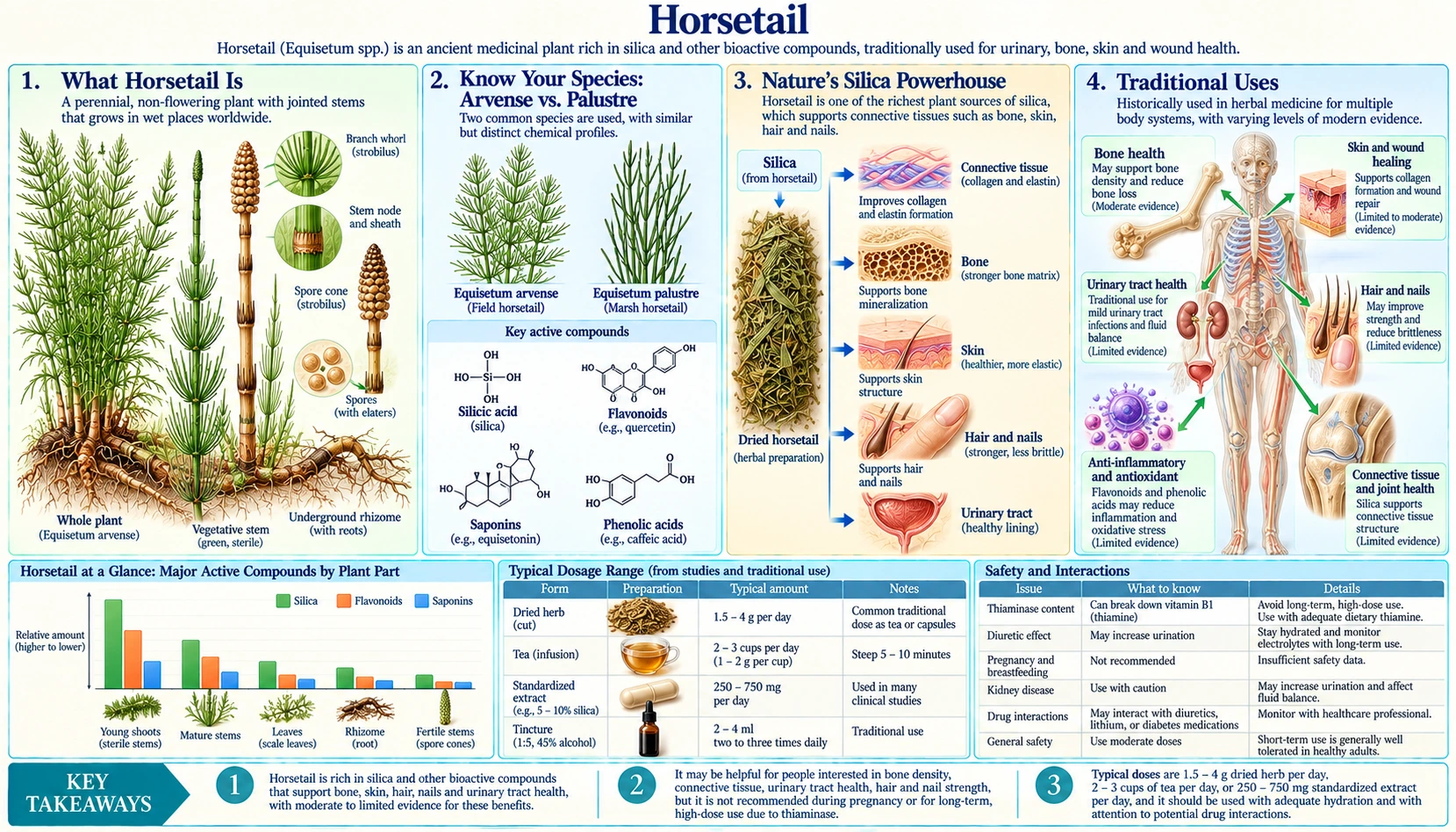
Horsetail (Equisetum arvense, also called field or common horsetail) is one of the oldest plants still growing on Earth — a green, jointed, spore-bearing survivor whose ancestors formed forests before the first dinosaurs. People have used it for centuries as a gentle diuretic and as a folk tonic for bones, hair, skin, and nails, mostly because it is unusually rich in silica, the mineral compound that gives sand and glass their structure. This page explains what horsetail actually is, why the silica matters, what the science does and does not show, and — just as important — the real safety cautions, including the enzyme thiaminase that can break down vitamin B1 and the risk of confusing it with a toxic look-alike species. The honest summary up front: horsetail is a plausible, mineral-rich traditional herb with some encouraging preliminary studies, but the strong human evidence is still thin, so it is best thought of as a short-term supportive herb rather than a treatment.
Table of Contents
- What Horsetail Is
- Two Look-Alike Species: Arvense vs. Palustre
- Nature's Silica Powerhouse
- Traditional Uses
- Silica, Bone, and Connective Tissue
- Hair, Skin, and Nails
- The Diuretic Evidence
- Other Investigated Effects
- Forms and How It Is Used
- Safety and Cautions
- The Honest Bottom Line
- Key Research Papers
- Connections
- Featured Videos
What Horsetail Is
Horsetail is a non-flowering plant that reproduces by spores rather than seeds, more closely related to ferns than to any garden herb. Its common name comes from the bushy, feathery look of its sterile green stems, which fan out in whorls of thin branches like the tail of a horse. Those stems are hollow and clearly jointed — you can pull them apart segment by segment at the dark rings, a little like a natural drinking straw made of stacked cups.
What makes horsetail genuinely remarkable is its age. Equisetum is the last surviving genus of an ancient plant family that dominated the swampy forests of the Carboniferous period more than 300 million years ago. Back then its relatives grew as tall as trees; today's knee-high horsetail is often called a “living fossil” because the basic body plan has barely changed. In early spring the plant sends up pale, brownish fertile shoots tipped with cone-like structures that release spores; later the familiar green, photosynthetic stems appear and do the plant's food-making work through summer.
It grows almost everywhere in the Northern Hemisphere — ditches, riverbanks, damp fields, roadsides, and gardens, where it is often considered a stubborn weed because its deep rhizomes are nearly impossible to dig out. That toughness is part of its charm and part of its chemistry: the same mineral hardening that helps the plant stand up is the reason it has been valued as a herb.
Two Look-Alike Species: Arvense vs. Palustre
This is the single most important thing to understand before anyone uses horsetail, so it comes early. The medicinal, generally safe species is Equisetum arvense — field or common horsetail. A close look-alike, Equisetum palustre (marsh horsetail), contains a toxic alkaloid called palustrine and is considered potentially poisonous; it has caused livestock poisonings. The two plants can grow side by side in damp ground and are easy to confuse if you are not trained.
The European Medicines Agency's 2016 assessment report states that adulteration with Equisetum palustre is possible when horsetail is harvested by unqualified people, and for that reason advises that patients take only quality-controlled horsetail from pharmacies. The European Pharmacopoeia, the official quality standard for medicines in Europe, includes a laboratory test that identifies the herb and rules out E. palustre. A label that just says “horsetail,” with no species and no quality information, gives no sign that such a test was done.
Nature's Silica Powerhouse
Horsetail's defining feature is that it is one of the richest plant sources of silica (silicon dioxide) known. The plant pulls dissolved silicon out of the soil and deposits it throughout its tissues as tiny, glass-like mineral particles. This is why the stems feel gritty and slightly abrasive if you rub them — and why, for centuries, people used dried horsetail as a natural scouring pad to polish pots, pewter, and wood. Two of its old folk names, “scouring rush” and “pewterwort,” come straight from that use.
Silicon is a trace element that plays a quiet structural role in the body, particularly in the tissues that give us shape and strength: bone, cartilage, skin, hair, nails, and the walls of blood vessels. Because horsetail is so concentrated in silica, it became the go-to herbal source of this mineral long before anyone could measure silicon in a laboratory.
There is an important honesty note here, though. Much of the silica in horsetail is present as relatively insoluble mineral particles, and the body can only absorb silicon in a soluble form (orthosilicic acid). So having a lot of silica in the plant does not automatically mean a lot of usable silicon reaches your tissues — how much is actually absorbed from horsetail specifically has not been well quantified in people. We will return to this when we look at the bone and hair claims.
Traditional Uses
Horsetail has one of the longest track records of any European herb, mentioned by classical Greek and Roman writers and used steadily through the folk-medicine traditions of Europe, Asia, and North America. Its traditional roles cluster into a few themes:
- Diuretic (“water” herb): the most consistent traditional use — a mild tea taken to increase urine output and “flush” the urinary tract. Germany's Commission E, an official expert body that reviewed herbal medicines, recognized horsetail for irrigation therapy of the lower urinary tract and for supporting the passing of kidney gravel, always paired with drinking plenty of water.
- Bones, hair, skin, and nails: because of its silica content, horsetail was traditionally taken as a tonic to strengthen brittle nails and thinning hair, support connective tissue, and aid recovery from fractures.
- Wound and styptic use: the astringent, mineral-rich herb was applied to minor cuts, wounds, and nosebleeds to help stop bleeding and tighten tissue.
- Urinary and kidney folk use: beyond simple diuresis, it was used as a supportive remedy for mild urinary discomfort and to discourage the formation of stones — a traditional idea, not a proven treatment.
These traditions are genuinely old and widely shared, which is worth respecting. But tradition tells us how a plant was used and valued, not how well it works by modern standards — and that is a different question, which the next sections take up honestly.
Silica, Bone, and Connective Tissue
The idea that horsetail is good for bones rests on a real and reasonable chain of biology: silicon appears to matter for how the body builds bone and the collagen framework beneath it. Classic laboratory work by Edith Carlisle in 1970 showed that silicon is concentrated at active calcification sites in young bone and appears to be involved in an early stage of bone calcification, and later population studies found that people with higher dietary silicon intake tend to have somewhat higher bone mineral density. In the large Framingham Offspring study, greater silicon intake was positively linked with hip bone density in men and younger women. Reviews of silicon and orthosilicic acid have gathered this evidence and proposed that adequate silicon supports bone health.
So the rationale is biologically plausible. Where honesty is required is the gap between “silicon may help bone” and “taking horsetail improves your bones.” Most of the supportive evidence is about silicon in general — from ordinary foods and from a well-absorbed supplemental form (orthosilicic acid) — not about horsetail specifically. Direct human trials of horsetail extract for bone density are few, small, and dated, and the question of how much usable silicon the body actually extracts from horsetail's largely insoluble silica remains open. The fair conclusion: the bone story is plausible and interesting, but robust clinical proof that horsetail builds or protects bone in people is not yet there.
Hair, Skin, and Nails
The most popular modern reason people reach for horsetail — stronger nails, thicker hair, better skin — leans on the same silicon logic. Silicon is a component of the connective tissues that make up skin, and of the proteins in hair and nails, so the theory is that supplying more of it could help these tissues.
There is some supportive human research, but it is important to see exactly what was tested. Controlled trials in women found that a purified, well-absorbed form of silicon called choline-stabilized orthosilicic acid improved skin quality and made hair and nails less brittle. Those are encouraging results — but the supplement studied was orthosilicic acid, not horsetail. Horsetail is a traditional, cheaper, plant source of silica, and it is frequently assumed to do the same thing, yet high-quality trials of horsetail itself for hair, skin, and nails are lacking. In short: the mechanism is shared and plausible, but the good clinical data belong to a different, more absorbable form of silicon, and the two have not been shown to be interchangeable.
The Diuretic Evidence
Of all horsetail's claims, its diuretic reputation has the clearest — though still limited — human support. A well-conducted randomized, double-blind study published in 2014 tested a dried extract of Equisetum arvense in 36 healthy male volunteers, comparing it against both a placebo and the standard diuretic drug hydrochlorothiazide. The horsetail extract produced a diuretic effect greater than placebo and roughly comparable to the medication over the 24-hour test, and notably it did this without causing the significant electrolyte losses (such as changes in sodium and potassium excretion) seen with the drug.
That is a genuinely interesting finding and lends credibility to the oldest folk use. The honest caveats: it was a single, small, short-term study in healthy young men, not a long-term trial in people who actually need diuretic therapy, and one study — however good — is not the same as a settled conclusion. It supports the idea that horsetail can mildly increase urine output; it does not make horsetail a substitute for prescribed diuretics in heart, kidney, or blood-pressure conditions.
Other Investigated Effects
Laboratory and animal research has probed several other properties of horsetail, mostly attributed to its flavonoids and other phenolic compounds rather than its silica. These early findings are worth knowing about, with the clear understanding that test-tube and rodent results do not translate into proven human benefits:
- Antioxidant activity: extracts of field horsetail are rich in phenolic antioxidants that neutralize reactive molecules in laboratory tests.
- Anti-inflammatory and pain-related effects: in mice, horsetail stem extract reduced pain responses and inflammation, and in cell studies it modulated the behavior of immune cells.
- Liver-protective and free-radical-scavenging effects: specific compounds isolated from horsetail showed protective, antioxidant activity in cell-based liver models.
These are legitimate leads for future research, not reasons to treat any illness. Marketing that calls horsetail “anti-inflammatory” or “detoxifying” traces back mostly to preliminary studies of this kind.
Forms and How It Is Used
Horsetail is sold and used in several forms, most commonly:
- Dried herb / tea (infusion or decoction): the traditional preparation, steeped or briefly simmered and drunk once or twice a day.
- Tincture: an alcohol-based liquid extract taken in drops diluted in water.
- Capsules and tablets: powdered herb or concentrated extracts, sometimes standardized for silica content.
- Topical preparations: compresses, washes, and cosmetic products for skin, nails, and hair.
Because of the thiaminase issue discussed below, Health Canada requires manufacturers to prove that their horsetail products are free of thiaminase activity, according to the European Medicines Agency's 2016 assessment report. Quality-conscious products are often labeled “thiaminase-free” — a signal that the herb has been processed (heat can inactivate the enzyme) to remove that risk. The same report notes that the enzyme is fully inactivated at 80 °C, and that no thiaminase activity was found in industrial water-based dry extracts or in a 30% alcohol extract. For unheated plant powder, it says a strong toxic effect “cannot be excluded,” though none is expected at the amounts used traditionally.
The European Medicines Agency's 2016 monograph gives an official traditional dose for adolescents and adults: as a tea, 1 to 4 grams of the cut dried herb in 150 ml of boiling water, taken 3 to 4 times a day (3 to 12 grams a day), traditionally used over a short period of 2 to 4 weeks. For forms other than tea, it calls for adequate fluid intake. The monograph does not recommend horsetail for children under 12 or in pregnancy and breastfeeding, rules it out where a reduced fluid intake is advised (for example, severe heart or kidney disease), and lists symptoms that last longer than one week during use as a reason to see a doctor or qualified health practitioner. Product label directions vary. This page describes how horsetail is used; it is not a prescription.
Safety and Cautions
Horsetail is not a harmless salad green, and its safety notes are the most important part of this page. Three features of the plant deserve real attention:
- Thiaminase and vitamin B1: horsetail contains thiaminase, an enzyme that breaks down thiamine (vitamin B1). This is well documented in veterinary medicine — horses that eat large amounts of horsetail can develop thiamine-deficiency illness. In people, the concern is that prolonged or heavy use could deplete B1 over time. The European Medicines Agency's assessment report notes that such harm has not been observed in people with traditional use in Europe, and that heat and alcohol extraction inactivate the enzyme.
- Selenium accumulation: like some other wild plants, horsetail can draw up and concentrate selenium and other minerals from the soil. Selenium is essential in tiny amounts but toxic in excess, so herb grown on selenium-rich ground can carry more of it.
- Trace nicotine and alkaloids: the European Medicines Agency's assessment report lists small amounts of nicotine and other alkaloids among the plant's constituents, and notes that an allergic reaction is possible in people sensitive to nicotine.
Who the cautions concern:
- Pregnant or breastfeeding women — safety has not been established, and in the absence of sufficient data the European Medicines Agency does not recommend use in pregnancy or breastfeeding.
- Infants and children — the European Medicines Agency does not recommend use in children under 12, because use at that age has not been established for lack of adequate data.
- People with low thiamine or heavy alcohol use — alcohol already lowers B1, and adding a thiaminase-containing herb compounds the risk of deficiency.
- People with kidney disease or heart conditions — the European Medicines Agency rules horsetail out where a reduced fluid intake is advised, such as severe heart or kidney disease; a diuretic herb can also stress fluid and electrolyte balance and interfere with medical management.
- Anyone taking diuretic (“water pill”) medications, or lithium — combining diuretics can amplify fluid and potassium loss, and diuretics can reduce the body's clearance of lithium, raising the risk of lithium toxicity. Medicines where potassium levels matter raise a similar concern.
Finally, identity: the European Pharmacopoeia test confirms the correct species (Equisetum arvense) and rules out the toxic marsh horsetail. For urinary use, the European Medicines Agency lists fever, pain or burning when passing urine (dysuria), cramping (spasm) or blood in the urine, and symptoms that worsen during use, as signs that need a doctor or qualified health practitioner.
The Honest Bottom Line
Horsetail is a fascinating, silica-rich traditional herb with a diuretic reputation that has some real human support and bone-and-hair claims that are biologically plausible but still under-proven — largely because the good silicon research was done on a more absorbable form, not on horsetail itself. The European Medicines Agency describes it as a traditional medicine used for 2 to 4 weeks with adequate fluid. The cautions on this page concern the toxic look-alike species, thiaminase in unheated plant material, selenium, and use in pregnancy, breastfeeding, children, people low in thiamine, people with severe heart or kidney disease, and people taking diuretics or lithium. Horsetail is a gentle, mineral-rich supportive herb with an ancient pedigree — interesting for short-term use, but not a proven treatment and not without its cautions.
Key Research Papers
- Carneiro DM, Freire RC, Honório TCDD, Zoghaib I, et al. Randomized, Double-Blind Clinical Trial to Assess the Acute Diuretic Effect of Equisetum arvense (Field Horsetail) in Healthy Volunteers. Evidence-Based Complementary and Alternative Medicine. 2014;2014:760683. — the key small human trial; horsetail extract matched a standard diuretic drug over 24 hours without major electrolyte loss. — doi:10.1155/2014/760683
- Gründemann C, Lengen K, Sauer B, Garcia-Käufer M, et al. Equisetum arvense (common horsetail) modulates the function of inflammatory immunocompetent cells. BMC Complementary and Alternative Medicine. 2014;14:283. — cell study showing effects of horsetail extract on immune cells. — doi:10.1186/1472-6882-14-283
- Do Monte FHM, dos Santos JG, Russi M, Lanziotti VMNB, et al. Antinociceptive and anti-inflammatory properties of the hydroalcoholic extract of stems from Equisetum arvense L. in mice. Pharmacological Research. 2004;49(3):239-243. — animal evidence of pain-reducing and anti-inflammatory activity. — doi:10.1016/j.phrs.2003.10.002
- Oh H, Kim D-H, Cho J-H, Kim Y-C. Hepatoprotective and free radical scavenging activities of phenolic petrosins and flavonoids isolated from Equisetum arvense. Journal of Ethnopharmacology. 2004;95(2-3):421-424. — isolated horsetail compounds showed antioxidant, liver-protective activity in cell models. — doi:10.1016/j.jep.2004.08.015
- Mimica-Dukić N, Simin N, Cvejić J, Jovin E, et al. Phenolic Compounds in Field Horsetail (Equisetum arvense L.) as Natural Antioxidants. Molecules. 2008;13(7):1455-1464. — characterizes the antioxidant phenolics behind many of horsetail's lab effects. — doi:10.3390/molecules13071455
- Carlisle EM. Silicon: A Possible Factor in Bone Calcification. Science. 1970;167(3916):279-280. — foundational work linking silicon to an early stage of bone calcification. — doi:10.1126/science.167.3916.279
- Jugdaohsingh R, Tucker KL, Qiao N, Cupples LA, et al. Dietary Silicon Intake Is Positively Associated With Bone Mineral Density in Men and Premenopausal Women of the Framingham Offspring Cohort. Journal of Bone and Mineral Research. 2004;19(2):297-307. — large population study tying dietary silicon to higher bone density. — doi:10.1359/jbmr.0301225
- Price CT, Koval KJ, Langford JR. Silicon: A Review of Its Potential Role in the Prevention and Treatment of Postmenopausal Osteoporosis. International Journal of Endocrinology. 2013;2013:316783. — review of the silicon-and-bone rationale relevant to horsetail's traditional bone use. — doi:10.1155/2013/316783
- Jurkić LM, Cepanec I, Pavelić SK, Pavelić K. Biological and therapeutic effects of ortho-silicic acid and some ortho-silicic acid-releasing compounds: new perspectives for therapy. Nutrition & Metabolism. 2013;10:2. — reviews how the body uses the soluble, absorbable form of silicon. — doi:10.1186/1743-7075-10-2
- Sripanyakorn S, Jugdaohsingh R, Dissayabutr W, Anderson SHC, et al. The comparative absorption of silicon from different foods and food supplements. British Journal of Nutrition. 2009;102(6):825-834. — shows silicon absorption depends heavily on its form, key to the “insoluble silica” caveat. — doi:10.1017/S0007114509311757
- Barel A, Calomme M, Timchenko A, De Paepe K, et al. Effect of oral intake of choline-stabilized orthosilicic acid on skin, nails and hair in women with photodamaged skin. Archives of Dermatological Research. 2005;297(4):147-153. — human trial of an absorbable silicon form (not horsetail) improving skin, hair, and nails. — doi:10.1007/s00403-005-0584-6
- Thiaminase and vitamin B1 depletion in Equisetum — PubMed: Equisetum thiaminase thiamine — the documented basis for the horsetail safety caution around vitamin B1.
- European Medicines Agency, Committee on Herbal Medicinal Products. European Union herbal monograph on Equisetum arvense L., herba. 2016. — EMA/HMPC/278091/2015
- European Medicines Agency, Committee on Herbal Medicinal Products. Assessment report on Equisetum arvense L., herba. 2016. — thiaminase, nicotine, species adulteration and the European Pharmacopoeia test. — EMA/HMPC/278089/2015
Connections
- Fluoride Chelation — silica for bone during a fluoride protocol
- All Herbs
- Silicon
- Silicon: Benefits
- Vitamin B1 (Thiamine)
- Selenium
- Dandelion
- Stinging Nettle
- Uva Ursi
- Nephrology & Hepatology
- Osteoporosis
- Conditions on this site that reference this page: Osteoporosis · Rheumatology · Benign Prostatic Hyperplasia · Interstitial Cystitis / Bladder Pain Syndrome · Overactive Bladder