Gotu Kola for Wound Healing and Scars
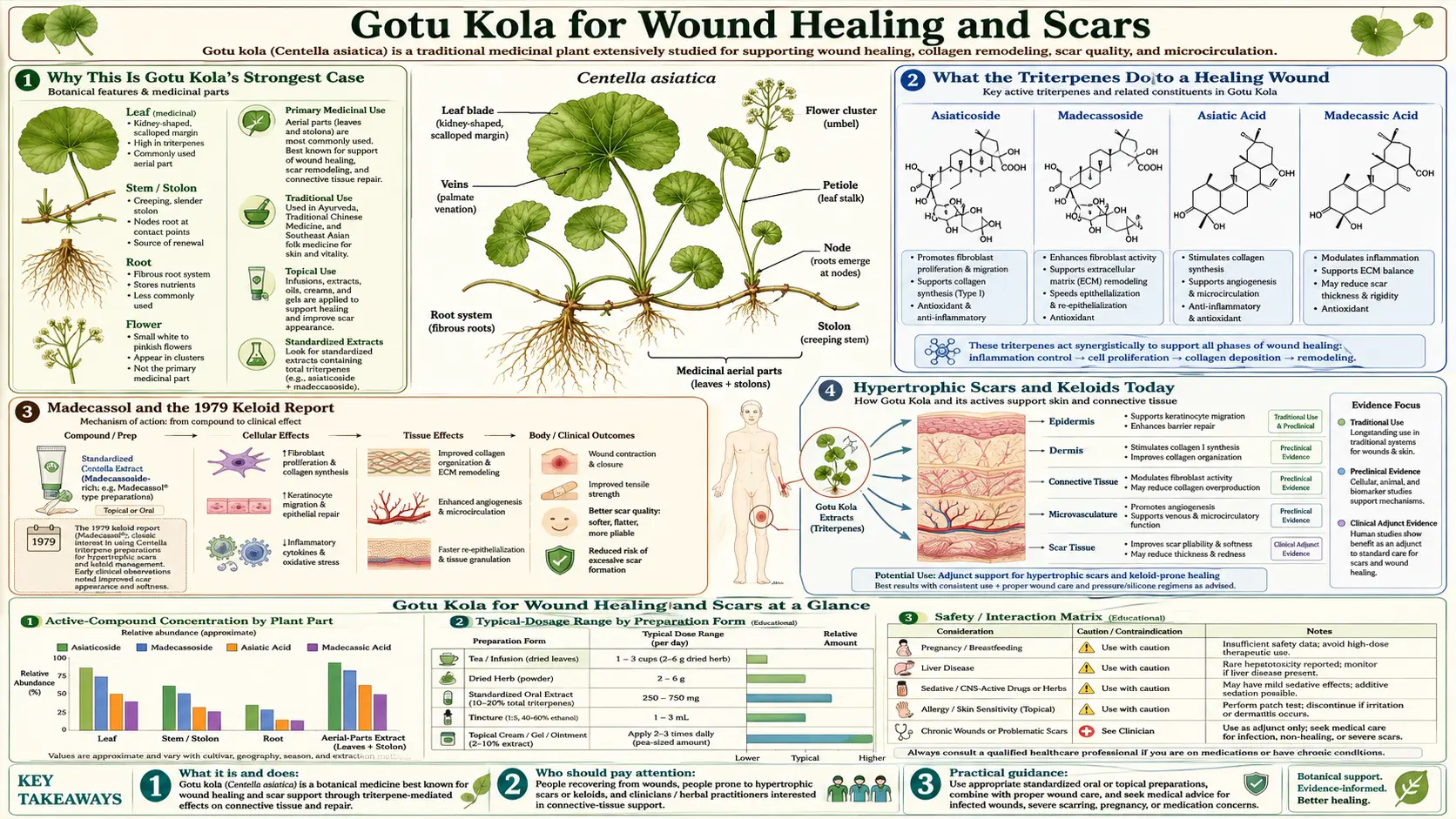
This is the use that earned gotu kola its reputation, and it is the one where the modern evidence and the traditional claim actually line up. Not perfectly — the human trial base is much thinner than the confident language on skincare packaging suggests — but genuinely. A purified triterpene fraction of Centella asiatica has been sold as a prescription scar and wound product in Europe and Asia since the 1970s under the name Madecassol, and dermatology reviews still treat it as a legitimate, mechanism-backed option rather than folklore.
What follows is what the trials actually did, how many people were in them, what preparation was used, and where the results were negative or ambiguous — because several of them were.
Table of Contents
- Why This Is Gotu Kola’s Strongest Case
- What the Triterpenes Do to a Healing Wound
- Madecassol and the 1979 Keloid Report
- Hypertrophic Scars and Keloids Today
- Stretch Marks: Two Trials, Two Different Answers
- Diabetic Wounds and Foot Ulcers
- What the 2022 Systematic Review Found
- Cica Creams and the Cosmetic Boom
- How People Actually Use It
- Cautions
- Key Research Papers
- Connections
Why This Is Gotu Kola’s Strongest Case
Most herbal wound claims rest on one of three things: tradition, a dish of cultured cells, or a rat. Gotu kola has all three, but it also has something rarer — a standardised extract that regulators licensed as a medicine, prescribed by plastic surgeons, and tested in patients with actual scars.
That does not mean the evidence is strong in the way the evidence for, say, a silicone sheet or intralesional triamcinolone is strong. It means the question has been asked in a testable form. The 2022 systematic review that went looking for controlled human trials of Centella asiatica in wound healing found exactly four that met its criteria. Four. For a plant that has been in continuous medicinal use for two thousand years and sits in thousands of cosmetic products, that number is the single most useful fact on this page.
So the honest framing is: plausible mechanism, real pharmaceutical history, decades of clinical use, and a surprisingly small pile of good trials. Better than most botanicals. Not settled.
What the Triterpenes Do to a Healing Wound
A wound closes in overlapping stages: bleeding stops, inflammatory cells arrive and clean up, fibroblasts move in and lay down collagen, new capillaries grow to feed the repair, the surface re-epithelialises, and finally the collagen is remodelled from a disorganised mesh into something closer to normal skin. A scar is what you get when that last stage goes badly — too much collagen, laid down in the wrong orientation, and not resolved.
Gotu kola’s triterpenes act on the middle and late parts of that sequence. The specific findings, and what kind of experiment produced them:
- Collagen I synthesis, human cell culture. Lee and colleagues showed that asiaticoside increases type I collagen production in human dermal fibroblasts, and traced the effect through Smad signalling that did not require TGF-β receptor I kinase — an unusual route, and one reason the compound behaves differently from a straightforward growth-factor mimic.
- Wound closure and tensile strength, animal models. Shukla and colleagues applied isolated asiaticoside to punch wounds and reported faster epithelialisation, more hydroxyproline (the collagen marker) and stronger new tissue. Somboonwong and colleagues compared different solvent extracts in rat incision and burn models with broadly similar results.
- Angiogenesis. The 2022 review concluded that the most likely explanation for any human benefit is improved new blood-vessel growth, driven by effects on fibroblast growth factor and vascular endothelial growth factor.
- Inflammatory signalling. Across cell and animal work the extract reduces IL-1β, IL-6, TNF-α, prostaglandin E2, COX-2 and lipoxygenase activity — the same broad damping seen with many plant triterpenes.
- Keloid fibroblasts specifically. Wu and colleagues found asiaticoside restrained the invasive growth of cultured keloid fibroblasts through the GDF-9/MAPK/Smad pathway. This is cell culture — keloid fibroblasts in a dish, not keloids on a person.
Notice the shape of that list. The mechanism is well characterised in fibroblasts and rodents, and thinly characterised in humans. A mechanism explains why a benefit is plausible. It has never healed anybody by itself.
Madecassol and the 1979 Keloid Report
The pharmaceutical story starts with the titrated extract — TECA, about 40% asiaticoside plus asiatic and madecassic acids — formulated as Madecassol and marketed in France, Korea, Japan and elsewhere as an ointment, powder and oral tablet for scars and wounds.
The paper usually cited as its clinical foundation is Bossé and colleagues, published in Annals of Plastic Surgery in 1979, from a Montreal plastic-surgery group. It reported that the drug was “of clinical value in stopping the inflammatory phase of hypertrophic scars and keloids”, that it gradually brought scars into the maturation phase, and that it compared favourably with compression bandaging and gave more lasting results than intralesional cortisone or radiation.
Two things about that paper deserve stating plainly. First, it is nearly fifty years old, and its published abstract does not report the number of patients per arm, the randomisation method, or the scar-scoring instrument — reporting standards that would not pass today. Second, to the authors’ considerable credit, they disclosed something most modern supplement marketing never would: Madecassol had a placebo response of 29%. Nearly one scar in three improved on the dummy treatment. That is exactly why uncontrolled scar testimonials are worthless, and the fact that the number appears at all is a sign of an honest report rather than a weak one.
They also noted that the only adverse effects seen were occasional mild gastric intolerance and allergic reaction — the allergy point turned out to be prophetic, as the Cautions section explains.
Hypertrophic Scars and Keloids Today
A hypertrophic scar is raised and red but stays inside the original wound boundary and usually flattens over a year or two. A keloid grows beyond the wound edge, does not regress on its own, and disproportionately affects people with darker skin. They are not the same problem, and treatments that help the first often do nothing for the second.
Where does gotu kola sit in modern scar management? Honestly: as an adjunct with a long history of use and weak contemporary trial support. The dermatology reviews — Bylka and colleagues in Phytotherapy Research is the most cited — describe it as a reasonable component of scar care, based on the mechanism and on the older European clinical experience, while noting that head-to-head trials against current standards are essentially absent.
What the current standards are, for context, so you can place it:
| Approach | Evidence position |
|---|---|
| Silicone gel sheeting or gel | First-line for hypertrophic scars; multiple randomised trials |
| Pressure therapy | Long-standing standard, especially after burns |
| Intralesional corticosteroid | First-line for keloids; injections, not creams |
| Onion extract gels | Widely sold, mixed and often disappointing trial results |
| Centella asiatica / TECA | Historical prescription use, mechanistic support, thin modern trial base |
A practical reading: if you have an active keloid, the intervention with the best odds is a dermatologist with a syringe, not a cream. If you have an ordinary healing surgical scar and want to support it, a Centella-containing topical is a low-risk thing to add to silicone and sun protection — but expect a modest cosmetic difference at best, and remember the 29%.
Stretch Marks: Two Trials, Two Different Answers
Striae gravidarum — pregnancy stretch marks — are the one scar-adjacent indication where gotu kola has been through proper double-blind randomised trials. Two of them, twenty-two years apart, and they did not agree.
Mallol 1991 — 80 pregnant women
A Spanish double-blind trial tested a cream containing Centella asiatica extract, alpha-tocopherol (vitamin E) and collagen–elastin hydrolysates against placebo in 80 pregnant women. The results were positive:
- Striae developed in 56% of the placebo group versus 34% of the treated group (p < 0.05).
- On a 0–3 intensity score, treated women averaged 1.42 versus 2.13 on placebo (p = 0.014).
- Among women who had developed striae during puberty — the highest-risk subgroup — the active cream prevented them entirely in 89% of cases, while every woman in the placebo arm developed them (p = 0.00014).
García Hernández 2013 — a mixed result
A randomised, double-blind, placebo-controlled trial at a maternity hospital in Las Palmas tested a cream containing hydroxyprolisilane-C, rosehip oil, Centella asiatica triterpenes and vitamin E. Its headline finding was negative:
- Overall incidence of stretch marks was not reduced — 33.3% in the control group versus 37.6% in the treated group, not statistically significant.
- Severity of pre-existing stretch marks increased significantly in controls (17.8%, p = 0.001) but not in the treated group (6.3%, not significant).
- Among women who did develop new marks, the increase in severity was smaller with treatment (0.14 versus 0.47, p = 0.031).
- In the subgroup with no striae at baseline, new marks appeared in 5.6% of treated women versus 35% of controls (p = 0.031) — but the confidence interval on that odds ratio ran from 1.0 to 83.3, which is another way of saying the estimate is barely distinguishable from no effect.
What to take from the pair
Three cautions apply to both. They tested multi-ingredient creams, so any benefit belongs to the formula, not to Centella specifically. Massage is a confounder — applying any cream twice daily to the abdomen involves mechanical stimulation that the placebo arm also received, which is at least a fair comparison, but means the cream base is doing some of the work. And the endpoint is partly cosmetic and partly observer-scored, which is softer than a wound edge.
The reasonable summary: a Centella-containing cream may reduce how bad stretch marks get, and may help most in women who have never had them. It does not reliably stop them appearing. Anyone selling it as prevention is overstating two trials, one of which failed on its primary incidence measure.
Diabetic Wounds and Foot Ulcers
Two trials looked at gotu kola where wound healing genuinely matters clinically.
Paocharoen 2010 randomised 200 diabetic patients at Thammasat University Hospital in Thailand to an oral Centella asiatica capsule or placebo — two capsules three times daily, each containing 50 mg of extracted asiaticoside, so roughly 300 mg of asiaticoside a day. Wounds were assessed at days 7, 14 and 21. The result was genuinely mixed: wound contraction was better in the treated group, but granulation tissue formation was better on placebo. No serious adverse reactions occurred in either arm. The trial is published in a journal supplement with sparse reporting, and its own conclusion (“effective in wound healing promotion and also suppress the scar”) is stronger than the results it presents.
Kuo 2012 ran a small single-centre randomised open-label study in 24 patients with Wagner grade 3 diabetic foot ulcers after surgical debridement. Twelve received a cream containing Plectranthus amboinicus and Centella asiatica twice daily for two weeks; twelve received standard hydrocolloid fibre dressings. There was no statistically significant difference in wound size change at 7 or 14 days. More patients in the cream group showed an improvement in Wagner grade, but not significantly so. The authors’ conclusion is appropriately modest: the cream is a safe alternative to hydrocolloid dressing, not a better one.
That is an equivalence finding in a 24-person open-label study, which is very weak evidence in either direction. It is included here because negative and neutral results are the ones that vanish from herb marketing, and a diabetic foot ulcer is not a wound to experiment on. Ulcers need offloading, debridement, infection control and vascular assessment. A botanical cream is at most an adjunct to a proper wound-care plan.
What the 2022 Systematic Review Found
Arribas-López and colleagues at the University of Greenwich ran a PRISMA systematic review across four databases looking for clinical studies of Centella asiatica in wound healing. Four trials met inclusion criteria.
Across those four they identified benefit signals in wound contraction and granulation, healing and bleeding time, re-epithelialisation, visual analogue scale scores, and skin erythema and wound appearance. Their proposed explanation was improved angiogenesis via effects on collagen I, FGF and VEGF, plus the anti-inflammatory profile described above.
Their conclusion, quoted in substance: Centella asiatica might enhance wound healing; more studies are needed before a meta-analysis is even possible. They also flagged bioavailability as a limiting factor and suggested nanoencapsulation as a research direction — which is a polite way of noting that getting these triterpenes to the tissue in a useful concentration is an unsolved problem.
“Might, and we cannot yet pool the data” is the accurate state of the evidence. Anything more confident than that is somebody selling something.
Cica Creams and the Cosmetic Boom
Since Korean skincare popularised “cica” products around 2015, Centella asiatica has become one of the most widely used botanical actives in cosmetics — usually as madecassoside, sometimes as a total Centella extract, marketed for redness, barrier repair and post-procedure skin.
A few honest observations about that market:
- The cosmetic dose is not the pharmaceutical dose. A prescription TECA ointment is formulated to deliver a defined triterpene concentration. A cosmetic listing “Centella asiatica extract” near the bottom of an ingredient list may contain a fraction of a percent.
- “Cica” is not a regulated term. It signals nothing about concentration or standardisation.
- The soothing effect people report is plausible and mostly untested at cosmetic doses. The anti-inflammatory mechanism is real; whether 0.1% of an extract in a moisturiser reproduces it is a different question, and one that the reviews specifically say has not been answered.
- Rising use has meant rising allergy reports. The 2024 Contact Dermatitis case series from Turkey describes exactly this — patients sensitised to Centella asiatica extract in cosmetic products.
None of this makes cica products a bad idea. For irritated or barrier-damaged skin they are a sensible, low-risk category. It just means the leap from “asiaticoside makes fibroblasts produce collagen in a dish” to “this moisturiser rebuilds your skin” is several steps longer than the packaging implies.
How People Actually Use It
- Topical, for scars. Applied to a closed, fully healed wound — not an open one — usually twice daily for weeks to months. Scar remodelling takes a year or more; nothing you apply will produce a visible change in a fortnight.
- Topical, for irritated or post-procedure skin. A cica cream or madecassoside serum, as a barrier-supportive moisturiser. Patch-test on the inner forearm for several days first.
- Oral, in wound support. The Thai diabetic-wound trial used the equivalent of 300 mg asiaticoside daily in divided doses. Standardised extract products more commonly supply 60–180 mg of total triterpenes daily. Oral use carries the liver caution and should be time-limited.
- What to combine it with. For an ordinary surgical scar the interventions with the best evidence are silicone and rigorous sun protection for the first year. Add a Centella topical to those, not instead of them.
- What not to do. Do not put a herbal cream into an open, infected, deep or non-healing wound, and do not delay proper assessment of a wound that is not closing. That is where real harm happens.
Cautions
- Allergic contact dermatitis is the main documented risk of topical use. It is well described: Danese and colleagues in 1994, Bilbao and colleagues in 1995 (in combination with butoxyethyl nicotinic acid), Gomes and colleagues in 2010, and Özkaya and Toprak in 2024. The tell is a reaction that builds over days rather than stinging immediately, and that recurs each time the product is used. Patch-test before applying anything Centella-based to a large area, a face, or freshly healed skin.
- Do not use on open wounds without medical advice. Sterility, infection risk and dressing choice all matter more than any botanical activity.
- Oral use carries a rare liver risk. See the forms article for the case series. Stop and seek care for unexplained fatigue, nausea, dark urine or yellowing of the eyes.
- Pregnancy. Oral gotu kola should be avoided. The striae creams were tested topically in pregnancy under trial supervision; that is not a licence to take capsules, and any product used in pregnancy should be cleared with your obstetric team.
- Carrot family, not daisy family. Cross-reactivity warnings naming ragweed and chrysanthemum are copied from Asteraceae herbs and do not apply. If you react to celery, carrot or parsley, that is the relevant question.
- Keloid-prone skin needs a clinician. A keloid that is growing, painful or itchy will not be managed by a cream. Early intralesional treatment gives much better odds than late.
Key Research Papers
- Arribas-López E, Zand N, Ojo O, Snowden MJ, Kochhar T. A systematic review of the effect of Centella asiatica on wound healing. International Journal of Environmental Research and Public Health. 2022;19(6):3266. Four clinical trials met inclusion criteria; concludes benefit is possible and a meta-analysis is not yet feasible.
- Bossé JP, Papillon J, Frenette G, Dansereau J, Cadotte M, Le Lorier J. Clinical study of a new antikeloid agent. Annals of Plastic Surgery. 1979;3(1):13–21. The Madecassol hypertrophic-scar and keloid report; discloses a 29% placebo response.
- Bylka W, Znajdek-Awiżeń P, Studzińska-Sroka E, Dańczak-Pazdrowska A, Brzezińska M. Centella asiatica in dermatology: an overview. Phytotherapy Research. 2014;28(8):1117–1124. The standard dermatology review of the herb.
- Mallol J, Belda MA, Costa D, Noval A, Sola M. Prophylaxis of striae gravidarum with a topical formulation. A double blind trial. International Journal of Cosmetic Science. 1991;13(1):51–57. 80 pregnant women; striae in 34% of treated versus 56% of placebo.
- García Hernández JÁ, Madera González D, Padilla Castillo M, Figueras Falcón T. Use of a specific anti-stretch mark cream for preventing or reducing the severity of striae gravidarum. Randomized, double-blind, controlled trial. International Journal of Cosmetic Science. 2013;35(3):233–237. Overall incidence unchanged; severity outcomes favoured treatment.
- Paocharoen V. The efficacy and side effects of oral Centella asiatica extract for wound healing promotion in diabetic wound patients. Journal of the Medical Association of Thailand. 2010;93(Suppl 7):S166–S170. 200 patients; better wound contraction on treatment, better granulation on placebo.
- Kuo YS, Chien HF, Lu W. Plectranthus amboinicus and Centella asiatica cream for the treatment of diabetic foot ulcers. Evidence-Based Complementary and Alternative Medicine. 2012;2012:418679. 24 patients; no significant difference versus hydrocolloid dressing.
- Lee J, Jung E, Kim Y, Park J, Park J, Hong S, et al. Asiaticoside induces human collagen I synthesis through TGFβ receptor I kinase-independent Smad signaling. Planta Medica. 2006;72(4):324–328. Human dermal fibroblasts, cell culture.
- Shukla A, Rasik AM, Jain GK, Shankar R, Kulshrestha DK, Dhawan BN. In vitro and in vivo wound healing activity of asiaticoside isolated from Centella asiatica. Journal of Ethnopharmacology. 1999;65(1):1–11. Animal wound models.
- Somboonwong J, Kankaisre M, Tantisira B, Tantisira MH. Wound healing activities of different extracts of Centella asiatica in incision and burn wound models: an experimental animal study. BMC Complementary and Alternative Medicine. 2012;12:103. Compares solvent extracts in rats.
- Wu X, Bian D, Dou Y, Gong Z, Tan Q, Xia Y, et al. Asiaticoside hinders the invasive growth of keloid fibroblasts through inhibition of the GDF-9/MAPK/Smad pathway. Journal of Biochemical and Molecular Toxicology. 2017;31(8). Cultured keloid fibroblasts.
- Bylka W, Znajdek-Awiżeń P, Studzińska-Sroka E, Brzezińska M. Centella asiatica in cosmetology. Postępy Dermatologii i Alergologii. 2013;30(1):46–49. The cosmetic-use review behind the cica category.
- Özkaya E, Toprak İD. Allergic contact dermatitis from Centella asiatica extract and fragrance allergens: report of two patients from Turkey. Contact Dermatitis. 2024;91(1):85–87.
Live PubMed Searches
- Centella asiatica wound healing — randomised trials
- Asiaticoside, collagen and fibroblasts
- Madecassoside and skin barrier repair
- Striae gravidarum prevention — topical trials
- Hypertrophic scar and keloid topical treatment reviews
- Centella asiatica and diabetic wounds