Nutmeg Safety, Dose and Myristicin Toxicity
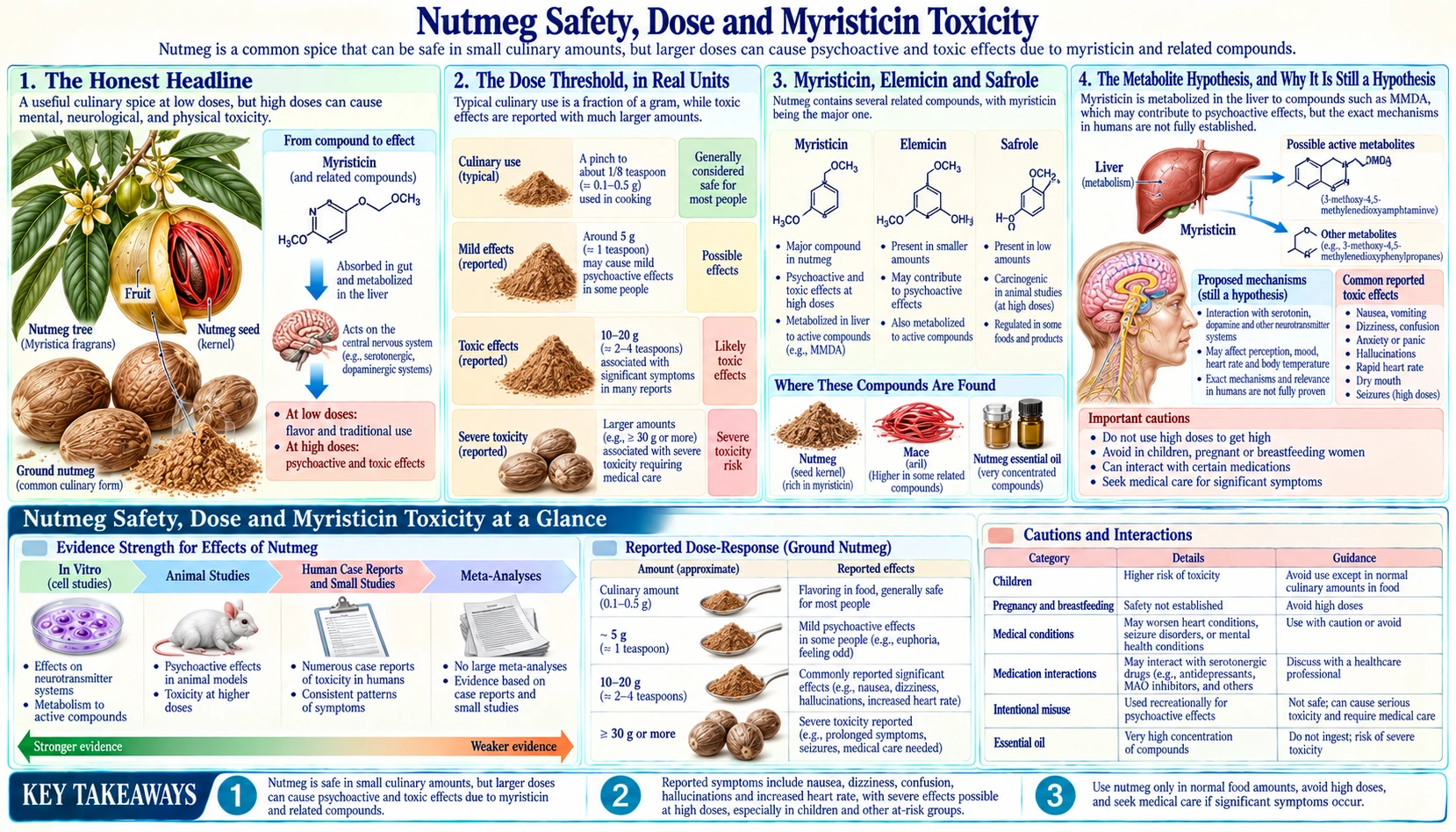
If someone has swallowed a large quantity of nutmeg — a whole seed or more, or several heaped teaspoons of the ground spice — contact a poison-control centre now, before symptoms appear. Onset is delayed by three to eight hours, so "they seem fine" tells you nothing yet. In the United States, Poison Help is reachable at poisonhelp.org or 1-800-222-1222. Elsewhere, call your national poison information service or emergency number.
Everything else on this page is context for that paragraph.
This is the most rigorous page in the Nutmeg Benefits section, and deliberately so, because it is the only one where the human evidence is strong. The three benefit pages describe claims supported by cell cultures, rodents and tradition. This page describes a syndrome documented in named patients, in named emergency departments, in the peer-reviewed literature, reported to poison-control centres every year, and occasionally fatal. Nutmeg's benefit evidence is overwhelmingly preclinical. Its toxicity evidence is human and well documented. That asymmetry is the honest headline for this herb.
None of this concerns the nutmeg in an ordinary kitchen. Ordinary cooking is safe, and nothing about a béchamel, a pumpkin pie or a bowl of eggnog needs to change. The point of this page is to draw the line accurately — neither alarming you about a spice you have eaten all your life, nor pretending a real toxic dose does not exist.
Table of Contents
- The Honest Headline
- The Dose Threshold, in Real Units
- Myristicin, Elemicin and Safrole
- The Metabolite Hypothesis, and Why It Is Still a Hypothesis
- Time Course of a Nutmeg Overdose
- What the Poisoning Presents As
- Who It Actually Happens To
- Fatalities and Serious Outcomes
- What Emergency Treatment Involves
- Pregnancy: A Firm Contraindication
- Children, Pets and the Kitchen Cupboard
- Drug Interactions
- Safrole, the Liver and Long-Term Use
- The Highest-Risk Forms
- Dose Summary
- Key Research Papers
- Connections
- Featured Videos
The Honest Headline
Most kitchen spices are pharmacologically inert at any dose a person could plausibly swallow. You cannot poison yourself with cinnamon, cumin or coriander seed by eating them — you would be defeated by the taste and the volume long before anything happened. Nutmeg is one of the small handful of exceptions, and it is the most commonly encountered one.
The reason is a group of compounds called allylbenzenes or phenylpropenes, present in the essential-oil fraction of the seed and the aril. Two of them — myristicin and elemicin — are responsible for a distinctive toxic syndrome that combines features of anticholinergic poisoning with a dysphoric hallucinatory state. A third, safrole, is a recognised rodent liver carcinogen and matters for anyone contemplating long-term use rather than for acute toxicity.
Here is the asymmetry stated as plainly as we can:
- Nutmeg's benefits are claimed on the basis of cell cultures, rodent studies and centuries of traditional use. There is not one randomised controlled trial of nutmeg for any health outcome — not digestion, not sleep, not pain, not blood sugar, not anything.
- Nutmeg's toxicity is documented in humans, in the peer-reviewed clinical literature, with case series from poison-control centres, a recognised clinical presentation, a known time course, and reported deaths.
Any page, product or video that presents nutmeg's benefits with confidence and its toxicity as a footnote has the weight of evidence exactly backwards.
The Dose Threshold, in Real Units
Vague dose talk is useless, so here are concrete numbers.
Physical reference points. A whole nutmeg seed weighs roughly 5 to 10 grams depending on size and origin. A level teaspoon of pre-ground nutmeg is approximately 2 grams. A few passes on a fine rasp — the amount you would put over a custard or a plate of pasta — is on the order of 0.1 to 0.3 grams.
Culinary range: roughly 0.1 to 0.5 g per dish. That is what nutmeg is for, and it is safe for essentially everyone. A teaspoon of ground nutmeg divided across a recipe that serves six is around 0.3 g per person. Baking a batch of twelve muffins with a teaspoon of nutmeg puts about 0.17 g in each. A shared bowl of eggnog is fine. There is no realistic route to harm through cooking.
Traditional medicinal range: generally under about 1 g a day for an adult, frequently far less — a pinch — and traditionally not intended for continuous long-term use. Note that this is tradition, not a validated therapeutic dose. There is no established therapeutic dose of nutmeg, because there are no controlled human trials from which to derive one. Anyone quoting you a precise medicinal dosage is quoting custom, however confidently they state it.
Reported toxicity: begins in the region of 5 g of ground nutmeg in a single dose, which is one to two whole seeds or roughly two to three heaped teaspoons of the powder. Severity rises from there, and case reports commonly involve amounts in the range of one to three whole nutmegs. The often-repeated "5 to 15 g" range in the toxicology literature reflects both the variability of the material and the variability between people.
Three things make the threshold a range rather than a number:
- Myristicin content varies. Volatile oil is roughly 5 to 15 percent of the kernel by weight, and myristicin is a few percent of that oil. Origin, seed maturity, storage time and grinding all change the number. Two "5 gram doses" are not necessarily equivalent doses of the active compounds.
- Body weight matters. A child reaches the toxic range at a proportionally smaller amount, which is the entire reason paediatric exposures are treated seriously.
- Individual variation in metabolism. The compounds are handled by liver enzyme systems with substantial person-to-person variability.
The practical reading: the gap between "delicious" and "dangerous" is large — roughly a factor of ten to fifty — but it is not infinite, and it is much smaller than for any other spice in your cupboard. Nobody reaches it by accident while cooking. People reach it by taking nutmeg deliberately as a drug or as a remedy, and by escalating.
Myristicin, Elemicin and Safrole
Nutmeg kernel is roughly a quarter to a third fixed fat by weight — largely trimyristin, the triglyceride of myristic acid, which is what makes nutmeg butter — plus 5 to 15 percent volatile essential oil. The toxicology lives in the volatile fraction.
Myristicin is the compound most associated with nutmeg's psychoactivity and toxicity. It is an allylbenzene ether, typically a few percent of the essential oil, and it also occurs in smaller quantities in parsley, dill and carrot — which is why the compound alone is not the whole story, since nobody is hospitalised by parsley. Reference data at PubChem — myristicin.
Elemicin is a close structural relative, present in similar or sometimes greater amounts than myristicin, and considerably less studied. It is thought to contribute to the same central effects, and any complete account of nutmeg intoxication probably requires it. Reference data at PubChem — elemicin; the pharmacology literature via a PubMed search on elemicin pharmacology.
Safrole is present in small amounts. It is a recognised rodent liver carcinogen, banned as an isolated food additive in the United States and restricted in the European Union, although the natural spice itself is not banned. Safrole is not why nutmeg overdose is acutely dangerous; it is the concern with daily long-term nutmeg supplementation. Reference data at PubChem — safrole.
The terpene bulk — sabinene as the usual largest single component, with α- and β-pinene, limonene, myrcene and terpinen-4-ol — is what you actually smell. These are shared with dozens of aromatic plants and are not the toxicological concern.
An important confirmation. Usui K and colleagues published a gas-chromatography–tandem-mass-spectrometry method in 2023 for detecting safrole, myristicin and elemicin in human serum, and applied it to one patient who had swallowed 75 g of nutmeg powder, measuring the three compounds at admission (about 8 hours after ingestion) and again about 94 hours later. That work matters for two reasons: it measured these compounds in a poisoned person's bloodstream — in a single case, but a measurement rather than an assumption — and it gives forensic and clinical toxicologists a tool for confirming suspected nutmeg poisoning, which was previously a diagnosis of exclusion based on history. PubMed PMID: 37453146.
The Metabolite Hypothesis, and Why It Is Still a Hypothesis
You will frequently read that the body converts myristicin into MMDA, an amphetamine-like compound, and that this explains nutmeg's effects. It is worth being precise, because this is one of those claims that has hardened into fact through repetition.
What is true: myristicin and elemicin are structurally related to compounds that could in principle be converted, by amination of the allyl side chain, into amphetamine-like or serotonergic metabolites. The chemistry is plausible on paper and the hypothesis is decades old.
What is not established: that this conversion actually occurs in humans to a pharmacologically meaningful extent. The metabolic route has not been demonstrated to produce the quantities that would be required. Survey the literature via a PubMed search on myristicin metabolism.
What argues against a single-compound explanation: myristicin administered alone does not fully reproduce whole-nutmeg intoxication in animals. If myristicin-to-MMDA were the mechanism, isolated myristicin should behave like nutmeg. It does not. That strongly suggests the syndrome arises from several constituents acting together — myristicin, elemicin, possibly others — which is a much messier and much more likely story.
What the clinical picture suggests instead. The presentation — dry mouth, flushed skin, blurred vision, tachycardia, urinary retention, confusion, hallucinations — is a close match for anticholinergic toxicity, and emergency physicians have made exactly that comparison in print. Demetriades AK and colleagues argued in the Emergency Medicine Journal in 2005 that nutmeg intoxication should be considered in a recreational drug user presenting with acute psychotic symptoms and signs partly mimicking anticholinergic overstimulation. Background on that toxidrome via a PubMed search on the anticholinergic toxidrome and delirium.
Myristicin has also been reported to have weak monoamine-oxidase-inhibiting activity in laboratory systems, which is the basis for a theoretical interaction with serotonergic drugs. Myristicin and MAO inhibition on PubMed.
Why the uncertainty matters practically: because there is no single identified receptor or enzyme target, there is no antidote, and no rational pharmacological treatment. Care is supportive. A mechanism that is still partly unknown is a mechanism nobody can reverse.
Time Course of a Nutmeg Overdose
This section is the most clinically useful thing on the page, because the time course is what turns a bad decision into a hospital admission.
Hour 0: ingestion. Nothing happens. This is the critical fact. Nutmeg has no rapid onset.
Hours 0 to 3: the deceptive silence. Still nothing, or at most mild nausea. This is when people take a second dose. A teenager who swallowed two teaspoons and feels nothing after two hours concludes it did not work and takes more. A person treating an upset stomach takes another spoonful. The absence of any early signal removes the feedback loop that normally prevents overdose with a drug that acts quickly. Every account of nutmeg poisoning that involves escalation involves this window.
Hours 3 to 8: onset. Symptoms begin. Typically gastrointestinal first — nausea, vomiting, abdominal pain — then the autonomic and central features: dry mouth, flushing, blurred vision, palpitations, dizziness, unsteadiness.
Hours 6 to 24: peak. The full syndrome. Tachycardia, sometimes raised blood pressure, marked dissociation and unreality, agitation, mounting anxiety, the characteristic sense of impending doom, disorientation, and in more severe cases visual hallucinations and frank confusion. Sleep is usually impossible during this phase, which compounds everything.
Hours 24 to 72: prolonged resolution. The episode commonly lasts one to three days — far longer than most recreational intoxications and far longer than people expect. Symptoms wane unevenly, often with a long tail of exhaustion, fogginess, unsteadiness and dysphoria. Recovery is typically complete, but the following days are unpleasant.
Two consequences follow from this timeline, and both are actionable.
First: if a large amount has been swallowed, seek advice immediately — do not wait for symptoms. Waiting means arriving several hours later with a full syndrome instead of arriving early. Poison-control centres would far rather advise on an asymptomatic exposure.
Second: nothing seeming to happen is the expected state for the first three hours. A second dose taken in that window adds to a first dose that has not yet acted.
What the Poisoning Presents As
The full documented picture, grouped by system. This is what emergency clinicians see and what a person going through it experiences.
Gastrointestinal — nausea, often severe; vomiting; abdominal pain and cramping. Usually the first features to appear. Worth noting the irony: nutmeg is traditionally taken for stomach upset, and overdose produces exactly that.
Autonomic / anticholinergic-like — dry mouth; flushed, hot, dry skin; blurred vision from impaired accommodation; pupils that may be dilated; tachycardia and palpitations; sometimes raised blood pressure; occasionally urinary retention. Body temperature may rise. This cluster is what prompts the anticholinergic comparison.
Neurological and psychiatric — dizziness and unsteadiness; headache; a strong sense of dissociation, detachment or unreality; disorientation in time and place; agitation and restlessness; severe anxiety; a characteristic and much-reported sense of impending doom; visual hallucinations; confusion and impaired new memory formation; in severe cases delirium. Occasionally drowsiness alternating with agitation.
Severe or complicated cases — the most serious outcomes in the literature involve co-ingestion of other substances. One patient in the Illinois Poison Center series who had taken nutmeg with several pharmaceuticals required ventilatory support.
What it is emphatically not. Accounts from people who have taken nutmeg deliberately are strikingly consistent: it is not euphoric, not pleasant, and not interesting. It is nauseating, disorienting, anxious and long. The word that recurs is "regret." Whatever nutmeg's reputation as a free high, the experiential evidence does not support it, and that is worth knowing before rather than after.
The differential diagnosis problem. For a clinician, a young person presenting with tachycardia, flushing, dilated pupils, agitation and hallucinations looks like a great many things — anticholinergic drug overdose, stimulant toxicity, serotonin syndrome, an acute psychotic episode, or a novel psychoactive substance. Nutmeg is easy to miss because nobody thinks of the spice rack, and because the delayed onset means the ingestion may have been many hours earlier and may not be volunteered. This is precisely why the Demetriades paper argued for keeping nutmeg on the differential, and why the serum-detection method published in 2023 is useful.
Who It Actually Happens To
The best single dataset is Ehrenpreis JE and colleagues' review of ten years of nutmeg exposures reported to the Illinois Poison Center between 2001 and 2011, published in the Journal of Medical Toxicology in 2014. It found 32 exposures. PubMed PMID: 24452991.
What that series showed:
- About 47 percent were intentional. People taking nutmeg deliberately, for effect.
- Roughly a third of the intentional exposures involved co-ingestion of other drugs — and every one of those was in a person aged 15 to 20. That is the highest-risk pattern in the whole dataset: an adolescent combining nutmeg with something else.
- One patient who had combined nutmeg with several pharmaceuticals required ventilatory support in hospital. Combination is what escalates severity.
- The remaining half were unintentional, and most of those were in children under 13, including several eye exposures from handling the spice.
Two patterns come directly out of that data.
For anyone considering nutmeg as a legal high: the co-ingestion pattern is the one that hospitalises people. Nutmeg alone is usually a miserable two days. Nutmeg plus alcohol, cannabis, prescription medication or anything else is where the serious outcomes cluster.
For every household with a spice rack: the accidental cases involve small children reaching the jar or the grater, and spice left on the hands. Half of a decade's worth of poison-centre cases were accidents, mostly in young children, and eye exposure from spice-covered fingers is a real category.
A caveat on the numbers: 32 cases over ten years in one American state is a small series, and it certainly undercounts — most people who take too much nutmeg have an awful night at home and never call anyone. The series tells you about the pattern of harm, not its true frequency.
Fatalities and Serious Outcomes
Deaths from nutmeg are genuinely rare. They are also on record, and the distinction between "rare" and "never" is the whole point of this section.
The standing reference is Stein U, Greyer H and Hentschel H, Nutmeg (myristicin) poisoning — report on a fatal case and a series of cases recorded by a poison information centre, published in Forensic Science International in 2001. It reports the death of a 55-year-old woman whose post-mortem serum held myristicin (4 µg/ml) and also the sedative drug flunitrazepam; the authors concluded that death had probably been due to the combined toxic effect of both substances. It notes that only one earlier fatal case had been reported in the literature. In the seven other poisonings recorded by the Erfurt Poison Information Centre from 1996 to 1998, a life-threatening situation was never observed, even where 20 to 80 g of powder had been swallowed. PubMed PMID: 11343860.
The broader case-report literature is where most clinical knowledge of nutmeg lives, and it is worth browsing if you want a sense of how these presentations actually read: nutmeg intoxication case reports and nutmeg poisoning in the emergency department.
Serious non-fatal outcomes reported across the literature include the need for ventilatory support in mixed-ingestion cases, marked tachyarrhythmia, severe agitation requiring sedation, and prolonged delirium. In pregnancy, toxicity has been reported in the mother with concern for the fetus.
How to hold this proportionately. The chance that any given nutmeg overdose kills someone is low. The chance that it produces two to three days of genuine misery is high. The chance of a serious outcome rises substantially with co-ingestion, with small body weight, and with underlying cardiac disease. A rare fatality says nothing against the spice rack; it does mean a deliberate nutmeg dose is not a harmless experiment.
What Emergency Treatment Involves
Included so that expectations are accurate, not as a substitute for medical care.
There is no antidote. No specific reversal agent, no dialysis role, no antagonist. Because the mechanism is not fully characterised and there is no single identified target, there is nothing to block.
Care is supportive. In practice that means intravenous fluids for vomiting and dehydration; antiemetics for nausea; cardiac monitoring; a quiet, low-stimulation environment for agitation; and a benzodiazepine if sedation is needed for someone dangerously agitated. Reassurance matters more than it sounds: much of the distress is the sense of impending doom, and knowing the state is self-limiting and expected to resolve genuinely helps.
Activated charcoal may be considered in early presentations, at clinical discretion, and is a decision for the treating team rather than for a web page.
Investigation is largely to exclude other things. Because nutmeg mimics several other toxidromes, the workup typically focuses on ruling out alternatives — other drugs, metabolic causes, cardiac causes. The 2023 serum-detection method offers the prospect of positive confirmation, but it is a specialist assay and not a bedside test.
What clinicians most need to know is the history: what was taken, how much, when, and crucially what else was taken with it. Co-ingestion changes management. There is no reason to conceal it — the point of the visit is to be treated safely.
Prognosis is good with supportive care. Recovery is usually complete within one to three days, with a lingering tail of fatigue and low mood.
Pregnancy: A Firm Contraindication
This is the clearest safety line on the page, and it has its own section.
Culinary amounts of nutmeg in food are considered acceptable in pregnancy. Nutmeg in a béchamel or a slice of pumpkin pie is not the concern. That is not what this section is about.
The concern in pregnancy is medicinal or large amounts of nutmeg. Four separate reasons converge:
- A long ethnographic record as a folk abortifacient. Nutmeg appears in traditional abortifacient practice across multiple cultures. Whether it is effective at that is beside the point — the tradition exists because large doses were understood to affect pregnancy.
- Myristicin crosses the placenta. The fetus is exposed.
- Documented maternal toxicity. Large doses have caused toxic reactions in pregnant women, and there are case reports specific to pregnancy exposure. PubMed search on nutmeg in pregnancy.
- No safety data whatever on concentrated nutmeg preparations, capsules or essential oil in pregnancy, and none for breastfeeding either.
In summary: nutmeg in food is considered acceptable in pregnancy; nutmeg taken as a remedy, a supplement, a sleep aid, a capsule, or an essential oil (by mouth or on the skin) has no safety data at any point in pregnancy. There is no data for breastfeeding either.
Children, Pets and the Kitchen Cupboard
Children. Nutmeg in food is fine — a child eating a nutmeg-spiced cake is not at risk. But body weight means the toxic threshold is much smaller for a child than for an adult, and the poison-centre data show young children make up a large share of unintentional exposures. The accidental exposures involve a jar or grater within reach, whole seeds mistaken for something edible, and spice-covered fingers (eye exposure is a documented category). There is no safety data for giving a child a deliberate dose of nutmeg as a sleep aid or a remedy, whatever a traditional source says. Concentrated preparations, capsules and essential oil carry the most risk for children.
Adolescents. The poison-centre data are unambiguous that this is the group taking nutmeg deliberately, and that the ones who end up seriously unwell are the ones combining it with something else. The facts that matter for teenagers are these: it takes hours to start, it lasts two to three days, it is described by everyone who has done it as thoroughly unpleasant rather than fun, there is no antidote, and mixing it with anything is what lands people in hospital.
Pets. Nutmeg is toxic to dogs. This matters more than people realise, because the exposure routes are festive and ordinary: a bowl of eggnog left within reach, spiced baked goods on a counter, a spilled jar. Signs include disorientation, tremors, elevated heart rate and abdominal pain. If a dog has eaten nutmeg or a nutmeg-heavy food, call a veterinarian.
Drug Interactions
Culinary amounts are not a realistic interaction concern. Everything below applies to medicinal or large doses.
- Anticholinergic drugs — some antihistamines, tricyclic antidepressants, oxybutynin, scopolamine and others. Nutmeg's high-dose toxicity is anticholinergic-like, so effects may be additive. This is the interaction most likely to matter clinically.
- Monoamine oxidase inhibitors and serotonergic drugs — myristicin has weak MAO-inhibiting activity in laboratory systems. The interaction is theoretical rather than documented, and it is the reason large nutmeg doses raise a concern for people on antidepressants.
- Sedatives, alcohol, cannabis and other recreational drugs — not theoretical. The Illinois poison-centre data identified co-ingestion as the factor driving more severe outcomes, and the single case requiring ventilatory support was a mixed ingestion.
- Cytochrome P450 substrates generally — nutmeg constituents affect several P450 enzymes in laboratory systems, so large doses could in principle alter the clearance of other medicines. This is a plausible mechanism rather than a documented clinical event, and culinary amounts are not a concern.
- Cardiac medication — given that tachycardia and raised blood pressure are features of nutmeg toxicity, anyone with arrhythmia, ischaemic heart disease or on rate-controlling medication carries an additional risk from doses above culinary amounts.
- Surgery — concentrated nutmeg preparations raise a general, theoretical concern before planned surgery because of their central nervous system activity and interaction potential; no surgical event has been documented.
Safrole, the Liver and Long-Term Use
Everything above concerns acute toxicity. This section concerns the different and quieter question of taking nutmeg regularly over years, which is what anyone using it as a daily supplement is doing.
Safrole is present in nutmeg in small amounts. It is a recognised hepatocarcinogen in rodents, and it is banned as an isolated food additive in the United States and restricted in the European Union. The mechanism involves metabolic activation in the liver to a reactive species capable of forming DNA adducts. Survey via a PubMed search on safrole hepatocarcinogenicity and metabolism.
Myristicin and elemicin belong to the same allylbenzene chemical class, and questions have been raised about that class more broadly.
Reading this proportionately matters, so here is the careful version.
This is not a reason to avoid nutmeg in food. The quantities in cooking are tiny, the exposure is intermittent, and no epidemiological signal links culinary spice use to liver cancer. Regulators restrict isolated safrole as an additive; they do not restrict nutmeg as a spice, and that distinction is deliberate and reasonable.
It is the main concern with taking nutmeg daily as a supplement. Daily gram-quantity intake over years is a completely different exposure profile from seasoning food, and nobody has characterised its risk. There is no human evidence that daily nutmeg does anything beneficial, so the long-term risk is uncharacterised and the benefit unproven.
The concern is greatest for nutmeg essential oil taken internally. The essential oil concentrates precisely the fraction containing safrole, myristicin and elemicin. See Nutmeg Oil.
For general background on how compounds like this are assessed, see Toxins.
The Highest-Risk Forms
Not all nutmeg is equally easy to over-dose, and the ranking is worth knowing.
- Whole seeds, grated fresh — lowest risk. The physical act of grating limits the amount, the aroma gives immediate feedback, and it is the best form culinarily anyway. Whole seeds keep their aroma for years.
- Ground nutmeg from a jar — low risk, slightly higher. Easier to over-pour, and it fades within months, which paradoxically tempts people to use more.
- Whole mace blades and ground mace — same class of risk as the seed. Mace is not a "safe nutmeg." It carries the same aromatic ethers, and the common belief that only the seed is a concern is wrong.
- Capsules and powders sold as supplements — highest oral risk. This is the form in which accidental over-dosing is easiest, for one specific reason: a capsule bypasses taste, and taste is the natural brake that stops people eating multiple grams of a pungent spice. The per-capsule weight is the figure that matters, and "nutmeg extract" tells you nothing about concentration.
- Nutmeg essential oil — highest risk overall, and not an internal product. Steam-distilled from the seed and dramatically more concentrated than the spice, which means the entire dose discussion on this page applies with much greater force and much smaller volumes. There is no safety data for taking it internally; topical use is described with proper dilution and a patch test. Full discussion on Nutmeg Oil.
- Nutmeg butter — the pressed fixed oil, semi-solid at room temperature. A traditional external liniment base, not a food.
Dose Summary
Everything on this page compressed into one place.
- A few passes of a grater — about 0.1 to 0.3 g. Ordinary seasoning. Safe.
- Up to about 0.5 g per dish. Generous culinary use. Safe.
- A level teaspoon of ground nutmeg — about 2 g. Enough to season a dish for six or more; safe divided across a recipe, and more than anyone would want in a single serving.
- Under about 1 g a day for an adult. The traditional medicinal range across Ayurveda, TCM and Unani, not intended for continuous long-term use. Not a validated therapeutic dose — no such dose exists, because no controlled trial has ever been run.
- Around 5 g in a single dose — one to two whole seeds, two to three heaped teaspoons. Where reported human poisoning begins.
- Above 5 g. Severity increases. Case reports commonly involve one to three whole nutmegs.
- Children: proportionally smaller amounts reach the toxic range. No safety data for deliberate dosing.
- Pregnancy: food amounts considered acceptable; no safety data for medicinal or large amounts or essential oil.
- Onset: three to eight hours. Nothing happening early is expected; a second dose adds to the first.
- Duration: 24 to 72 hours. No antidote. Supportive care only.
The mental model that fits all of it: nutmeg is a seasoning with a pharmacological tail. Stay in seasoning territory and it is one of the world's great spices, safe and delicious and worth buying whole. Step out of it deliberately and you have taken a drug with no proven benefit, no antidote and a two-day duration.
Key Research Papers
Papers with a PubMed record end with their PMID link; the entries after them are PubMed topic searches for the wider literature on each subject.
- Ehrenpreis JE, DesLauriers C, Lank P and colleagues, Nutmeg poisonings: a retrospective review of 10 years experience from the Illinois Poison Center, 2001-2011, Journal of Medical Toxicology, 2014;10(2):148–51. Thirty-two exposures; the intentional/unintentional split, the adolescent co-ingestion pattern, and the paediatric exposures all come from here. PubMed PMID: 24452991.
- Stein U, Greyer H and Hentschel H, Nutmeg (myristicin) poisoning — report on a fatal case and a series of cases recorded by a poison information centre, Forensic Science International, 2001. A fatal case in which death was probably due to the combined toxic effect of nutmeg (myristicin) and the sedative flunitrazepam, plus seven non-fatal poison-centre cases. PubMed PMID: 11343860.
- Demetriades AK, Wallman PD, McGuiness A and Gavalas MC, Low cost, high risk: accidental nutmeg intoxication, Emergency Medicine Journal, 2005. The paper that put nutmeg on the differential for acute psychosis with anticholinergic features. PubMed PMID: 15735280.
- Usui K, Kubota E, Kobayashi H and colleagues, Detection of major psychoactive compounds (safrole, myristicin, and elemicin) of nutmeg in human serum via GC-MS/MS using MonoSpin extraction: application in a nutmeg poisoning case, Journal of Pharmaceutical and Biomedical Analysis, 2023;234:115565. Measures the three compounds in the serum of one patient who swallowed 75 g of nutmeg powder, and provides a confirmatory assay. PubMed PMID: 37453146.
- Luo J, Yang X, Bai M and colleagues, Myristica fragrans: a comprehensive review of its botanical characterization, traditional uses, phytochemistry, and pharmacological properties, Journal of Ethnopharmacology, 2026;358:120916 — the best single entry point to the whole literature, benefits and harms together. PubMed PMID: 41275940.
- The wider nutmeg case-report literature — where most clinical knowledge of this syndrome lives. Nutmeg intoxication case reports; nutmeg poisoning in the emergency department.
- Myristicin metabolism and the unproven amphetamine-metabolite hypothesis. Myristicin metabolism.
- Myristicin's reported monoamine-oxidase-inhibiting activity in laboratory systems — the basis of the theoretical serotonergic interaction. Myristicin and MAO inhibition.
- Elemicin pharmacology and pharmacokinetics — the under-studied co-constituent that probably contributes as much as myristicin. Elemicin pharmacology.
- Safrole toxicology and hepatocarcinogenicity — the long-term rather than acute concern. Safrole hepatocarcinogenicity.
- Nutmeg exposure in pregnancy and the folk-abortifacient record. Nutmeg in pregnancy.
- Paediatric nutmeg ingestion reported to poison centres. Paediatric nutmeg exposure.
- The anticholinergic toxidrome and its management — the clinical framework used to interpret nutmeg intoxication. Anticholinergic delirium.
- Nutmeg essential-oil composition studies, which establish the myristicin and elemicin content underlying the whole dose discussion. Nutmeg oil composition.
- Nutmeg contact dermatitis, relevant to topical and occupational exposure. Nutmeg contact dermatitis.
Connections
- All Herbs
- Nutmeg — Benefits Deep Dive — the hub, with the full evidence map showing the preclinical/human asymmetry.
- Nutmeg and Mace (Myristica fragrans) — the main topic page: botany, history, compounds, culinary technique.
- Nutmeg for Digestive Health — where escalating a dose for stomach upset is the specific danger.
- Nutmeg for Sleep and Relaxation — the biphasic problem, and the "legal high" phenomenon in detail.
- Nutmeg for Pain and Inflammation — why the dose ceiling rules out oral use as an anti-inflammatory.
- Nutmeg Oil — the concentrated essential oil, where every caution here applies with greater force.
- Toxins — how compounds like safrole are assessed, and the wider toxicology context.
- Clove — the other Maluku spice with a genuine toxicity ceiling in concentrated form; clove oil ingestion is a real paediatric poisoning.
- Cinnamon — where the safety question is coumarin content in cassia rather than acute neurotoxicity.
- Black Seed — another intensely aromatic seed spice, with a different risk profile worth comparing.
Safety and disclaimer. Nutmeg is a food spice with a genuine, documented toxic dose. Culinary amounts are safe for essentially everyone and nothing about ordinary cooking needs to change. Doses around 5 g or more of ground nutmeg can cause a serious toxic syndrome lasting one to three days, with no antidote and only supportive treatment available. Onset is delayed three to eight hours, so if a large amount has been swallowed, contact a poison-control centre immediately rather than waiting for symptoms — a second dose taken because nothing seems to be happening adds to the first. There is no safety data for medicinal or large amounts in pregnancy or while breastfeeding. Concentrated preparations, capsules and essential oil carry the most risk for children, and nutmeg is toxic to dogs.