Galangal: History and Traditional Use
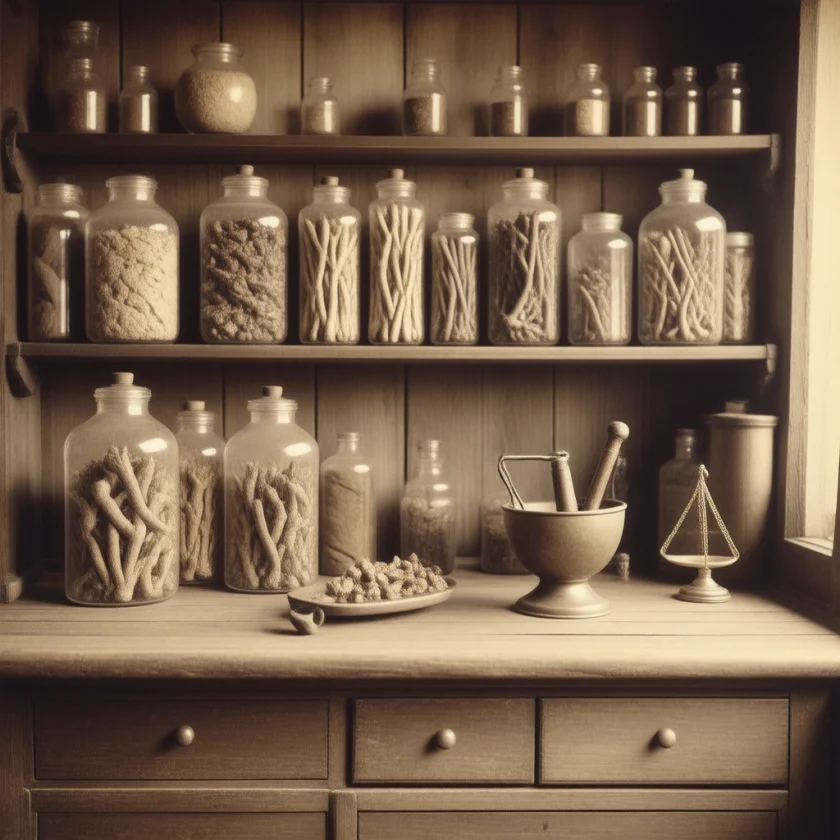
Galangal is a spice with two homelands and one very well-travelled name. The large, pine-scented rhizome that perfumes Thai tom kha gai is greater galangal, Alpinia galanga, a plant of island and mainland Southeast Asia. The slimmer, hotter rhizome that Chinese physicians have prescribed for "cold" stomach pain for some fifteen centuries is lesser galangal, Alpinia officinarum, from the coast of southern China. The word that covers both of them set out from a Chinese place-name, passed through Sanskrit, Persian and Arabic, entered the Latin herbals of medieval Europe, and turned up in Chaucer and in the kitchen of Richard II before Europe largely forgot it again. This article follows that documented journey, from the Chinese materia medica of around 500 CE to the laboratory work that began in 1881, and says plainly where the record is firm and where it is only tradition.
Table of Contents
- Three Plants, One Word: Botany and Origins
- The Long Journey of a Name
- Gao Liang Jiang: Galangal in Chinese Medicine
- Kulanjan and Rasna: Ayurveda and Unani
- Arab Physicians and the Medieval Spice Trade
- Hildegard of Bingen and the Latin Herbals
- Galyngale: Chaucer, the Forme of Cury, and Europe's Forgetting
- The Kitchens That Never Forgot: Southeast Asia
- From Rhizome to Molecule: Galangin (1881) and ACA (1976)
- Tradition Meets Modern Evidence
- Galangal Today
- Key Research Papers
- Connections
- Featured Videos
Three Plants, One Word: Botany and Origins
"Galangal" has named at least three different plants for as long as the word has existed in English. All belong to the ginger family, Zingiberaceae, and all are used for their rhizome — the horizontal underground stem in which the plant stores its starch and aromatic oil.
Greater galangal, Alpinia galanga, is the culinary galangal of Thailand, Indonesia, Malaysia, Vietnam and Cambodia. It is a tall perennial native to South and Southeast Asia; during the spice-trade centuries its centre of cultivation was Java, and it is still grown extensively across island Southeast Asia. Its rhizome is thick, hard and pale, and smells of pine, camphor and citrus. Linnaeus first described it in 1762, in the second edition of his Species Plantarum, under the name Maranta galanga; Carl Ludwig Willdenow moved it into the genus Alpinia in 1797, which is why the full botanical citation reads Alpinia galanga (L.) Willd. The genus honours Prospero Alpini, an Italian botanist of around 1600 who studied the plants of Egypt.
Lesser galangal, Alpinia officinarum, is the medicinal galangal of China. It is native to the south-eastern Chinese coast — Guangdong, Guangxi and Hainan Island — and to neighbouring Indochina, and its rhizome is slimmer, reddish-brown and markedly hotter and more peppery than its larger cousin. Although Chinese physicians had used it for well over a thousand years, it received a Western botanical name only in 1871, when the British consular official and botanist Henry Fletcher Hance described it in the Journal of the Linnean Society. The epithet officinarum, "of the workshops," is the old marker of a plant kept in the apothecary's store.
The third plant, kencur or aromatic ginger, Kaempferia galanga, is a small rhizome of Indonesian and Indian cooking sometimes sold in English as "lesser galangal" or "sand ginger". It has its own page on this site and is kept out of this one. When an old text says "galangal" it is often impossible to be certain which rhizome was meant; the working rule is that the medicinal galangal of Chinese, Arab and medieval European sources was usually the lesser, Chinese species, and the culinary galangal of Southeast Asian sources is the greater.
The Long Journey of a Name
Few spice names carry as much geography as this one. The usual reconstruction runs like this. The Chinese name for lesser galangal is gao liang jiang (高良薑), and the Chinese materia medica tradition explains it as "the ginger of Gaoliang": Tao Hongjing, the great editor of the Chinese herbal canon writing around 500 CE, recorded that the drug came from Gaoliang Commandery, an administrative district in what is now western Guangdong, the region later called Gaozhou. From China the drug and its name travelled west. Sanskrit has kulañjana, Persian qulanjān or khūlanjān, and Arabic khalanjān; medieval Latin took the Arabic as galanga, Old French made it galingal, and Middle English spelled it galyngale or galingale. Modern English "galangal" is the same word with one more turn of the wheel.
Two cautions belong beside that chain. The link between the Chinese and Sanskrit forms is reconstructed rather than documented, and dictionaries mark it as probable, not certain. And in medieval Europe galingale was also applied to an unrelated plant, the aromatic root of a European sedge (Cyperus longus), sold as a cheap local stand-in.
The Southeast Asian names are a separate family. Malay and Indonesian lengkuas, with cognates across the Austronesian languages, is the native name of the greater species; older Indonesian and Dutch-era usage called it laos, a label still seen on spice packets. Thai and Lao kha, Khmer romdeng and Vietnamese riềng name the same plant, and none owes anything to Gaoliang.
Gao Liang Jiang: Galangal in Chinese Medicine
The oldest continuous medical record of galangal is Chinese, and it concerns the lesser species. Tao Hongjing's Bencao Jing Jizhu ("Collected Commentaries on the Classic of Materia Medica"), compiled around 500 CE, is the text usually credited with the first written account of gao liang jiang and the source of the story that it was named for the district that produced it. In the framework of Chinese medicine the rhizome is warm and pungent and its job is to "warm the middle": it was, and is, prescribed for abdominal pain described as cold in character, for vomiting and hiccup, and for poor appetite. These are the categories of a traditional system, recorded here as history rather than as demonstrated mechanisms.
That tradition has an unusually formal modern afterlife. The Pharmacopoeia of the People's Republic of China lists gao liang jiang as an official drug and, in its 2005 edition, fixed Alpinia officinarum as its sole legal botanical source, settling by statute an identity question that market traders had left open for centuries. The dried fruit of the greater species is a separate drug in the same system, one more reason to check the species behind any Chinese "galangal" product. Southern China also cooks with it: in the Chaoshan region of eastern Guangdong it is called indispensable in the master stocks for the region's braised dishes.
Kulanjan and Rasna: Ayurveda and Unani
Galangal reached the Indian subcontinent as a traded drug, and Indian medicine absorbed it under names derived from the same root as the Persian and Arabic: kulanjan in Hindi and the North Indian languages, with bara kulanjan ("greater kulanjan") distinguishing the large Southeast Asian species from the small Chinese one. In Ayurvedic usage Alpinia galanga is also one of the plants supplied under the Sanskrit drug-name rasna, and it is classified as a vata-pacifying remedy — that is, in Ayurveda's three-humour framework, a warming drug for disorders attributed to the "air" principle, which include joint pain, stiffness and certain respiratory complaints. Rasna is a famously contested drug-name, applied to several unrelated plants in different regions, so an ancient reference to rasna is not by itself a reference to galangal; this article claims no named Sanskrit text for the plant.
The Unani tradition — the Graeco-Arabic medicine practised in India, Pakistan and the wider Islamic world — knows the rhizome as khulanjan and has used it for asthma, cough, sore throat and a range of chest and digestive complaints, in keeping with its Arabic medical inheritance described in the next section. In Tamil folk practice it is reported to be combined with liquorice root for colds. West Bengal, Assam and the eastern Himalayan plains later became cultivation areas for the lesser species, so that modern India grows both galangals as well as importing them.
Arab Physicians and the Medieval Spice Trade
One negative fact anchors the European story: Dioscorides, Pliny and Galen do not describe galangal. It entered Western medicine some eight centuries after them, carried by the Arab merchant networks that linked the Indian Ocean to the Mediterranean, and it arrived with its Arabic name attached.
The earliest clearly identifiable Western description comes from Muslim Spain. Ibn Juljul, a physician working in Córdoba in the tenth century, recorded khūlanjān as "an Indian drug, warm and moist," which "strengthens the stomach, the cold liver and the inner organs." The humoral language is the Graeco-Arabic framework of the age, and the indication is the one the Chinese had given the rhizome five centuries earlier: a warming remedy for a chilled, sluggish digestion. From the eleventh century onward galangal appears in the Arabic and Latin medical literature that shaped European practice for the next five hundred years: in Avicenna (Ibn Sina), whose Canon of Medicine became the standard medical textbook of both the Islamic world and the European universities, and in the Latin translations of Constantine the African, the monk of Monte Cassino who carried Arabic medicine into Italy.
From there it passed into the standard Latin herbals. The verse herbal known as Macer floridus, the Salernitan drug-book Circa instans (twelfth century), and the great printed German herbal, the Gart der Gesundheit of 1485, all carry galangal, consistently as a warming stomachic. Throughout this period it was an expensive import, a rhizome that had passed through Indian, Persian and Arab hands before it reached Venice or Genoa, priced alongside ginger, cloves and nutmeg.
Hildegard of Bingen and the Latin Herbals
The most famous medieval European voice on galangal is Hildegard of Bingen (1098–1179), the Benedictine abbess, composer and visionary whose natural-history work, the Physica, was composed around the 1150s. In her chapter on galgan she calls the rhizome wholly warm, with no coldness in it, and gives several uses: a person burning with fever should powder galangal and drink the powder in spring water; it is recommended for pain in the back and side that she attributes to corrupt humours; and it is given for weakness of the heart. The heart indication is the one modern admirers repeat most often, and it has made galangal a fixture of the "Hildegard medicine" revival in German-speaking countries. Popular writers like to call it her "spice of life"; the Physica chapter itself is plainer than that, speaking in the twelfth-century vocabulary of heat, humours and the strengthening of organs, and readers should treat the catchier phrase as a modern gloss rather than a quotation.
Hildegard matters for what she represents: writing in the Rhineland within a century of the drug's entry into Latin medicine, she already treats it as a familiar item of the monastery pharmacy. None of her uses has been tested in the modern sense; they are an accurate record of what a learned twelfth-century healer believed.
Galyngale: Chaucer, the Forme of Cury, and Europe's Forgetting
Medieval Europe did not keep galangal in the apothecary's jar alone; it cooked with it, and the two best-known English documents of medieval cooking both prove it. The Forme of Cury, the roll of recipes compiled about 1390 by the master cooks of King Richard II, calls repeatedly for "powdour of galyngale." It is ground into sauces for eels and lampreys, combined with ginger, cinnamon ("canel"), cloves and mace in spiced pottages, and once simply boiled with sugar and salt.
A few years earlier Geoffrey Chaucer had put it in the General Prologue to The Canterbury Tales. Introducing the Cook, he writes that the man had come along "to boille the chiknes with the mary-bones, / And poudre-marchant tart, and galingale" — to boil chickens with the marrow-bones, with a tart spice-blend and with galangal. The line (381 in the standard numbering) is small but precise evidence that galangal was a recognisable professional cook's spice in late-fourteenth-century London.
And then Europe largely forgot it. Galangal held its place through the sixteenth and seventeenth centuries and then faded with the whole heavily spiced medieval palate. By the eighteenth and nineteenth centuries it was essentially a pharmacist's article in the West: a nineteenth-century Tinctura aromatica combined it with cinnamon, cardamom and cloves as a digestive. Older English reference works add that the Tatars of the Russian steppe prepared a tea from the rhizome, and galangal is often said to have flavoured Russian spirits. That last claim needs care: the Russian word kalgan, which came from "galangal", is applied in everyday Russian to the native root of tormentil (Potentilla erecta), an unrelated plant of the rose family, and the traditional dark-red kalganovka vodka infusion is made from that root. The Russian galangal liqueur is mostly a case of the name outliving the plant.
The Kitchens That Never Forgot: Southeast Asia
The plant's homeland never stopped using it, and Southeast Asian cooking has carried greater galangal into the twenty-first century. In Thailand fresh kha is one of the three aromatics — with lemongrass and makrut (kaffir) lime leaf — on which the cuisine's soups and curry pastes are built. Tom kha gai, the coconut-and-galangal chicken soup whose name literally reads "boiled galangal chicken," is younger than its fame suggests: the dish is first recorded in a Thai recipe book around 1890, as tom kha pet, made with duck and young galangal; chicken took over later and the shrimp version followed. In Indonesia and Malaysia lengkuas is bruised whole into rendang, the slow-cooked coconut beef of the Minangkabau of West Sumatra, and pounded into the spice pastes (bumbu) that begin countless dishes; in Vietnam riềng seasons braised fish; in Cambodia romdeng goes into kroeung, the pounded aromatic base of Khmer cooking.
Among the Mansaka people of the Philippines the rhizome is traditionally fermented with honey to make a wine called byais. Across the region it is used fresh, dried and ground, and the young pink-tipped rhizome and the mature woody one are treated as different ingredients. Galangal in a Thai or Javanese kitchen is as ordinary as an onion in a European one, which is exactly why it survived there when its European career ended.
From Rhizome to Molecule: Galangin (1881) and ACA (1976)
The scientific chapter opens in Germany. In 1881 the pharmaceutical chemist E. Jahns published two papers in the Berichte der deutschen chemischen Gesellschaft on the crystalline substances he had extracted from lesser galangal root: one on a compound he named kaempferide, and one, "Ueber Galangin und Alpinin," describing galangin, a yellow flavonol he named directly after the plant. Galangin (3,5,7-trihydroxyflavone) is one of the simplest flavonols, the family of plant pigments that includes quercetin and kaempferol, and remains the marker compound of Alpinia officinarum; it was later found in propolis and other plants, but its name still carries the rhizome it was first drawn from.
The signature compound of the greater species came almost a century later and from Japan. In 1976 Seiji Mitsui and colleagues, publishing in Chemical and Pharmaceutical Bulletin, isolated the constituents of the seeds of Alpinia galanga and tested them for anti-ulcer activity in animals; among them was the phenylpropanoid ester now called 1'-acetoxychavicol acetate, or ACA. In 1985 Janssen and Scheffer in the Netherlands showed that the same compound was the antifungal principle of the rhizome, and ACA went on to become one of the most-studied natural anti-inflammatory molecules in cell culture, credited with blocking the NF-κB pathway that switches on inflammatory genes; a 2020 review by Kojima-Yuasa and Matsui-Yuasa gathers that literature. It is worth noticing that the first modern pharmacological question asked of greater galangal, in 1976, was whether it protected the stomach — the very indication the Chinese and Arab physicians had given the rhizome a millennium and more before.
Regulatory recognition followed the older European tradition rather than the newer chemistry. Germany's Commission E, the expert panel that assessed traditional herbal drugs for the former Federal Health Office, issued a monograph on galangal rhizome (Galangae rhizoma, the lesser species) in the late 1980s, accepting its use for digestive complaints of the dyspeptic and appetite-loss kind — the indication of Ibn Juljul and the Gart der Gesundheit, restated in regulatory language on the strength of long use rather than trials.
Tradition Meets Modern Evidence
Set the fifteen-hundred-year tradition beside the human evidence and the contrast is stark: a large laboratory literature and a very small clinical one. Almost everything written about galangal's antimicrobial, anti-inflammatory and anticancer activity rests on cell-culture and animal studies. The human trials can be counted on one hand.
The best-designed human work concerns, of all things, alertness. In 2017 Srivastava and colleagues published a randomised, double-blind, placebo-controlled crossover study in 59 healthy adults comparing a proprietary Alpinia galanga extract with caffeine and placebo; the extract modestly improved a laboratory measure of alertness, most clearly at three hours, and taken with caffeine it appeared to blunt the "caffeine crash." A second placebo-controlled trial by the same group in 2021 reported similar findings. Both were industry-sponsored studies of a branded extract with a reaction-time test as the outcome, and the tradition never claimed galangal as a stimulant of the mind; this is a new use, not a vindicated old one.
The other cluster is male fertility. In 2014 a Danish group (Fedder and colleagues) randomised 70 men with reduced semen quality to three months of a tablet combining pomegranate extract with freeze-dried greater galangal rhizome standardised on ACA, or placebo; 66 completed, and the number of motile sperm rose by about 62 percent on treatment against 20 percent on placebo. Because the product combined two plants the trial cannot say what galangal did on its own, and two authors were commercialising the tablet. In 2019 an Iranian group (Kolangi and colleagues) tested the lesser species: 76 men with unexplained infertility were enrolled and 60 completed twelve weeks of 300 mg daily of Alpinia officinarum extract or placebo, with improvements reported in sperm count and in the share of normally shaped sperm. These are small single trials with surrogate outcomes — none measured pregnancies — and they justify curiosity, not a recommendation. The anti-emetic and stomach tradition, by contrast, has essentially no human trial behind it: the 1976 Japanese work and its successors were animal studies.
Safety has a longer paper trail than efficacy. A 1992 study in Saudi Arabia fed mice ethanol extracts of A. galanga rhizome at single doses up to 3 g per kilogram and at 100 mg per kilogram daily for 90 days, and reported no significant mortality, no toxic effect on sperm and no adverse change in blood counts. Greater galangal is in any case eaten daily by tens of millions of people; the remaining safety questions attach to concentrated extracts rather than to the spice, and are covered on the hub page.
Galangal Today
Galangal's present reflects its past. In Southeast Asia and southern China it is what it has always been: an everyday market aromatic and, in China, an official pharmacopoeial drug. In India both species are grown and dispensed. In Europe and North America it is being rediscovered twice over: through Thai and Indonesian cooking, which has put fresh and frozen greater galangal back into Western groceries after a gap of some three centuries, and through the supplement trade, which sells extracts of both species standardised on ACA or galangin.
The history offers a modest lesson. The plant carried the same reputation — a warming remedy for a cold and sluggish stomach — from Tao Hongjing in the sixth century to Ibn Juljul in the tenth, Hildegard in the twelfth, the Gart der Gesundheit in the fifteenth and the Commission E in the twentieth, and the first modern experiment asked precisely that question in 1976. That is a remarkably consistent record, and still a record of use, not of proof. The one thing every era has struggled with is knowing which rhizome was in the jar; fifteen hundred years on, the most useful thing a buyer can do is read the Latin name.
Key Research Papers
The chemistry landmarks, the standard reviews of each species, the few human trials and the principal toxicity study; the medieval and Chinese primary texts are named in the article, not cited here.
- Jahns E (1881). Ueber Galangin und Alpinin. Berichte der deutschen chemischen Gesellschaft. — doi:10.1002/cber.188101402256
- Mitsui S, Kobayashi S, Nagahori H, Ogiso A (1976). Constituents from seeds of Alpinia galanga Wild. and their anti-ulcer activities. Chemical and Pharmaceutical Bulletin. — doi:10.1248/cpb.24.2377
- Janssen AM, Scheffer JJ (1985). Acetoxychavicol acetate, an antifungal component of Alpinia galanga. Planta Medica. — PubMed PMID: 17345272
- Kojima-Yuasa A, Matsui-Yuasa I (2020). Pharmacological Effects of 1'-Acetoxychavicol Acetate, a Major Constituent in the Rhizomes of Alpinia galanga and Alpinia conchigera. Journal of Medicinal Food. — PubMed PMID: 32069429
- Ramanunny AK, Wadhwa S, Gulati M, et al. (2022). Journey of Alpinia galanga from kitchen spice to nutraceutical to folk medicine to nanomedicine. Journal of Ethnopharmacology. — PubMed PMID: 35227783
- Abubakar IB, Malami I, Yahaya Y, et al. (2018). A review on the ethnomedicinal uses, phytochemistry and pharmacology of Alpinia officinarum Hance. Journal of Ethnopharmacology. — PubMed PMID: 29803568
- Srivastava S, Mennemeier M, Pimple S (2017). Effect of Alpinia galanga on Mental Alertness and Sustained Attention With or Without Caffeine: A Randomized Placebo-Controlled Study. Journal of the American College of Nutrition. — PubMed PMID: 28910196
- Fedder MD, Jakobsen HB, Giversen I, et al. (2014). An extract of pomegranate fruit and galangal rhizome increases the numbers of motile sperm: a prospective, randomised, controlled, double-blinded trial. PLoS One. — PubMed PMID: 25275520
- Kolangi F, Shafi H, Memariani Z, et al. (2019). Effect of Alpinia officinarum Hance rhizome extract on spermatogram factors in men with idiopathic infertility: A prospective double-blinded randomised clinical trial. Andrologia. — PubMed PMID: 30378695
- Qureshi S, Shah AH, Ageel AM (1992). Toxicity studies on Alpinia galanga and Curcuma longa. Planta Medica. — PubMed PMID: 1529022
PubMed Topic Searches
- PubMed: Galangal ethnobotany and traditional use
- PubMed: Lesser galangal history of pharmacology
- PubMed: 1'-acetoxychavicol acetate