Black Walnut for Parasites — Traditional Use and the Honest Evidence
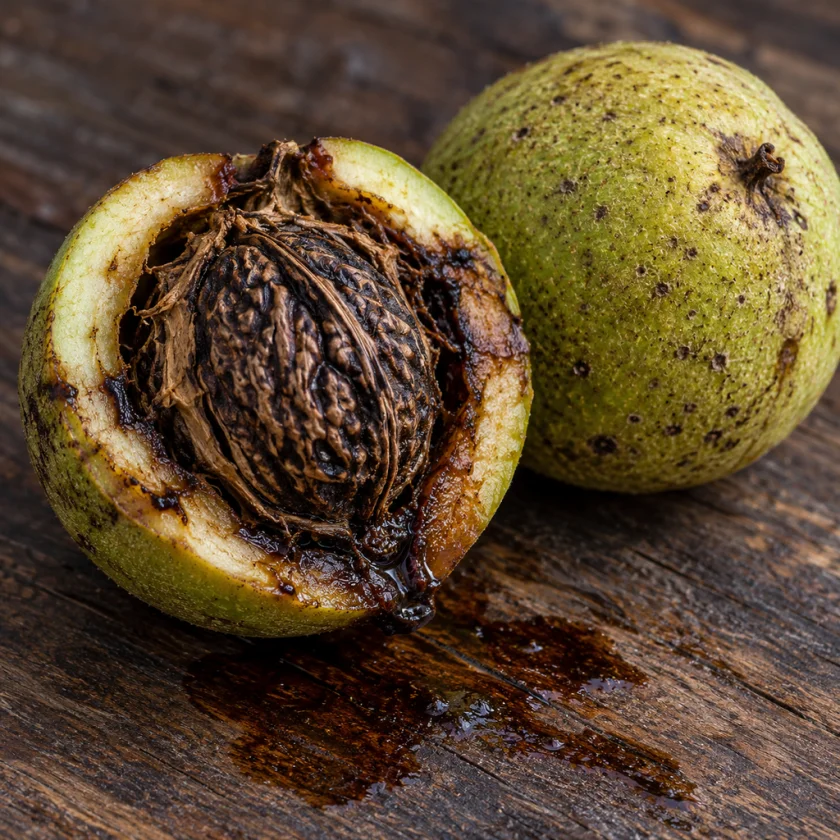
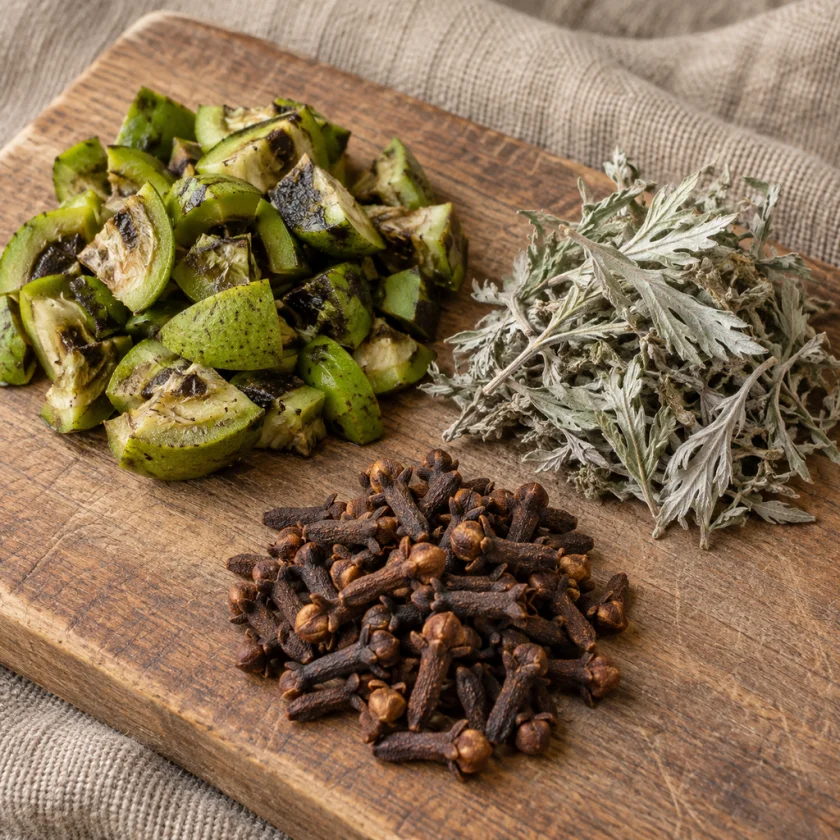
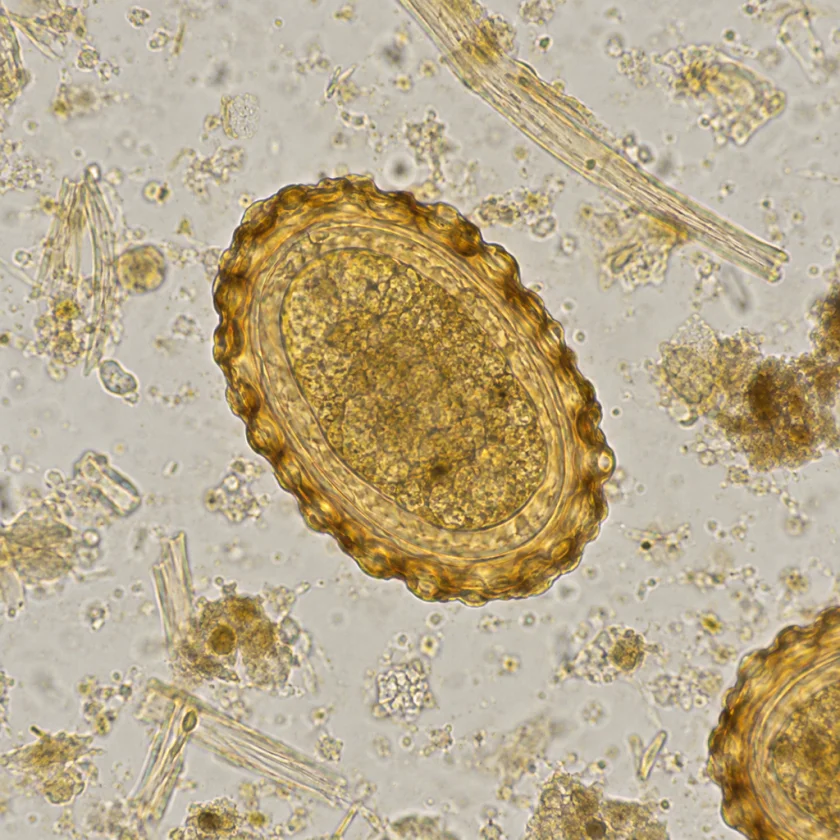
Black walnut hull is the herb most people associate with "natural parasite cleansing," almost always paired with wormwood and clove in a three-part formula. The tradition is real and old; the laboratory chemistry behind it is real too. What is missing — and it is a big thing to be missing — is human clinical evidence. There are no rigorous trials showing that a black walnut hull tincture clears a diagnosed parasitic infection in a person. This page walks through the traditional trio, the actual in-vitro and veterinary data, and two questions product labels rarely cover: how a parasite infection is confirmed, and what treats one.
Table of Contents
- The Traditional "Parasite Cleanse" Trio
- Where the Modern Cleanse Idea Came From
- What Juglone Does to Parasites in the Lab
- The Veterinary and Livestock Evidence
- Wormwood and Clove: the Other Two
- The Human Evidence — Or the Lack of It
- Real Human Parasites: Diagnosis and Proven Treatment
- What the Evidence Means in Practice
- Cautions
- Key Research Papers
- Connections
- Featured Videos
The Traditional "Parasite Cleanse" Trio
Open almost any commercial "parasite cleanse" kit and you will find the same three ingredients working together:
- Black walnut hull (Juglans nigra) — the green outer husk, dried and tinctured, valued for its juglone content.
- Wormwood (Artemisia absinthium) — a bitter herb whose very name in several languages refers to worms, containing the sesquiterpene lactones absinthin and artemisinin-related compounds.
- Clove (Syzygium aromaticum) — the dried flower bud, rich in the aromatic compound eugenol.
The traditional logic is a division of labor: black walnut and wormwood are said to target adult worms and larvae, while clove is said to target eggs. This tidy "adults, larvae, eggs" story is repeated everywhere in cleanse marketing, but it is a traditional rationale, not a finding from controlled human research. Herbal use of black walnut hull for intestinal worms is genuinely centuries old across North American and European folk medicine — the tradition is not invented. The mechanistic story layered on top of it, however, is a modern addition that has not been tested in controlled research.
You can read more about the individual herbs on our Clove and Berberine pages (berberine-containing herbs such as goldenseal are the other common folk antimicrobials), and the overall herb landscape on the Antibacterial Herbs listing.
Where the Modern Cleanse Idea Came From
Much of today's black-walnut-plus-wormwood-plus-clove protocol traces to a popular parasite-cleanse author in the 1990s who claimed that essentially all human disease — including cancer — is caused by a single intestinal fluke, and that this trio eliminates it. No published study supports the claim that one intestinal fluke causes all disease or all cancer, and no study has shown a herbal tincture curing cancer.
A few parasites are, however, recognised causes of specific cancers. A 2026 review in Tropical Medicine and Infectious Disease names the strongest links: the blood fluke Schistosoma haematobium with bladder cancer, and the food-borne liver flukes Opisthorchis viverrini and Clonorchis sinensis with bile-duct cancer (cholangiocarcinoma). Liver flukes account for roughly 1,300 to nearly 7,000 new bile-duct cancers a year, depending on the estimate. Infection does not always lead to cancer: the review describes cancer as an uncommon outcome that appears after many years and depends on how heavy the infection is, repeated reinfection, long-lasting inflammation and other factors. See Liver Flukes and Bile Duct Cancer and Parasites Classified as Carcinogens.
That does not mean black walnut, wormwood, and clove are worthless plants — each has real, testable chemistry, and each has some laboratory and veterinary support for antiparasitic activity, which we cover below. The sweeping health claims that surround "parasite cleansing" go far beyond what has been tested, and the existence of a product category is not evidence that the product works.
What Juglone Does to Parasites in the Lab
Black walnut hull's antiparasitic reputation rests on juglone (5-hydroxy-1,4-naphthoquinone) and its precursor hydrojuglone glucoside. Juglone is a reactive naphthoquinone: it cycles between oxidized and reduced forms, generating reactive oxygen species and interfering with the electron-transport chemistry that cells — including single-celled parasites — use to make energy.
The most concrete parasite finding comes from a careful 2015 chemical study that used statistical modeling to pinpoint which compound in Juglans species is responsible for killing Trypanosoma (the protozoan behind sleeping sickness and Chagas disease) in culture. The researchers prepared 36 extracts from different parts of black walnut (J. nigra), English walnut (J. regia) and butternut (J. cinerea) and tested them against three single-celled parasites: Trypanosoma cruzi (Chagas disease), Trypanosoma brucei rhodesiense (sleeping sickness) and Leishmania donovani (leishmaniasis). The model pointed to hydrojuglone glucoside, the storage form of juglone; once isolated, it was active against T. brucei and was significantly less toxic to mammalian cells in the dish than established antiparasitic naphthoquinones such as lapachol. This is a real, well-designed in-vitro result — but it is a test-tube result against a cultured protozoan, and it tells us nothing about whether an oral hull tincture reaches an infection in a human gut or bloodstream at a meaningful concentration.
The same reactivity that lets juglone poison a parasite also lets it poison human cells and the tree's plant competitors, which is a recurring theme with this molecule: juglone's activity is not selective (the hydrojuglone glucoside in the 2015 study was gentler on mammalian cells, but only in cell culture). A compound that harms many cell types indiscriminately is exactly the kind of substance that looks good in a dish and then fails as a medicine because the effective dose is also a toxic dose. See the Sources & Safety page for more on juglone's toxicity profile.
The Veterinary and Livestock Evidence
The strongest antiparasitic evidence for walnut is not human at all — it is veterinary. Livestock face heavy worm burdens and rising drug resistance, so researchers have tested many plant extracts against animal gut worms. Walnut features in this literature:
- An ethanolic leaf extract of Juglans regia (the English walnut) showed measurable activity against Ascaridia galli, a poultry roundworm, in both test-tube and live-bird experiments — paralyzing and killing the worms. In the dish, the extract at 100 mg/ml stopped 96.5% of worm movement at 24 hours (the deworming drug levamisole stopped 100%). In infected chickens, the best result came on day 14, with a 67.28% fall in worm egg counts and a 65.03% fall in worm numbers; the lowest dose tested, 500 mg/kg, did no better than no treatment.
- Walnut appears in records of North American ethnoveterinary practice — the folk remedies people have used to deworm animals. A 2007 survey in British Columbia, Canada, recorded black walnut (Juglans nigra) among the plants used to deworm pigs, dogs, and cats.
- A 2025 laboratory study from Ukraine tested tinctures of 46 traditional European medicinal plants, including English walnut (Juglans regia), against larvae of two livestock roundworms (Strongyloides papillosus and Haemonchus contortus). Only five plants killed the larvae — wormwood, elecampane, chamomile, sage and black poplar; walnut and the other plants tested did not affect larval survival.
Veterinary evidence is genuinely useful: it is done in living animals with real infections, which is a big step up from a Petri dish. But it comes with two caveats. First, most of it uses walnut leaf, not the hull that sits in human cleanse products, and the two have different chemistry. Second, deworming a chicken or a sheep is not the same as treating a person; dose, safety margin, and the specific parasites differ. The veterinary data are a reason researchers keep studying walnut; they are not data on treating people.
Wormwood and Clove: the Other Two
Because black walnut is almost never used alone for parasites, it is worth knowing what the partner herbs bring:
Wormwood (Artemisia absinthium and relatives) has the most respectable antiparasitic pedigree of the three, and for good reason: the Artemisia genus gave us artemisinin, the front-line antimalarial drug isolated from Artemisia annua. Multiple veterinary studies show Artemisia extracts reduce worm burdens in sheep and poultry. One distinction matters here: the antimalarial success belongs to a purified compound from a specific species, given at a controlled dose — not to a bitter-herb tincture of a different Artemisia.
Clove supplies eugenol, a compound with broad antimicrobial and some antiparasitic activity in the laboratory. Its traditional job in the trio is to kill eggs, though this specific claim is not backed by human data. Clove is a well-studied culinary spice; see our Clove page.
The honest summary of the trio: three plants with real laboratory and veterinary antiparasitic signals, combined on the basis of tradition and marketing rather than a single human trial demonstrating the combination clears parasites in people.
The Human Evidence — Or the Lack of It
This is the part product labels rarely include. Searching the medical literature for randomized controlled trials of black walnut hull — alone or in the classic trio — for treating a diagnosed parasitic infection in humans returns essentially nothing. There is no published trial establishing:
- that a hull tincture eliminates pinworm, roundworm, hookworm, Giardia, or any named human parasite;
- a dose that is both effective and safe in people;
- how oral juglone is absorbed, distributed, and broken down in humans, or whether it ever reaches an intestinal parasite at an active concentration.
Absence of evidence is not the same as evidence of harm, but it is a genuine problem when a product is sold specifically to treat infections. The research does not show that black walnut definitely does nothing; it shows that the human data needed to know do not exist, and that no study has tested it in place of proven treatment. That is a very different message from the confidence of a typical cleanse label.
Real Human Parasites: Diagnosis and Proven Treatment
Human parasitic infections are real, they are diagnosable, and they have effective, inexpensive, well-tested drug treatments. The standard medical path has two steps:
Diagnosis first. The symptoms attributed to "parasites" in cleanse marketing — fatigue, bloating, brain fog, irritability — are non-specific and overlap with dozens of common conditions. A genuine parasitic infection is confirmed by a test: stool ova-and-parasite examination, the cellophane-tape test for pinworm eggs, stool antigen tests for Giardia, or blood tests for certain tissue parasites. Guessing is not diagnosis.
Then targeted treatment. Once a parasite is identified, standard anthelmintic and antiprotozoal drugs are highly effective and usually cheap:
- Pinworm, roundworm, hookworm, whipworm: mebendazole, albendazole, or pyrantel pamoate — often a single dose, repeated in two weeks.
- Strongyloides and some others: ivermectin.
- Giardia and other protozoa: metronidazole, tinidazole, or nitazoxanide.
These are the treatments proven to cure infections in controlled studies. Our conditions pages cover the specific parasites in detail: Parasites overview, Pinworm, Ascaris (roundworm), Hookworm, and Giardia.
What the Evidence Means in Practice
- Testing comes before treatment in standard care. A stool test or a doctor's visit costs little and answers the actual question. Treating a parasite that is not there costs money and can delay finding the real cause of symptoms.
- Black walnut hull has not been tested as a substitute for a proven anthelmintic when a parasite has been confirmed. The drugs are cheap, safe, and reliable; the hull tincture is unproven.
- Many "die-off" symptoms during a cleanse can be side effects. Nausea, cramps, and diarrhea from a bitter, reactive-compound tincture can come from the tincture itself; they are not proof that parasites are dying.
- Warning signs: blood in the stool, unexplained weight loss, fever, severe abdominal pain, or travel to a region with endemic parasites are signs that doctors treat as needing prompt diagnosis; a supplement does not identify their cause.
Cautions
- Pregnancy and breastfeeding: wormwood contains thujone, a neurotoxin, and juglone in black walnut hull is a reactive compound with unknown safety in pregnancy. The nut as a food is fine (unless allergic); the hull tincture is a different, untested product.
- Tree-nut allergy: walnut is a common and sometimes severe allergen. See the Sources & Safety page.
- Not a tested treatment for serious infection: in standard care a confirmed parasitic infection is treated with a proven drug, and delay leaves the infection untreated.
- Duration: juglone is a reactive pro-oxidant; no study supports taking hull tinctures long-term, and its pro-oxidant chemistry is a reason for concern.
Key Research Papers
- Mir FH et al. (2024). Evaluation of anthelmintic efficacy of ethanolic leaf extract of Juglans regia L. on Ascaridia galli: a comprehensive in vitro and in vivo study. Veterinary Research Communications — PubMed PMID: 38771447
- Ellendorff T et al. (2015). PLS-Prediction and Confirmation of Hydrojuglone Glucoside as the Antitrypanosomal Constituent of Juglans Spp. Molecules — PubMed PMID: 26035104
- Boyko O, Brygadyrenko V (2025). Anthelmintic Activity of Traditional Medicinal Plants Used in Europe. Biology — PubMed PMID: 41463411
- Lans C et al. (2007). Ethnoveterinary medicines used to treat endoparasites and stomach problems in pigs and pets in British Columbia, Canada. Veterinary Parasitology — PubMed PMID: 17628343
- Mravčáková D et al. (2020). Anthelmintic Activity of Wormwood (Artemisia absinthium L.) and Mallow against Haemonchus contortus in Sheep. Animals — PubMed PMID: 32013192
- Iqbal Z et al. (2004). Anthelmintic activity of Artemisia brevifolia in sheep. Journal of Ethnopharmacology — PubMed PMID: 15234763
- Khan S et al. (2015). Anthelmintic properties of extracts from Artemisia plants against nematodes. Tropical Biomedicine — PubMed PMID: 26691254
- Abidi A et al. (2018). Chemical analyses and anthelmintic effects of Artemisia campestris essential oil. Veterinary Parasitology — PubMed PMID: 30389026
- Leung AKC et al. (2025). Pinworm (Enterobius vermicularis) Infestation: An Updated Review. Current Pediatric Reviews — PubMed PMID: 38288810
- Wendt S et al. (2019). The Diagnosis and Treatment of Pinworm Infection. Deutsches Ärzteblatt International — PubMed PMID: 31064642
- Anthelmintic Agents. LiverTox: Clinical and Research Information on Drug-Induced Liver Injury (2012, updated). — Search PubMed
- Ahmad T, Suzuki YJ (2019). Juglone in Oxidative Stress and Cell Signaling. Antioxidants — PubMed PMID: 30959841
- Botelho MC (2026). Cancer-Associated Parasitic Neglected Tropical Diseases: Precision Diagnostics, Risk Stratification, and Implementation Priorities. Tropical Medicine and Infectious Disease — PubMed PMID: 42931452
PubMed Topic Searches
- PubMed: Juglans anthelmintic / antiparasitic
- PubMed: juglone antiparasitic / protozoa
- PubMed: wormwood (Artemisia absinthium) anthelmintic
- PubMed: herbal parasite cleanse (human)
- PubMed: pinworm treatment (mebendazole)
External Resources
- CDC — Parasites A to Z (diagnosis and proven treatment)
- MedlinePlus — Black Walnut
- European Medicines Agency — Absinthii herba (Wormwood) herbal monograph