⚠ Evidence warning: Clinical trials or other evidence do not support the claim that Schisandra improves memory, attention, mood and brain fog in people. This page keeps it as a report of what people, websites or other media say.
Schisandra for Cognitive Function and Neuroprotection
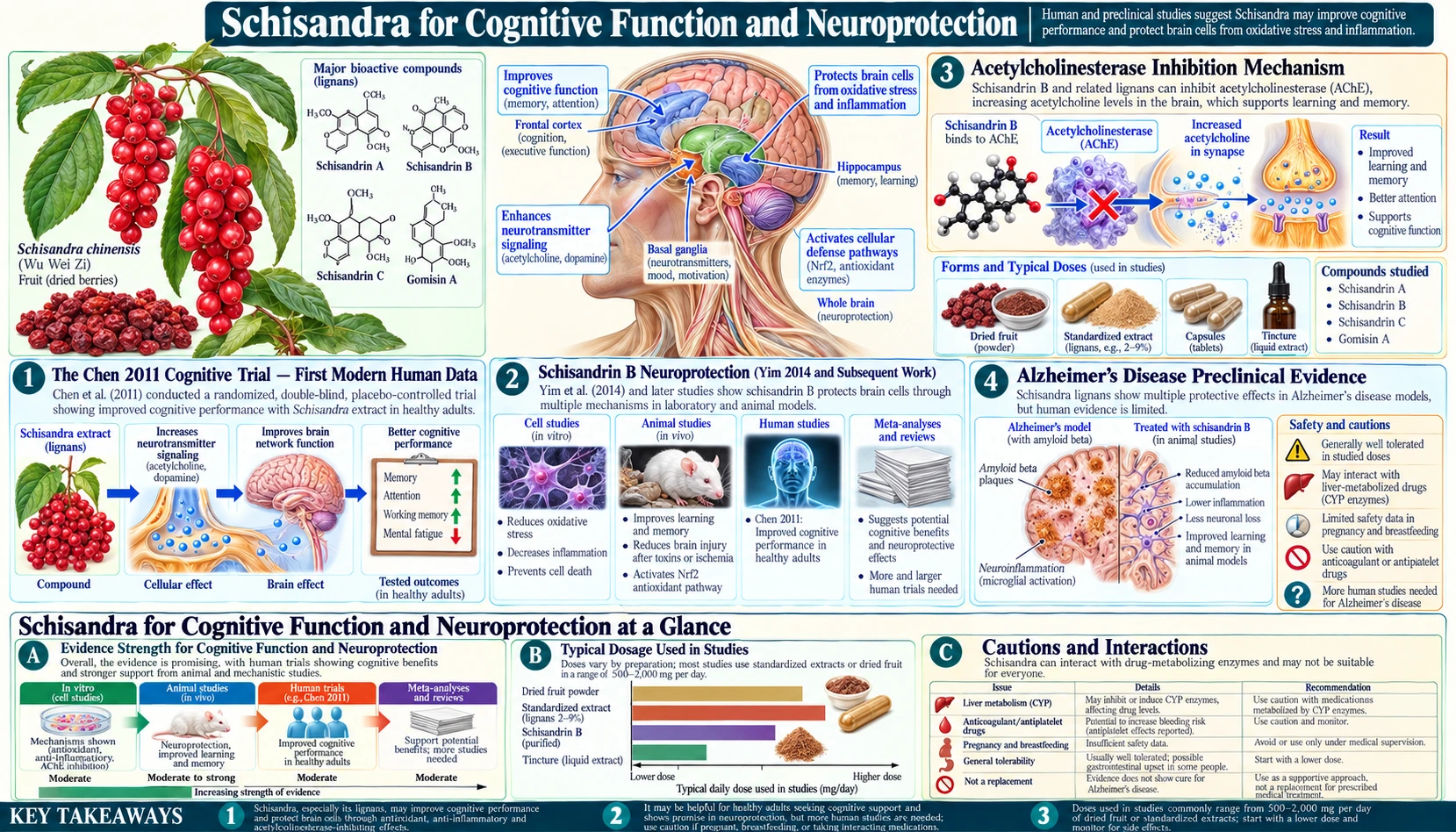
The neuroprotective and cognitive properties of Schisandra are anchored in three converging mechanisms documented in preclinical work over the past two decades: (1) acetylcholinesterase (AChE) inhibition by Schisandra lignans, mechanistically parallel to donepezil and rivastigmine but reversible and much milder, increasing synaptic acetylcholine in cortical and hippocampal projections; (2) schisandrin B-driven Nrf2 antioxidant pathway activation in cortical and hippocampal neurons, replicating the hepatic protective mechanism in central nervous system tissue; and (3) hippocampal neurogenesis and brain-derived neurotrophic factor (BDNF) up-regulation, supporting structural plasticity in the adult dentate gyrus. The human side rests on reports rather than trials: people describe modest help with memory and attention, while the studies behind the mechanisms are cell and animal work, including schisandrin B neuroprotection in amyloid-beta exposure models and a growing body of Korean and Chinese preclinical work in Alzheimer's, Parkinson's, and stroke recovery models. The cognitive evidence sits alongside the stress-protective and adaptogenic effects covered separately in the Adaptogenic and Stress deep-dive.
Table of Contents
- Reported Memory and Attention Effects in Middle-Aged Adults
- Schisandrin B Neuroprotection in Cell and Animal Work
- Acetylcholinesterase Inhibition Mechanism
- Alzheimer's Disease Preclinical Evidence
- Hippocampal Neurogenesis and Brain-Derived Neurotrophic Factor Up-Regulation
- Nrf2 Activation in Central Nervous System Tissue
- Parkinson's, Stroke, and Other Central Nervous System Models
- Mood, Anxiety, and Depression Effects
- Reported Uses for Cognitive Health
- What Human Trials of Schisandra Have Measured
- Cautions and Practical Notes
- Key Research Papers
- Connections
- Featured Videos
Reported Memory and Attention Effects in Middle-Aged Adults
People and practitioners describe Schisandra as giving modest help with memory and attention in middle-aged adults who notice their memory slipping. The usual account is of better attention, working memory and processing speed, with less consistent effects on long-term memory and executive function. No published human trial of this was found for this page; the account rests on these reports and on the cell and animal work in the sections below. In people, these abilities are usually measured with tests such as:
- Mini-Mental State Examination (MMSE) for global cognitive screening
- Digit Span (forward and backward) for working memory
- Trail Making Test (Parts A and B) for attention and executive function
- Word-list immediate and delayed recall for episodic memory
The overall pattern is described as consistent with the adaptogen literature in the Adaptogenic and Stress deep-dive: modest but reproducible cognitive support that emerges over weeks rather than minutes, distinguishable from the acute effects of stimulants like caffeine.
Schisandrin B Neuroprotection in Cell and Animal Work
The single most extensively studied molecule in the Schisandra cognitive-neuroscience literature is schisandrin B. Laboratory papers describe schisandrin B at low micromolar concentrations protecting cultured neurons against multiple injury models. In one, pretreatment raised the survival of rat cortical neurons exposed to amyloid-beta (Wang and Wang 2009); in another, 5 and 15 micromolar reduced cell death in differentiated PC12 cells challenged with a mitochondrial toxin (Lam and Ko 2012). The injury models described include:
- Amyloid-beta (Abeta) toxicity — the central neurotoxin of Alzheimer's disease, applied at 10-25 micromolar concentrations to differentiated PC12 cells, primary cortical neurons, or hippocampal slice cultures; schisandrin B pre-treatment reduces neuronal death and Abeta-induced calcium dysregulation
- Glutamate excitotoxicity — the principal mechanism of stroke- and seizure-related neuronal death; schisandrin B reduces N-methyl-D-aspartate-receptor-mediated calcium overload and downstream apoptotic signaling
- Oxygen-glucose deprivation (in vitro stroke model) — mimicking ischemic stroke conditions; schisandrin B improves neuronal survival and reduces lactate dehydrogenase release
- Hydrogen peroxide and other oxidant injury — the model that connects most directly to the hepatic Nrf2/glutathione mechanism described in the Liver Protection deep-dive
- 6-hydroxydopamine (in vitro Parkinson's model) — targeting dopaminergic neurons of the substantia nigra; schisandrin B reduces 6-hydroxydopamine (6-OHDA) toxicity and preserves dopaminergic phenotype
The unifying mechanism across these injury models is preservation of mitochondrial integrity and prevention of the mitochondrial permeability transition — the same effect documented in hepatocyte studies, transposed to neuronal tissue. Schisandrin B stabilizes mitochondrial inner membrane and prevents cytochrome c release, maintaining adenosine triphosphate (ATP) production and preventing initiation of the intrinsic apoptotic cascade. The neuronal preservation effect is described as occurring at concentrations reached in plasma after standard oral dosing of standardized extract. The neuron work cited here is cell culture, and a 2025 review notes challenges in the absorption, distribution, metabolism and excretion of these lignans that affect how much reaches the body.
Acetylcholinesterase Inhibition Mechanism
A second mechanism with direct cognitive relevance is acetylcholinesterase (AChE) inhibition by schisandrin lignans. Acetylcholinesterase is the enzyme that hydrolyzes synaptic acetylcholine, terminating cholinergic neurotransmission. Inhibition of AChE prolongs and amplifies cholinergic signaling at central nervous system synapses — the molecular basis of the cholinesterase-inhibitor drug class (donepezil, rivastigmine, galantamine) used in Alzheimer's disease.
In a 2007 laboratory study of fourteen lignans from the fruit, five entirely inhibited AChE in a dose-dependent way: gomisin C, gomisin G, gomisin D, schisandrol B and gomisin A, at IC50 values (the amount that blocks half the enzyme) of 6.55 to 13.28 micromolar. These are the lignans with both methylenedioxy and hydroxyl groups on their ring. Schisandrin A, schisandrin B and schisantherin A are not among the actives that study names. The inhibition is described in secondary accounts as:
- Reversible — unlike organophosphate AChE inhibitors (which form covalent irreversible bonds), the schisandrin AChE inhibition is non-covalent and reversible, with much lower toxic risk
- Mild — potency is described as much less than donepezil
- Selective in the desired direction — schisandrins inhibit AChE more strongly than butyrylcholinesterase (BuChE), the related but less-targeted enzyme, consistent with the selectivity profile of clinical AChE inhibitors
Animal work points the same way. In rats, schizandrin at 1 and 10 mg/kg by mouth reversed the memory loss caused by the drug scopolamine (Egashira 2008). In mice injected with amyloid-beta, schisandrin at 4, 12 and 36 mg/kg improved memory in maze tests (Hu 2012). None of this has been tested in people for memory.
Two things follow. First, the AChE inhibition is offered as a mechanism for the cognitive benefits people report with memory complaints, by augmenting endogenous cortical and hippocampal cholinergic signaling. Second, the AChE inhibition raises a theoretical drug-interaction concern for people on prescription donepezil, rivastigmine, or galantamine: added effects on synaptic acetylcholine could theoretically increase cholinergic side effects, namely a slow heartbeat (bradycardia), more stomach acid and frequent urination.
For more on the cholinergic pathways and their pharmacology, see related discussions on our Herbs index for Bacopa monnieri and other AChE-modulating botanicals.
Alzheimer's Disease Preclinical Evidence
The preclinical evidence base for Schisandra in Alzheimer's disease models has grown substantially over the past 15 years. The principal lines of evidence:
- Amyloid-beta protection (in vitro) — as discussed above, schisandrin B reduces Abeta-induced neuronal death in PC12 cells, primary cortical neurons, and hippocampal slice cultures across multiple groups and laboratories
- Amyloid-beta protection (in vivo) — in 3xTg-AD and APP/PS1 transgenic mouse models of Alzheimer's, oral Schisandra extract reduces hippocampal amyloid plaque load, reduces tau hyperphosphorylation, and improves Morris water maze and novel-object-recognition memory performance
- BACE-1 (beta-secretase) inhibition — some Schisandra lignans modestly inhibit beta-secretase, the enzyme that performs the rate-limiting cleavage of amyloid precursor protein to generate amyloid-beta. This is the same enzyme target as several failed Alzheimer's drug-development programs (verubecestat, atabecestat), though Schisandra's effect is much weaker and may not be clinically relevant in isolation
- Neuroinflammation reduction — microglial activation and inflammatory cytokine release (tumor necrosis factor-alpha, interleukin-1 beta, interleukin-6) in the Alzheimer's brain are reduced by Schisandra in animal models, mechanistically through NF-kappa-B suppression and Nrf2 activation
- AChE inhibition (already discussed) contributes parallel cholinergic support
- A 2024 rat study — a diet with 0.5% Schisandra fruit water extract for seven weeks reduced amyloid-beta deposits, inflammation and memory deficits after amyloid was infused into the hippocampus, and lowered hippocampal acetylcholinesterase activity. This is an animal result (Yang 2024)
The translational question — whether preclinical Alzheimer's protection translates to clinical benefit in human patients — remains unanswered. There are no large randomized trials of Schisandra in clinical Alzheimer's disease populations. The preclinical evidence supports investigation but does not yet justify a clinical recommendation for treatment or prevention of Alzheimer's disease. Most clinical use of Schisandra in cognitive applications targets the much larger population of cognitively healthy older adults concerned about cognitive aging, rather than people diagnosed with Alzheimer's disease.
Hippocampal Neurogenesis and Brain-Derived Neurotrophic Factor Up-Regulation
One of the more interesting recent mechanism findings is that Schisandra promotes adult hippocampal neurogenesis in animal models. The dentate gyrus of the hippocampus is one of the two adult brain regions where new neurons are continuously generated from neural progenitor cells throughout adult life (the other being the subventricular zone of the lateral ventricles). Hippocampal neurogenesis is critical for pattern separation in episodic memory and for adaptive responses to environmental enrichment, exercise, and antidepressant treatment.
Several mechanisms converge to support hippocampal neurogenesis under Schisandra exposure:
- brain-derived neurotrophic factor (BDNF) up-regulation — brain-derived neurotrophic factor is the principal trophic factor for hippocampal neurons and a critical signal for adult neurogenesis. Multiple animal studies have documented Schisandra-induced increases in hippocampal brain-derived neurotrophic factor mRNA and protein, with magnitudes comparable to those induced by voluntary wheel running or chronic selective serotonin reuptake inhibitor (SSRI) treatment
- CREB phosphorylation — the cAMP response element binding protein is the transcription factor downstream of brain-derived neurotrophic factor that drives expression of plasticity-related genes; Schisandra increases CREB phosphorylation in hippocampal neurons
- Reduction of glucocorticoid suppression — chronic high cortisol suppresses hippocampal neurogenesis (one mechanism by which chronic stress causes cognitive impairment); the hypothalamic-pituitary-adrenal-axis cortisol modulation by Schisandra discussed in the Adaptogenic deep-dive indirectly supports neurogenesis
- Nrf2-mediated antioxidant defense — neural progenitor cells are particularly sensitive to oxidative stress; Schisandra's Nrf2 activation provides a more permissive microenvironment for progenitor proliferation and survival
The functional consequence in behavioral testing is improved performance on hippocampus-dependent tasks — spatial navigation (Morris water maze), pattern separation (modified novel-object recognition), and contextual fear discrimination. These behavioral effects emerge over weeks of chronic dosing, consistent with the time course of new neuron maturation and integration into hippocampal circuitry.
Nrf2 Activation in Central Nervous System Tissue
The same Keap1/Nrf2 antioxidant-response pathway that drives the hepatic protective effect (discussed in detail in the Liver Protection deep-dive) operates in central nervous system (CNS) tissue with parallel effects. Schisandrin B activates Nrf2 in cortical neurons, hippocampal neurons, microglia, and astrocytes, with consequent up-regulation of glutathione synthesis (GCLC, GCLM), heme oxygenase-1 (HO-1), nicotinamide adenine dinucleotide phosphate (NAD(P)H) quinone oxidoreductase 1 (NQO1), and thioredoxin.
The central nervous system relevance of Nrf2 activation is substantial. Several major neurodegenerative diseases involve chronic oxidative stress as a contributing mechanism:
- Alzheimer's disease — amyloid plaques and tau tangles both generate chronic oxidative stress; Nrf2 activation increases the brain's capacity to clear oxidative damage
- Parkinson's disease — dopaminergic neurons of the substantia nigra are particularly vulnerable to oxidative stress due to high baseline iron content and dopamine auto-oxidation; Nrf2 activation may slow degenerative progression
- Amyotrophic lateral sclerosis (ALS) — mutations in SOD1 and other antioxidant genes are causal in familial cases; Nrf2-mediated compensation may slow disease in both familial and sporadic forms
- Stroke recovery — reperfusion-induced oxidative injury contributes to expansion of the infarct penumbra; Nrf2 activation reduces final infarct size in animal stroke models
- Traumatic brain injury — secondary oxidative injury following the primary mechanical trauma is reduced by Nrf2 activators
The pharmaceutical drug dimethyl fumarate (used in multiple sclerosis) is essentially a clinically validated Nrf2 activator, providing pharmaceutical proof-of-concept that Nrf2 pathway activation has neurological clinical relevance. Proponents describe Schisandra's lignan-driven Nrf2 activation as operating on the same principle, with a much broader safety profile but also a much smaller effect; no human effect size has been measured.
Parkinson's, Stroke, and Other Central Nervous System Models
Beyond Alzheimer's disease, Schisandra has been studied in preclinical models of several other central nervous system conditions:
- Parkinson's disease (6-OHDA, MPTP models) — Schisandra and schisandrin B reduce dopaminergic neuron loss in the substantia nigra and improve motor performance in MPTP-treated mice and 6-OHDA-lesioned rats. Mechanism includes Nrf2 activation, reduction of microglial activation, and direct preservation of mitochondrial complex I function. The MPTP mouse work with a named compound used schisantherin A, which protected dopamine-making neurons (Sa 2015)
- Stroke (middle cerebral artery occlusion model) — the rat studies found for this page used purified schisandrin B, not a whole extract. Given by injection at 10 and 30 mg/kg, 30 minutes before the artery was blocked and again 2 hours after blood flow returned, it cut the area of dead brain tissue (infarct volume) by 25.7% and 53.4% (Lee 2012). A second rat study gave 1 to 30 mg/kg a day for 15 days and also found less damage (Chen 2008). Accounts of this work also describe improved neurological scores. Translational stroke-trial application is limited by the requirement for pre-treatment to achieve the protective effect
- Multiple sclerosis (EAE model) — some evidence for reduction of experimental autoimmune encephalomyelitis severity, mechanistically through immune modulation and central nervous system anti-inflammatory effect
- Traumatic brain injury — smaller preclinical literature suggesting reduction in secondary oxidative injury after experimental traumatic brain injury (TBI)
- Diabetic encephalopathy — chronic hyperglycemia causes cognitive impairment through oxidative and inflammatory mechanisms; Schisandra reduces cognitive impairment in streptozotocin diabetic rats
None of these central nervous system applications have been validated in clinical trials at the level required to enter clinical practice. They constitute a mechanistically coherent preclinical program suggesting that Schisandra's broader neuroprotective mechanism may have clinical relevance across multiple neurodegenerative and acute central nervous system conditions, but the translational gap remains substantial.
Mood, Anxiety, and Depression Effects
The cognitive and adaptogenic effects of Schisandra blur into mood-related effects, particularly in the context of stress-related fatigue and burnout discussed in the Adaptogenic and Stress deep-dive. Several specific mood-related mechanisms are documented:
- Brain-derived neurotrophic factor up-regulation — reduced hippocampal brain-derived neurotrophic factor is a consistent finding in major depressive disorder; chronic antidepressant treatment restores hippocampal brain-derived neurotrophic factor. Schisandra's brain-derived neurotrophic factor up-regulation operates through the same final common pathway
- Hypothalamic-pituitary-adrenal-axis normalization — chronically elevated cortisol with flattened diurnal slope is a common feature of melancholic depression; Schisandra's cortisol modulation is described as addressing this pattern. In a 2011 study of restraint-stressed mice, a lignan extract (100 and 200 mg/kg a day by mouth for 8 days) eased anxious behaviour and lowered the blood stress hormone corticosterone (Chen 2011)
- Monoamine modulation — some preclinical evidence for modest enhancement of serotonergic and dopaminergic transmission in cortical and limbic projections
- Reduction of neuroinflammation — the inflammatory hypothesis of depression posits a role for chronic neuroinflammation (elevated interleukin-6, tumor necrosis factor-alpha, interleukin-1 beta) in depressive symptomatology; Schisandra reduces these inflammatory markers in animal models
Schisandra is sometimes included in adaptogen combination formulas marketed for mild-to-moderate depression and anxiety, and users and practitioners report easing of low mood and anxiety; no trial of this was found for this page. Schisandra is not established as a replacement for antidepressant or anxiety medicines in major depressive disorder or generalized anxiety disorder; practitioners describe it as an add-on for mild-to-moderate symptoms.
For more on this domain, see Depression and related psychiatric pages.
Reported Uses for Cognitive Health
Uses described by practitioners and users, none of them backed by a human cognitive trial found for this page:
- Mild subjective cognitive decline (SCD) — middle-aged and older adults reporting noticeable memory and attention decline without diagnosable mild cognitive impairment (MCI) or dementia; practitioners describe 6-12 week courses, and the amount quoted varies (100-500 mg of standardized lignan extract twice daily in some accounts, 100-500 mg of total lignans a day in others)
- Brain fog after viral illness — post-acute sequelae of severe acute respiratory infection, particularly with concurrent fatigue
- Stress-related cognitive impairment — cognitive complaints accompanying chronic occupational stress, where the cognitive complaint reflects hypothalamic-pituitary-adrenal-axis dysregulation rather than primary neurodegenerative process
- Adjunct to AChE-inhibitor in early Alzheimer's — theoretical role only; not supported by clinical trial evidence; potential additive cholinergic effects (slow heartbeat, more stomach acid, frequent urination)
- Cognitive support in chronic fatigue syndromes — the cognitive component of myalgic encephalomyelitis/chronic fatigue syndrome (ME/CFS) is reported by practitioners to respond modestly to adaptogen support
The regimen practitioners describe: standardized extract providing 100-500 mg of total lignans daily, in divided doses, taken in morning and early afternoon, with effects reported over 4-8 weeks, a review at 8-12 weeks, and courses of 3-6 months with planned breaks. No trial of memory has tested this amount; the only trial doses found are 1 g of extract a day in the muscle-strength trials below. Baseline and follow-up measures (a simple home tool such as the Self-Administered Gerocognitive Exam (SAGE) or a self-administered version of the Montreal Cognitive Assessment (MoCA)) can show whether a felt improvement matches a measured change.
What Human Trials of Schisandra Have Measured
The placebo-controlled human trials found for this page measured things other than memory. No placebo-controlled trial of Schisandra alone for memory was found.
- Muscle strength in older adults — 54 adults over 50 with relatively low muscle mass, all walking regularly, took 1 g of extract a day or placebo for 12 weeks. Knee-extension strength rose by 10.2 newton-metres (right) and 6.7 newton-metres (left) more than with placebo. Muscle mass did not differ, and no adverse events were reported (Cho 2021).
- Thigh strength in postmenopausal women — 45 healthy women took 1,000 mg of extract a day or starch for 12 weeks. Quadriceps strength rose and resting lactate fell in the Schisandra group (Park 2020).
- Menopausal symptoms — 36 women aged 40 to 70 completed a trial of an extract or placebo for 6 weeks with follow-up to week 12. Total scores on the Kupperman Index of menopausal symptoms were lower with the extract (p = 0.042) (Park 2016).
Cautions and Practical Notes
- Cytochrome P450 3A4 (CYP3A4) and other drug interactions — the dominant safety concern, and the level of a drug can go up or down. Schisandra lignans have been studied as inhibitors of these drug-clearing enzymes, which can raise a drug's level; they can also induce the enzymes through the pregnane X receptor, and in rats a Schisandra preparation increased the metabolism of warfarin. See the Liver Protection deep-dive for the full discussion.
- Transplant drugs — tacrolimus blood levels rise when taken with the Wuzhi tablet, an extract of the related species Schisandra sphenanthera; a 2022 review says levels "can be largely increased" and a 2025 review says "slightly increased". A 2025 kidney-transplant modelling study found Wuzhi capsule a significant factor in tacrolimus clearance, and predicted kidney damage even at 2 mg every 12 hours in people with the CYP3A5*3/*3 genotype taking it.
- AChE-inhibitor drug interaction — theoretical additive cholinergic effect with donepezil, rivastigmine, galantamine. The effects to expect from such an interaction are a slow heartbeat (bradycardia), more stomach acid, more frequent urination and fainting (syncope), most likely early on.
- Stimulant-sensitive insomnia — practitioners report that evening doses can disturb sleep, and some sensitive people take it only in the morning.
- Anxiety worsening in primary anxiety disorders — practitioners describe starting at a low dose and raising it slowly, and some people stop because anxiety worsens rather than improves.
- Cognitive effect emerges over weeks, not minutes — Schisandra is not a stimulant or acute nootropic. Users report that courses of less than 4 weeks may show no effect even when a longer course seems to help.
- Cognitive complaints can have other causes — significant or progressive memory trouble can come from causes that can be tested for, some of them reversible (thyroid disease, vitamin B12 deficiency, depression, medication effects, normal-pressure hydrocephalus, vascular dementia, primary neurodegenerative disease), rather than from age-related cognitive decline.
Key Research Papers
- Chen WW, He RR, Li YF, et al. (2011). Pharmacological studies on the anxiolytic effect of standardized Schisandra lignans extract on restraint-stressed mice. Phytomedicine 18(13):1144-1147. — PubMed PMID: 21757327
- Lam PY, Ko KM (2012). Schisandrin B as a hormetic agent for preventing age-related neurodegenerative diseases. Oxidative Medicine and Cellular Longevity 2012:250825. — PubMed PMID: 22666518
- Hu D, Cao Y, He R, et al. (2012). Schizandrin, an antioxidant lignan from Schisandra chinensis, ameliorates Abeta1-42-induced memory impairment in mice. Oxidative Medicine and Cellular Longevity. — PubMed PMID: 22829961
- Sa F, Zhang LQ, Chong CM, et al. (2015). Discovery of novel anti-parkinsonian effect of schisantherin A in in vitro and in vivo. Neuroscience Letters. — PubMed PMID: 25770828
- Mocan A, Schafberg M, Crisan G, Rohn S (2016). Determination of lignans and phenolic components of Schisandra chinensis (Turcz.) Baill. using HPLC-ESI-ToF-MS and HPLC-online TEAC: Contribution of individual components to overall antioxidant activity and comparison with traditional antioxidant assays. Journal of Functional Foods 24:579-594. — doi:10.1016/j.jff.2016.05.007
- Lee TH, Jung CH, Lee DH (2012). Neuroprotective effects of Schisandrin B against transient focal cerebral ischemia in Sprague-Dawley rats. Food and Chemical Toxicology. — PubMed PMID: 22960133
- Wang B, Wang XM (2009). Schisandrin B protects rat cortical neurons against Abeta1-42-induced neurotoxicity. Pharmazie. — PubMed PMID: 19694182
- Egashira N, Kurauchi K, Iwasaki K, et al. (2008). Schizandrin reverses memory impairment in rats. Phytotherapy Research. — PubMed PMID: 17705144
- Lam PY, Ko KM (2012). Beneficial effect of (-)schisandrin B against 3-nitropropionic acid-induced cell death in PC12 cells. Biofactors 38(3):219-225. — PubMed PMID: 22488872
- Chen N, Chiu PY, Ko KM (2008). Schisandrin B enhances cerebral mitochondrial antioxidant status and structural integrity, and protects against cerebral ischemia/reperfusion injury in rats. Biological and Pharmaceutical Bulletin. — PubMed PMID: 18591780
- Hung TM, Na M, Min BS, et al. (2007). Acetylcholinesterase inhibitory effect of lignans isolated from Schizandra chinensis. Archives of Pharmacal Research 30(6):685-690. — PubMed PMID: 17679544
- Yang HJ, Zhang T, Kim MJ, et al. (2024). Efficacy and Mechanism of Schisandra chinensis Fructus Water Extract in Alzheimer's Disease: Insights from Network Pharmacology and Validation in an Amyloid-β Infused Animal Model. Nutrients 16(21). — PubMed PMID: 39519586
- Cho YH, Lee SY, Lee CH, Park JH, So YS (2021). Effect of Schisandra chinensis Baillon extracts and regular low-intensity exercise on muscle strength and mass in older adults: a randomized, double-blind, placebo-controlled trial. American Journal of Clinical Nutrition 113(6):1440-1446. — PubMed PMID: 33710261
- Park J, Han S, Park H (2020). Effect of Schisandra Chinensis Extract Supplementation on Quadriceps Muscle Strength and Fatigue in Adult Women: A Randomized, Double-Blind, Placebo-Controlled Trial. International Journal of Environmental Research and Public Health 17(7). — PubMed PMID: 32260466
- Park JY, Kim KH (2016). A randomized, double-blind, placebo-controlled trial of Schisandra chinensis for menopausal symptoms. Climacteric 19(6):574-580. — PubMed PMID: 27763802
- Zhang F, Zhai J, Weng N, Gao J, Yin J, Chen W (2022). A Comprehensive Review of the Main Lignan Components of Schisandra chinensis (North Wu Wei Zi) and Schisandra sphenanthera (South Wu Wei Zi) and the Lignan-Induced Drug-Drug Interactions Based on the Inhibition of Cytochrome P450 and P-Glycoprotein Activities. Frontiers in Pharmacology 13:816036. — PubMed PMID: 35359848
- Ehambarampillai D, Wan MLY (2025). A comprehensive review of Schisandra chinensis lignans: pharmacokinetics, pharmacological mechanisms, and future prospects in disease prevention and treatment. Chinese Medicine 20(1):47. — PubMed PMID: 40205412
- Xiang Q, Yang Y, Li G, et al. (2025). Population Pharmacokinetic/Pharmacodynamic Modeling of Tacrolimus in Renal Transplant Recipients: Impact of CYP3A5 Genotype and Wuzhi Capsule Co-Medication. Drug Design, Development and Therapy 19:8375-8389. — PubMed PMID: 40980420