Pork Liver
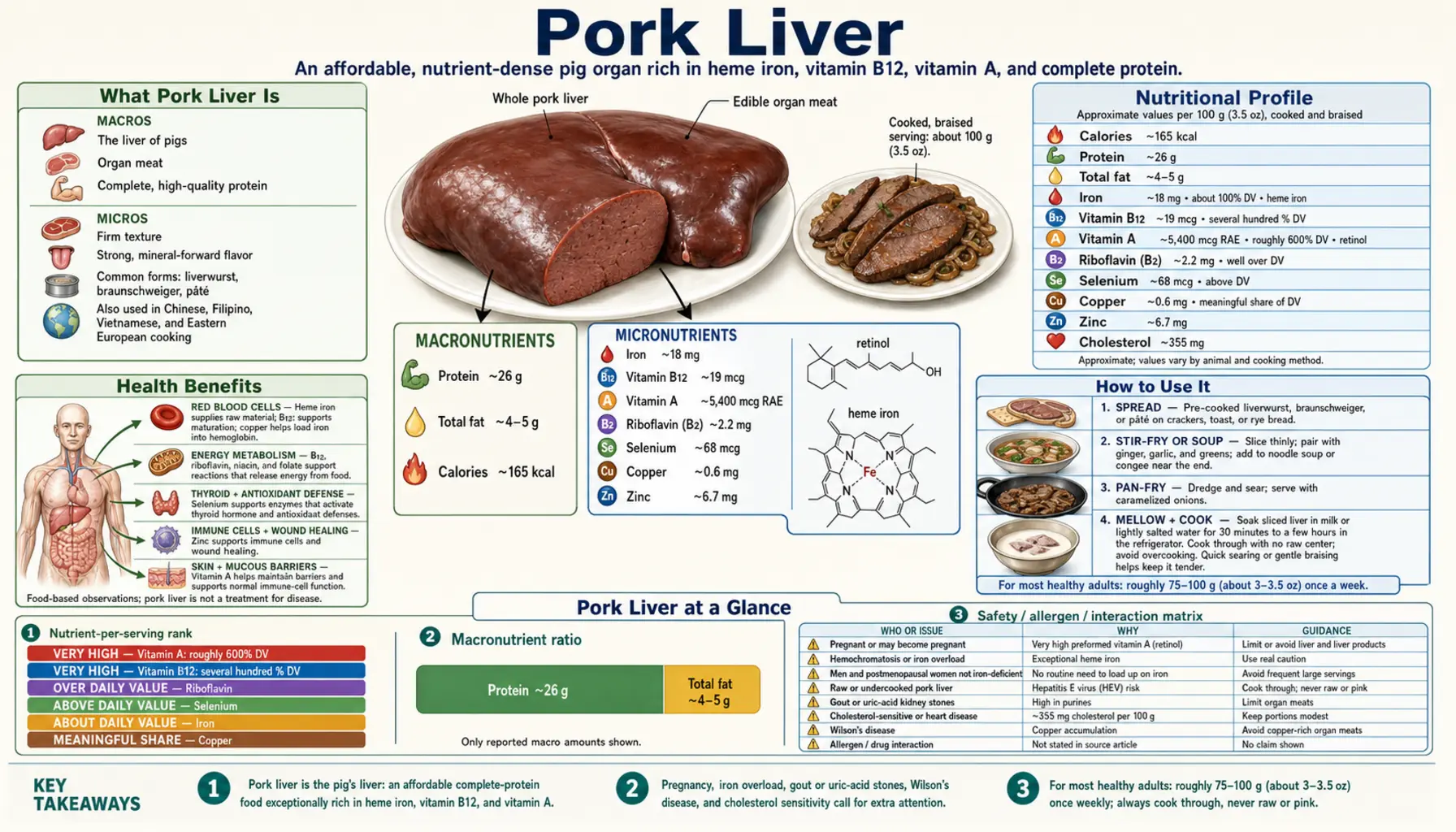
Pork liver is the liver of the pig. In the United States and Europe it is widely eaten as liverwurst, braunschweiger and pâté; USDA FoodData Central lists both liverwurst and braunschweiger as pork liver sausages. FDC lists cooked (braised) pork liver with 17.92 mg of iron per 100 g — more than it lists for cooked beef liver (6.54 mg) or chicken liver (11.63 mg) — along with vitamin B12, preformed vitamin A (retinol), riboflavin, selenium, zinc, copper and 26.02 g of protein. The research documents hazards as well: the vitamin A content is the basis of guidance on liver in pregnancy, and raw or undercooked pig liver and pig-liver sausages have been linked to hepatitis E virus infection.
Table of Contents
What Pork Liver Is
Pork liver is the liver of the pig. In the United States and Europe it is the main ingredient of liverwurst, braunschweiger and many pâtés, so it is often eaten without being thought of as “liver” at all. FDC lists both liverwurst and braunschweiger as pork liver sausages.
Pork liver is also an everyday ingredient in many cuisines. It appears in Chinese stir-fries and soups, in Filipino dishes (it thickens and flavors some styles of menudo and certain adobo preparations), in Vietnamese cooking, and throughout Eastern Europe in sausages, spreads and pan-fried preparations. In France, figatellu is a traditional pig-liver sausage that is commonly eaten raw (see the cautions below).
Compared with chicken liver, pork liver is commonly described as firmer, with a stronger, more mineral-forward flavor — one reason it is so often ground and blended with fat and spices rather than served as a plain slab. It is typically an inexpensive cut, which made it a staple of thrifty, whole-animal cooking.
Nutritional Profile
The figures below are USDA FoodData Central values for 100 grams of cooked (braised) pork liver (SR Legacy food 167863; FDC also lists an 85 g portion). FDC does not give a %DV for this food; the FDA Daily Value used on food labels is shown beside each nutrient for reference. Amounts vary with the animal and the cooking method.
- Calories: 165 kcal
- Protein: 26.02 g (FDA Daily Value 50 g)
- Total fat: 4.4 g
- Iron: 17.92 mg (FDA Daily Value 18 mg)
- Vitamin B12: 18.67 µg (FDA Daily Value 2.4 µg)
- Vitamin A: 5,405 µg RAE, all of it as retinol (preformed vitamin A) (FDA Daily Value 900 µg RAE)
- Riboflavin (vitamin B2): 2.196 mg (FDA Daily Value 1.3 mg)
- Niacin: 8.435 mg (FDA Daily Value 16 mg NE)
- Folate: 163 µg DFE (FDA Daily Value 400 µg DFE)
- Selenium: 67.5 µg (FDA Daily Value 55 µg)
- Copper: 0.634 mg (FDA Daily Value 0.9 mg)
- Zinc: 6.72 mg (FDA Daily Value 11 mg)
- Vitamin C: 23.6 mg (FDA Daily Value 90 mg)
- Cholesterol: 355 mg (FDA Daily Value 300 mg)
The FDA's label guidance describes 20% DV or more per serving as “high” and 5% DV or less as “low”. For raw pork liver (SR Legacy 167862), FDC lists per 100 g: 134 kcal, 21.39 g protein, 23.3 mg iron, 26.0 µg vitamin B12, 6,502 µg RAE vitamin A, 0.677 mg copper and 301 mg cholesterol.
The headline comparison is iron. Per 100 g cooked, FDC lists 17.92 mg of iron in braised pork liver, 11.63 mg in simmered chicken liver (SR Legacy 171061) and 6.54 mg in braised beef liver (SR Legacy 168626). Beef liver is listed higher for other nutrients: per 100 g braised, FDC lists beef liver at 70.58 µg vitamin B12, 9,442 µg RAE vitamin A and 14.283 mg copper, against 18.67 µg, 5,405 µg RAE and 0.634 mg for braised pork liver.
Liver iron is often described as heme iron, the form absorbed most readily (reviewed by Kalman and colleagues, 2025). Measurements in pigs do not support that description for pork liver: in an experimental study, liver from control pigs held 20.6 mg of total iron per 100 g, of which 14.0 mg was non-heme iron (Middleton et al., 2021). A study of calf organs likewise found heme iron made up 13.6% of the iron in liver, against 64% in muscle meat (Valenzuela et al., 2009).
Health Benefits
The points below describe what the nutrients listed above do in the body; they are not results of trials of pork liver itself, and they are not claims that liver treats any disease.
Iron and the nutrients that make red blood cells
Iron-deficiency anemia — too few healthy red blood cells because of too little iron — is one of the most common nutritional problems worldwide; the 2025 review by Kalman and colleagues describes iron as the most deficient nutrient in the world. Pork liver contains iron together with two other nutrients involved in blood formation: vitamin B12, which is required to make red blood cells, and copper, which is used in iron metabolism. Iron lets red cells carry oxygen. As noted above, most of the iron measured in pig liver is non-heme iron.
Energy and metabolism
Pork liver contains several B vitamins — FDC lists B12 at 18.67 µg, riboflavin at 2.196 mg, niacin at 8.435 mg and folate at 163 µg DFE per 100 g cooked — which act as cofactors in the enzymes cells use to release energy from carbohydrates, fats and protein.
Immune function and thyroid support
FDC lists 67.5 µg of selenium and 6.72 mg of zinc per 100 g of cooked pork liver. Selenium is part of the enzymes that activate thyroid hormone and of antioxidant enzymes; zinc is involved in immune function and wound healing. Vitamin A helps maintain the skin and mucous-membrane barriers and is involved in normal immune-cell function.
How It Is Prepared
Pork liver appears in a handful of common forms:
- Liverwurst, braunschweiger and pâté. These spreadable liver products are pork liver's most common Western form, typically eaten on crackers, toast or rye bread. FDC lists liverwurst (SR Legacy 173870) at 8,308 µg RAE vitamin A and 28.5 g fat per 100 g, and braunschweiger (SR Legacy 171621) at 4,220 µg RAE vitamin A and 28.5 g fat per 100 g.
- Stir-fries and Asian soups. Thinly sliced pork liver cooks quickly and is used in high-heat stir-fries with ginger, garlic and greens, and in noodle soups and congee.
- Pan-fried. As in the traditional “liver and onions,” pork liver is dredged and seared, often served with caramelized onions to balance its strong flavor.
Soaking sliced liver in milk or lightly salted water before cooking is a traditional practice for mellowing the flavor. Liver is commonly described as turning tough and grainy when overcooked. Food-safety research puts thorough cooking first for pork liver because of hepatitis E virus — see the cautions below.
What Sources Report on Amounts
The main limit on liver intake in the guidance is vitamin A. The Institute of Medicine (2001) set the Tolerable Upper Intake Level for adults at 3,000 µg of preformed vitamin A per day, a level the NIH Office of Dietary Supplements notes applies to preformed vitamin A; FDC lists 5,405 µg of retinol in 100 g of braised pork liver.
UK NHS guidance on vitamin A states: “Liver is a very rich source of vitamin A. Do not eat liver or liver products, such as pâté, more than once a week,” and “If you eat liver every week, do not take supplements that contain vitamin A.” The same page states: “Women who have been through the menopause and older men, who are more at risk of osteoporosis, should avoid having more than 1.5mg of vitamin A a day from food and supplements,” and that an average of 1.5 mg a day or less from diet and supplements combined is unlikely to cause any harm.
Cautions
The research documents hazards that apply to everyone (vitamin A excess and hepatitis E virus in raw or undercooked liver) and raises concerns for particular groups.
- Vitamin A in pregnancy. Pork liver is rich in preformed vitamin A (retinol), and high intakes of preformed vitamin A early in pregnancy are linked to birth defects. In a cohort of 22,748 pregnant women (Rothman et al., NEJM 1995), the prevalence of cranial-neural-crest defects was 3.5 times higher among babies of women consuming more than 15,000 IU of preformed vitamin A a day from food and supplements than among those consuming 5,000 IU or less; the excess was concentrated in intakes before the seventh week of gestation, and the authors concluded that high dietary intake of preformed vitamin A appears to be teratogenic. UK NHS guidance states that “if you're pregnant you should avoid eating liver or liver products”. (These findings and the IOM upper level concern preformed vitamin A from animal foods and supplements, not the carotenoids in plants.)
- Hepatitis E virus in raw or undercooked pig liver. Pigs are a reservoir of hepatitis E virus (HEV). In the United States, 14 of 127 packages of grocery-store pig liver tested positive for HEV RNA, and pigs inoculated with two of three PCR-positive liver homogenates became infected, showing the virus was still infectious (Feagins et al., 2007). In France, acute or recent HEV infection was found in 7 of 13 people who ate raw figatellu pig-liver sausage and in none of 5 who did not, and HEV RNA was recovered from 7 of 12 supermarket figatelli (Colson et al., 2010). In Italy, HEV RNA was detected in 10 of 45 slices (22.2%) of raw pork-liver sausage and 1 of 23 slices of dry sausage, though infectivity was not demonstrated (Di Bartolo et al., 2015).
- What heat does to the virus. In a pig bioassay, HEV in contaminated store-bought pig liver was inactivated by stir-frying at 191°C (internal temperature 71°C) for 5 minutes or by boiling for 5 minutes, but not by holding at 56°C for 1 hour; the authors concluded that pig livers must be thoroughly cooked (Feagins et al., 2008). In experimentally contaminated pork-liver products, heating to an internal temperature of 71°C for 20 minutes was needed to inactivate HEV completely (Barnaud et al., 2012). The U.S. federal safe-minimum-temperature chart (FoodSafety.gov) lists 145°F (63°C) with a 3-minute rest for pork steaks, roasts and chops and 160°F (71°C) for ground pork and sausage; it gives no separate figure for pork liver.
- Iron overload and hemochromatosis. Hemochromatosis involves increased absorption of dietary iron. The 2011 American Association for the Study of Liver Diseases (AASLD) practice guideline states that dietary adjustments are unnecessary during treatment, because a low-iron diet changes iron absorption by only 2–4 mg/day compared with about 250 mg/week removed by phlebotomy; the same guideline states that vitamin C and iron supplements should be avoided. Decisions about diet with an iron-overload condition belong with a clinician.
- Purines and gout. A purine analysis of 270 foods (Kaneko et al., 2014) lists organs such as the liver among the purine-rich foods; the body breaks purines down into uric acid, and frequent, high intake of purine-rich foods raises serum uric acid. In a 12-year study of 47,150 men (Choi et al., NEJM 2004), the highest fifth of meat intake carried a relative risk of new gout of 1.41 against the lowest fifth. The research therefore raises a concern for people who have gout or high uric acid.
- Cholesterol. FDC lists 355 mg of cholesterol per 100 g of braised pork liver (FDA Daily Value 300 mg). A 2020 American Heart Association science advisory found that observational studies generally do not show a significant association between dietary cholesterol and cardiovascular disease, while most meta-analyses of intervention studies link intakes above current average levels with higher total or LDL cholesterol.
- Copper and Wilson disease. Wilson disease is a rare inherited disorder of copper accumulation. The updated AASLD practice guidance (summarized by Alkhouri and colleagues, 2023) notes that limited data support the previous advice to reduce dietary copper, and encourages a dietitian-designed plan keeping copper intake below 0.9 mg/day alongside drug treatment. FDC lists 0.634 mg of copper per 100 g of braised pork liver and 14.283 mg in braised beef liver.
Key Research Papers
- U.S. Department of Agriculture, FoodData Central. Pork, fresh, variety meats and by-products, liver, cooked, braised (SR Legacy, FDC ID 167863). fdc.nal.usda.gov — Source for the per-100 g figures on this page (iron 17.92 mg, vitamin B12 18.67 µg, vitamin A 5,405 µg RAE as retinol, protein 26.02 g, selenium 67.5 µg, copper 0.634 mg, zinc 6.72 mg, cholesterol 355 mg).
- Kalman D, Hewlings S, Madelyn-Adjei A, Ebersole B. Dietary heme iron: a review of efficacy, safety and tolerability. Nutrients. 2025;17(13):2132. — Reviews the absorption of heme iron from animal foods compared with non-heme forms of iron. — doi:10.3390/nu17132132
- Feagins AR, Opriessnig T, Guenette DK, Halbur PG, Meng XJ. Detection and characterization of infectious hepatitis E virus from commercial pig livers sold in local grocery stores in the USA. J Gen Virol. 2007;88(Pt 3):912–917. — 14 of 127 store-bought pig livers were positive for HEV RNA (all genotype 3); two of three PCR-positive liver homogenates infected pigs. — doi:10.1099/vir.0.82613-0
- Di Bartolo I, Angeloni G, Ponterio E, Ostanello F, Ruggeri FM. Detection of hepatitis E virus in pork liver sausages. Int J Food Microbiol. 2015;193:29–33. — HEV RNA in 10 of 45 slices (22.2%) of raw and 1 of 23 slices of dry pork-liver sausage; infectivity was not demonstrated. — doi:10.1016/j.ijfoodmicro.2014.10.005
- Rothman KJ, Moore LL, Singer MR, Nguyen US, Mannino S, Milunsky A. Teratogenicity of high vitamin A intake. N Engl J Med. 1995;333(21):1369–1373. — Cohort of 22,748 pregnant women linking high preformed vitamin A intake in early pregnancy to cranial-neural-crest birth defects. — doi:10.1056/NEJM199511233332101
- U.S. Department of Agriculture, FoodData Central. Pork, fresh, variety meats and by-products, liver, raw (SR Legacy, FDC ID 167862). fdc.nal.usda.gov — Raw values per 100 g: iron 23.3 mg, vitamin B12 26.0 µg, vitamin A 6,502 µg RAE, copper 0.677 mg.
- U.S. Department of Agriculture, FoodData Central. Beef, variety meats and by-products, liver, cooked, braised (SR Legacy 168626). fdc.nal.usda.gov — Comparison food: per 100 g, iron 6.54 mg, vitamin B12 70.58 µg, vitamin A 9,442 µg RAE, copper 14.283 mg.
- U.S. Department of Agriculture, FoodData Central. Chicken, liver, all classes, cooked, simmered (SR Legacy 171061). fdc.nal.usda.gov — Comparison food: iron 11.63 mg per 100 g.
- U.S. Department of Agriculture, FoodData Central. Liver sausage, liverwurst, pork (SR Legacy 173870) and Braunschweiger (a liver sausage), pork (SR Legacy 171621). fdc.nal.usda.gov, fdc.nal.usda.gov — Vitamin A 8,308 and 4,220 µg RAE per 100 g respectively.
- Middleton M, Olivares M, Espinoza A, Arredondo M, Pizarro F, Valenzuela C. Exploratory study: excessive iron supplementation reduces zinc content in pork without affecting iron and copper. Animals (Basel). 2021;11(3):776. — Pig study; liver of control pigs held 20.6 mg total iron and 14.0 mg non-heme iron per 100 g. — PubMed PMID: 33799563
- Valenzuela C, de Romaña DL, Olivares M, Morales MS, Pizarro F. Total iron and heme iron content and their distribution in beef meat and viscera. Biol Trace Elem Res. 2009;132(1–3):103–111. — Heme iron was 64% of iron in meat cuts but 13.6% in calf liver. — PubMed PMID: 19475341
- Colson P, Borentain P, Queyriaux B, Kaba M, Moal V, Gallian P, Heyries L, Raoult D, Gerolami R. Pig liver sausage as a source of hepatitis E virus transmission to humans. J Infect Dis. 2010;202(6):825–834. — HEV infection in 7 of 13 people who ate raw figatellu vs 0 of 5 who did not; HEV RNA in 7 of 12 supermarket figatelli. — PubMed PMID: 20695796
- Feagins AR, Opriessnig T, Guenette DK, Halbur PG, Meng XJ. Inactivation of infectious hepatitis E virus present in commercial pig livers sold in local grocery stores in the United States. Int J Food Microbiol. 2008;123(1–2):32–37. — Stir-frying (internal 71°C, 5 min) or boiling 5 min inactivated HEV; 56°C for 1 h did not. — PubMed PMID: 18166239
- Barnaud E, Rogée S, Garry P, Rose N, Pavio N. Thermal inactivation of infectious hepatitis E virus in experimentally contaminated food. Appl Environ Microbiol. 2012;78(15):5153–5159. — An internal temperature of 71°C for 20 min was needed to inactivate HEV completely. — PubMed PMID: 22610436
- Bacon BR, Adams PC, Kowdley KV, Powell LW, Tavill AS; American Association for the Study of Liver Diseases. Diagnosis and management of hemochromatosis: 2011 practice guideline by the American Association for the Study of Liver Diseases. Hepatology. 2011;54(1):328–343. — PubMed PMID: 21452290
- Alkhouri N, Gonzalez-Peralta RP, Medici V. Wilson disease: a summary of the updated AASLD Practice Guidance. Hepatol Commun. 2023;7(6):e0150. — PubMed PMID: 37184530
- Kaneko K, Aoyagi Y, Fukuuchi T, Inazawa K, Yamaoka N. Total purine and purine base content of common foodstuffs for facilitating nutritional therapy for gout and hyperuricemia. Biol Pharm Bull. 2014;37(5):709–721. — PubMed PMID: 24553148
- Choi HK, Atkinson K, Karlson EW, Willett W, Curhan G. Purine-rich foods, dairy and protein intake, and the risk of gout in men. N Engl J Med. 2004;350(11):1093–1103. — PubMed PMID: 15014182
- Carson JAS, Lichtenstein AH, Anderson CAM, Appel LJ, Kris-Etherton PM, Meyer KA, Petersen K, Polonsky T, Van Horn L; American Heart Association. Dietary cholesterol and cardiovascular risk: a science advisory from the American Heart Association. Circulation. 2020;141(3):e39–e53. — PubMed PMID: 31838890
- Institute of Medicine, Food and Nutrition Board. Dietary Reference Intakes for Vitamin A, Vitamin K, Arsenic, Boron, Chromium, Copper, Iodine, Iron, Manganese, Molybdenum, Nickel, Silicon, Vanadium, and Zinc. Washington, DC: National Academy Press; 2001. — Adult Tolerable Upper Intake Level of 3,000 µg/day of preformed vitamin A. — nap.nationalacademies.org
- NIH Office of Dietary Supplements. Vitamin A and Carotenoids: Fact Sheet for Health Professionals. — Table of Tolerable Upper Intake Levels for preformed vitamin A (3,000 µg for adults 19+). — ods.od.nih.gov
- NHS (UK). Vitamin A. — Guidance on liver and liver products (no more than once a week; avoided in pregnancy; 1.5 mg/day). — nhs.uk
- U.S. Food and Drug Administration. Daily Value on the Nutrition and Supplement Facts Labels. — Daily Values cited on this page; 5% DV or less is low, 20% DV or more is high. — fda.gov
- FoodSafety.gov (U.S. Department of Health and Human Services). Safe Minimum Internal Temperatures chart. — Pork steaks, roasts and chops 145°F (63°C) with a 3-minute rest; ground meat and sausage 160°F (71°C). — foodsafety.gov