Cauliflower Rice and the Low-Carb Swap
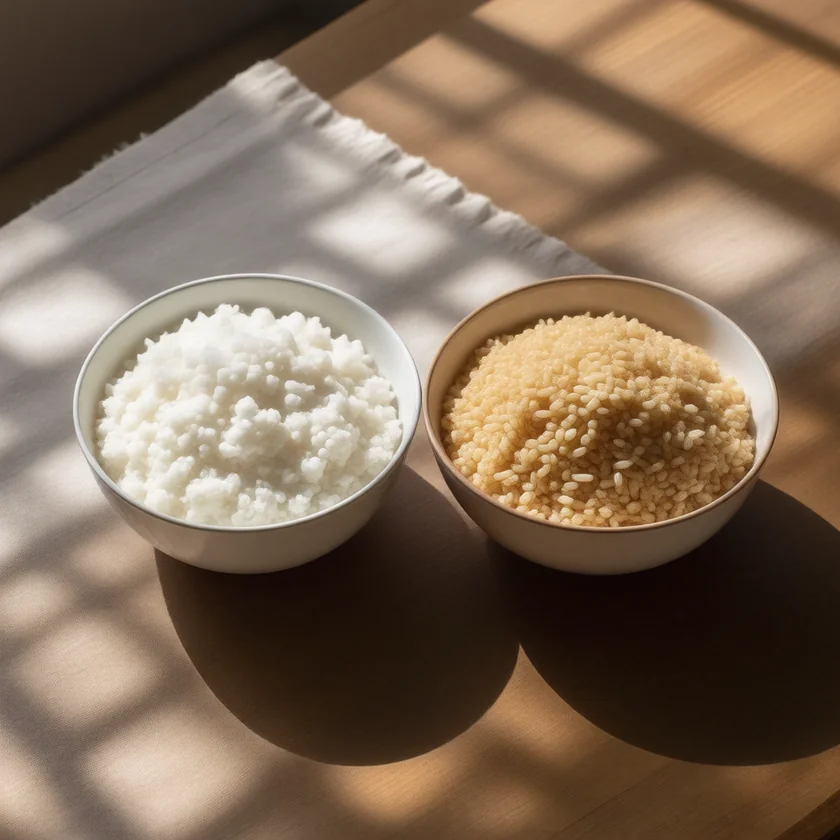
Somewhere in the middle of the 2010s a vegetable that had spent a century as a boiled side dish became a starch substitute, and the change was big enough to move acreage. Riced cauliflower, cauliflower pizza bases, cauliflower gnocchi and cauliflower mash went from home-cook improvisation to supermarket freezer staples in a few years. The question this page answers is not whether that is a fad — it plainly is not, it stuck — but whether it is a good trade. The short version: swapping cauliflower for white rice is a defensible move, swapping it for brown rice gives away a food with real long-term outcome evidence behind it, and the fibre claim that gets attached to the swap is only half true in a way worth understanding.
Table of Contents
- How Cauliflower Became a Starch Substitute
- The Numbers, Side by Side
- Fibre Per Calorie Versus Fibre Per Bowl
- What Brown Rice Brings That Cauliflower Does Not
- What the Low-Carbohydrate Evidence Actually Shows
- Volume, Energy Density and Why the Swap Works
- Where the Swap Is a Clear Win, and Where It Is Not
- Pizza Bases, Gnocchi and Mash: What the Ingredient List Shows
- Making Cauliflower Rice Well
- The Digestive Cost of a Big Bowl
- A Fair Conclusion
- Key Research Papers
- Connections
- Featured Videos
How Cauliflower Became a Starch Substitute
Cauliflower was well placed for this job long before anyone marketed it that way. It is bland, so it takes on whatever it is cooked with. Its texture, once broken down, is granular rather than stringy or slimy — unlike, say, courgette, which turns to water. It is pale, so it does not visually announce itself in a dish. And it holds together as a mash, a purée, a crumb or a crust. No other common vegetable does all four.
The technique began in home kitchens: grate a head on a box grater, or pulse it in a food processor, and you get something the size and shape of rice grains that can be dry-fried in a pan. It circulated in low-carbohydrate and grain-free cooking communities for years before industry noticed. What changed in the second half of the 2010s was availability — frozen and chilled pre-riced cauliflower appeared in mainstream supermarkets, and grocery-trade reporting through that period repeatedly described it as one of the fastest-growing categories in the produce aisle. Pizza bases, gnocchi, mash, tortillas and crusts followed as processors worked out how to bind it.
This is a genuine change in the commercial position of the crop, not just a change in recipes. A vegetable that had been sold as a whole head to be boiled acquired a second life as an ingredient sold by the bag, which is the sort of thing that shifts what growers plant. It belongs in cauliflower's history as much as its arrival from the eastern Mediterranean does.
The Numbers, Side by Side
Here is the comparison that drives the whole phenomenon. Approximate values for a cup of cooked medium-grain brown rice and a cup of raw riced cauliflower, from the USDA FoodData Central records for those two foods:
- Cooked medium-grain brown rice (about 195 grams): roughly 215–220 calories, about 45 grams of carbohydrate, about 3.5 grams of fibre, around 4–5 grams of protein, plus meaningful magnesium, manganese, selenium, phosphorus, niacin, thiamine and vitamin B6.
- Raw riced cauliflower (about 100–110 grams): roughly 25 calories, about 5 grams of carbohydrate, about 2 grams of fibre, about 2 grams of protein, plus roughly half a day's vitamin C, useful folate, potassium, and around 44 milligrams of choline.
Set out like that, the appeal is obvious. The swap removes roughly 190 calories and roughly 40 grams of carbohydrate from a meal, and it does so without removing anything from the plate — the bowl still looks full. For someone eating rice with dinner most nights, that is a substantial change in weekly energy intake achieved by a single substitution rather than by portion discipline.
What the comparison hides is that these are not two versions of the same food. They are a grain and a vegetable, and they are contributing different things. Reading the table as "cauliflower wins" requires deciding in advance that calories and carbohydrate are the only columns that matter.
Fibre Per Calorie Versus Fibre Per Bowl
The swap is routinely described as a higher-fibre one. That claim is true in one sense and false in another, and the distinction is worth getting right because fibre is one of the few nutrients with genuinely strong outcome evidence behind it.
Per calorie, cauliflower wins by a mile. Around 2 grams of fibre for 25 calories works out at roughly 8 grams of fibre per 100 calories. Brown rice delivers about 3.5 grams for 218 calories — roughly 1.6 grams per 100 calories. On the metric of "how much fibre am I getting for the energy I am spending", cauliflower is about five times better.
Per bowl, brown rice actually wins. A cup of cooked brown rice carries about 3.5 grams of fibre; a cup of riced cauliflower carries about 2. For someone aiming at a daily fibre target — and most people are well short of one — swapping a cup of brown rice for a cup of cauliflower rice moves the day’s fibre backwards by a gram and a half.
Both statements are true because they answer different questions. For reducing energy intake while keeping fibre up, the swap helps. For increasing fibre in absolute terms, it does not; eating the brown rice with cauliflower alongside it adds fibre instead.
The fibre is also of a different kind. Brown rice contributes largely insoluble bran fibre, which adds bulk and speeds transit. Cauliflower contributes a mix that includes more readily fermentable material — which feeds the colonic bacteria that produce short-chain fatty acids, and which also, honestly, is why a large bowl of it produces more gas than a bowl of rice does. That trade-off gets its own section below.
What Brown Rice Brings That Cauliflower Does Not
Cauliflower is not a nutritional downgrade in general — it brings vitamin C, folate, choline and glucosinolates that rice cannot match, all covered on our nutrients page. But the things it removes are real, and pretending otherwise is how people end up quietly worse off.
Minerals. Whole grains are a major dietary source of magnesium, manganese, selenium and phosphorus. Magnesium in particular is a nutrient large numbers of people fall short of, and brown rice is one of the more reliable everyday sources. Cauliflower carries small amounts of all of these and cannot substitute for them.
B vitamins. The bran and germ carry niacin, thiamine and vitamin B6. Removing them is exactly what refining does to white rice; removing the grain entirely removes them too.
Energy. Calories are a benefit for a great many people, not a cost. Older adults with poor appetite, people recovering from illness or surgery, anyone underweight, and anyone doing hard physical work all need food that carries energy in a manageable volume. For these groups, replacing a dense staple with a bulky low-calorie vegetable removes exactly what they need, yet the swap is often suggested to them regardless.
Prospective outcome evidence. This is the biggest item, and the one most often skipped. Whole grains have been studied in large cohorts followed for decades. Aune and colleagues' dose-response meta-analysis in the BMJ found whole grain intake associated with lower cardiovascular disease, cancer and all-cause mortality, with reductions in risk observed up to an intake of 210–225 grams a day (seven to seven and a half servings) for most of the outcomes. Reynolds and colleagues' series of systematic reviews in The Lancet reached the same conclusion from a different angle: dietary fibre and whole grain intake are the carbohydrate-quality measures that track health outcomes. Comparing the highest with the lowest fibre eaters, the observational data suggested a 15–30% decrease in all-cause and cardiovascular-related mortality and in coronary heart disease, stroke, type 2 diabetes and colorectal cancer, with risk reduction greatest when daily fibre intake was between 25 g and 29 g. And Sun and colleagues, following 39,765 men and 157,463 women in US cohorts, found white rice associated with higher type 2 diabetes risk (five or more servings a week against less than one a month: relative risk 1.17) and brown rice with lower risk (two or more servings a week: relative risk 0.89). They estimated that replacing 50 g a day of cooked white rice with the same amount of brown rice was associated with a 16% lower risk of type 2 diabetes.
There is no comparable body of evidence for cauliflower rice, and there cannot be yet — the food is barely a decade old at scale. That is not evidence against it. It does mean that displacing a food that does have that evidence gives up a known benefit for an unknown one.
What the Low-Carbohydrate Evidence Actually Shows
Cauliflower rice belongs to low-carbohydrate eating, so the honest question is what that approach has actually delivered when tested.
Randomised comparison: no clear winner. Gardner and colleagues' DIETFITS trial randomised 609 adults to a healthy low-fat or a healthy low-carbohydrate diet for twelve months, with substantial dietitian support on both arms. At a year, average weight loss was similar between the groups and the difference was not statistically significant: weight change was −5.3 kg on the healthy low-fat diet and −6.0 kg on the healthy low-carbohydrate diet (mean between-group difference 0.7 kg, 95% confidence interval −0.2 to 1.6 kg). The trial also tested whether a genotype pattern or baseline insulin secretion predicted who did better on which diet, and neither did. Notably, both arms were instructed to maximise vegetables and minimise refined grains and added sugar — so what the trial really compared was two versions of a whole-food diet, and they performed about the same.
Observational: the relationship is U-shaped, and the replacement matters. Seidelmann and colleagues analysed the ARIC cohort together with a meta-analysis of other prospective studies and found a U-shaped association between the percentage of energy from carbohydrate and mortality: risk was lowest in a middle band, at 50–55% of energy from carbohydrate, and higher at both the low and the high extremes. The finding that matters most here is the second one — what replaced the carbohydrate changed the direction of the association. Low-carbohydrate eating built on animal fat and protein tracked with higher mortality; low-carbohydrate eating built on plant fats and proteins tracked with lower mortality (pooled hazard ratio 1.18 when carbohydrate was exchanged for animal-derived fat or protein, and 0.82 when the substitutions were plant-based).
Read together, these say something useful and unglamorous. Cutting carbohydrate is not intrinsically good or bad; it depends entirely on what goes in its place, and the healthiest observed pattern is not an extreme one. Replacing rice with a vegetable is a plant-forward substitution, which puts it on the favourable side of Seidelmann's distinction. Replacing rice with more meat and cheese does not.
Volume, Energy Density and Why the Swap Works
There is a real mechanism underneath the cauliflower-rice phenomenon, and it is not about carbohydrate at all. It is about energy density — calories per gram of food.
People tend to eat a fairly consistent weight of food from meal to meal rather than a consistent number of calories. Lowering the calories per gram lowers total intake without reducing the amount of food. Blatt, Roe and Rolls demonstrated this directly: in a crossover study, 20 men and 21 women ate breakfast, lunch and dinner in the laboratory once a week for three weeks, with puréed vegetables covertly incorporated into familiar entrées to lower their energy density. Participants ate a consistent weight of food, so daily energy intake fell by 202 ± 60 kcal when the entrées were at 85% of their standard energy density and by 357 ± 47 kcal at 75%, while daily vegetable intake rose from 270 ± 17 g to 487 ± 25 g. Participants rated the entrées as similar in palatability across conditions, and their hunger and fullness ratings did not differ.
That is exactly what riced cauliflower does to a curry, a stir-fry or a burrito bowl. The plate looks the same, the eating experience is broadly the same, and the meal carries a fraction of the energy. It is a legitimate and well-supported strategy for anyone whose goal is to eat less without eating less food.
Two honest limits on it. First, low energy density can cut both ways: a meal that is very low in calories may leave you genuinely hungry sooner, and the calories often reappear later in the evening. A cauliflower-rice bowl usually needs adequate protein and fat alongside it to hold. Second, the strategy works because it is unobtrusive — and a bowl of plain, watery cauliflower rice is very obtrusive indeed. How well it is made is not a side issue; it is the condition for the strategy working at all.
Where the Swap Is a Clear Win, and Where It Is Not
Clear wins:
- Replacing white rice, white pasta or white bread. Refined grains have had the bran and germ stripped out, so you are giving up starch and little else. Sun and colleagues' finding that white rice tracks with higher diabetes risk while brown tracks with lower puts a number on that difference. Cauliflower against white rice is a straightforwardly favourable trade.
- Managing blood glucose. Around 5 grams of total carbohydrate in a cup of raw riced cauliflower against around 45 in a cup of cooked brown rice (both totals include fibre) is a large difference in post-meal glucose load. For anyone with type 2 diabetes, prediabetes or insulin resistance who wants to keep the shape and volume of familiar meals, this is a practical tool. See Insulin Resistance.
- Getting more vegetables in. If cauliflower rice means a serving of cruciferous vegetable four nights a week instead of none, that alone is a gain.
- Bulking, rather than replacing. Half brown rice, half cauliflower keeps the grain's minerals, B vitamins and bran fibre, and takes roughly half the energy out of the bowl.
Not a win:
- Replacing brown rice, oats, barley or other whole grains when the diet is otherwise sound. The trade gives up a food with decades of favourable cohort evidence for one with none yet, and loses magnesium, B vitamins and bran fibre in the process.
- For anyone who needs calories. Underweight adults, older people with poor appetite, people recovering from illness, and anyone doing heavy physical work are ill served by removing energy from the plate.
- For sensitive guts. Cauliflower is high in the polyol mannitol, and a whole cauliflower's worth in one bowl is a large dose of it. See the section below.
- As a licence. The calories saved on the rice do not create a budget for a larger portion of everything else. This is the most common way the swap quietly fails.
- On cost. Per calorie and per serving, riced cauliflower is far more expensive than a bag of brown rice. For anyone feeding a household on a tight budget this is not a small point.
Pizza Bases, Gnocchi and Mash: What the Ingredient List Shows
Riced cauliflower that you make yourself, or buy frozen with one ingredient on the bag, is a vegetable. The manufactured products that carry the word "cauliflower" on the front are a different proposition, and the only reliable way to know which one is in the basket is the back of the packet.
Cauliflower has almost no starch and almost no protein, which means it does not bind. To make a pizza base that holds a slice, or a gnocchi that survives boiling, a manufacturer has to add something that does: commonly rice flour, potato starch, tapioca starch, corn starch, or cheese and egg. Once those are in, the carbohydrate content of the finished product can approach that of the conventional version it is replacing — and the ingredient list will tell you, because ingredients are listed by weight.
What the label shows, in order of usefulness:
- Where cauliflower appears in the list. Because ingredients are listed by weight, cauliflower first means it is the main ingredient; third, behind two starches, means a starch product with cauliflower in it.
- The carbohydrate figure per serving, compared against the ordinary version. If it is not much lower, the product is not doing the low-carbohydrate job its packaging implies.
- The serving size the figures refer to, which for pizza bases and gnocchi is often smaller than a portion anyone actually eats.
None of this makes these products bad food. A cauliflower-and-rice-flour pizza base eaten with enthusiasm is a perfectly reasonable dinner. It is simply not the low-carbohydrate vegetable dish the packaging implies, and buying it under that impression is how people end up puzzled that nothing changed.
The same caution applies to the "cauliflower" snack products — crisps, puffs, crackers — that are largely starch with cauliflower powder added for the label.
Making Cauliflower Rice Well
Most people who dislike cauliflower rice have eaten a bad version of it: wet, grey and steamy, with a raw brassica smell. All of that is fixable, and the fixes are simple.
- Pulsing, not puréeing. Cooks pulse it in short bursts in a food processor, in small batches, until the pieces are the size of rice grains; running it continuously gives wet mush. A box grater on the coarse side works well and gives a better texture.
- Getting the water out. This is the whole game. Cauliflower is more than ninety percent water. Frozen riced cauliflower, thawed and squeezed hard in a clean tea towel, gives up a surprising amount.
- Dry-frying in a wide, hot pan. A big surface area lets steam escape instead of stewing the vegetable. Cooked hot and fast, in a single layer and moved only occasionally, it picks up some colour; five to eight minutes is usually enough.
- No lid and no added water. A lid traps steam and produces exactly the sulfurous, soggy result people complain about.
- Fat in the pan. Olive oil, butter or ghee carries flavour, improves browning, aids the absorption of the fat-soluble vitamin K, and makes the dish satisfying rather than austere.
- Generous seasoning. Cauliflower is bland by design, so it carries strong seasoning well: salt, garlic, ginger, cumin, mustard seed, lemon zest, herbs, a squeeze of lemon or a splash of fish sauce, toasted nuts or seeds on top. In an Indian register, whole cumin and mustard seed bloomed in the fat first is the obvious route — cauliflower has been cooked that way for two centuries.
- Mustard or horseradish somewhere in the dish. Both restore the myrosinase that cooking destroys, which meaningfully increases the isothiocyanates absorbed. Explained in full on the glucosinolates page.
- Half and half. Cooked brown rice mixed with dry-fried cauliflower rice is better than either alone: the grain gives structure, chew, minerals and bran fibre, the cauliflower cuts the energy density and adds a vegetable serving. In a 2018 randomised crossover test on 16 healthy volunteers, a meal of cooked cauliflower with cooked rice had a significantly lower glycaemic index (73) than rice alone, while the homogenised (blended) version did not differ significantly from rice; the authors concluded that unblended cooked vegetables in a rice meal could slow carbohydrate digestion and improve the blood-sugar response.
- The stem. The core rices perfectly well and is usually thrown out.
The Digestive Cost of a Big Bowl
There is a reason the swap makes some people feel dreadful, and it is not in their head.
Cauliflower is high in mannitol, a sugar alcohol that is poorly absorbed in the small intestine and passes into the colon, where it draws in water and is fermented by bacteria. Yao and colleagues measured the sorbitol and mannitol content of foods alongside absorption patterns in healthy people and in people with irritable bowel syndrome, and Muir and colleagues' analysis of short-chain carbohydrates in common vegetables provides the underlying composition data. Cauliflower sits among the higher-mannitol vegetables.
Portion is the other half of the story. A side serving of cauliflower is a few florets. A bowl of cauliflower rice replacing a bowl of rice is most of a small head — several times the mannitol dose, eaten in one sitting, several nights a week. Someone who tolerated cauliflower perfectly well as a side dish can find the same vegetable intolerable in this form, and reasonably conclude that something is wrong with them rather than with the portion size.
For people in that position, the usual adjustments are smaller portions, mixing half and half with a grain, cooking it thoroughly rather than eating it raw, and spreading it across the week rather than eating it nightly; smaller portions and grain mixing lower the mannitol dose in each meal. For people with irritable bowel syndrome, cauliflower is one of the vegetables a structured low-FODMAP elimination removes first. Our FODMAPs, goitrogens and tolerance page covers all of this properly, including how people test whether cauliflower is genuinely their trigger.
A Fair Conclusion
Cauliflower rice is a good food that has been oversold as a replacement and undersold as an addition.
It is an effective way to lower the energy density of a meal without shrinking it, and the mechanism behind that is well demonstrated. It is a straightforwardly good trade against refined grains. It gets a cruciferous vegetable into meals where none was. And it lets people who are managing blood glucose keep the shape of the food they actually like eating, which matters more for sticking with a diet than any macronutrient ratio does.
It is not nutritionally equivalent to a whole grain, and routinely displacing one gives up what the grain carries. Whole grains carry minerals, B vitamins and bran fibre that cauliflower does not, and they carry decades of prospective cohort evidence that cauliflower rice, a food barely ten years old at scale, cannot yet have. The evidence on carbohydrate restriction itself is more modest than the marketing: a year-long randomised trial found low-carbohydrate and low-fat approaches performed about the same when both were built on whole foods, and the best observational outcomes sit in the middle of the carbohydrate range rather than at the bottom of it.
So cauliflower rice earns its place as a decent way to eat more cauliflower, as a lighter dinner that is not a smaller one, and as a dish people enjoy. Against white rice it is a favourable trade at any frequency. Against brown rice it gives something up, and a bowl with both keeps the grain’s minerals, B vitamins and bran fibre while adding the vegetable. That is the version that keeps everything and gives up nothing.
Key Research Papers
- Gardner CD, Trepanowski JF, Del Gobbo LC, et al. Effect of low-fat vs low-carbohydrate diet on 12-month weight loss in overweight adults and the association with genotype pattern or insulin secretion: the DIETFITS randomized clinical trial. JAMA. 2018;319(7):667-679. — doi:10.1001/jama.2018.0245
- Seidelmann SB, Claggett B, Cheng S, et al. Dietary carbohydrate intake and mortality: a prospective cohort study and meta-analysis. The Lancet Public Health. 2018;3(9):e419-e428. — doi:10.1016/S2468-2667(18)30135-X
- Reynolds A, Mann J, Cummings J, Winter N, Mete E, Te Morenga L. Carbohydrate quality and human health: a series of systematic reviews and meta-analyses. The Lancet. 2019;393(10170):434-445. — doi:10.1016/S0140-6736(18)31809-9
- Aune D, Keum N, Giovannucci E, et al. Whole grain consumption and risk of cardiovascular disease, cancer, and all cause and cause specific mortality: systematic review and dose-response meta-analysis of prospective studies. BMJ. 2016;353:i2716. — doi:10.1136/bmj.i2716
- Sun Q, Spiegelman D, van Dam RM, et al. White rice, brown rice, and risk of type 2 diabetes in US men and women. Archives of Internal Medicine. 2010;170(11):961-969. — doi:10.1001/archinternmed.2010.109
- Blatt AD, Roe LS, Rolls BJ. Hidden vegetables: an effective strategy to reduce energy intake and increase vegetable intake in adults. The American Journal of Clinical Nutrition. 2011;93(4):756-763. — doi:10.3945/ajcn.110.009332
- Zhu R, Liu M, Han Y, et al. Acute effects of non-homogenised and homogenised vegetables added to rice-based meals on postprandial glycaemic responses and in vitro carbohydrate digestion. British Journal of Nutrition. 2018;120(9):1023-1033. — doi:10.1017/S0007114518002489
- Yao CK, Tan HL, van Langenberg DR, et al. Dietary sorbitol and mannitol: food content and distinct absorption patterns between healthy individuals and patients with irritable bowel syndrome. Journal of Human Nutrition and Dietetics. 2014;27(Suppl 2):263-275. — doi:10.1111/jhn.12144
- Muir JG, Rose R, Rosella O, et al. Measurement of short-chain carbohydrates in common Australian vegetables and fruits by high-performance liquid chromatography (HPLC). Journal of Agricultural and Food Chemistry. 2009;57(2):554-565. — doi:10.1021/jf802700e
- Zhang X, Shu XO, Xiang YB, et al. Cruciferous vegetable consumption is associated with a reduced risk of total and cardiovascular disease mortality. The American Journal of Clinical Nutrition. 2011;94(1):240-246. — doi:10.3945/ajcn.110.009340
- Higdon JV, Delage B, Williams DE, Dashwood RH. Cruciferous vegetables and human cancer risk: epidemiologic evidence and mechanistic basis. Pharmacological Research. 2007;55(3):224-236. — doi:10.1016/j.phrs.2007.01.009
- Wallace TC, Fulgoni VL. Assessment of total choline intakes in the United States. Journal of the American College of Nutrition. 2016;35(2):108-112. — doi:10.1080/07315724.2015.1080127
- Ahmed FA, Ali RFM. Bioactive compounds and antioxidant activity of fresh and processed white cauliflower. BioMed Research International. 2013;2013:367819. — doi:10.1155/2013/367819
PubMed Topic Searches
Connections
- Cauliflower — the main topic page.
- Cauliflower — Benefits Deep Dive — the hub for this set of articles.
- Cauliflower: History and Origins — including how the low-carbohydrate boom changed the crop.
- Cauliflower's Vitamin C, Vitamin K and Choline — what the vegetable brings to the bowl.
- Cauliflower Glucosinolates and Indoles — cooking method and what survives it.
- Cauliflower FODMAPs, Goitrogens and Tolerance — why a big bowl can backfire.
- Brown Rice — the whole grain this swap usually displaces.
- Insulin Resistance — where the glycaemic argument for the swap is strongest.
- Metabolic Syndrome — the wider cluster this sits inside.
- Diabetes — carbohydrate load and meal planning.
- Gut Health — fibre, fermentation and the colon.
- Broccoli — the other cruciferous vegetable worth rotating in.
- Cabbage — the cheapest member of the family by a distance.
- Longevity — where the whole-grain and carbohydrate-quality evidence points.