Resistant Starches: History and Discovery
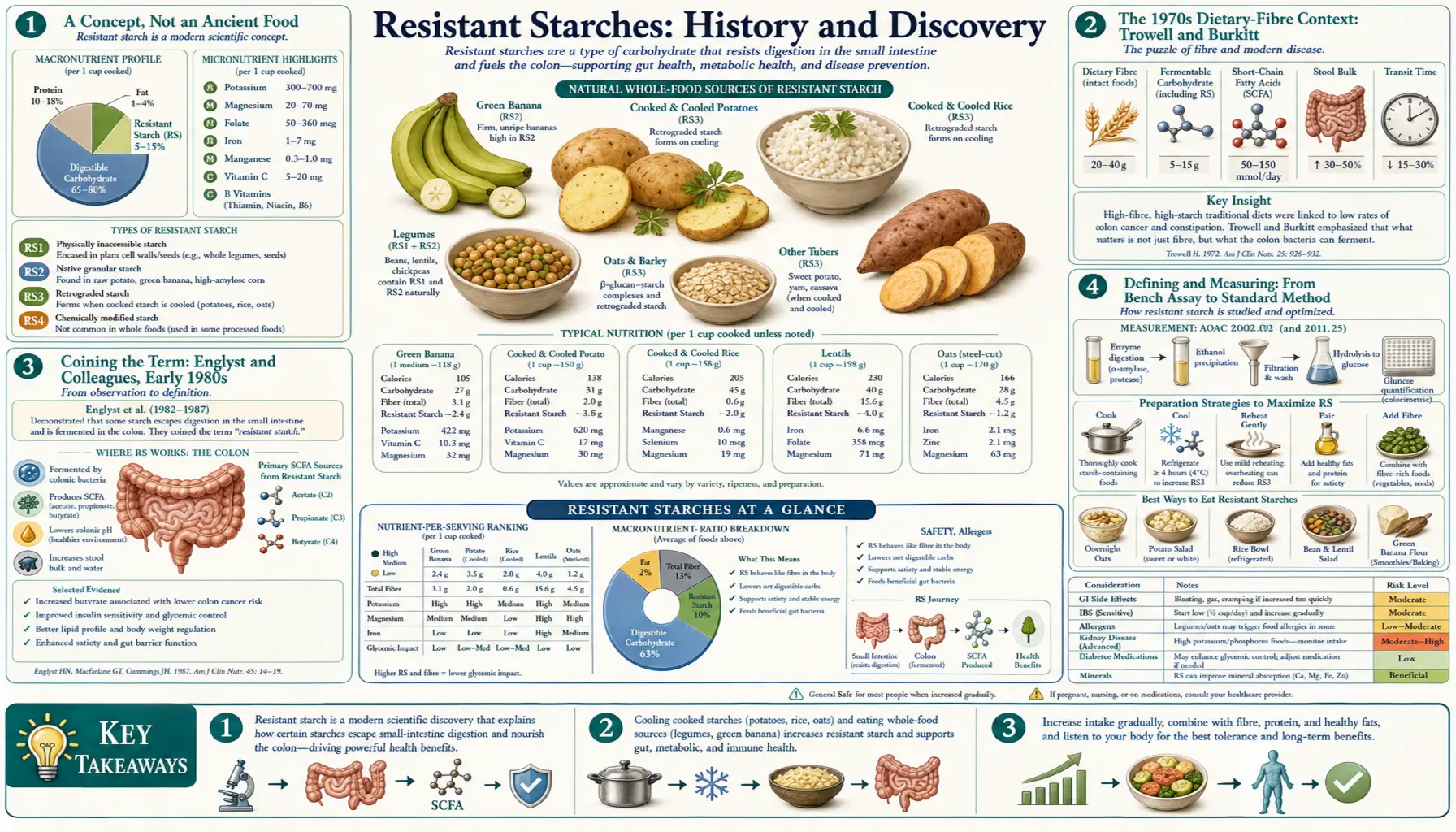
Resistant starch is not an ancient food with a folk origin — it is a scientific category with a traceable beginning in the laboratory. Unlike honey or garlic, nobody "discovered" resistant starch while cooking; it was defined into existence by nutrition scientists who were measuring dietary fibre and noticed that a portion of starch refused to be digested. The term itself was coined by the British researcher Hans Englyst and his colleagues in the early 1980s, and the concept was sharpened over the following decade by a Europe-wide research collaboration called EURESTA. This page tells that story honestly: the 1970s dietary-fibre research that set the stage, the precise moment the word "resistant starch" appeared, how the RS1–RS4 (and later RS5) classification took shape, and the discovery that this escaped starch is fermented in the colon into health-promoting short-chain fatty acids such as butyrate. Where dates or wording are firmly documented, we say so; where the historical record is approximate or contested, we name it as such.
Table of Contents
- A Concept, Not an Ancient Food
- The 1970s Dietary-Fibre Context: Trowell and Burkitt
- Coining the Term: Englyst and Colleagues, Early 1980s
- Defining and Measuring: From Bench Assay to Standard Method
- The RS1–RS4 Classification (and RS5)
- Colonic Fermentation and the Butyrate Connection
- EURESTA: A Europe-Wide Research Effort
- From Analytical Curiosity to Modern Prebiotic
- Research Papers and References
- Connections
- Featured Videos
A Concept, Not an Ancient Food
It is worth being clear from the start about what resistant starch is, because its history is unlike that of most foods on this site. Resistant starch (RS) is not a single ingredient or a traditional dish — it is the name for any starch that escapes digestion in the small intestine and passes into the large bowel largely intact. That definition is functional rather than botanical: the same potato can contain very little resistant starch when hot and freshly cooked, yet much more after it has been cooled. So "resistant starch" describes a behaviour of starch under digestion, not a substance you could have pointed to before the science existed to measure it.
This matters for the history. People have eaten foods rich in resistant starch — cooked-and-cooled potatoes, beans, lentils, slightly green bananas, whole grains — for as long as those foods have existed. But they had no concept of "resistant starch," because the very idea depends on knowing that a measurable fraction of starch survives the small intestine. That knowledge is recent. The story of resistant starch is therefore a story of analytical chemistry and human-nutrition research in the late twentieth century, with named scientists, datable papers, and a definition that was negotiated and refined — not a story of folklore.
Because of this, an honest history must resist the temptation to project the modern category backwards. We will not claim that any ancient culture "used" resistant starch deliberately. What we can document is precisely when and by whom the category was named, defined, classified, and connected to gut health — and that is the genuine discovery story told below.
The 1970s Dietary-Fibre Context: Trowell and Burkitt
Resistant starch was born out of the broader effort to understand dietary fibre. In its modern form, the "dietary fibre hypothesis" stems from the writing and lecturing of two British medical men in the early 1970s: the surgeon Denis Burkitt and the physician Hugh Trowell. Both had worked for much of their careers in East Africa, and both were struck by how rare certain "Western" diseases — large-bowel cancer, diverticular disease, diabetes, coronary heart disease — were in communities eating high-fibre, minimally processed diets. They proposed that a deficiency of dietary fibre was linked to this cluster of conditions, an idea that drew on earlier work by figures such as Peter Cleave, Neil Painter, and Alec Walker.
This hypothesis created urgent demand for a way to measure fibre accurately. Earlier methods captured fibre only crudely, and researchers wanted a definition grounded in chemistry. The answer that emerged in Britain was to define and measure dietary fibre as non-starch polysaccharides (NSP) — the plant-cell-wall carbohydrates such as cellulose and hemicelluloses, deliberately excluding starch, which was assumed to be fully digestible. To isolate the NSP, the assay first had to destroy all the starch in a sample using enzymes. It was inside this starch-removal step, while trying to get rid of starch so they could measure something else, that scientists ran into the surprising observation that launched the resistant-starch concept.
Coining the Term: Englyst and Colleagues, Early 1980s
The term resistant starch is credited to Hans (H. N.) Englyst and his co-workers, working in the United Kingdom on the measurement of dietary fibre. In 1982, Englyst, together with H. S. Wiggins and the gut-physiology researcher John H. Cummings, published a landmark method for determining non-starch polysaccharides in plant foods (in the journal Analyst). The procedure used enzymes — α-amylase together with pullulanase — to break down and remove starch before the remaining fibre was measured. The problem they kept encountering was that a portion of starch resisted this enzymatic removal: it would not fully break down, and it interfered with the fibre measurement.
That stubborn, enzyme-resistant fraction is what Englyst and colleagues named resistant starch — literally, the starch that resisted digestion in their assay. It is widely reported in the resistant-starch literature that the term was coined by Englyst and co-workers in the early 1980s (commonly cited as 1982) in exactly this context. So the word entered nutrition science almost as a by-product: it began as a technical nuisance in a fibre assay and only later became a category of interest in its own right.
Crucially, the in-vitro observation was soon backed by evidence from real human digestion. Studies in ileostomy volunteers — people whose small intestine has been surgically diverted to a stoma, so that what leaves the small bowel can be collected and analysed — confirmed that a measurable amount of starch genuinely escapes digestion in the human small intestine and would otherwise pass into the colon. This closed the loop: resistant starch was not merely an artefact of the laboratory method but a real feature of how humans digest starchy food.
Defining and Measuring: From Bench Assay to Standard Method
Once the phenomenon had a name, the next task was to define it rigorously and measure it reproducibly — and this occupied much of the late 1980s and early 1990s. A turning point was the 1992 paper by H. N. Englyst, S. M. Kingman, and J. H. Cummings, "Classification and Measurement of Nutritionally Important Starch Fractions," published in the European Journal of Clinical Nutrition. This work proposed dividing food starch, for nutritional purposes, into three behavioural classes: rapidly digestible starch (RDS), slowly digestible starch (SDS), and resistant starch (RS), and it described a controlled enzymatic method (using pancreatin and amyloglucosidase) to quantify each fraction.
What makes resistant starch unusual as a definition is that it is essentially physiological: RS is defined by what the body does — or fails to do — with the starch, not by a fixed chemical formula. The same physical starch can be classified as resistant or digestible depending on the food matrix, cooking, cooling, and processing. This is why the measurement methods are so central to the history: the definition of resistant starch is inseparable from the analytical assay used to determine it, and refining that assay was itself a major scientific project.
Because no government agency originally legislated the term, it fell to scientists to agree on a working definition. That agreement was reached, more than anywhere else, through the European collaboration discussed below, which settled on resistant starch as "the sum of starch and products of starch degradation not absorbed in the small intestine of healthy individuals." That sentence — deceptively simple — is the negotiated, consensus definition that underpins the field.
The RS1–RS4 Classification (and RS5)
As research deepened in the 1990s, it became clear that starch can resist digestion for several quite different reasons, so a classification was introduced that grouped resistant starch into types RS1 through RS4. This typology became the standard framework of the field and remains in use today:
RS1 is starch that is physically inaccessible to digestive enzymes — trapped within intact plant structures such as whole or coarsely milled grains, seeds, and legumes, where the food matrix shields it from attack. RS2 is starch that resists digestion because of its native granular and crystalline structure; classic examples are raw potato, green (unripe) banana, and high-amylose starches, whose tightly packed granules enzymes struggle to penetrate. RS3 is retrograded starch — starch that has been cooked (gelatinised) and then cooled, during which the starch molecules re-associate into a crystalline form that resists digestion. This is why cooked-and-cooled potatoes, rice, or pasta contain more resistant starch than the same foods served hot. RS4 is chemically modified starch, deliberately altered by industrial processes to resist enzymatic breakdown; it is engineered, not naturally occurring.
A fifth category, RS5, was added later to the literature to describe amylose–lipid complexes — starch that becomes resistant because it has formed helical structures bound to fatty acids or other lipids. RS5 is a more recent and still-evolving addition; the original and most widely cited scheme is the four-type RS1–RS4 framework. We present RS5 as a later extension rather than part of the founding classification, in keeping with how the field itself developed.
Colonic Fermentation and the Butyrate Connection
The reason resistant starch became genuinely exciting — rather than just a measurement headache — is what happens to it after it escapes the small intestine. Resistant starch reaches the large intestine (colon), where the resident gut bacteria ferment it. This fermentation produces gases and, most importantly, short-chain fatty acids (SCFAs) — principally acetate, propionate, and butyrate. In this respect resistant starch behaves much like dietary fibre, feeding the colonic microbes rather than the host directly.
Among these short-chain fatty acids, butyrate drew particular attention, and it remains the headline finding of resistant-starch physiology. Butyrate is the preferred energy source for the colonocytes — the cells lining the colon — and it is associated with maintaining the integrity of the gut lining and with a normal, healthy cell phenotype in the colon. A frequently cited observation is that resistant starch tends to yield proportionally more butyrate than many other fermentable fibres, which is a large part of why it became a focus of gut-health research. The short-chain fatty acids are typically produced in an approximate molar ratio of acetate, propionate, and butyrate around 60:20:20.
A comprehensive 2001 review by David Topping and Peter Clifton in Physiological Reviews consolidated much of this understanding, examining the roles of resistant starch and non-starch polysaccharides in producing short-chain fatty acids and supporting human colonic function. It is important to be measured here: establishing that resistant starch produces butyrate, and that butyrate fuels colonocytes, is well supported; translating that into firm claims about preventing specific diseases is an active research area where evidence is still developing. The history is clear that the butyrate mechanism is what transformed resistant starch from an analytical category into a topic of nutritional interest.
EURESTA: A Europe-Wide Research Effort
The single most important organising force in the early history of resistant starch was EURESTA — the European RESistant STarch research group, formally the European FLAIR Concerted Action No. 11 on the "physiological implications of the consumption of resistant starch in man." FLAIR was a European Commission research programme (Food-Linked Agro-Industrial Research), and the EURESTA concerted action ran from July 1990 until June 1994. It brought together scientists from roughly 40 research groups across 11 European countries — spanning universities, research institutes, and industry — to study resistant starch in a coordinated way.
EURESTA mattered because it did what no single laboratory could: it forged consensus. It was within EURESTA that the working definition of resistant starch — "the sum of starch and products of starch degradation not absorbed in the small intestine of healthy individuals" — was agreed (associated with N.-G. Asp, 1992), giving the whole field a shared starting point. The group held plenary meetings, including a well-documented second plenary meeting in Crete in 1991, whose proceedings were published in the European Journal of Clinical Nutrition. EURESTA also helped standardise measurement approaches and pooled physiological data on how resistant starch behaves in the human body.
This is a clear example of resistant starch’s history being institutional and collaborative rather than the work of a lone discoverer. The term traces to Englyst and colleagues; the definition, classification framework, and physiological consensus were hammered out across the late 1980s and early 1990s by a community of researchers, with EURESTA as the central forum. That collaborative origin is part of what makes resistant starch a genuine scientific category with a documented paper trail.
From Analytical Curiosity to Modern Prebiotic
From the late 1990s onward, resistant starch shifted from a specialist analytical topic into a mainstream subject in nutrition, food science, and gut-microbiome research. Once it was understood that resistant starch reaches the colon and feeds beneficial bacteria, it fit naturally into the developing concept of a prebiotic — a food component that selectively nourishes helpful gut microbes and supports their growth and activity. Interest grew further as the gut microbiome itself became a major research frontier, and resistant starch was studied as a way to increase butyrate production and shape the microbial community of the colon.
This modern phase also drove practical developments: food technologists worked on high-amylose crops and on manufactured resistant-starch ingredients (including the chemically modified RS4 type) so that resistant starch could be added to everyday foods such as breads and flours without changing them too much. Food-labelling and dietary-fibre definitions in various countries gradually came to grapple with whether and how resistant starch should count as fibre — a direct echo of its origins inside the fibre-measurement problem decades earlier.
The detailed, up-to-date evidence on resistant starch — its effects on blood sugar, satiety, the microbiome, and metabolic health, plus food sources and practical guidance — is covered on the main Resistant Starches page and the Resistant Starches Benefits articles. This history has done its job once one thing is clear: resistant starch is a defined scientific category with a real, traceable origin — coined by Englyst and colleagues, classified into RS1–RS4, linked to colonic butyrate production, and consolidated by EURESTA — not an ancient food dressed up in modern language.
Research Papers and References
The list below combines the foundational peer-reviewed papers behind the resistant-starch concept with curated PubMed topic-search links and reputable reference sources. Author names, titles, and journals are given as plain text; only the stable DOI, PMID, or archive link is hyperlinked, and each opens in a new tab. Where a precise identifier is given, the claim it supports is one we were able to cross-check against multiple sources; broader narrative points (such as the early-1980s coining of the term) are drawn from review literature and are described as such in the article.
- Englyst H, Wiggins HS, Cummings JH. Determination of the non-starch polysaccharides in plant foods by gas-liquid chromatography of constituent sugars as alditol acetates. Analyst. 1982;107(1272):307-318. — doi:10.1039/an9820700307 · PMID: 6283946
- Englyst HN, Kingman SM, Cummings JH. Classification and measurement of nutritionally important starch fractions. European Journal of Clinical Nutrition. 1992;46 Suppl 2:S33-S50. — PMID: 1330528
- Asp NG. Resistant starch — Proceedings from the second plenary meeting of EURESTA: European FLAIR Concerted Action No. 11 on physiological implications of the consumption of resistant starch in man. European Journal of Clinical Nutrition. 1992;46 Suppl 2:S1. — PMID: 1330526
- Topping DL, Clifton PM. Short-chain fatty acids and human colonic function: roles of resistant starch and nonstarch polysaccharides. Physiological Reviews. 2001;81(3):1031-1064. — doi:10.1152/physrev.2001.81.3.1031 · PMID: 11427691
- Nugent AP. Health properties of resistant starch. Nutrition Bulletin. 2005;30(1):27-54. — doi:10.1111/j.1467-3010.2005.00481.x
- Cummings JH, Macfarlane GT. The control and consequences of bacterial fermentation in the human colon. Journal of Applied Bacteriology. 1991;70(6):443-459. — doi:10.1111/j.1365-2672.1991.tb02739.x · PMID: 1938669
- Cummings JH, Englyst HN. Measurement of starch fermentation in the human large intestine. Canadian Journal of Physiology and Pharmacology. 1991;69(1):121-129. — doi:10.1139/y91-018 Search PubMed
- O'Keefe SJD. Denis Burkitt and the origins of the dietary fibre hypothesis. Nutrition Research Reviews. 2017;30(1):1-7. — doi:10.1017/S0954422417000117 · PMID: 28583217
- Resistant starch — definition, history, and classification (RS1–RS4, RS5) PubMed: resistant starch classification (RS1–RS4)
- Resistant starch, colonic fermentation, and butyrate production PubMed: resistant starch butyrate and short-chain fatty acids
- EURESTA and the European measurement and definition of resistant starch PubMed: EURESTA resistant starch (Englyst, measurement)
External Authoritative Resources
- Resistant starch (definition, RS1–RS5 classification, fermentation) — Wikipedia
- Meet the Molecules: Resistant Starch — John Innes Centre
- PubMed — All research on resistant starch
Connections
- All Food
- Resistant Starches
- Resistant Starches Benefits
- Oats
- Fermented Foods
- Probiotics
- Gut Health & Gastroenterology