Raspberries: History and Origins
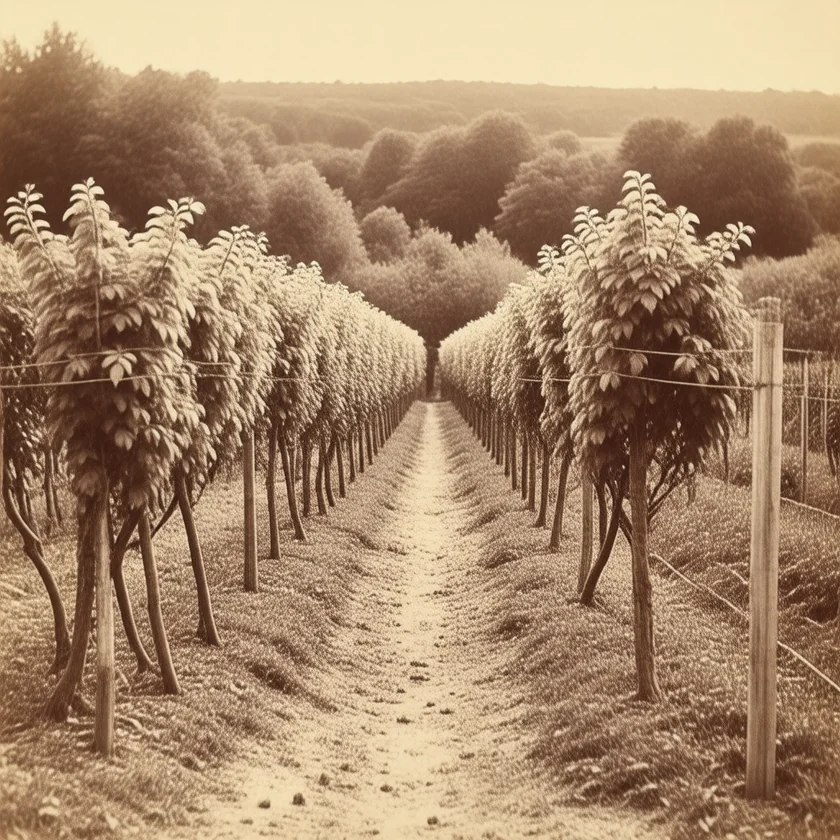
The raspberry is one of the youngest of the old fruits. People were eating it long before anyone farmed anything — its seeds lie in the mud beneath Stone Age lake villages in Switzerland — yet it was barely a garden plant until the sixteenth century, and it did not become a serious crop until the nineteenth. In between, Pliny the Elder gave it the name it still carries: Rubus idaeus, the bramble of Mount Ida. Almost everything that makes the modern raspberry modern — the big, firm berry, the autumn-fruiting cane, the plant that shrugs off aphids — was bred in the last hundred years at three research stations in England, Scotland and upstate New York, and the world crop is now led by Russia and Mexico rather than by any country that wrote its history. This page follows the documented record; where a claim is legend, a disputed etymology or a story that outgrew its evidence, it is labelled as such.
Table of Contents
- A Berry of the Cold North: The Wild Species
- Seeds in the Mud: The Prehistoric Record
- Mount Ida and the Name Idaeus
- Raspis, Hindberry, Framboise: The English Name
- From Hedgerow to Garden: Turner to the Antwerps
- Raspberry Leaf and the Midwives
- America: Two Native Raspberries and the Cuthbert
- The Breeders’ Century: East Malling, Dundee and Geneva
- Ellagitannins: The Berry in the Laboratory
- Raspberries Today
- Key Research Papers
- Connections
- Featured Videos
A Berry of the Cold North: The Wild Species
Unlike the apple or the banana, the raspberry has no single, faraway homeland that a botanist can point to on a map. The red raspberry, Rubus idaeus, is a plant of the cool northern forests, and it was already spread across most of them before people took any interest in it. In its wild state it grows in woodland clearings, on burnt ground and along forest edges from Britain across northern and central Europe and on through Siberia; in the warmer, southern parts of that range it retreats up into the mountains. It is a coloniser — one of the first shrubs to appear after a fire or a felling — and it spreads by underground suckers as readily as by seed.
North America has a red raspberry of its own. The American red raspberry is so close to the European plant that botanists have never quite agreed what to call it: some treat it as a subspecies, Rubus idaeus subsp. strigosus, others as a separate species, Rubus strigosus. The two probably diverged from a common ancestor fairly recently in evolutionary terms; the American plant has gland-tipped hairs on its young canes and the European plant does not, and that is about the size of the difference. Its range runs from Alaska across Canada to Newfoundland and south through the mountains to North Carolina and northern Mexico. This matters for the later story, because the raspberries grown commercially today, even in Europe, are largely descended from crosses between the two.
Eastern North America also has a quite different raspberry: the black raspberry or blackcap, Rubus occidentalis, native from New Brunswick west to Nebraska and south to Mississippi. It is not a dark form of the red raspberry but a distinct species with arching canes that root at their tips rather than suckering, and a fruit that pulls free of its core like a red raspberry but is purple-black and firmer. It has its own history on this page, and it is kept apart from the red raspberry throughout.
What does the genetic evidence say about where the cultivated raspberry came from? Honestly, less than for most crops. Raspberry has had full genome sequences only recently — the black raspberry in 2016 and a chromosome-level assembly of the red raspberry in 2022 — and those papers were written to help breeders, not to reconstruct domestication. What they confirm is the picture above: a Eurasian red raspberry, an American red raspberry that is its very near relative, and a distinct American black raspberry, with the modern crop drawing on all three. There is no equivalent of the apple’s Tian Shan here, because there was no single place where a wild plant was turned into a crop. The raspberry was simply picked, everywhere it grew, for a very long time.
Seeds in the Mud: The Prehistoric Record
The oldest direct evidence that people ate raspberries comes from an accident of preservation. A raspberry is mostly water and pulp, which rot, but each of its little drupelets holds a hard seed, and hard seeds survive when they fall into waterlogged mud where oxygen cannot reach them. In the 1850s and 1860s, when the water levels of Swiss lakes fell and the remains of prehistoric pile-dwellings were found along their shores, archaeologists digging in the old lake-bottom — the “relic-bed” — found exactly that kind of deposit.
Ferdinand Keller’s reports on the lake dwellings, published in English translation in 1866, describe raspberry seeds again and again. At Robenhausen, on the former Lake Pfäffikon, the excavators listed “the seeds of raspberries, strawberries, elderberries, and blackberries” alongside stores of apples, beech-nuts and water-chestnuts. At Wangen on Lake Constance they found “the seeds of raspberries and brambleberries” among hazel-nut shells and crab-apple pips and judged them “the refuse of the colonists’ feasts.” The botanist Oswald Heer, who identified the plant remains, was careful about contamination from the modern shore: ancient seeds, he noted, had lost their inner contents and were hollow shells, and no one had managed to germinate one. His list of the lake-dwellers’ fruits reads like a hedgerow forage — crab-apple, sloe, wild strawberry, bilberry, elder — with Rubus idaeus among them. The Neolithic settlements at Robenhausen and Wangen are today dated by radiocarbon and by tree-ring counts on their timber piles to roughly the fourth millennium BCE; Keller’s generation, working before either method existed, could say only “the Stone Age.”
The important point is what these finds are not. They are not evidence of cultivation. Wild raspberries grow in exactly the disturbed, cleared ground that a village creates, and the lake-dwellers were gathering them as they gathered everything else the forest offered. That is the raspberry’s prehistoric role across its whole northern range: a gathered fruit — in the words of Kim Hummer’s 2010 review of Rubus through history, “a food and medicinal source for native peoples soon after the Ice Age” — and it stayed one for the next five thousand years.
Mount Ida and the Name Idaeus
The Greeks and Romans knew the raspberry, but as a wild plant and a medicine, not a crop. The Greek and Roman agricultural writers — Cato, Varro, Virgil, Columella — say a great deal about grapes, figs and tree fruits and nothing about raspberries. The one classical author who describes the plant clearly is Pliny the Elder, in the Natural History he finished shortly before his death in the eruption of Vesuvius in 79 CE.
Pliny mentions it twice. In Book 16, discussing brambles, he lists a third kind “known to the Greeks as the Idaean bramble, from the place where it grows: it is slighter than the others, with smaller thorns, and not so hooked.” In Book 24, on the medicinal uses of plants, he returns to it: “The Idaean bramble is so called from the fact that it is the only plant of the kind found growing upon Mount Ida. It is of a more delicate nature than the others, and smaller; the canes too are thinner, and not so prickly: it mostly grows beneath the shade of trees.” Its flower, mixed with honey, was applied to sore eyes and the skin infection erysipelas, and an infusion of it in water was given for “affections of the stomach.” Anyone who has seen a raspberry cane beside a blackberry cane will recognise the description.
Which Mount Ida? There were two in the Greek world: Mount Ida in the Troad, above Troy in what is now north-western Turkey, and Mount Ida on Crete, where Zeus was said to have been hidden as an infant. Pliny does not say, and the ancient sources give no way to decide. Most modern reference works favour the Trojan Ida, on the grounds that wild raspberries are common on its slopes and rare on Crete, but the honest answer is that the name records a Greek belief about where the plant was found, not a botanist’s survey. Pliny’s “only plant of the kind found growing upon Mount Ida” is in any case plainly wrong — it grew across half of Europe — and tells us only how a Mediterranean people met a northern plant: on a cool, wooded mountain, as an exception.
When Carl Linnaeus formalised plant names in Species Plantarum in 1753 he took Pliny’s epithet and made it permanent: Rubus idaeus, “the bramble of Ida.” Every red raspberry on earth has carried a Roman’s guess about a Greek mountain ever since.
A legend, told as legend. A story often repeated in garden writing has it that raspberries were once white, and that the nymph Ida — one of the nurses of the infant Zeus on Crete — pricked her finger on the thorns while picking them for him, staining the berries red for ever. It explains both the name and the colour, which is what such tales are for, and there is no ancient source for it. Ida the nurse of Zeus does appear in classical mythology — in Apollodorus, Hyginus and Diodorus Siculus — but none of those authors mentions a berry, a thorn or a drop of blood. The story is a modern embroidery on Pliny’s place-name, and it should be enjoyed as one.
Raspis, Hindberry, Framboise: The English Name
The older English name for the fruit was hindberry, “the deer’s berry,” and the same idea survives in the German Himbeere. The word raspberry is much newer and its origin is genuinely uncertain. The first element appears in the 1530s as raspis, spelt a dozen ways — raspas, raspice, raspys, rasbes — and for a while it was used loosely of other soft fruits too. One suggestion is that raspis was originally the name of a sweetish red wine, raspise, and that the berry took the wine’s name because it was used to flavour or colour it; the popular explanation that the berry is “rasp-like” because its surface is rough is folk etymology, invented after the fact. The compound raspberry is first found in print at the start of the seventeenth century.
The herbalist John Gerard caught all three names at once. His Herball, first published in 1597 and enlarged by Thomas Johnson in 1633, treats the raspberry in the chapter on brambles: “The Raspis is called in Greeke batos idaia: in Latin Rubus idaeus, of the mountaine Ida on which it groweth: in English, Raspis, Framboise, and Hinde-berry.” Framboise, the French name, was evidently current in English gardens too. Gerard also recorded something that tells us how new the plant was as a crop: “The Raspis is planted in gardens: it groweth not wilde that I know of, except in the field by a village in Lancashire called Harwood, not far from Blackeburne.” Johnson, correcting him, added that he had found it growing wild among the bushes of a causeway near Nantwich in Cheshire, “where I went to schoole.” In the England of 1600, in other words, a botanist could know the raspberry chiefly as a garden plant and be surprised to meet it wild.
Gerard’s medical notes are second-hand from the ancients — “the fruit is good to be giuen to those that haue weake and queasie stomackes” is Pliny’s stomach remedy, fifteen centuries on. That is tradition being copied, and it should be read as such.
From Hedgerow to Garden: Turner to the Antwerps
The best short history of the raspberry’s slow move into the garden was written a century ago by U. P. Hedrick, the pomologist at the New York State Agricultural Experiment Station at Geneva, in The Small Fruits of New York (1925). Hedrick went looking for the first records of cultivation and was struck by how late they were. Palladius, a Roman writer on farming of the fourth century, “is credited with naming the raspberry as one of the garden plants of his time” — Hedrick’s careful phrasing, and it is as far as the evidence goes. After that the silence is long. Charlemagne’s famous list of the plants to be grown on his estates, drawn up around 800 CE, names dozens of fruits and vegetables and omits the raspberry. The Forme of Cury, the English royal cookbook of about 1390, does not use it.
Hedrick’s candidate for the first unambiguous record of cultivation is William Turner, the “father of English botany,” who wrote of raspberries in 1548 that “they growe in certayne gardines in Englande.” Seventy years later William Lawson’s A New Orchard and Garden (1618) pictured raspberries and currants edging the garden paths. And in 1629 John Parkinson, apothecary to James I, gave the raspberry the first full chapter it had ever had, at the very front of the fruit section of his Paradisi in Sole Paradisus Terrestris. Parkinson knew two sorts, “white and red, not differing in the forme either of bush, leafe, or berry, but onely in the colour and taste of the fruit,” thought the white “a little more pleasant then the red,” and mentioned a third “whose stemme and branches are wholly without prickles” — a thornless raspberry three centuries before breeders set out to make one. He recorded the fruit eaten fresh “in the Summer time, as an afternoones dish,” made into conserve and syrup, and distilled into a cordial water, and passed on with open scepticism a rumour that the vintners’ cheap red wine was really made from raspberries.
For the next century and a half almost nothing changed. Batty Langley’s Pomona of 1729 knew “but three Kinds of Rasberries in England, viz. The White, the Red, and the Purple.” Mawe and Abercrombie’s Universal Gardener of 1778 listed four, one of them a “twice-bearing red, and white Raspberry, producing the first crop of fruit in July, and the second in September” that was “esteemed a curiosity” — the earliest clear reference to what growers now call a primocane-fruiting raspberry, one that fruits on the current year’s canes. Named varieties in the modern sense arrive only in the early nineteenth century, and the first to matter were the Red Antwerp and White (or Yellow) Antwerp, illustrated in George Brookshaw’s Pomona Britannica in 1817. Even then Brookshaw damned the fruit with faint praise — “their smell is more grateful than their taste” — and said it was grown for jam, syrup, wine, and to flavour brandy and vinegar. When the Horticultural Society of London catalogued every fruit variety it could find in 1826, it managed twenty-three raspberries.
Hedrick drew the obvious conclusion. Compared with the apple, pear or grape, which had thousands of years of selection behind them, Rubus idaeus “has received the attention of gardeners but a short time, and its evolution has not gone far.” He meant it as encouragement.
Raspberry Leaf and the Midwives
One thread of raspberry history runs not through the fruit but the leaf. The ancient and Renaissance herbals used raspberry and bramble leaves, which are rich in tannins, as an astringent — a gargle for a sore mouth, a wash for wounds, a remedy for diarrhoea — and Hummer’s 2010 review traces that use from Dioscorides through the Anglo-Saxon Leechbook of Bald to the modern herbals. The specific tradition of raspberry leaf tea in pregnancy, drunk in the last weeks to “tone the womb” and ease labour, is a good deal harder to date. It is often called ancient; the written record that can actually be checked is much more recent. This site’s Red Raspberry Leaf page covers the herb itself; what belongs here is the history of the claim and of its testing.
By the early twentieth century the belief was widespread enough in Britain to reach the medical journals. In 1941 the British Medical Journal published a short paper by Beckwith Whitehouse titled “Fragarine: an inhibitor of uterine action,” reporting that an extract of raspberry leaves relaxed strips of uterine muscle in the laboratory — an attempt to find a pharmacological basis for what midwives and mothers were already doing. It is the oldest study that the modern systematic reviews are able to include.
The only randomised trial came sixty years later. Simpson and colleagues, in Sydney, gave 192 first-time mothers either raspberry leaf tablets (1.2 g twice daily) or a placebo from 32 weeks of pregnancy until birth and published the result in 2001. Raspberry leaf caused no harm to mother or baby, but “contrary to popular belief, did not shorten the first stage of labor.” The second stage was on average 9.6 minutes shorter and forceps deliveries were less frequent (19.3 per cent against 30.4 per cent), differences the authors described as clinically interesting but which did not reach statistical significance in a trial of that size. A 2009 review by Holst, Haavik and Nordeng concluded that the lack of evidence on both safety and efficacy made recommending it to pregnant women “questionable,” and a 2021 systematic review by Bowman and colleagues, which found thirteen usable studies published between 1941 and 2016, judged the evidence base “weak.” That is where the science stands: a genuine folk tradition, a real but modest laboratory effect on smooth muscle, and one under-powered human trial. The tradition is recorded here as tradition, not as proof.
America: Two Native Raspberries and the Cuthbert
When Europeans reached North America they found both native raspberries already in use. The red raspberry, the US Forest Service’s species review notes, “was traditionally an important food of many Native American peoples,” eaten fresh and dried for winter, with the fruit, root bark and stems used in medicinal preparations; the black raspberry was among the wild fruits the early settlers of the Atlantic seaboard described with delight. Neither was cultivated, for the simple reason Hedrick gives: “Wherever its culture could have succeeded the native plant runs riot in waste places.”
The first American record of raspberries for sale is a 1771 list from the nursery of William Prince at Flushing Landing, New York, offering a White, an English Red and an American Red; a Large Canada was added by 1790. The so-called English Red, renamed Common Red by Prince’s son in 1832, turned out to be a native from the Catskills, and by then about a hundred acres of Long Island grew it for the New York market and for raspberry brandy. Alongside it the imported Antwerps set the standard for quality, and a Philadelphia physician, William D. Brincklé, spent the middle decades of the century breeding European-type reds — his ‘Orange’ was a commercial variety for years — which, Hedrick argued, taught American breeders to insist on flavour even as they turned to the hardier native species.
The variety that finally married the two came, as so many did, by accident. ‘Cuthbert’ “was found as a chance seedling by Thomas Cuthbert in his garden at Riverdale, now a part of New York City, about 1865,” near a bed of Hudson River Antwerp, of which it was assumed to be a seedling. It was not widely distributed until about 1880, was added to the American Pomological Society’s recommended list in 1881, and then dominated American raspberry growing for half a century. Hedrick thought its vigour showed native blood, and later breeders used it for decades as a parent.
The black raspberry’s domestication ran on a separate track and is even younger. The first named variety was the ‘Ohio Everbearing’, found wild by the Cincinnati pomologist Nicholas Longworth when cholera drove him into the Ohio interior in the autumn of 1832; it was an autumn-fruiting curiosity that never caught on. The real start, Hedrick says, came in 1850 “not by the introduction of a superior fruit but by the discovery of a better method of propagation”: H. H. Doolittle of Oaks Corners, New York, noticed that blackcap canes root where their tips touch the ground, copied nature, and began selling plants by the thousand. Black raspberries did not become a real industry until the 1880s, when western New York started drying them for sale and planted several thousand acres. The crop later moved west; the Willamette Valley of Oregon is its centre today, and most of what is grown there is still a single old cultivar, ‘Munger’.
The Breeders’ Century: East Malling, Dundee and Geneva
Until the 1920s every raspberry variety in existence was a chance seedling or a gardener’s selection. The plant that growers now take for granted — large, firm, bright, disease-resistant, cropping when the market wants it — was made deliberately, in three places.
East Malling, Kent. The East Malling Research Station, founded in 1913 and best known for its numbered apple rootstocks, began systematic raspberry breeding in 1922 under Norman Grubb, who reported the first twelve years of the programme in 1935. Its cultivars took the station’s name — the ‘Malling’ raspberries, of which ‘Malling Jewel’ is still grown — and set the pattern for the century: cross the best European reds with the American red raspberry and its hybrids, and select for size, firmness and yield. The programme’s later great theme, under Elizabeth Keep, was resistance. The large raspberry aphid Amphorophora idaei spreads the viruses that wear a plantation out, and breeding raspberries the aphid will not colonise proved more durable than spraying it; the East Malling resistance gene A1 was still being mapped by the station’s scientists in 2007. Keep also reviewed, in 1988, the state of primocane (autumn-fruiting) breeding, the second great theme of the period, and the East Malling autumn cultivar ‘Autumn Bliss’ that is widely credited to her programme became a garden standard.
Dundee, Scotland. At the Scottish Horticultural Research Institute at Invergowrie, outside Dundee, Derek Jennings built from the 1960s the programme that produced the ‘Glen’ raspberries — ‘Glen Clova’, then ‘Glen Moy’ and ‘Glen Prosen’, and, after his time, ‘Glen Ample’. Jennings’s particular contribution was the spine-free cane. Wild and old raspberries are bristly, and a picker’s forearms show it; Jennings worked out the genetics of spinelessness, including its awkwardly variable inheritance from a spine-free mutant of the American cultivar ‘Willamette’, and bred it into commercial varieties. Anyone who has picked a modern raspberry without being scratched is in his debt. His 1988 book Raspberries and Blackberries: Their Breeding, Diseases and Growth remains the standard account of the whole subject.
Geneva, New York. The station where Hedrick had written his history produced the single most influential raspberry of the twentieth century. In 1969 Donald Ourecky announced ‘Heritage’, “a new fall bearing red raspberry,” in the journal of the American Pomological Society. Autumn-fruiting raspberries had existed since Mawe and Abercrombie’s “curiosity” of 1778, but they had always been thin, small-fruited and late. ‘Heritage’ fruited heavily on its first-year canes, with firm, good-sized berries, and it changed the way raspberries could be grown: cut every cane to the ground each winter, and a plantation needs no trellis, no cane-thinning and no winter protection, and it crops in late summer and autumn when the summer varieties are finished. Primocane raspberries have been a large share of world production ever since, and ‘Heritage’ is in the ancestry of a great many of them.
Ellagitannins: The Berry in the Laboratory
For most of its history the raspberry was valued as a flavour and a folk remedy, and Hummer’s 2010 review is a catalogue of what people believed it did: Greek and Roman decoctions of the branches for diarrhoea and snakebite, leaves chewed to strengthen the gums, flowers in oil for inflamed eyes, and the whole plant pressed into service by Chinese, Ayurvedic and Native American medicine. Around the turn of the twenty-first century the berry acquired a new kind of attention, and it came from an unexpected direction.
Chemists measuring the polyphenols in fruit found that raspberries — red and black — are unusually rich in ellagitannins, large tannin molecules that release ellagic acid in the gut, and in the anthocyanin pigments that colour them. At Ohio State University, Gary Stoner’s group began feeding freeze-dried black raspberries to laboratory animals exposed to chemical carcinogens and reported, through the 1990s and 2000s, that the berry powder reduced the number of tumours in the oesophagus and colon. A 2007 review by Stoner and colleagues summarised that work; small human pilot studies followed, and a 2016 review by Kresty, Mallery and Stoner took stock of the black raspberry’s cancer trials “past, present and future.”
Two things about this episode belong in a history rather than a health claim. First, it was the black raspberry, the eastern American species with the Ohio and Oregon industry, that carried the research, largely because it was the berry to hand; the results do not transfer automatically to the red raspberry in the supermarket. Second, the human evidence remains preliminary — small trials, surrogate markers, no outcome data — and the researchers themselves say so. What the episode changed was not medicine but the raspberry’s reputation, which moved in the public mind from jam fruit to “superfood.” The compounds themselves are discussed on this site’s Ellagic Acid and Anthocyanins pages.
Raspberries Today
The raspberry is still a small crop by the standards of the great fruits — the world grows roughly a hundred apples for every raspberry by weight — but it has become a global one, and the map of who grows it would have astonished Hedrick. The Food and Agriculture Organization’s figures for 2023 put world production at about 941,000 tonnes. Russia led with about 219,000 tonnes, close to a quarter of the total, most of it from smallholdings and gardens rather than commercial farms. Mexico was second with about 190,000 tonnes, followed by Serbia (about 99,000), Poland (about 96,000) and the United States (about 63,000). Britain, which wrote most of the raspberry’s early history, is not in the top rank.
Those countries grow the same fruit for quite different markets. Serbia and Poland are the heart of the frozen raspberry trade: their crops are picked in the summer, frozen individually within hours, and exported by the container-load to the food industry across Europe, where they become yoghurt, jam, juice and the raspberry in a supermarket dessert. The Serbian district of Arilje built a whole regional economy on it. Freezing, along with jam, is the old answer to the raspberry’s central problem: it is among the most perishable of all fruits, a hollow cup of soft drupelets that moulds within days of picking. Jam and syrup were how Parkinson’s England used the fruit; the freezer is their industrial descendant.
Mexico’s rise is the newest chapter, and it is about the fresh berry. Its climate allows raspberries to be picked through the northern winter, and from October to May roughly 96 per cent of the fresh raspberries imported into the United States now come from Mexico. That trade rests on a business model that is itself a historical novelty. Where ‘Cuthbert’ and ‘Heritage’ were public varieties that anyone could plant, the fresh-market berry trade is now led by large marketing companies that breed their own proprietary cultivars, keep the plants under licence, and supply growers on contract — so that the raspberry on a winter breakfast table may belong to a variety with no public name, bred for firmness, size, shelf-life and year-round supply.
And the wild plant is exactly where it always was. Walk into a forest clearing in July anywhere from Scotland to Siberia, or from Maine to the Rockies, and the first shrub on the burnt or felled ground will very likely be a raspberry — the same berry whose seeds the lake-dwellers dropped into the water at Robenhausen more than five thousand years ago.
Key Research Papers
Peer-reviewed sources for the botanical, breeding and medical sections, followed by the two historical books behind the classical, herbal and American material; Pliny, Gerard and Parkinson are named in the text. Every DOI and PMID was checked against Crossref or PubMed before publication.
- Hummer KE (2010). Rubus Pharmacology: Antiquity to the Present. HortScience. — doi:10.21273/HORTSCI.45.11.1587
- Davik J, Røen D, Lysøe E, Buti M, et al. (2022). A chromosome-level genome sequence assembly of the red raspberry (Rubus idaeus L.). PLOS ONE. — doi:10.1371/journal.pone.0265096
- VanBuren R, Bryant D, Bushakra JM, Vining KJ, et al. (2016). The genome of black raspberry (Rubus occidentalis). The Plant Journal. — doi:10.1111/tpj.13215
- Foster TM, Bassil NV, Dossett M, Leigh Worthington M, Graham J (2019). Genetic and genomic resources for Rubus breeding: a roadmap for the future. Horticulture Research. — doi:10.1038/s41438-019-0199-2
- Grubb NH (1935). Raspberry Breeding at East Malling, 1922–34. Journal of Pomology and Horticultural Science. — doi:10.1080/03683621.1935.11513447
- Ourecky DK (1969). Heritage, A New Fall Bearing Red Raspberry. Journal of the American Pomological Society. — doi:10.71318/apom.1969.23.4.78
- Keep E (1988). Primocane (autumn)-fruiting raspberries: a review with particular reference to progress in breeding. Journal of Horticultural Science. — doi:10.1080/14620316.1988.11515821
- Jennings DL, Dale A, Carmichael E (1976). Raspberry and Blackberry Breeding at the Scottish Horticultural Research Institute. Acta Horticulturae. — doi:10.17660/ActaHortic.1976.60.17
- Jennings DL, Brydon E (1990). Variable inheritance of spinelessness in progenies of a mutant of the red raspberry cv. Willamette. Euphytica. — doi:10.1007/BF00057620
- Sargent DJ, Fernández-Fernández F, Rys A, Knight VH, Simpson DW (2007). Mapping of A1 conferring resistance to the aphid Amphorophora idaei and dw (dwarfing habit) in red raspberry (Rubus idaeus L.) using AFLP and microsatellite markers. BMC Plant Biology. — doi:10.1186/1471-2229-7-15
- Whitehouse B (1941). Fragarine: An Inhibitor of Uterine Action. BMJ. — doi:10.1136/bmj.2.4210.370
- Simpson M, Parsons M, Greenwood J, Wade K (2001). Raspberry leaf in pregnancy: its safety and efficacy in labor. Journal of Midwifery & Women’s Health. — PubMed PMID: 11370690
- Holst L, Haavik S, Nordeng H (2009). Raspberry leaf – should it be recommended to pregnant women? Complementary Therapies in Clinical Practice. — PubMed PMID: 19880082
- Bowman R, Taylor J, Muggleton S, Davis D (2021). Biophysical effects, safety and efficacy of raspberry leaf use in pregnancy: a systematic integrative review. BMC Complementary Medicine and Therapies. — PubMed PMID: 33563275
- Stoner GD, Wang LS, Zikri N, Chen T, et al. (2007). Cancer prevention with freeze-dried berries and berry components. Seminars in Cancer Biology. — PubMed PMID: 17574861
- Kresty LA, Mallery SR, Stoner GD (2016). Black raspberries in cancer clinical trials: Past, present and future. Journal of Berry Research. — doi:10.3233/JBR-160125
- Hedrick UP (1925). The Small Fruits of New York. New York State Agricultural Experiment Station, Geneva. (Book — the history of raspberry cultivation in Europe and America, and the varietal entry for ‘Cuthbert’.) — Internet Archive
- Keller F (1866). The Lake Dwellings of Switzerland and Other Parts of Europe, translated by J. E. Lee, with the botanical appendix by Oswald Heer. (Book — the raspberry seeds at Robenhausen and Wangen.) — Internet Archive
PubMed Topic Searches
- PubMed: Raspberry domestication and origin
- PubMed: Raspberry archaeobotany
- PubMed: Raspberry leaf in pregnancy and labour
- PubMed: Black raspberry chemoprevention research
External Authoritative Resources
- Pliny the Elder, Natural History 24.75, “The Idaean Bramble” (Bostock & Riley translation, Perseus Digital Library)
- US Forest Service Fire Effects Information System — Rubus idaeus, American red raspberry (range, ecology and traditional uses)
- FAOSTAT — world raspberry production by country and year
- Agricultural Marketing Resource Center — Raspberries (US production, imports and exports)
- Gerard’s Herball, 1633 edition (Internet Archive) — the chapter on brambles and the raspis