Grapes: Pesticides and the Choking Hazard
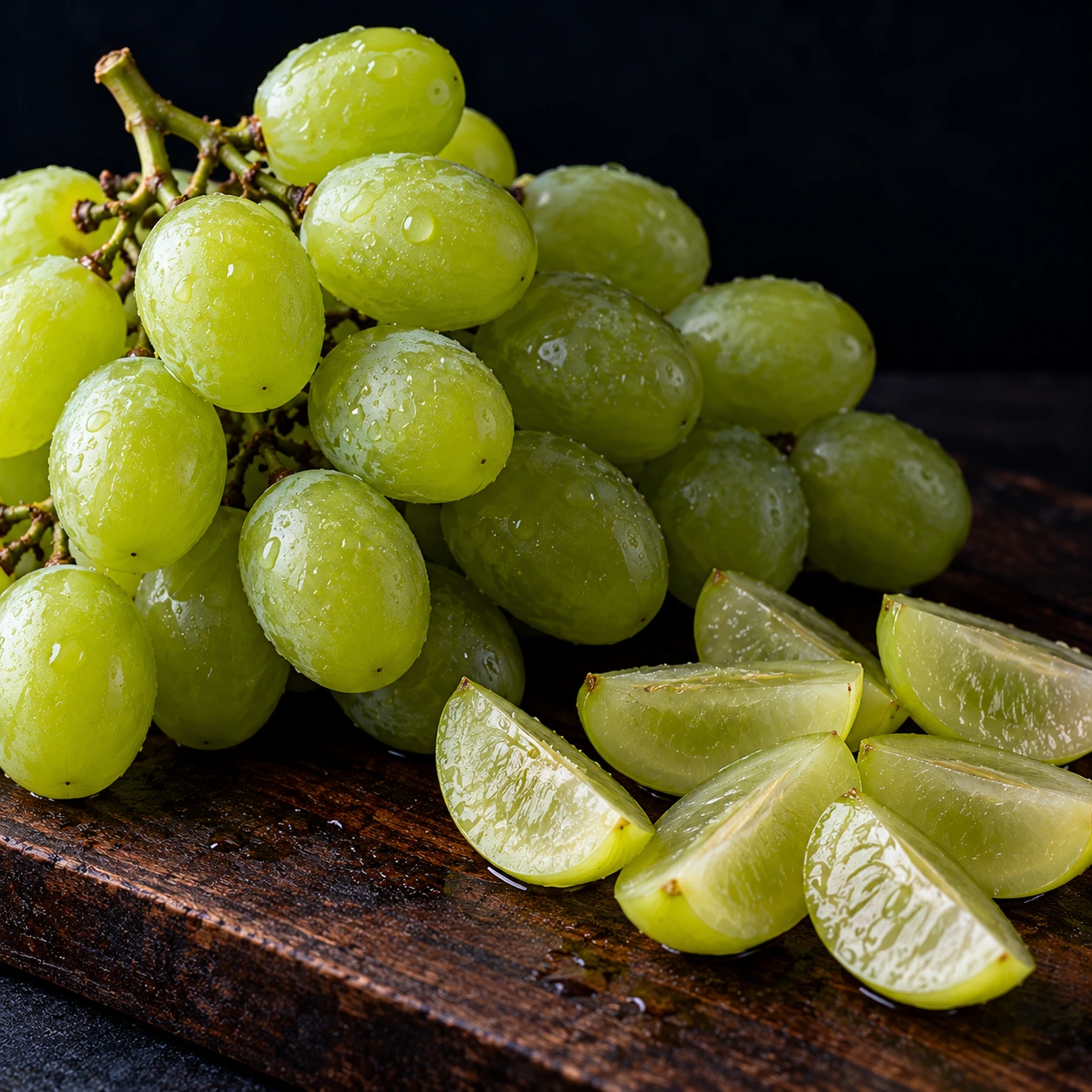
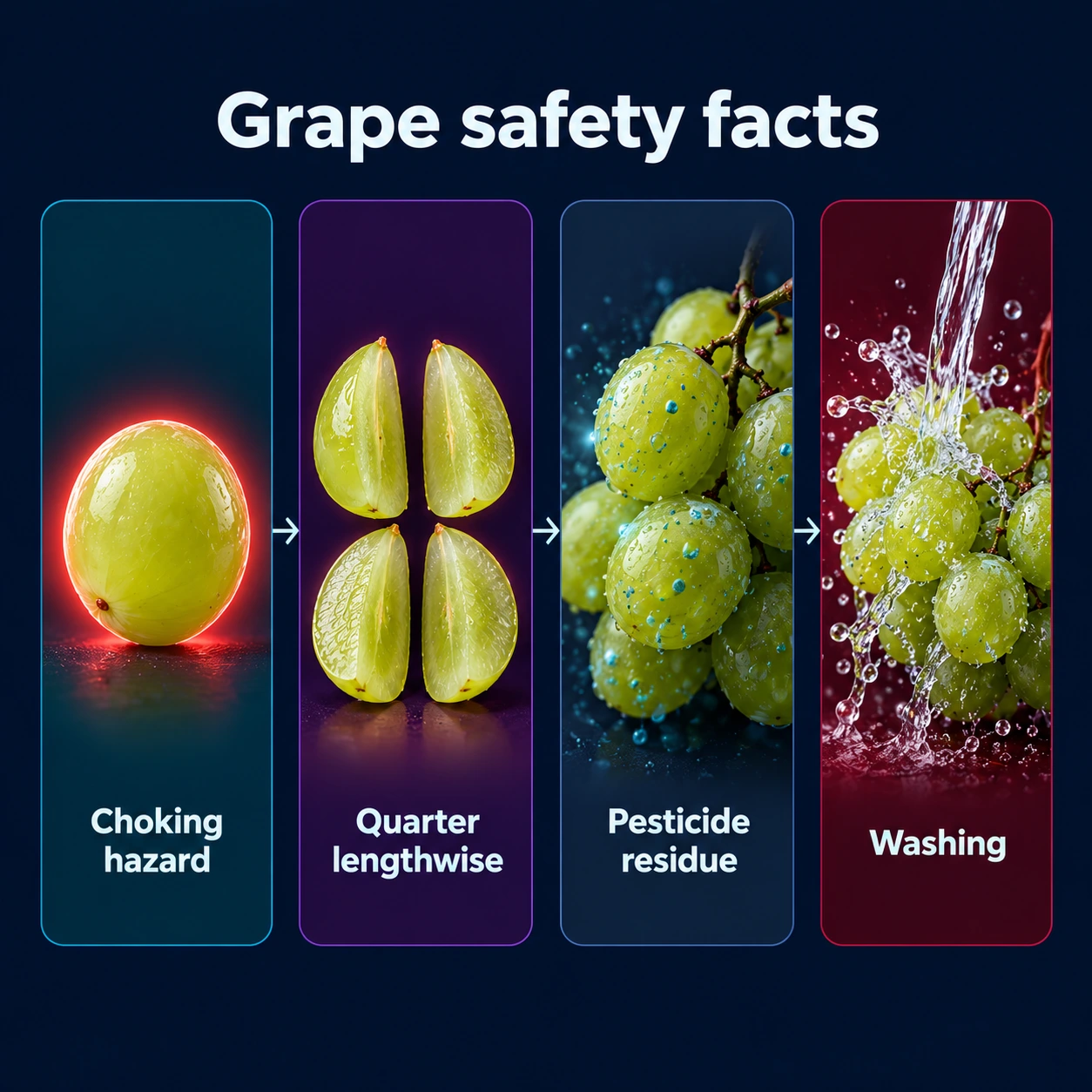

Two safety questions come up about grapes, and they are wildly mismatched in how much attention each gets and how much each deserves. The one people worry about is pesticide residue — grapes appear year after year on a widely publicised list of the most contaminated produce, and that list has been the subject of serious peer-reviewed criticism that almost nobody reads alongside it. The one people rarely think about is the choking hazard a whole grape poses to a small child, which is a documented cause of paediatric death, has a fix that takes three seconds, and, as the paediatric literature below notes, is not widely known. This page gives both a fair hearing, and it puts the urgent one first.
Table of Contents
- Why a Grape Is the Worst Possible Shape
- What the Paediatric Record Shows
- Quartering Lengthwise Removes the Round Shape
- Other Foods With the Same Shape
- Grapes and a Widely Publicised Pesticide-Residue Ranking
- What the Peer-Reviewed Critiques Found
- How Much Buying Organic Changes Residue Exposure
- How the Estimated Benefits Compare With the Estimated Risks
- Washing: What Works and What Does Not
- Grapes Are Genuinely Dangerous to Dogs
- Other Practical Cautions
- Key Research Papers
- Connections
- Featured Videos
Why a Grape Is the Worst Possible Shape
A young child's airway is narrow — roughly the diameter of their own little finger — and it is not a rigid tube. Children under about five also have immature chewing and swallowing coordination, few or no molars for grinding, and a strong tendency to talk, laugh, run and be startled while eating. Any object that can reach the larynx before being chewed can lodge there.
A whole grape is close to the worst-case object, and it is worth spelling out why, because the reasons also identify every other food on the same list.
- It is almost exactly the right size. A grape is comparable in diameter to a small child's airway. Slightly smaller and it would pass; slightly larger and it could not enter.
- It is round, so it seals. An irregular object leaves gaps that air can move through. A sphere in a cylinder forms a complete plug, and no air moves at all.
- It is smooth and slippery. The waxy skin means it slides past the tongue and into the throat before a child registers that it has not been chewed.
- It is soft and compressible — which makes it worse, not better. This is the counter-intuitive part. A firm object may sit loosely; a soft one deforms to the shape of the airway, wedges itself in and forms a tighter seal. Its softness also makes it far harder to dislodge with back blows or abdominal thrusts, and difficult for a clinician to grasp with forceps.
Deaths from choking are a major cause of childhood mortality, especially in the very young, and as the Aberdeen emergency physicians who wrote about this put it, whole grapes are "ideally suited to cause paediatric airway obstruction".
What the Paediatric Record Shows
This is not a theoretical risk raised by cautious people. It is documented in the clinical literature and in national paediatric guidance.
Lumsden and Cooper, emergency physicians at Aberdeen Royal Infirmary, published a short paper in Archives of Disease in Childhood in 2017 under the title "The choking hazard of grapes: a plea for awareness". They described three children who presented to their department after grape aspiration, and their central observation was not about the mechanism — which is obvious once stated — but about awareness. Although grapes are regularly implicated in paediatric choking, they wrote, knowledge that this popular fruit and other similarly shaped foods pose a choking hazard is not widespread. They argued for wider dissemination among health professionals working with children. The fact that a case report in a major paediatric journal was needed to make this point tells you how far the message has travelled.
The American Academy of Pediatrics, through its Committee on Injury, Violence, and Poison Prevention, published a policy statement on the prevention of choking among children in Pediatrics in 2010, which sets out the food characteristics that make choking likely — round, cylindrical, compressible, smooth, slippery — and names the specific foods that combine them. Grapes and hot dogs are the archetypes. The statement opens by noting that choking is a leading cause of illness and death among children, “especially those aged 3 years or younger,” and that food, coins and toys are the primary causes of choking-related injury and death. Canadian paediatric guidance, summarised by Cyr in Paediatrics & Child Health in 2012, makes the same points about prevention.
The consistent theme across all of it is that this is a preventable injury, and that the prevention is trivial.
Quartering Lengthwise Removes the Round Shape
The preparation rule given for small children is specific.
For children under about five, the guidance is to cut grapes lengthwise into quarters — not crosswise into discs.
The direction of the cut is the entire point and it is the part people get wrong. A grape sliced crosswise gives round discs, which are still circular in cross-section and can still form a seal. A grape cut lengthwise, twice, gives pieces that are each a long thin wedge with no round profile in any orientation. A wedge cannot plug a tube.
Further points:
- Halving lengthwise is better than nothing but is not enough for the youngest children. A lengthwise half of a large grape can still be wide enough to obstruct a toddler's airway. Quarters are the standard advice.
- The same applies to cherry and grape tomatoes, which have identical geometry, and to mozzarella balls, olives and large blueberries.
- Guidance generally extends to about age five. Children develop molars and safe chewing at different rates, and there is no cost to continuing longer.
- Supervision and sitting still are part of the guidance. Most choking incidents involve a child eating while moving, playing, laughing or lying down; the usual guidance is for a child to eat sitting up, at a table, with an adult present.
- The information matters for everyone who feeds the child. Grandparents, childminders, nursery staff, older siblings, party hosts. This information does not spread on its own — that was the whole point of the Aberdeen paper.
- Removing the skin does not remove the hazard. A peeled grape is more slippery, not less dangerous; it is the cut that changes the shape.
The Canadian Paediatric Society statement says paediatric health care providers should be encouraging parents and other caregivers to learn cardiopulmonary resuscitation (CPR) and choking first aid. Paediatric choking first aid — back blows and chest or abdominal thrusts appropriate to the child's age — is taught in hands-on courses rather than learned from a web page, this one included. A soft, wedged grape is notoriously difficult to dislodge, which is another reason prevention is so much better than response.
Other Foods With the Same Shape
The same pattern — round, smooth, compressible, airway-sized — identifies the other hazards. The commonly named ones for young children are:
- Whole grapes, cherry tomatoes, cherries, large berries and olives — commonly quartered lengthwise, with stones removed.
- Hot dogs and sausages — the classic worst case, a compressible cylinder of exactly airway diameter. Usually cut lengthwise first, then into small pieces.
- Whole nuts — hard, irregular, impossible for a child without molars to grind. Commonly kept from children under about four; nut butters spread thinly are the usual alternative.
- Raw carrot rounds, apple chunks and other hard raw pieces — usually grated, cooked until soft, or cut into thin strips rather than coins.
- Popcorn, hard sweets, chewing gum and marshmallows — generally listed as unsuitable for the youngest children.
- Large blobs of thick nut butter — can adhere to the palate and throat; the usual guidance is to spread it thinly rather than give it by the spoonful.
None of this is a reason to keep fruit away from children. Grapes are a good food for a child, and cut correctly they are entirely safe. The point is that the preparation is what makes them safe.
Grapes and a Widely Publicised Pesticide-Residue Ranking
Now to the question that gets far more attention.
Each year a US environmental advocacy group publishes an annual pesticide-residue ranking of fruits and vegetables, naming the twelve it ranks worst and the fifteen it ranks cleanest. Grapes have appeared among its worst twelve consistently for many years, and imported table grapes typically rank among the produce items with the largest number of distinct residues detected.
That basic fact is not in dispute, and it deserves to be stated plainly rather than dismissed. Table grapes are a high-input crop. Vines are vulnerable to powdery mildew, downy mildew, botrytis bunch rot, mealybugs, mites and leafhoppers, so vineyards are sprayed repeatedly through a season. The fruit has a thin, waxy, absorbent skin, it is not peeled before eating, and its tight clusters trap spray residue in places that are hard to rinse. Multi-residue testing of table grapes routinely detects several different fungicides and insecticides on a single sample.
The advocacy group draws its data from a legitimate source: the U.S. Department of Agriculture (USDA) Pesticide Data Program, a large annual federal residue-monitoring programme whose results are public. Where the disagreement lies is not in the measurements but in what the ranking means and what it implies for shoppers.
What the Peer-Reviewed Critiques Found
The most-cited scientific analysis of that ranking is Winter and Katz, published in the Journal of Toxicology in 2011. It is worth walking through carefully, because it is quantitative and because its findings are rarely reported alongside the list itself.
The authors took the same U.S. Department of Agriculture Pesticide Data Program data and did something the ranking does not do: they calculated actual consumer exposure, using probabilistic modelling of how much of each commodity people eat, and compared it with the chronic reference dose for each pesticide — the daily exposure a regulator considers to carry no appreciable risk over a lifetime, itself set with large safety factors below the level where no effect is seen in animal studies. They ran this for the ten most frequently detected residues on each of the twelve commodities, giving 120 estimates.
Their results:
- All 120 exposure estimates were well below the chronic reference dose.
- Only one of the 120 exceeded 1% of the reference dose — methamidophos on bell peppers, at 2%.
- Only seven estimates (5.8%) exceeded even 0.1% of the reference dose.
- Three quarters of the combinations came in below 0.01% of the reference dose — which the authors note corresponds to exposures a million times below the levels at which no adverse effect is observed in animal toxicology studies.
- Over 40% were below 0.001% of the reference dose.
Their three conclusions were that exposures to the most commonly detected pesticides on these twelve commodities pose negligible risk to consumers; that substituting organic forms of the twelve for conventional forms does not appreciably reduce consumer risk; and — the sharpest of the three — that the methodology used to rank commodities by pesticide risk "lacks scientific credibility".
The methodological objection is the substantive one. The ranking is built largely on the frequency and number of residues detected, not on how toxic each residue is or how much of it is present. Detection technology has improved enormously; instruments now find residues at parts per billion that were invisible twenty years ago. A food can therefore rise up such a ranking because six different compounds were each detected at a thousandth of the level of regulatory concern, while a food with one residue closer to the limit ranks lower. Winter developed this argument further in the International Journal of Food Contamination in 2015, examining chronic dietary pesticide exposure across the American diet.
Two points stand on the other side. Reference doses are set one compound at a time, and the question of cumulative exposure to mixtures is a real and unresolved area of regulatory science — European regulators have been developing cumulative risk assessment methods for exactly this reason, and the annual European Food Safety Authority (EFSA) reports on pesticide residues in food discuss it. And people with occupational or residential exposure to agricultural spraying face an entirely different situation from a shopper eating a bunch of grapes; nothing here applies to farmworker exposure, which is a genuine and serious public-health issue in its own right. The site’s page on pesticides covers that wider picture.
How Much Buying Organic Changes Residue Exposure
The reviews point to a partial effect, smaller than most people expect.
Smith-Spangler and colleagues published a systematic review in Annals of Internal Medicine in 2012 asking whether organic foods are safer or healthier than conventional alternatives. On residues, the risk of contamination with detectable pesticide residues was lower among organic than conventional produce (risk difference, 30%), but differences in the risk of exceeding maximum allowed limits were small, and two studies reported significantly lower urinary pesticide levels among children eating organic rather than conventional diets. On nutrients, the review found little difference of consequence. On health outcomes, the evidence was insufficient to show that eating organic makes people healthier — which is not the same as showing it does not, but is where the evidence stood.
A 2019 US study measured exposure directly. In four families (16 children and adults, 158 urine samples), urinary levels of thirteen pesticide metabolites and parent compounds fell significantly after the families switched to an organic diet. The greatest reductions were for clothianidin (−82.7%), malathion dicarboxylic acid, a breakdown product of malathion (−95.0%), and 3,5,6-trichlor-2-pyridinol, a breakdown product of chlorpyrifos (−60.7%). The study measured urinary pesticide levels, not health outcomes.
Three points make this less decisive than it sounds:
- Organic farming uses pesticides too — approved substances of natural origin, including copper compounds, sulfur, spinosad and pyrethrins. "Organic" means a different list of permitted inputs, not an absence of pest control. Copper fungicide, heavily used in organic viticulture, accumulates in soil and is not benign.
- If conventional exposure is already three to six orders of magnitude below the level of concern, reducing it further has little room to matter, which is precisely what Winter and Katz argued.
- Cost matters, and it is a health variable. If organic grapes cost three times as much and the result is that a family buys less fruit, the substitution has made things worse rather than better.
The research summarised here does not support treating conventional grapes as dangerous. The reasons people give for choosing organic that have nothing to do with their own residue exposure — farmworker safety, water contamination, soil biology, biodiversity — stand on their own merits.
How the Estimated Benefits Compare With the Estimated Risks
One study puts the whole question in proportion better than any other. Reiss and colleagues, writing in Food and Chemical Toxicology in 2012, asked a directly practical question: if half the US population ate one more serving of fruit and one more of vegetables per day, how many cancer cases would be prevented — and how many might theoretically be caused by the extra pesticide residue that came with them?
They estimated the prevention side from a published meta-analysis of nutritional epidemiology, and the risk side using U.S. Environmental Protection Agency (EPA) methods, cancer potency estimates from rodent bioassays and U.S. Department of Agriculture residue sampling data. Their answer: approximately 20,000 cancer cases per year prevented, against up to 10 cancer cases per year potentially caused by the added pesticide intake.
The authors were candid about the uncertainties — residual confounding in observational fruit-and-vegetable epidemiology is a well-known problem, and extrapolating human cancer risk from high-dose rodent bioassays is contested in both directions. But the ratio here is not marginal. It is roughly two thousand to one, and no plausible correction to either estimate reverses the direction.
Reiss and colleagues concluded that the overwhelming difference between the benefit and risk estimates “provides confidence that consumers should not be concerned about cancer risks from consuming conventionally-grown fruits and vegetables.” On their estimates, the health risk of not eating the fruit is far larger than the health risk of the residue on it.
Washing: What Works and What Does Not
Washing matters mostly for reasons that have nothing to do with pesticides — dirt, handling, and the bacterial contamination that causes real and immediate illness.
- Rinsing under cold running water while rubbing the fruit by hand is the standard method. The mechanical action does most of the work, and it applies equally to organic grapes and to fruit that will be peeled.
- A short soak helps with clusters. Grapes are awkward because the fruit sits tightly packed on the stem. A few minutes in a bowl of water, agitated, then a rinse, reaches more surface than a quick pass under the tap.
- Baking soda solution has some evidence behind it for removing certain surface residues from produce, and is cheap and harmless; a thorough plain-water rinse usually follows. In a 2017 laboratory study on apples, a baking soda (sodium bicarbonate) solution removed surface residues of the pesticides thiabendazole and phosmet more effectively than tap water or a bleach solution; at 10 mg/mL it took 12 and 15 minutes, respectively, to remove them completely.
- Washing removes surface residue, not systemic residue. Some pesticides are taken up into the plant and distributed through its tissue; no amount of washing reaches those. This is a real limitation and it is why washing is a partial measure rather than a solution. In the same apple study, 20% of the applied thiabendazole and 4.4% of the applied phosmet had penetrated into the apples after 24 hours, and the baking soda wash could not wash away the thiabendazole inside; the authors found peeling more effective for penetrated residues, though bioactive compounds in the peel are lost with it.
- Washing just before eating, rather than before storing, keeps grapes longer. Wet grapes spoil and mould quickly, so grapes keep best dry in the refrigerator, with only the portion about to be eaten rinsed.
- Soap, detergent and bleach are not household produce washes. They are not intended for food contact, they are absorbed by porous surfaces, and they cause more problems than they solve.
Grapes Are Genuinely Dangerous to Dogs
This belongs on any grape safety page, because it is a real emergency and because the mechanism was only recently identified.
Grapes and raisins can cause acute kidney injury in dogs. The toxicity has been recognised clinically for decades, but it is unusual: some dogs eat grapes with no effect, others develop kidney failure after a small quantity, and no reliable toxic dose has ever been established. Schweighauser and colleagues described the clinical picture — acute kidney injury and neurological signs following grape or raisin ingestion — in the Journal of Veterinary Internal Medicine in 2020. All 15 dogs with grape or raisin toxicosis in that study arrived with severe acute kidney injury. Eleven (73%) had marked forebrain, cerebellar or vestibular signs (problems with alertness, coordination or balance), which dominated the clinical picture in some dogs but were not associated with the severity of azotemia (waste build-up in the blood from failing kidneys). Eight dogs (53%) survived, and 5 dogs made a complete neurological recovery.
For years the responsible agent was unknown. In 2022 Wegenast and colleagues at the ASPCA Animal Poison Control Center published a case series in the Journal of Veterinary Emergency and Critical Care that made the connection. They described four dogs that developed acute kidney injury after eating tamarinds and two after eating cream of tartar — two substances with nothing in common with grapes except one thing: tartaric acid and its salt, potassium bitartrate. Clinical signs, laboratory findings and the changes seen at necropsy closely matched those of grape and raisin toxicosis. The authors identified tartaric acid as the likely toxic principle. Grapes are unusually rich in it, dogs appear to be unusually sensitive to it, and the wide variation in tartaric acid content between grape varieties and ripeness would explain why the toxic dose has never been pinned down. The outcomes in that series were poor: two dogs became anuric, one oliguric, and four were euthanised.
Key points:
- Grapes, raisins, sultanas and currants have all been linked to kidney failure in dogs, and no safe amount has been established. That includes small amounts given as treats or training rewards.
- Raisins are worse than grapes because the toxin is concentrated by drying, and because a dog can eat a great many quickly.
- Hidden sources are common — fruitcake, mince pies, hot cross buns, granola, trail mix, oatmeal cookies, and anything else on a low table at Christmas.
- Vets and animal poison control lines treat any quantity eaten as an emergency, before symptoms appear. Early decontamination and intravenous fluids are what changes the outcome; in the published tamarind and cream-of-tartar series, decontamination was not performed and treatment was delayed.
- Cats and ferrets are also advised to avoid them, though the evidence base is much thinner than for dogs.
Other Practical Cautions
- Food safety. Table grapes have been involved in foodborne illness outbreaks, as all fresh produce occasionally is. Washing, refrigeration and discarding any that are split, mouldy or leaking are the usual food-safety steps — damaged skin lets in both bacteria and mould.
- Mould and mycotoxins. Grapes are prone to grey mould, and mouldy grapes in a bunch are usually removed rather than eaten around. Ochratoxin A, a mycotoxin regulated in dried vine fruit and wine, is the reason dried-fruit standards exist for it.
- Grapefruit is a different fruit. The famous interaction that affects statins, some blood-pressure drugs and many others is a property of grapefruit, not grapes. Grapes do not carry the furanocoumarins responsible. Confusing the two names is common and is worth clearing up.
- Anticoagulants and antiplatelet drugs. Grape polyphenols have mild antiplatelet activity, and grape seed extract supplements more so. Large habitual supplemental doses add that antiplatelet effect to the effect of warfarin, clopidogrel or similar drugs, which matters most around surgery.
- Sulfites in dried fruit. Golden raisins and sultanas are usually sulfured. Most people are unaffected; a minority, including some people with asthma, are sensitive. Dark, sun-dried raisins are typically unsulfured.
- Fructose intolerance and irritable bowel syndrome (IBS). Grapes and especially raisins are relatively high in fructose and are restricted on a low-FODMAP protocol. When grapes reliably cause bloating or pain, their fructose is a plausible reason.
- Kidney disease. Grapes and raisins are a good potassium source, which is usually an advantage. For anyone on a potassium-restricted diet for advanced kidney disease, raisins in particular are concentrated enough to matter.
Key Research Papers
- Lumsden AJ, Cooper JG. The choking hazard of grapes: a plea for awareness. Archives of Disease in Childhood. 2017;102(5):473–474. — doi:10.1136/archdischild-2016-311750
- Committee on Injury, Violence, and Poison Prevention. Prevention of choking among children. Pediatrics. 2010;125(3):601–607. — doi:10.1542/peds.2009-2862
- Cyr C. Preventing choking and suffocation in children. Paediatrics & Child Health. 2012;17(2):91–92. — doi:10.1093/pch/17.2.91
- Winter CK, Katz JM. Dietary exposure to pesticide residues from commodities alleged to contain the highest contamination levels. Journal of Toxicology. 2011;2011:589674. — doi:10.1155/2011/589674
- Winter CK. Chronic dietary exposure to pesticide residues in the United States. International Journal of Food Contamination. 2015;2:11. — doi:10.1186/s40550-015-0018-y
- Reiss R, Johnston J, Tucker K, DeSesso JM, Keen CL. Estimation of cancer risks and benefits associated with a potential increased consumption of fruits and vegetables. Food and Chemical Toxicology. 2012;50(12):4421–4427. — doi:10.1016/j.fct.2012.08.055
- Smith-Spangler C, Brandeau ML, Hunter GE, et al. Are organic foods safer or healthier than conventional alternatives? A systematic review. Annals of Internal Medicine. 2012;157(5):348–366. — doi:10.7326/0003-4819-157-5-201209040-00007
- European Food Safety Authority, Medina-Pastor P, Triacchini G. The 2018 European Union report on pesticide residues in food. EFSA Journal. 2020;18(4):e06057. — doi:10.2903/j.efsa.2020.6057
- Wegenast CA, Meadows ID, Anderson RE, Southard T, González Barrientos CR, Wismer TA. Acute kidney injury in dogs following ingestion of cream of tartar and tamarinds and the connection to tartaric acid as the proposed toxic principle in grapes and raisins. Journal of Veterinary Emergency and Critical Care. 2022;32(6):812–816. — doi:10.1111/vec.13234
- Schweighauser A, Henke D, Oevermann A, Gurtner C, Francey T. Toxicosis with grapes or raisins causing acute kidney injury and neurological signs in dogs. Journal of Veterinary Internal Medicine. 2020;34(5):1957–1966. — doi:10.1111/jvim.15884
- Bates N, Tizzard Z, Edwards N. Acute kidney injury in dogs following ingestion of cream of tartar and tamarinds and the connection to tartaric acid as the proposed toxic principle in grapes and raisins (correspondence). Journal of Veterinary Emergency and Critical Care. 2023;33(6):722–723. — doi:10.1111/vec.13349
- Hyland C, Bradman A, Gerona R, et al. Organic diet intervention significantly reduces urinary pesticide levels in U.S. children and adults. Environmental Research. 2019;171:568–575. — PubMed PMID: 30765100
- Yang T, Doherty J, Zhao B, et al. Effectiveness of commercial and homemade washing agents in removing pesticide residues on and in apples. Journal of Agricultural and Food Chemistry. 2017;65(44):9744–9752. — PubMed PMID: 29067814
- Primary data source — the USDA Pesticide Data Program annual residue monitoring results: USDA Agricultural Marketing Service: Pesticide Data Program
- Live literature search — paediatric food choking prevention: PubMed: paediatric food choking prevention
- Live literature search — dietary pesticide residue risk assessment: PubMed: dietary pesticide residue risk assessment
Connections
- Grapes — the main topic page.
- Grapes — Benefits Deep Dive — the hub for this set of articles.
- Raisins, Blood Sugar and Teeth — sulfites, portions and the dried form.
- Polyphenols and Vascular Health — the reason to keep eating them.
- Pesticides in Our Food — the wider picture, including occupational exposure.
- Glyphosate — the most contested individual pesticide.
- All Toxins — the complete index.
- Strawberries and Apples — other perennial members of the same residue list.
- Blueberries — another round fruit worth halving for very young children.
- All Food — the complete food index.
- Grapes: History and Origins — including why vineyards need so much spraying.
- Lab Tests — kidney function testing, relevant to the veterinary section above.