Cranberries: History and Origins
The cranberry is one of very few fruits in the modern diet that is native to North America, and one of the youngest crops on earth: it was still a wild bog plant when the United States was founded, and it has been farmed for barely two hundred years. The large American cranberry (Vaccinium macrocarpon) crept across the acid peatlands of the northeast long before anyone planted it. The Narragansett called it sasemineash and ate it fresh, dried and cooked; a New England colonist wrote in 1672 that both "the Indians and English" boiled it with sugar for sauce and that it was "excellent against the Scurvy"; a Cape Cod grower noticed around 1816 that wild vines fruited better where sand blew over them, and an industry followed. This page traces what is actually documented — the sixteen-forties name, the 1796 cookbook, the sand, the flooded harvest, the 1959 government warning that emptied Thanksgiving tables, the trials behind the bladder folklore — and marks the legends as legends.
Table of Contents
- A Bog Plant of the Cold North
- Sasemineash: The First Peoples' Berry
- The Name: Craneberry, Fenberry, Bearberry
- Thanksgiving: What 1621 Does and Does Not Say
- Henry Hall's Sand: Cape Cod, About 1816
- From Wooden Scoop to Water Reel
- Cans, Cooperatives and Juice Cocktail
- The Cranberry Scare of 1959
- Breeding a Barely Domesticated Crop
- The Bladder Tradition Meets the Trials
- Wisconsin, Quebec and the Cranberry Today
- Key Research Papers
- Connections
- Featured Videos
A Bog Plant of the Cold North
Most of the fruit in a supermarket came from somewhere else: apples from Central Asia, oranges from southern China, bananas from New Guinea. The cranberry is a rare exception. The species that fills the sauce boat, Vaccinium macrocarpon, is a native of northeastern North America, a low evergreen vine that trails across acid peat bogs and sandy wetlands from the Atlantic provinces of Canada down through New England and west around the Great Lakes, with scattered populations further south along the Appalachians. Botanically it is a cousin of the blueberry — both belong to the genus Vaccinium in the heath family — but where blueberries are upright bushes, the cranberry hugs the ground, rooting as it goes, and bears its fruit on short upright shoots above the runners.
It has a smaller relative on both sides of the Atlantic. The small or northern cranberry, Vaccinium oxycoccos, grows in bogs across northern Europe, northern Asia and the colder parts of North America. In England it was gathered from the fens long before any American berry arrived, and the sixteenth-century herbalist John Gerard listed it under names like marish-wortes and fenne-berries; Linnaeus discussed it in his 1737 flora of Lapland. It is still picked wild and grown on a small scale in central and northern Europe, but it has never supported an industry. Everything that follows — the bogs, the harvest, the juice, the trials — is the story of the larger American species.
Why does a bog plant make such a hard, sour, long-keeping berry? The first draft of the cranberry genome, published in 2014, was framed explicitly as a look at "a species adapted to bog habitat" — acidic, waterlogged, nutrient-poor ground that few crop plants tolerate — and a chromosome-level assembly followed in 2021, sequenced alongside a wild relative. The berry's air pockets, which let it float, and its dense load of acids and tannin-like polyphenols are the traits of a plant built for a cold, wet, hostile place, not of anything a farmer selected.
Sasemineash: The First Peoples' Berry
The cranberry was food, medicine and colour to the Algonquian-speaking peoples of the northeast for a very long time before there was an English word for it. The best early written record comes from Roger Williams, the founder of Rhode Island, whose A Key into the Language of America (1643) is a working phrasebook of the Narragansett language. Williams recorded the berry as sasemineash, describing it as "another sharp cooling fruit, growing in fresh waters all the winter; excellent in conserve against fevers." That is a remarkably compact piece of ethnobotany: it names the plant, notes that the berries overwinter on the vine (they do, under ice, which is one reason they were a spring food as well as an autumn one), and records a medicinal use.
Later accounts add that the berries were eaten fresh, dried for storage and pounded together with dried meat and fat into travelling food — the preparation English writers came to call pemmican — and that their juice was used to dye cloth and quillwork a lasting red. These uses are reported by later agricultural historians rather than by any single early document, and details vary from nation to nation; the honest summary is that cranberries were a staple of the wetland peoples of the northeast, valued for food, colour and medicine, and that the colonists learned to use them from their neighbours — the Narragansett, by the same accounts, may have introduced the berry to the Massachusetts settlers.
A note on names you will see online: sasemineash is the one securely documented, in Williams's own book. Other Indigenous names are quoted in popular articles, usually without a source; this page does not repeat them.
The colonists' own view of the berry is captured by John Josselyn, an English traveller who published New-Englands Rarities Discovered in 1672. His entry reads, in the spelling of the day: "Cran Berry, or Bear Berry, because Bears use much to feed upon them," describing a fruit "as big as a Cherry; some perfectly round, others Oval, all of them hollow, of a sower astringent taste; they are ripe in August and September." He then adds two lines that anticipate the next three centuries: "They are excellent against the Scurvy," and "The Indians and English use them much, boyling them with Sugar for Sauce to eat with their Meat." Cranberry sauce, in other words, is older than the United States by more than a century — and it was a shared dish from the start.
The Name: Craneberry, Fenberry, Bearberry
Cranberry is not an English coinage. Etymologists trace it to Low German kraanbere — kraan, crane, plus bere, berry — the name German-speaking Europeans used for their own small bog cranberry. The word was adopted into American English in the 1640s, and Dutch and German settlers in New England, recognising a bigger version of a fruit they knew from home, are the likeliest carriers. By the 1680s the American word had travelled back across the Atlantic and displaced the older English names for the native fenland berry: fenberry and marsh-wort.
Why a crane? The explanation repeated on almost every grower's website is that the pink flower, with its swept-back petals and long stamens, resembles the head and bill of a crane. It is a plausible and pretty story, and it may well be right, but the standard etymological dictionaries are more cautious: the reason for the crane is "not known," and the flower's resemblance is offered as a guess rather than a documented origin. An alternative folk explanation — that cranes fed in the bogs — is equally unproven. What is documented is the word's earliest recorded shape in print. A 1694 travel account speaks of "the New England Cranberry, or Bear-Berry, (call'd so from the Bears devouring it very greedily;) with which we make Tarts," and Josselyn had used the same pairing, Cran Berry, or Bear Berry, in 1672. A commonly quoted claim that the missionary John Eliot used the word in a 1647 letter could not be confirmed from a primary source for this page, so it is left aside; the 1640s dating rests on the dictionaries.
The name also records that the American cranberry was named by analogy to a European fruit, not the other way round — which is why in Britain "cranberry" can still mean the small native V. oxycoccos, while in North America it means the big bog berry of Massachusetts and Wisconsin.
Thanksgiving: What 1621 Does and Does Not Say
The cranberry's place on the American Thanksgiving table is so fixed that it is worth stating plainly what the record contains. Two eyewitness accounts of the 1621 harvest gathering at Plymouth survive. Edward Winslow's letter, printed in Mourt's Relation (1622), says that after the harvest the governor sent four men fowling, that the birds fed the company for almost a week, that the Wampanoag leader Massasoit arrived with about ninety men, that the guests killed five deer, and that the celebration lasted three days. William Bradford's Of Plymouth Plantation adds that autumn brought "a great store of wild turkeys" and Indian corn. That is the whole documented menu: fowl, venison, corn. Neither account mentions cranberries. Nor does either mention sugar, and the colony had little or none of it in 1621 — which matters, because the cranberry sauce Josselyn described fifty years later depended on it.
Could cranberries have been eaten in some form at Plymouth that autumn? Certainly; the bogs were nearby and the Wampanoag used the berry. But "could have been" is not a record, and the picture of a 1621 table with a dish of cranberry sauce on it is a nineteenth-century back-projection.
The first hard evidence of cranberries as a turkey side dish is culinary, not colonial. Amelia Simmons's American Cookery (Hartford, 1796) — generally regarded as the first cookbook written by an American for Americans — instructs the reader, under "To stuff and roast a Turkey, or Fowl," to "serve up with boiled onions and cramberry-sauce," and gives a separate recipe for cranberry tarts ("stewed, strained and sweetened"). The pairing was therefore an established New England habit by the end of the eighteenth century. The national holiday came later still: Sarah Josepha Hale, the editor of Godey's Lady's Book, campaigned for decades for a fixed national Thanksgiving, and Abraham Lincoln began the annual presidential proclamations in 1863, during the Civil War. The Pilgrim story was attached to the holiday only in the late nineteenth and early twentieth centuries, and the cranberry, already on the table, was written into the founding scene retrospectively; the food historian Andrew F. Smith's 2003 article "The First Thanksgiving" traces how the modern menu was assembled.
Henry Hall's Sand: Cape Cod, About 1816
For two centuries after Josselyn, cranberries were gathered, not grown. Cultivation is conventionally traced to a Cape Cod resident named Henry Hall — a Revolutionary War veteran and, in most tellings, a sea captain — in the town of Dennis around 1816. The observation attributed to him is the whole foundation of the industry: wild vines fruited more heavily where wind had blown sand over them. Hall transplanted vines into what he called cranberry yards, spread sand over them by hand, and found that the practice controlled weeds and insects and encouraged the runners to root. Growers still sand their beds every few years for exactly the same reasons. By the 1820s, according to the plant-pathology and agricultural-economics histories that record him, Hall was shipping berries to Boston and New York, from where some went on to Europe.
The sea-captain part of the story comes with a second tale attached: that Hall, or captains like him, fed wild cranberries to their crews to prevent scurvy, and that barrels of the long-keeping berries went aboard New England whalers and merchant ships for the same reason. The academic history of the industry describes this as "purported," and that is the right word. The idea was certainly current — Josselyn had written "excellent against the Scurvy" in 1672, and a fresh cranberry does contain a useful amount of vitamin C, the nutrient whose absence causes the disease — but no ship's manifest or captain's log is cited in support of the barrels, and the story should be read as a well-founded tradition rather than a documented practice.
Cultivation spread quickly along the sandy, acid, water-rich country that suited the plant. In New Jersey, cranberry farming began in 1835 in a bog near Burrs Mills in Burlington County, on the edge of the Pine Barrens. The first named variety, Howes, was planted on Cape Cod in 1843 — not a bred plant but a wild vine selected for its fruit, as was the other great nineteenth-century Massachusetts variety, Early Black. In Wisconsin the first commercial marshes were established in the 1860s near Berlin, again simply by tending native vines where they already grew. By the end of the century the growers had organised: the American Cranberry Growers' Association in New Jersey in 1873, the Wisconsin State Cranberry Growers Association in 1887, the Cape Cod Cranberry Growers' Association in 1888. Around 21,500 acres were in cultivation in New England alone by 1900.
From Wooden Scoop to Water Reel
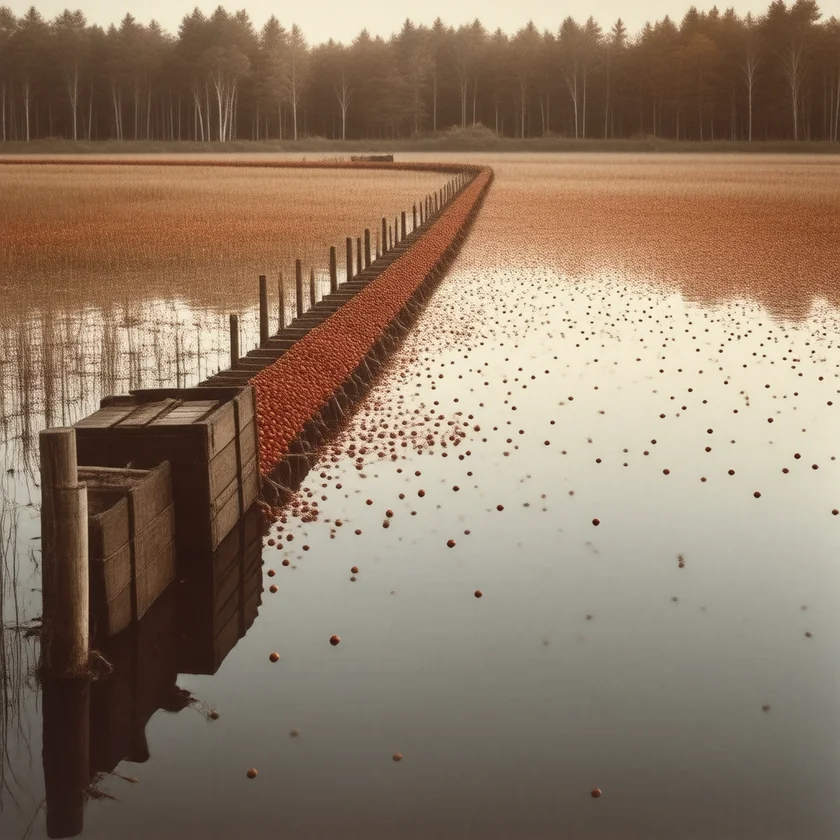
The image everyone carries of a cranberry harvest — growers in waders, thigh-deep in a flooded bed carpeted with floating red fruit — is real, but it is recent, and it has produced a durable misunderstanding. Cranberry beds are not under water for most of the year. During the growing season they are irrigated like any other crop; water is put on in autumn to harvest and in winter to protect the vines from cold, and in the north the winter flood freezes into an ice sheet across which trucks spread the sand that Henry Hall applied by hand.
For the first century and a half of the industry the harvest was dry and done by hand: pickers on their knees, and from the later nineteenth century wooden scoops — box-shaped combs with long tines raked through the vines to strip the berries. It was slow, labour-intensive and hard on the vines.
Two developments changed it. The first was mechanised dry harvesting, with motorised walk-behind pickers that comb the fruit off the vines; this survives today for the small share of the crop — on the order of one berry in ten or twenty — that is sold fresh, because dry-picked fruit bruises less and keeps longer. The second, adopted from the 1960s onward, was the wet harvest: the bed is flooded to a depth of a few inches above the vines, a machine with a large water reel is driven through to knock the berries loose, and the fruit floats free because each berry carries small internal air pockets. The floating crop is corralled with booms to one corner of the bed and pumped or conveyed onto trucks. Wet-harvested fruit must be processed quickly — it is the berry that becomes juice, sauce and dried fruit — and its arrival in the 1960s coincided exactly with the industry's shift from fresh berries to processed products described in the next section. The great majority of the North American crop is now harvested this way.
Cans, Cooperatives and Juice Cocktail
A fresh cranberry is a seasonal, perishable, extremely sour product, and for the nineteenth-century grower that meant a few frantic weeks of selling and wild swings in price from year to year. The industry's answer, worked out over the first half of the twentieth century, was to organise the growers and to process the fruit.
Cooperative marketing came first. As early as 1904 a Wisconsin grower, John Gaynor, and an Iowa fruit broker, A. U. Chaney, organised Wisconsin growers into a sales company to obtain a uniform price from buyers; New Jersey and Massachusetts growers followed, and their pooled organisations marketed fresh berries nationally under a shared brand. Processing came next. In 1912 a Massachusetts lawyer-turned-grower, Marcus L. Urann, began experimenting with cooking whole cranberries into a sauce that could be canned and sold locally, extending the selling season from weeks to the whole year. His venture succeeded and attracted competitors, and in 1930 the rivalry between canners — and between the canning and fresh-fruit sides of the business — was resolved by merging three growers' canning operations into a single growers' cooperative based in Hanson, Massachusetts. That cooperative still handles the majority of the North American crop today. Canned cranberry sauce went on national sale in 1941; the jellied "log" that slides out of the tin with the ridges of the can still on it dates from that era.
The Second World War pushed processing further, into dehydrated cranberries for the military, and post-war development added frozen fruit, relish and sweetened, diluted cranberry drinks — the "cranberry juice cocktail" that made a berry too sour to drink neat into a mass-market beverage. Fresh consumption still outpaced processed use until the 1950s. From the 1960s the balance tipped for good: sales of juice cocktail climbed, blends with apple and grape juice followed, and the volume of fruit going to the presses rose year after year while the fresh market stayed flat. Sweetened dried cranberries — the berry infused with sugar syrup and dried, so that it eats like a raisin — are a late-twentieth-century invention that opened a third large market in cereals, baking and salads. Each solves the problem Josselyn's neighbours solved with boiling and sugar: the cranberry is too sour to eat as it comes, so it is sweetened — and the sugar travels with it.
The Cranberry Scare of 1959
On 9 November 1959, seventeen days before Thanksgiving, the United States Secretary of Health, Education and Welfare, Arthur S. Flemming, held a press conference to announce that shipments of the 1959 cranberry crop from Oregon and Washington had been found to contain traces of aminotriazole, a weedkiller that had been approved for use on cranberry beds only the year before, and that had been shown to cause cancer in laboratory animals. Under the Delaney clause of the 1958 Food Additives Amendment, no substance shown to cause cancer in animals could be permitted in food in any amount, so there was no lawful tolerance to fall back on. Because contaminated and clean berries could not be told apart on the shelf, Flemming advised shoppers who could not establish where their berries were grown not to buy them.
The effect on a crop that sells most of its fresh fruit in one month was immediate and nearly total. Grocers pulled cranberries from the shelves; restaurants and school cafeterias dropped them; the Department of Agriculture later reported fresh cranberry sales for the season as effectively zero. Growers who had never used the herbicide — the great majority — lost their market along with those who had. The Food and Drug Administration set up an emergency testing programme and certified batches as free of the chemical, and cleared fruit went on sale under "approved" signs; both of the next year's presidential candidates, Richard Nixon and John F. Kennedy, were photographed eating cranberries to reassure the public; President Eisenhower's own Thanksgiving dinner, by one account, substituted apple sauce. Use of the herbicide on cranberries stopped at once. Under a special federal programme, growers were eventually indemnified at roughly eight dollars a barrel for their 1959 losses, against a market price of about nine, a payout usually put at around eight million dollars; and in 1962 the industry obtained a federal marketing order that let it manage supply in the depressed market that followed.
The episode is remembered as the first great modern food scare and a test case for the Delaney clause. Consumer confidence returned by the following Thanksgiving; the glut and low prices on the growers' side lasted years.
Breeding a Barely Domesticated Crop
By the standards of wheat, maize or apples, the cranberry has hardly been domesticated at all. Every variety grown in the nineteenth century, and most of the acreage grown through the twentieth, was a wild selection: a vine somebody found in a bog, liked, and propagated by cuttings. Howes (1843) and Early Black were such plants; so were the dozens of local "natives" that growers dug from their own marshes. No deliberate cross had been made.
Breeding began in 1929, and it began because of a disease. Cranberry false blossom, which turns the flowers into sterile, upright, reddish tufts and can wipe out a bed, had been spreading through New Jersey and Massachusetts. In December 1929 the entomologist Irene D. Dobroscky reported in Science that the disease was transmitted by the blunt-nosed leafhopper, a small sap-feeding insect; the causal agent is now attributed to a phytoplasma, a wall-less bacterium that lives in the plant's sap and in the insect that carries it. The United States Department of Agriculture and the New Jersey experiment station responded with a programme to cross the best natives and select for resistance to the leafhopper — the first breeding cycle in the crop's history. Its products, released in the mid-twentieth century, included the varieties Stevens and Franklin, and Stevens in particular became the standard variety against which newer releases are still measured.
A second cycle, run by Rutgers University and the New Jersey Agricultural Experiment Station in recent decades, crossed those first-generation hybrids again and selected for yield, fruit size and colour, releasing cultivars such as Crimson Queen, Mullica Queen and Demoranville. That is the whole pedigree: modern high-yielding cranberries are at most two or three generations removed from a wild vine. It has an unusual consequence. When researchers genotyped the national cranberry germplasm collection in 2018, they found that plants held under a single cultivar name were not all genetically the same — "cultivar variants," in the paper's careful phrase — a legacy of a century of digging vines from mixed bogs and passing cuttings from hand to hand. Wild populations still hold most of the species' diversity: surveys of wild V. macrocarpon and V. oxycoccos across United States national forests (2020) and of the climates wild populations are genetically matched to (2022) are cataloguing raw material that breeders never used. For most crops that library was lost thousands of years ago; for the cranberry it is still standing in the bog.
The Bladder Tradition Meets the Trials
The folk reputation of cranberries for the urinary tract is old and, as folk medicine goes, unusually specific: not a general tonic but a remedy for bladder infections in particular. Where it came from is not recorded; Williams and Josselyn wrote of fevers and scurvy, not the bladder. Through much of the twentieth century the usual explanation was that cranberry juice acidified the urine and so discouraged bacteria — an idea that turned out to be mostly wrong, since the effect on urine acidity is small and short-lived.
The turn came in 1998, when Amy Howell and colleagues at Rutgers published a letter in the New England Journal of Medicine showing something different. Cranberry extracts stopped Escherichia coli — the bacterium behind most bladder infections — from sticking to the cells that line the urinary tract, and the active fraction was the cranberry's proanthocyanidins, the tannin-like polyphenols that make the raw berry so astringent. In 2000 the same group identified the specific molecules: A-type proanthocyanidin trimers, so called because of an unusual double linkage between their units that most other plants' proanthocyanidins lack. The mechanism was elegant and plausible: if bacteria cannot grip the bladder wall, they are flushed out before they can multiply.
Whether that translates into fewer infections in real people took another two decades to settle, and the honest answer is that the verdict changed. The Cochrane Collaboration, which produces the standard independent summaries of medical trials, first reviewed the question in the late 1990s and updated it repeatedly. Its 2012 update, drawing on 24 studies with about 4,500 participants, concluded that cranberry products could not be recommended for preventing urinary tract infections: the pooled benefit was small and not statistically convincing, and many participants found it hard to keep drinking the juice for months on end. That review shaped a decade of medical advice. The 2023 update, with 50 studies and 8,857 participants, reached a different and more nuanced conclusion: cranberry products do reduce the risk of repeat symptomatic infections, with the clearest benefit in women with recurrent infections and in children, and in people at risk after medical procedures, but with no demonstrated benefit in the elderly, in people with bladder-emptying problems or in pregnant women. Neither review found meaningful harm. The 2023 review's own authors were explicit about why the answer moved: more and better trials, many of them using standardised capsules rather than sweetened juice.
A three-hundred-year-old tradition, a mechanism found in 1998, a sceptical synthesis in 2012 and a cautiously positive one in 2023 are not a contradiction; they are what it looks like when a folk remedy is tested properly. For what this means in practice — doses, forms, and the oxalate and warfarin cautions — see the main Cranberries page and the Urinary Tract Infections article.
Wisconsin, Quebec and the Cranberry Today
For most of its history the cranberry was a Massachusetts crop, and Cape Cod's small, irregular bogs in natural wetlands remained the heart of the industry into the 1990s. But the newer marshes of central Wisconsin — larger, flatter, laid out for machinery, and cheaper to run — grew through the 1980s and 1990s at something like a thousand acres a year. By the count of the two agricultural economists who wrote the standard history of the industry, Wisconsin overtook Massachusetts as the leading cranberry state in 1995 and never looked back. It now grows roughly 60 percent of the United States crop; Massachusetts is second, followed by New Jersey, Oregon and Washington. The United States harvest in 2021 was about 360,000 tonnes (790 million pounds).
The second change is Canadian. Cranberry growing in Quebec has expanded enormously in recent decades, and by 2024 Quebec produced almost three quarters of Canada's crop, British Columbia most of the rest; Canada's 2024 harvest of about 212,000 tonnes was its largest on record, and cranberries ranked third among Canadian fruits by volume, after apples and blueberries. Roughly a sixth of Quebec's cranberry area is now certified organic. On the United Nations food agency's figures, world production in 2024 was about 621,000 tonnes, of which the United States grew 65 percent and Canada 34 percent — 99 percent of the world's cranberries from two countries. The only other producer of note is Chile, where the American species is grown in the Southern Hemisphere; Europe's small V. oxycoccos harvest is a rounding error.
What has changed least is the plant. Two centuries after Henry Hall spread sand over wild vines, the cranberry is still grown on a handful of cultivars a generation or two from the bog, still harvested in the same few autumn weeks, and still, as Josselyn wrote in 1672, mostly eaten boiled with sugar for sauce.
Key Research Papers
The list covers the cranberry genome and its wild relatives, the 1929 discovery that started cranberry breeding, the food history of the Thanksgiving menu, and the four papers that frame the bladder story — the 1998 anti-adhesion finding, the 2000 identification of the active molecules, and the 2012 and 2023 Cochrane reviews. The agricultural and regulatory history above is drawn from the sources listed under External Authoritative Resources.
- Polashock J, Zelzion E, Fajardo D, Zalapa J, et al. (2014). The American cranberry: first insights into the whole genome of a species adapted to bog habitat. BMC Plant Biology. — doi:10.1186/1471-2229-14-165
- Diaz-Garcia L, Garcia-Ortega LF, González-Rodríguez M, Delaye L, et al. (2021). Chromosome-Level Genome Assembly of the American Cranberry (Vaccinium macrocarpon Ait.) and Its Wild Relative Vaccinium microcarpum. Frontiers in Plant Science. — PubMed PMID: 33643360
- Vorsa N, Zalapa J (2019). Domestication, Genetics, and Genomics of the American Cranberry. Plant Breeding Reviews. — doi:10.1002/9781119616801.ch8
- Schlautman B, Covarrubias-Pazaran G, Rodriguez-Bonilla L, Hummer K, Bassil N, Smith T, et al. (2018). Genetic diversity and cultivar variants in the NCGR cranberry (Vaccinium macrocarpon Aiton) collection. Journal of Genetics. — doi:10.1007/s12041-018-1036-3
- Rodriguez-Bonilla L, Williams KA, Rodríguez Bonilla F, Matusinec D, Maule A, Coe K, et al. (2020). The Genetic Diversity of Cranberry Crop Wild Relatives, Vaccinium macrocarpon Aiton and V. oxycoccos L., in the US, with Special Emphasis on National Forests. Plants. — doi:10.3390/plants9111446
- Neyhart JL, Kantar MB, Zalapa J, Vorsa N (2022). Genomic-environmental associations in wild cranberry (Vaccinium macrocarpon Ait.). G3 Genes|Genomes|Genetics. — doi:10.1093/g3journal/jkac203
- Dobroscky ID (1929). Cranberry False-Blossom Disease Spread by a Leafhopper. Science. — doi:10.1126/science.70.1826.635.a
- Ben-Zvi Y, Rodriguez-Saona C (2023). Advances in cranberry insect pest management: A literature synthesis. Frontiers in Agronomy. — doi:10.3389/fagro.2023.1006106
- Smith AF (2003). The First Thanksgiving. Gastronomica. — doi:10.1525/gfc.2003.3.4.79
- Howell AB, Vorsa N, Der Marderosian A, Foo LY (1998). Inhibition of the adherence of P-fimbriated Escherichia coli to uroepithelial-cell surfaces by proanthocyanidin extracts from cranberries. The New England Journal of Medicine. — PubMed PMID: 9767006
- Foo LY, Lu Y, Howell AB, Vorsa N (2000). A-Type Proanthocyanidin Trimers from Cranberry that Inhibit Adherence of Uropathogenic P-Fimbriated Escherichia coli. Journal of Natural Products. — doi:10.1021/np000128u
- Jepson RG, Williams G, Craig JC (2012). Cranberries for preventing urinary tract infections. Cochrane Database of Systematic Reviews. — doi:10.1002/14651858.CD001321.pub5
- Williams G, Hahn D, Stephens JH, Craig JC, et al. (2023). Cranberries for preventing urinary tract infections. Cochrane Database of Systematic Reviews. — doi:10.1002/14651858.CD001321.pub6
PubMed Topic Searches
- PubMed: Cranberry domestication and origin
- PubMed: Cranberry ethnobotany and traditional use
- PubMed: Cranberry proanthocyanidins and urinary anti-adhesion
External Authoritative Resources
- Jesse EV, Rogers RT. The Cranberry Industry and Ocean Spray Cooperative: Lessons in Cooperative Governance. FSRG Monograph 19, University of Wisconsin–Madison, 2006 — the standard economic history: Henry Hall, the 1959 scare, Wisconsin's 1995 overtaking of Massachusetts (archived PDF)
- New Jersey Pinelands Commission — "The Cranberry Story": New Jersey's 1835 beginnings and the 1960s wet harvest
- Josselyn J. New-Englands Rarities Discovered (1672), 1865 annotated edition, Internet Archive — the "Cran Berry, or Bear Berry" entry and the editor's note on Roger Williams's sasemineash
- Simmons A. American Cookery (Hartford, 1796), Project Gutenberg — the "cramberry-sauce" with roast turkey
- Wikipedia — Cranberry scare of 1959, with the contemporary press and regulatory sources
- Agriculture and Agri-Food Canada — Statistical Overview of the Canadian Fruit Industry (cranberry production by province)
- FAOSTAT — world cranberry production by country and year
- Online Etymology Dictionary — cranberry