Frozen vs Fresh Blueberries
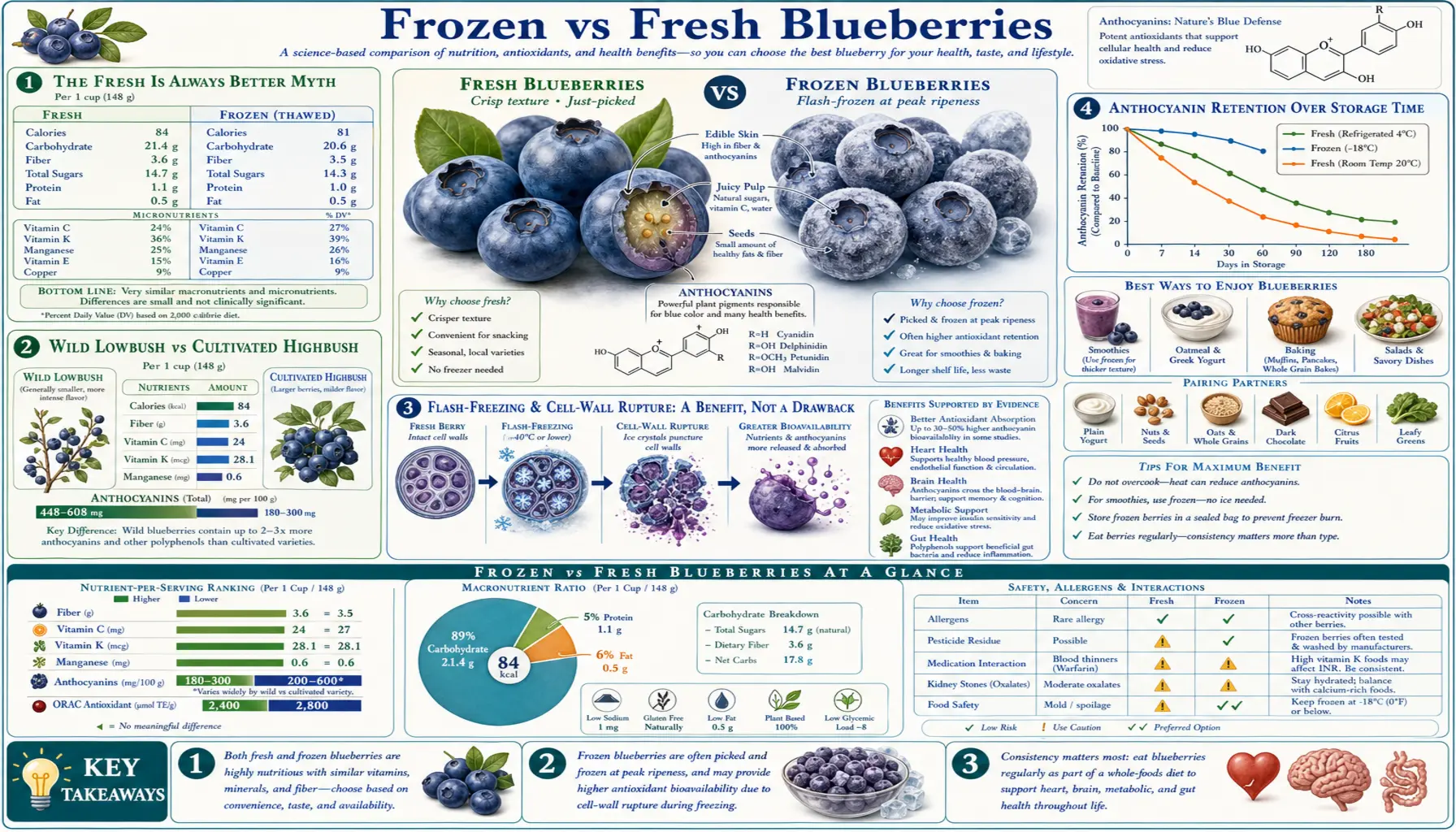
Whether frozen blueberries are as nutritious as fresh ones is one of the most common practical questions about the fruit. The studies that measured it found little difference from freezing itself: in a 2004 laboratory study, frozen highbush blueberries showed no significant loss of anthocyanins over three months at −20 °C, and a 2015 University of California comparison of eight fruits and vegetables (blueberries among them) found the vitamin content of frozen produce comparable to, and occasionally higher than, fresh. Heat processing and long storage of heat-processed products are where the large anthocyanin losses in the research appear. This page walks through the storage, species, freezing, absorption, cooking and organic-versus-conventional research, and notes where widely repeated figures were not found in any study.
Table of Contents
- Is Fresh Always Better?
- Wild Lowbush vs Cultivated Highbush
- Flash-Freezing & Cell-Wall Rupture
- Anthocyanin Retention Over Storage Time
- Bioavailability After Freezing
- Cooking, Baking, & Heat Effects
- Cost and Anthocyanin Content
- Organic vs Conventional Blueberries
- What Product Labels Show
- Freeze-Dried Blueberry Powder
- Cautions & Processed Blueberry Products
- Key Research Papers
- Connections
- Featured Videos
Is Fresh Always Better?
The intuition that fresh produce is healthier than frozen comes from a kitchen-quality association — fresh tomatoes taste better than frozen in a salad, fresh herbs are more aromatic than dried. Eating quality and nutrient content are separate questions, and for blueberries the nutrient research does not show a general advantage for fresh.
Out-of-season fresh blueberries in many markets are imported and spend time in refrigerated transport and storage before sale. How much anthocyanin is lost along that chain was not measured in the studies reviewed for this page. The short-term storage studies that do exist found that blueberry anthocyanins changed little over several days, and in underripe fruit kept rising (see Anthocyanin Retention Over Storage Time). Per-day loss figures for fresh berries that circulate online were not found in any of these studies.
Commercial frozen blueberries are frozen after harvest, and freezing slows enzymatic and chemical change. In the Lohachoompol 2004 study of highbush blueberries (Vaccinium corymbosum), frozen samples kept for up to three months at −20 °C showed no significant decrease in anthocyanins, while cabinet-dried berries lost 41% (untreated) and 49% (osmotic pretreatment), and the antioxidant activity of the anthocyanin extracts did not differ significantly between fresh, dried and frozen berries.
For vitamins, Bouzari and colleagues (2015) analyzed ascorbic acid, riboflavin, α-tocopherol and β-carotene in eight commodities including blueberries. Ascorbic acid showed no significant fresh-versus-frozen difference in five of the eight and was higher in the frozen samples of the other three; the authors concluded that the vitamin content of the frozen commodities was comparable to and occasionally higher than that of their fresh counterparts. β-carotene was not found in significant amounts in blueberries.
Wild Lowbush vs Cultivated Highbush
The research suggests the species and cultivar of the berry matter more for anthocyanin content than whether it is fresh or frozen. North American blueberries come in two principal species:
- Highbush blueberry (Vaccinium corymbosum): the larger cultivated berry sold fresh in clamshell containers, grown commercially in many US states and, for out-of-season export, in South America and Mexico.
- Lowbush blueberry (Vaccinium angustifolium): the smaller “wild” berry from a low-growing shrub, harvested mainly in Maine and the Canadian Maritimes from managed native stands, and widely sold frozen.
Kalt and colleagues (2001) compared genotypes of both species and found that, regardless of the extraction method, lowbush blueberries were consistently higher in anthocyanins, total phenolics and antioxidant capacity than highbush blueberries; they found no relationship between fruit size and anthocyanin content within either species. Other studies show wide overlap between varieties: Rodriguez-Mateos and colleagues (2012) found that four highbush varieties (Bluecrop, O'Neal, Bluejay and Brigitta) had significantly greater anthocyanidin levels than the other varieties tested, while the one lowbush sample had the highest chlorogenic acid concentration. Howard and colleagues (2003) found that genotype influenced phenolic content more than growing season, and that genotypes with smaller berries generally had higher anthocyanin and phenolic levels. Connor and colleagues (2002) and Wang and colleagues (2012) reported significant genotype-by-environment and cultivar-by-year interactions, so the same cultivar can differ between locations and years.
Retail prices and per-cup anthocyanin figures that appeared in earlier versions of this section had no source and have been removed.
Flash-Freezing & Cell-Wall Rupture
Commercial frozen blueberries are usually individually quick frozen (IQF): the berries are frozen separately so they do not clump. In general, faster freezing forms smaller ice crystals, which cause less physical damage to plant tissue than the larger crystals of slow freezing.
Plant cells store anthocyanins in the vacuole, a fluid-filled compartment inside the cell. Freezing and thawing damage cell membranes and walls, which is why thawed berries are softer than fresh ones and release purple juice. A common claim is that this damage makes anthocyanins more available for absorption. That claim has not been tested directly in people: no study comparing anthocyanin absorption from fresh and frozen blueberries was found in PubMed (see Bioavailability After Freezing). Earlier versions of this page stated that Lohachoompol 2004 found 10–30% more extractable anthocyanin in frozen-thawed berries; that study reported no such figure — it found no significant change in total anthocyanins during three months of frozen storage.
Anthocyanins are water-soluble pigments, so the juice released by thawed berries carries part of the pigment with it.
Anthocyanin Retention Over Storage Time
What the storage studies on this page measured:
- Fresh berries, short-term storage: Kalt and colleagues (1999) stored highbush and lowbush blueberries, strawberries and raspberries at 0, 10, 20 and 30 °C for up to 8 days. Antioxidant capacity was strongly correlated with anthocyanin content; anthocyanins increased during storage in strawberries and raspberries. Vitamin C did not fall in highbush blueberries over 8 days at any of the temperatures, but did fall in lowbush blueberries and raspberries.
- Underripe fresh berries: Kalt and colleagues (2003) stored underripe highbush blueberries at 20 °C for up to 8 days. Anthocyanins continued to form during storage, with the rate slowing after about 4 days, and after 8 days the anthocyanin content of fruit harvested 5–50% or 50–95% blue exceeded that of ripe fruit.
- Frozen whole berries: in Lohachoompol 2004, highbush blueberries frozen at −20 °C showed no significant decrease in anthocyanins over three months.
- A blueberry extract in glass bottles: Srivastava and colleagues (2007) studied a pressed and heated blueberry extract, not whole berries. Pressing and heating alone recovered only about 29% of the total anthocyanins. In storage, there was no statistically significant loss at −20 °C up to 30 days; at 6 °C there was a significant loss from 15 to 30 days; and at 35 °C no anthocyanins were detected after 60 days. Earlier versions of this page credited this paper with 90%+ retention in frozen blueberries after 12 months; the paper reports no such result.
- Heat-processed products in long storage: Brownmiller and colleagues (2008) found that 6 months at 25 °C caused total anthocyanin losses of 62% (berries canned in water) to 85% (clarified juice), on top of losses during processing. Syamaladevi and colleagues (2012) found that total anthocyanins in canned blueberry solids fell by up to 86% over 13 months of storage.
Per-day loss rates for refrigerated or room-temperature fresh berries, 12-month figures for home-frozen berries, and multi-year figures for freeze-dried powder were not found in these studies and have been removed.
Bioavailability After Freezing
“Bioavailability” refers to the fraction of an ingested compound that is absorbed and reaches the body's tissues. Anthocyanins were long thought to be very poorly absorbed. In the Czank 2013 tracer study, eight men took 500 mg of carbon-13-labeled cyanidin-3-glucoside; the relative bioavailability was 12.38% (label recovered in urine and breath), labeled metabolites peaked in the blood at about 10 hours, and the authors concluded that anthocyanins are more bioavailable than previously perceived, with metabolites present in the circulation for up to 48 hours. A pharmacokinetic analysis of the same design (de Ferrars 2014) identified 17 labeled compounds in serum, the main ones being hippuric acid and ferulic acid, which peaked at about 16 and 8 hours.
Neither study compared fresh with frozen fruit; both used a single purified anthocyanin. No study directly comparing anthocyanin absorption from fresh versus frozen blueberries — in people or in animals — was found in PubMed. A pig study described on earlier versions of this page could not be found and has been removed. Whether freezing changes anthocyanin absorption is therefore unknown.
Cooking, Baking, & Heat Effects
Heat is where the research shows the largest anthocyanin losses. How fast anthocyanins degrade depends on temperature, time, pH and the food matrix (reviewed by Patras and colleagues, 2010).
- Heating blueberry juice: Kechinski and colleagues (2010) found that anthocyanin degradation in blueberry juice followed first-order kinetics, with half-lives of 180.5 hours at 40 °C, 42.3 hours at 50 °C, 25.3 hours at 60 °C, 8.6 hours at 70 °C and 5.1 hours at 80 °C.
- Canning, puréeing and juicing: Brownmiller and colleagues (2008) found that thermal processing caused total anthocyanin losses of 28% to 59%, greatest in clarified juices and least in nonclarified juices. Sablani and colleagues (2010) found that canning reduced total anthocyanins by up to 44%, while total phenolic content and antioxidant activity generally rose (by up to 50% and 53%), and that blanching before purée or juice processing improved retention in blueberries.
- Baking: in a randomized crossover trial in ten healthy volunteers (Rodriguez-Mateos 2014), baked products made with freeze-dried blueberry powder contained 42% less anthocyanin than an unprocessed drink made with the same amount of powder, but blood-vessel function (flow-mediated dilation) rose after the baked products to a similar degree as after the unprocessed drink. The authors concluded that careful processing can preserve important biological activities of blueberries despite changing their polyphenol composition.
Figures that earlier versions of this page gave for muffins, jam, microwaving and blending were not found in these studies and have been removed.
Cost and Anthocyanin Content
Earlier versions of this section carried a cost-per-gram-of-anthocyanin worked example. Its prices, per-cup anthocyanin contents and loss percentages had no source and have been removed. Retail prices vary by region, season and year, and anthocyanin content varies by species, cultivar, growing location and season (see Wild Lowbush vs Cultivated Highbush), so no single per-cup figure applies to all blueberries.
Blueberry trials have usually expressed their doses as whole-fruit equivalents rather than milligrams of anthocyanin. Krikorian and colleagues (2022) gave a freeze-dried whole highbush blueberry powder at a daily dose equal to half a cup of whole fruit to insulin-resistant adults aged 50 to 65 with subjective cognitive decline, and reported improvements on measures of lexical access and memory interference and a correction of peripheral hyperinsulinemia compared with placebo. Whyte and colleagues (2021) gave 35 adults aged 40 to 65 a single 1-cup-equivalent wild blueberry drink with breakfast and reported better performance on some memory and executive-function measures and lower post-meal glucose and insulin over the first 2 hours compared with placebo.
Organic vs Conventional Blueberries
The studies comparing organically and conventionally grown blueberries disagree:
- Wang and colleagues (2008), sampling Bluecrop highbush fruit from commercial farms in New Jersey, found significantly higher sugars, total phenolics, total anthocyanins and antioxidant activity in organic fruit: total anthocyanins averaged 131.2 mg per 100 g fresh weight in organic fruit and 82.4 mg per 100 g in conventional fruit.
- Rodriguez-Mateos and colleagues (2012) found that the organically grown highbush sample had the highest flavanol oligomer and chlorogenic acid contents but a lower anthocyanidin content than its conventionally grown counterpart.
- Sablani and colleagues (2010) found that total anthocyanin and phenolic contents of blueberries and raspberries were not influenced by the production system, and Syamaladevi and colleagues (2012) found that retention during storage of heat-processed blueberries did not differ between organic and conventional fruit.
Pesticide residues on conventionally grown produce, and the research on them, are covered on the Pesticides page linked under Connections.
What Product Labels Show
- Species: frozen blueberries are sold both as cultivated (highbush) and as wild (lowbush) berries; some packages name the species, Vaccinium corymbosum or Vaccinium angustifolium.
- Ingredients: plain frozen blueberries list blueberries as the only ingredient. Some frozen berry products and mixes add sugar, syrup or fruit-juice concentrate, which appears in the ingredient list.
- Organic certification: appears on the label; the research on organic and conventional blueberries is summarized in the section above.
- “Blueberry-flavored” products: a product named for blueberries may contain flavoring rather than fruit; the ingredient list shows whether blueberries are present.
Freeze-Dried Blueberry Powder
Freeze-drying removes water from frozen fruit by sublimation under vacuum, at low temperature. It is a different process from hot-air (cabinet) drying: in Lohachoompol 2004, cabinet-dried blueberries lost 41–49% of their anthocyanins; that study did not test freeze-drying.
Freeze-dried whole-blueberry powder is the form used in many clinical trials, because it can be matched against a placebo powder. Krikorian and colleagues (2022) used a freeze-dried whole highbush blueberry powder at a daily dose equal to half a cup of whole fruit, and Rodriguez-Mateos and colleagues (2014) used freeze-dried blueberry powder both in an unprocessed drink and in baked products (see Cooking, Baking, & Heat Effects).
Prices, serving sizes, storage-life figures and product names that appeared in earlier versions of this section had no source and have been removed.
Cautions & Processed Blueberry Products
- Sweetened frozen products — some frozen berry products and mixes contain added sugar, syrup or fruit-juice concentrate, as shown on the ingredient list.
- “Blueberry-flavored” foods — some commercial foods named for blueberries contain blueberry flavoring rather than whole fruit; the ingredient list shows which.
- Canned, jammed and juiced blueberries — heat processing reduced total anthocyanins by 28–59% (Brownmiller 2008) or up to 44% on canning (Sablani 2010), and further losses occurred during months of storage (62–85% over 6 months at 25 °C; up to 86% in canned blueberry solids over 13 months).
- Hot-air-dried blueberries — cabinet drying cut anthocyanins by 41–49% in Lohachoompol 2004.
- Pesticide residues on conventional berries — covered on the Pesticides page under Connections.
Key Research Papers
- Lohachoompol V, Srzednicki G, Craske J (2004). The change of total anthocyanins in blueberries and their antioxidant effect after drying and freezing. Journal of Biomedicine and Biotechnology (5):248-252 — PubMed PMID: 15577185
- Srivastava A, Akoh CC, Yi W, Fischer J, Krewer G (2007). Effect of storage conditions on the biological activity of phenolic compounds of blueberry extract packed in glass bottles. Journal of Agricultural and Food Chemistry 55(7):2705-2713 — PubMed PMID: 17348670
- Connor AM, Luby JJ, Tong CB, Finn CE, Hancock JF (2002). Genotypic and environmental variation in antioxidant activity, total phenolic content, and anthocyanin content among blueberry cultivars. Journal of the American Society for Horticultural Science 127(1):89-97 — doi:10.21273/JASHS.127.1.89
- Kalt W, Forney CF, Martin A, Prior RL (1999). Antioxidant capacity, vitamin C, phenolics, and anthocyanins after fresh storage of small fruits. Journal of Agricultural and Food Chemistry 47(11):4638-4644 — PubMed PMID: 10552863
- Kalt W, Lawand C, Ryan DA, McDonald JE, Donner H, Forney CF (2003). Oxygen radical absorbing capacity, anthocyanin and phenolic content of highbush blueberries (Vaccinium corymbosum L.) during ripening and storage. Journal of the American Society for Horticultural Science 128(6):917-923 — doi:10.21273/JASHS.128.6.917
- Howard LR, Clark JR, Brownmiller C (2003). Antioxidant capacity and phenolic content in blueberries as affected by genotype and growing season. Journal of the Science of Food and Agriculture 83(12):1238-1247 — doi:10.1002/jsfa.1532
- Patras A, Brunton NP, O'Donnell C, Tiwari BK (2010). Effect of thermal processing on anthocyanin stability in foods; mechanisms and kinetics of degradation. Trends in Food Science and Technology 21(1):3-11 — doi:10.1016/j.tifs.2009.07.004
- Riihinen K, Jaakola L, Karenlampi S, Hohtola A (2008). Organ-specific distribution of phenolic compounds in bilberry (Vaccinium myrtillus) and "northblue" blueberry (Vaccinium corymbosum x V. angustifolium). Food Chemistry 110(1):156-160 — PubMed PMID: 26050178
- Wang SY, Lin HS (2000). Antioxidant activity in fruits and leaves of blackberry, raspberry, and strawberry varies with cultivar and developmental stage. Journal of Agricultural and Food Chemistry 48(2):140-146 — PubMed PMID: 10691606
- Brownmiller C, Howard LR, Prior RL (2008). Processing and storage effects on monomeric anthocyanins, percent polymeric color, and antioxidant capacity of processed blueberry products. Journal of Food Science 73(5):H72-H79 — PubMed PMID: 18576998
- Kechinski CP, Guimaraes PV, Norena CP, Tessaro IC, Marczak LD (2010). Degradation kinetics of anthocyanin in blueberry juice during thermal treatment. Journal of Food Science 75(2):C173-C176 — PubMed PMID: 20492222
- Wang SY, Chen H, Camp MJ, Ehlenfeldt MK (2012). Genotype and growing season influence blueberry antioxidant capacity and other quality attributes. International Journal of Food Science & Technology 47(7):1540-1549 — doi:10.1111/j.1365-2621.2012.03004.x
- Kalt W, Ryan DA, Duy JC, Prior RL, Ehlenfeldt MK, Vander Kloet SP (2001). Interspecific variation in anthocyanins, phenolics, and antioxidant capacity among genotypes of highbush and lowbush blueberries (Vaccinium section cyanococcus spp.). Journal of Agricultural and Food Chemistry 49(10):4761-4767 — PubMed PMID: 11600018
- Bouzari A, Holstege D, Barrett DM (2015). Vitamin retention in eight fruits and vegetables: a comparison of refrigerated and frozen storage. Journal of Agricultural and Food Chemistry 63(3):957-962 — PubMed PMID: 25526594
- Rodriguez-Mateos A, Del Pino-García R, George TW, Vidal-Diez A, Heiss C, Spencer JP (2014). Impact of processing on the bioavailability and vascular effects of blueberry (poly)phenols. Molecular Nutrition & Food Research 58(10):1952-1961 — PubMed PMID: 25044909
- Czank C, Cassidy A, Zhang Q, Morrison DJ, Preston T, Kroon PA, Botting NP, Kay CD (2013). Human metabolism and elimination of the anthocyanin, cyanidin-3-glucoside: a (13)C-tracer study. American Journal of Clinical Nutrition 97(5):995-1003 — PubMed PMID: 23604435
- de Ferrars RM, Czank C, Zhang Q, Botting NP, Kroon PA, Cassidy A, Kay CD (2014). The pharmacokinetics of anthocyanins and their metabolites in humans. British Journal of Pharmacology 171(13):3268-3282 — PubMed PMID: 24602005
- Krikorian R, Skelton MR, Summer SS, Shidler MD, Sullivan PG (2022). Blueberry supplementation in midlife for dementia risk reduction. Nutrients 14(8):1619 — PubMed PMID: 35458181
- Whyte AR, Rahman S, Bell L, Edirisinghe I, Krikorian R, Williams CM, Burton-Freeman B (2021). Improved metabolic function and cognitive performance in middle-aged adults following a single dose of wild blueberry. European Journal of Nutrition 60(3):1521-1536 — PubMed PMID: 32747995
- Wang SY, Chen CT, Sciarappa W, Wang CY, Camp MJ (2008). Fruit quality, antioxidant capacity, and flavonoid content of organically and conventionally grown blueberries. Journal of Agricultural and Food Chemistry 56(14):5788-5794 — PubMed PMID: 18590274
- Rodriguez-Mateos A, Cifuentes-Gomez T, Tabatabaee S, Lecras C, Spencer JP (2012). Procyanidin, anthocyanin, and chlorogenic acid contents of highbush and lowbush blueberries. Journal of Agricultural and Food Chemistry 60(23):5772-5778 — PubMed PMID: 22175691
- Sablani SS, Andrews PK, Davies NM, Walters T, Saez H, Syamaladevi RM, Mohekar PR (2010). Effect of thermal treatments on phytochemicals in conventionally and organically grown berries. Journal of the Science of Food and Agriculture 90(5):769-778 — PubMed PMID: 20355111
- Syamaladevi RM, Andrews PK, Davies NM, Walters T, Sablani SS (2012). Storage effects on anthocyanins, phenolics and antioxidant activity of thermally processed conventional and organic blueberries. Journal of the Science of Food and Agriculture 92(4):916-924 — PubMed PMID: 21969304