Kimchi: Nutrient Profile
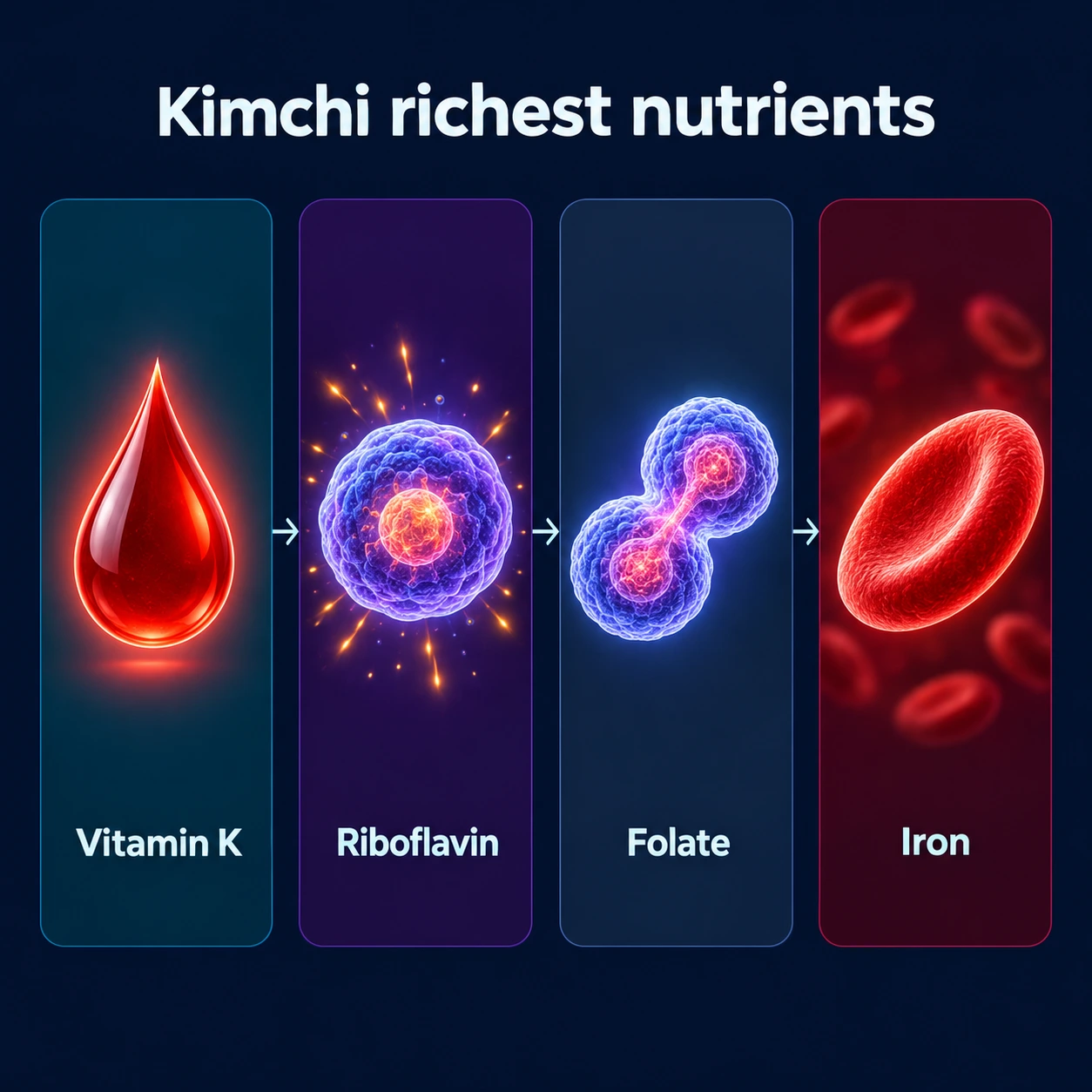
What is Kimchi richest in? Below are the vitamins, minerals and amino acids that 100 g of Kimchi delivers in the highest amounts. Each one links to that nutrient’s own page listing the best foods to get it from.
| Kimchi: Richest Nutrients (per 100 g) | ||||
|---|---|---|---|---|
| Rank | Nutrient | Per 100 g | %DV / 100g | Purpose |
| Vitamins | ||||
| 1 | Vitamin K | 44 mcg | 🟡 36% | Blood clotting & bone |
| 2 | Vitamin B2 (Riboflavin) | 0.2 mg | 🟡 16% | Energy & cell health |
| 3 | Vitamin B9 (Folate) | 52 mcg DFE | 🟡 13% | Cell division; pregnancy |
| 4 | Vitamin B6 | 0.2 mg | 🟡 13% | Brain & metabolism |
| Minerals | ||||
| 1 | Iron | 2.5 mg | 🟡 14% | Carries oxygen in blood |
Values are per 100 g of the U.S. Department of Agriculture (USDA) FoodData Central record FDC 170392, “Cabbage, kimchi” (SR Legacy). %DV is the amount per 100 g divided by the adult Daily Value in 21 CFR 101.9.
Kimchi Is Also a Major Source of Salt
The table above lists vitamins, minerals and amino acids only, so it leaves sodium out. The same USDA record (FDC 170392) lists 498 mg of sodium per 100 g of kimchi.
A Korean national survey (the Korea National Health and Nutrition Examination Survey, KNHANES, 2013–2017) found that kimchi supplied 487.3–539.6 mg of sodium a day in the Korean diet and was one of the top three dish groups for sodium intake, together with noodles and dumplings and soups. Average total sodium intake in that survey was 3,477.2–3,889.6 mg a day. The page Kimchi Sodium and Vegetable Trade-off covers this in more depth.
What Large Studies of Kimchi Eaters Show
In a cross-sectional study of 115,726 Korean adults aged 40–69 (the Health Examinees study), men who ate 1–3 servings of kimchi a day had lower odds of obesity than men who ate less than 1 serving a day (odds ratio 0.875 at 1–2 servings and 0.893 at 2–3 servings). Men who ate the most cabbage kimchi (baechu kimchi) had 10% lower odds of obesity and of belly (abdominal) obesity. The links were J-shaped: the lower odds did not continue at the highest intakes, and the authors noted this as a reason to limit very high kimchi intake. A cross-sectional study shows an association at one point in time; it cannot show that kimchi caused the difference.
Key Research Papers
- Jeong Y, Kim ES, Lee J, Kim Y. “Trends in sodium intake and major contributing food groups and dishes in Korea: the Korea National Health and Nutrition Examination Survey 2013-2017.” Nutr Res Pract. 2021;15(3):382–395. — PubMed PMID: 34093978
- Jung H, Yun YR, Hong SW, Shin S. “Association between kimchi consumption and obesity based on BMI and abdominal obesity in Korean adults: a cross-sectional analysis of the Health Examinees study.” BMJ Open. 2024;14(2):e076650. — PubMed PMID: 38290970