Bone Broth: History and Origins
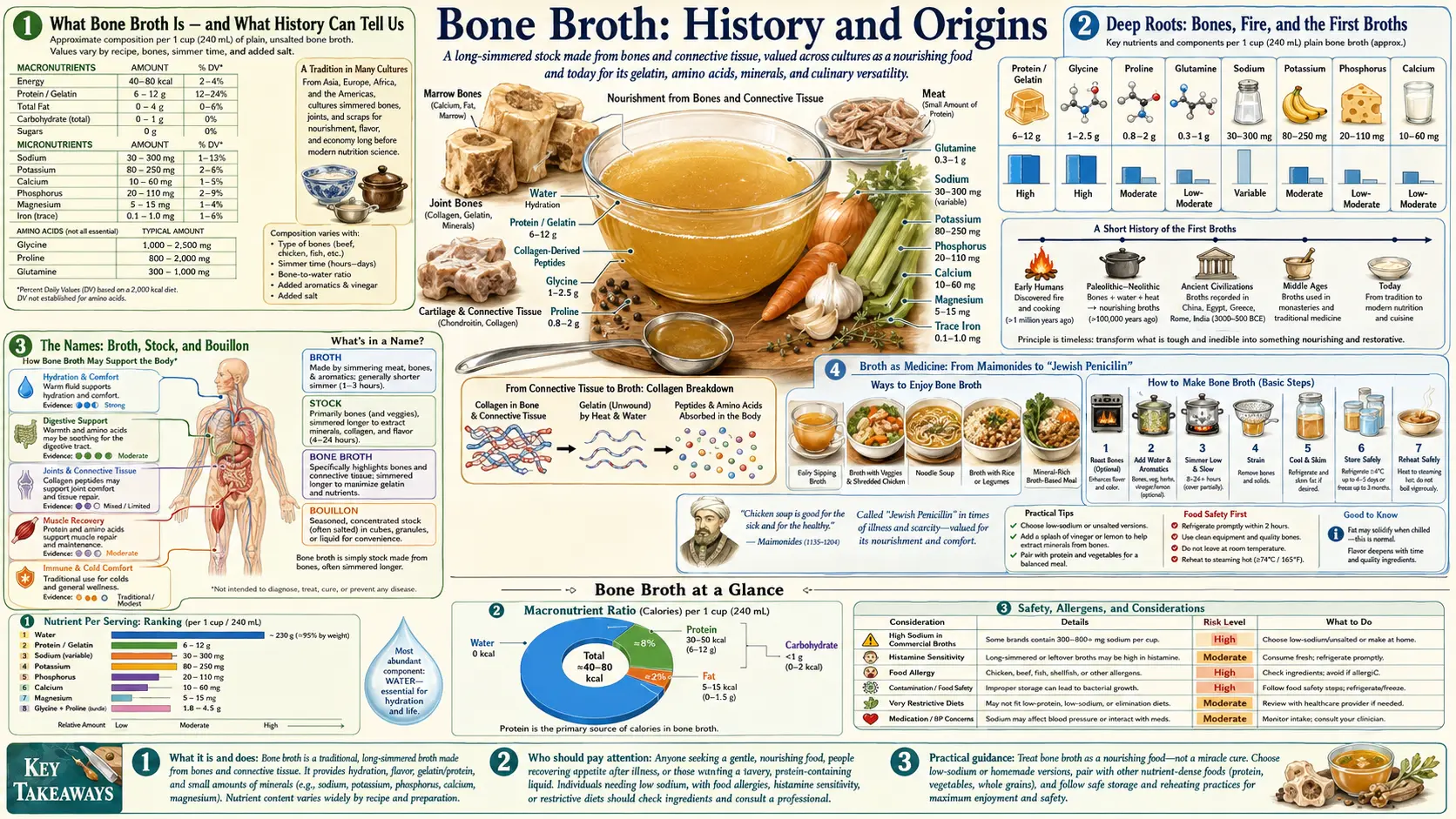
Bone broth has no inventor and no single birthplace. It is one of the oldest cooked foods humans have, born the moment our ancestors learned that bones and the tough, gristly parts of an animal — the bits you cannot simply roast and chew — give up something rich and nourishing when they are simmered in water for a long time. The same simple idea was discovered again and again, on every inhabited continent, because it answered a universal need: to waste nothing of a hard-won animal and to turn its least edible parts into food and warmth. This article traces what the record actually supports — the deep prehistoric roots of long-simmered bone, the words we use for it, its place in medicine from Maimonides onward, its role as the unseen foundation of classic cooking, and its surprising twenty-first-century revival as a fashionable health drink. Where something is firmly documented we say so; where a claim is folklore, marketing, or still uncertain, we name it as such.
Table of Contents
- What Bone Broth Is — and What History Can Tell Us
- Deep Roots: Bones, Fire, and the First Broths
- The Names: Broth, Stock, and Bouillon
- Broth as Medicine: From Maimonides to "Jewish Penicillin"
- The Backbone of the Kitchen: Stock in Classic Cooking
- Gelatin, Aspic, and the Jelly That Proves the Collagen
- The Modern Revival: From Traditional Foods to the Broth Bar
- What Modern Science Did and Did Not Confirm
- Research Papers and References
- Connections
- Featured Videos
What Bone Broth Is — and What History Can Tell Us
At its simplest, bone broth is water in which animal bones — usually together with their attached cartilage, tendons, skin, and scraps of meat — have been simmered for a long time. The heat and time slowly break down collagen, the tough connective protein that holds an animal together, and convert it into gelatin, the substance that makes a good broth turn to jelly when it cools. That gelling is the visible signature of the whole process, and it is the one thread that runs unbroken from a prehistoric cooking pit to a modern paper cup of "sippable" broth.
It is worth being clear at the outset about a distinction that history blurs. In everyday speech today, "broth," "stock," and "bone broth" are used loosely and often interchangeably. Cooks sometimes draw fine lines — stock made mainly from bones, broth made with more meat, bone broth simmered especially long — but these distinctions are modern, informal, and not consistent from one kitchen or country to the next. For most of the past, there was simply the pot of bones and water on the fire. This page treats that long-simmered bone liquid as one continuous tradition and notes where a particular name or fashion attached itself to it.
Finally, a word on what history can honestly say. Bone broth is a food, not an invention with a patent and a date. We can document the deep antiquity of cooking bones, the words different cultures gave the result, the medical reputation it acquired, and the moment the specific phrase "bone broth" became a wellness brand. We cannot name a discoverer, and we should be wary of tidy origin stories — many of the "ancient" claims attached to bone broth in marketing copy are far less certain than they sound, and several are flagged as such below.
Deep Roots: Bones, Fire, and the First Broths
The practice of getting nourishment out of bone is genuinely ancient and predates pottery itself. Long before there were cooking pots, people had ways to apply prolonged wet heat to bones. One well-documented technique is stone boiling: heating rocks in a fire and dropping them into water held in a pit lined with hide or in a vessel of skin, bark, or a hollowed stone, raising the water to a simmer without a fireproof container. Another was to use the animal's own hide or stomach as a cooking bag. These methods are reconstructed by archaeologists from fire-cracked rock, charred bone, and ethnographic parallels with recent hunter-gatherers, and they show that the basic conditions for making broth — gentle, sustained heat and time — were available to people deep in prehistory.
The motive was practical and powerful. A hunted or butchered animal is mostly not tender steak; much of it is bone, marrow, hide, sinew, hoof, and head. Marrow is densely caloric, and the connective tissue around joints is packed with collagen that becomes digestible only after long cooking. Simmering these parts extracts fat, gelatin, and dissolved minerals into a warm, easily swallowed liquid — valuable nourishment from material that would otherwise be hard to eat or wasted entirely. In a world where calories were scarce and a large kill was rare, a way to use the whole animal, including its skeleton, was an obvious survival advantage. This is why the practice appears so widely: it was not handed down from one clever culture to the rest, but discovered independently wherever people cooked bones.
Two cautions belong here. First, charred bone and fire-cracked rock confirm that bones were heated, but a cooking pit rarely preserves a label saying "broth"; the deepest prehistory of bone broth is therefore inferred from technique and context, not read off a recipe. Second, popular articles sometimes attach very precise dates or named ancient physicians to bone broth's origin; the honest picture is broader and humbler — long-simmered bone is older than writing, and its beginnings are a story of human ingenuity in general rather than of any one people or any one date.
The Names: Broth, Stock, and Bouillon
The words we use for bone broth carry their own quiet history, and almost all of them point back to the act of boiling. The English word broth is very old: it descends from Old English broþ and, beyond that, from a Proto-Indo-European root (reconstructed as *b&shacek;rewₖ-, often written *bhreu-) meaning roughly "to boil, bubble, brew." The same ancient root gives us brew and is related to words for fermentation and heat. In other words, "broth" means, at its core, simply the liquid in which something has been boiled — a definition that has scarcely changed in well over a thousand years.
The French bouillon tells the same story in another language. First recorded in the seventeenth century, it comes from the French verb bouillir, "to boil," which traces back through Old French to the Latin bullīre, "to bubble or boil" (from bulla, "a bubble"). When English speakers borrowed bouillon, they borrowed, quite literally, "the boiled thing."
Stock is the odd one out, and its culinary sense is comparatively recent. The everyday English word stock — a store or supply kept on hand — came to be applied in the kitchen to the basic prepared liquid a cook keeps ready as the foundation for soups and sauces. That is the meaning behind the very idea of a "stockpot": the pot in which the kitchen's working supply of broth is always simmering. The compound term bone broth itself is the youngest label of all; though the food is ancient, the phrase only became a fixed, marketed name in the modern wellness era described later on this page. The tangle of names is a useful reminder that bone broth is not one invention but a single simple thing that many cultures and eras renamed to suit themselves.
Broth as Medicine: From Maimonides to "Jewish Penicillin"
Bone broth and meat broths have a long reputation as restorative foods for the sick, the weak, the new mother, and the elderly — people who needed nourishment in an easily swallowed, easily digested form. The most securely documented landmark in this medical history is the twelfth-century physician and philosopher Maimonides (Moshe ben Maimon, 1138–1204), who lived and practised in the medieval Islamic world. In his medical writings he recommended the broth of hens and roosters for the sick, within the humoral framework of his day, suggesting that fowl and their broth helped "rectify corrupted humors" and could ease chronic fevers and the breathing difficulty he called asthma. This is well attested by modern scholars of Maimonides' medical works, and it is the strongest single thread tying broth to a named historical physician.
Beyond Maimonides, broth's medical reputation appears in scattered places across the old world — for example, a second-century-BC Chinese text describes warming soups as nourishing "yang" food — but here caution is needed. Marketing copy routinely claims that specific famous physicians of antiquity "prescribed bone broth," and several such attributions do not hold up well against careful sources. This page therefore rests the documented medical history on Maimonides and the broader, genuine tradition of broth as a food for the sick, rather than on the more decorative claims.
By the modern era this tradition had crystallised, in the popular imagination, around chicken soup as a remedy for colds and respiratory illness — the dish affectionately nicknamed "Jewish penicillin" for its place in Ashkenazi Jewish home medicine. That nickname is twentieth-century and partly tongue-in-cheek, and food historians are careful to note that chicken soup is comfort and tradition as much as pharmacology. Yet, as the final section describes, this particular folk remedy is also one of the very few broth claims to have been put to a genuine laboratory test — with intriguing results. The enduring lesson of broth's medical history is consistent across cultures: when someone was ailing or depleted, the food reached for, again and again, was a warm cup of long-simmered bones and meat.
The Backbone of the Kitchen: Stock in Classic Cooking
If bone broth's medical career is ancient, its culinary career is just as deep — and in classic French cooking it became nothing less than the hidden foundation of an entire cuisine. A good stock, made from simmered bones, trimmings, and aromatics, is the base from which soups, braises, glazes, and the great family of French sauces are built. The clarity, body, and savour of a finished dish often depend on the quality of the unglamorous pot of bones that started it.
This principle was codified by two of the most influential cooks in Western history. Marie-Antoine Carême (1784–1833), one of the founders of French haute cuisine, helped systematise the classification of the great sauces, all of which descend from carefully made stocks. A century later Auguste Escoffier (1846–1935) simplified and modernised Carême's elaborate system in his landmark Le Guide Culinaire (first published 1903), the reference that organised modern French cookery around its "mother sauces" — and therefore around stock. Escoffier is widely quoted as insisting that stock is the very foundation of cooking; the sentiment, whatever its exact wording, captures how the profession regarded the bone-broth pot: not as a humble leftover but as the indispensable groundwork on which everything else was built.
The same truth holds far beyond France. Across the world's cuisines, a long-simmered bone or meat broth sits at the heart of beloved dishes — the painstaking pork-bone and chicken stocks behind a bowl of ramen, the slow beef-bone broth of Korean seolleongtang, the aromatic pho of Vietnam, the restorative chicken soups of Jewish and many other home kitchens. None of these was "invented" from bone broth; rather, each is a local flowering of the same universal practice of coaxing flavour and nourishment from simmered bone. Bone broth's real culinary history is this quiet ubiquity: it is the foundation so basic that, for most of its life, no one thought to give it a special name at all.
Gelatin, Aspic, and the Jelly That Proves the Collagen
One of the clearest places to watch bone broth's history take physical form is in aspic — the savoury jelly made when a gelatin-rich stock is allowed to set. Cooks noticed long ago that broth made from especially collagen-heavy parts (calves' feet, pig trotters, skin, and bones) would, on cooling, firm into a wobbling jelly entirely on its own, with nothing added. That is simply the dissolved collagen, now gelatin, doing what gelatin does. The discovery was not only a curiosity but a practical preservation method: a coat of set jelly sealed cooked meat away from air, helping it keep.
The technique has a documented place in the medieval European kitchen. Jellied meat and fish dishes appear in the earliest cookery collections, and one of the most famous, the fourteenth-century French Le Viandier associated with the royal cook Guillaume Tirel (known as Taillevent), describes the making of such gelatins — a reminder that medieval cooks understood, in practice if not in chemistry, that long-simmered bone and connective tissue yielded a setting broth. Centuries later the same Carême who codified the sauces became renowned for his architectural, glittering aspics, turning a humble property of bone broth into showpiece cuisine.
What aspic shows, historically, is continuity at the level of substance. The gel that forms in a jar of carefully made bone broth in a modern kitchen is the very same phenomenon a medieval cook relied on to set a galantine and a prehistoric cook would have seen congeal in a cooling pot of bones. The food science came late — gelatin is now understood as collagen partially broken down (hydrolysed) by heat and time — but the kitchen knowledge is old. The jelly is, in effect, history you can see and touch: visible proof that the bones gave up their collagen, exactly as they have for cooks across the millennia.
The Modern Revival: From Traditional Foods to the Broth Bar
For most of the twentieth century, bone broth in the industrialised West receded into the background — displaced in many homes by powdered bouillon cubes and canned soups, and surviving mainly as professional stock and as grandmother's chicken soup. Its return as a self-conscious health food is recent and well documented, and it came in two waves.
The first wave grew out of the traditional-foods movement. The cookbook author Sally Fallon Morell and the Weston A. Price Foundation championed long-simmered bone broths as a cornerstone of ancestral eating; Fallon Morell's influential Nourishing Traditions (first published in the 1990s) and a widely read essay arguing that "broth is beautiful" helped reintroduce homemade broth to a health-minded audience, later expanded in the book Nourishing Broth. From there, bone broth became a fixture of the Paleo and ancestral-diet communities and of gut-healing protocols such as GAPS, where simmered bones were prized for their gelatin and minerals.
The second wave was the moment bone broth went fully mainstream. In 2014, the New York chef Marco Canora began selling hot, sippable bone broth by the cup from a small window at his East Village restaurant under the name Brodo (Italian for "broth"). The "broth bar" idea caught fire: bone broth was suddenly a fashionable drink, sold in cups like coffee, packaged by national brands, and discussed everywhere as a wellness staple. It is one of the more striking turns in this food's long story — a substance as old as cooking itself, rebranded with a fixed modern name and presented as a novelty. The deeper truth, which the rest of this history makes plain, is that there was nothing new about it at all: people were simply rediscovering, and renaming, one of the oldest cooked foods there is.
What Modern Science Did and Did Not Confirm
A food this old and this celebrated naturally attracts strong health claims, and an honest history has to separate the reputation from the evidence. The single most famous piece of research bearing on broth's folk reputation came in 2000, when Stephen Rennard and colleagues at the University of Nebraska Medical Center reported, in the journal Chest, that a traditional chicken soup inhibited the movement (chemotaxis) of neutrophils — the white blood cells whose activity drives much of the congestion and inflammation of a cold — in a laboratory setting. The finding gave a measured, modest basis for the old idea that chicken soup eases cold symptoms, though the authors were careful, and it is a test-tube result rather than proof of a cure.
Beyond that landmark, much of bone broth's modern reputation rests on the well-established nutrition of its component parts — collagen and the gelatin it becomes, the amino acids glycine and proline, and minerals drawn from bone — rather than on large clinical trials of broth itself. The chemistry is real and is the subject of serious food science: gelatin is collagen partially broken down by heat, and its extraction from bone and connective tissue has been studied in detail by food scientists. But it is an overstatement to present bone broth as a proven remedy for the long list of ailments folklore assigns it. The detailed evidence on collagen, gut, joints, sleep, and minerals — what is genuinely supported and what is not — is examined on the main Bone Broth page and in the Bone Broth Benefits articles; this history is concerned with where the food came from rather than with adjudicating every health claim.
The fair conclusion is the same one that closes most honest food histories. Bone broth is a nourishing, time-tested food with a deep and genuinely global past, a real culinary importance, and at least one folk use (chicken soup for colds) that modern science has treated with cautious respect. It is not a miracle, and the most extravagant claims made for it — ancient and modern alike — outrun the evidence. Knowing its history is valuable precisely because it lets us appreciate the food for what it truly is: one of humanity's oldest and most universal ways of turning bones into sustenance.
Research Papers and References
The list below combines peer-reviewed and food-science literature relevant to bone broth's composition and folk uses with curated PubMed topic-search links and reputable historical and etymological references. Historical primary sources (the medical writings of Maimonides, the medieval cookery collection Le Viandier, and Escoffier's Le Guide Culinaire) are named in the article as historical sources rather than as modern citations. Author names, titles, and journals are given as plain text; only the stable DOI, PMID, or archive link is hyperlinked, and each opens in a new tab.
- Rennard BO, Ertl RF, Gossman GL, Robbins RA, Rennard SI. Chicken soup inhibits neutrophil chemotaxis in vitro. Chest. 2000;118(4):1150-1157. — Search PubMed
- Mokrejs P, Langmaier F, Mladek M, Janacova D, Kolomaznik K, Vasek V. Extraction of collagen and gelatine from meat industry by-products for food and non food uses. Waste Management & Research. 2009;27(1):31-37. — doi:10.1177/0734242X07081483
- Monro JA, Leon R, Puri BK. The risk of lead contamination in bone broth diets. Medical Hypotheses. 2013;80(4):389-390. — PMID: 23375414
- Hsu DJ, Lee CW, Tsai WC, Chien YC. Essential and toxic metals in animal bone broths. Food & Nutrition Research. 2017;61(1):1347478. — doi:10.1080/16546628.2017.1347478
- Bone broth and stock — history and traditional use PubMed: bone broth and collagen
- Chicken soup and respiratory illness — research PubMed: chicken soup and the common cold
External Authoritative Resources
- Online Etymology Dictionary — "broth"
- Online Etymology Dictionary — "bouillon"
- McGill Office for Science and Society — Chicken Soup and "Jewish Penicillin"
- Wikipedia — Aspic (history of gelled stock and Le Viandier)