U.S. Food and Drug Administration (FDA) Traces a Salmonella Outbreak to Imported Whole Onions (2021)
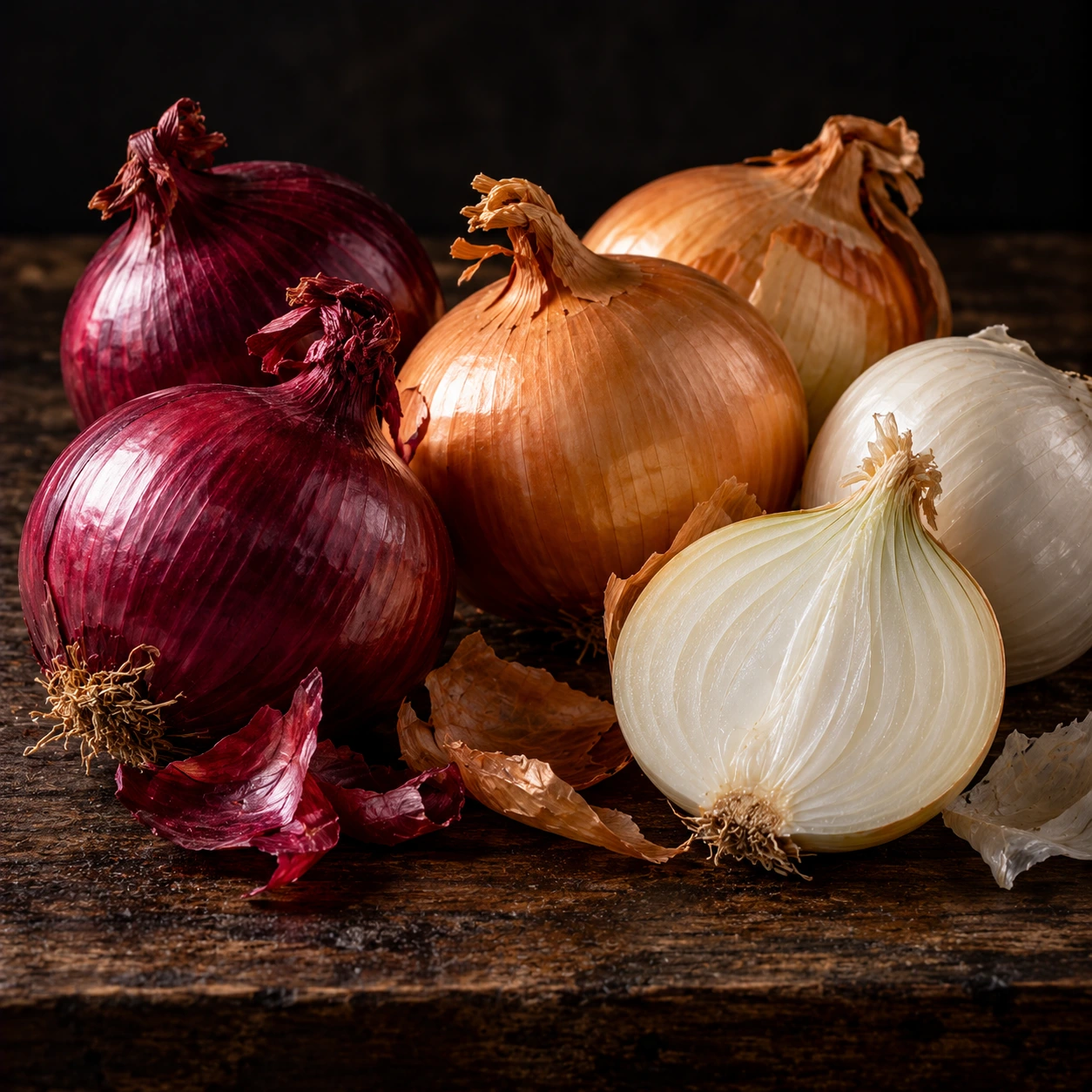
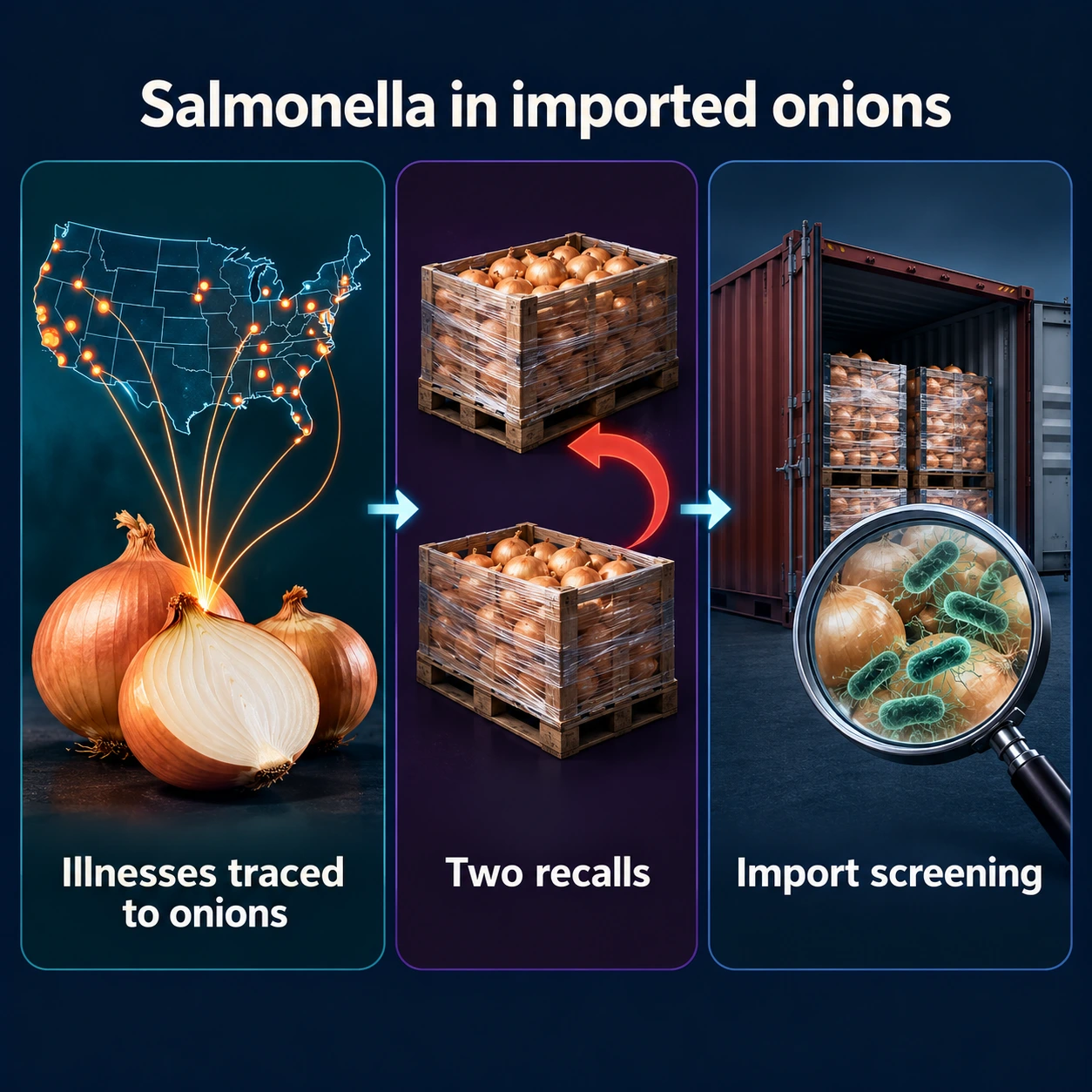
On October 20, 2021, the U.S. Food and Drug Administration (FDA) announced that it was investigating, with the Centers for Disease Control and Prevention (CDC) and state and local health officials, a multistate outbreak of Salmonella Oranienburg infections linked to whole, fresh onions imported from the State of Chihuahua, Mexico. Two U.S. onion suppliers recalled the onions that autumn. When U.S. Centers for Disease Control and Prevention declared the outbreak over in February 2022, it counted 1,040 illnesses and 260 hospitalizations in 39 states, Washington, D.C. and Puerto Rico. The vegetable itself is described on the site’s Onions page.
This page reports what the U.S. Food and Drug Administration’s own outbreak page and related U.S. Food and Drug Administration program pages say: how the illnesses were tied to onions, what was recalled, how the case count grew, what the U.S. Food and Drug Administration did at the border and with Mexican food-safety authorities, what the investigation did not establish, its status as of October 18, 2026, and how it fits the U.S. Food and Drug Administration’s other onion and produce-safety actions. No supplier, grower or retailer is named here.
Table of Contents
- What the U.S. Food and Drug Administration Announced on October 20, 2021
- How Investigators Linked the Illnesses to Onions
- Salmonella Oranienburg and Salmonellosis, per the U.S. Food and Drug Administration
- The Two Recalls and the Downstream Lists
- How the Case Count Grew
- Import Screening, Importer Inspections and Work With Mexico
- What the U.S. Food and Drug Administration Page Tells Readers Now
- What the Investigation Did Not Establish
- Dates and Status as of October 18, 2026
- How It Fits Other U.S. Food and Drug Administration Onion and Produce-Safety Actions
- Primary Documents
- Key Research Papers
- Connections
- Featured Videos
1. What the U.S. Food and Drug Administration Announced on October 20, 2021
The U.S. Food and Drug Administration’s outbreak page, “Outbreak Investigation of Salmonella Oranienburg: Whole, Fresh Onions (October 2021),” opened with an update dated October 20, 2021. It stated that the U.S. Food and Drug Administration, “along with U.S. Centers for Disease Control and Prevention and state and local partners, is investigating a multistate outbreak of Salmonella Oranienburg infections linked to whole, fresh onions.”
The same update reported that the U.S. Food and Drug Administration’s traceback investigation, though still ongoing, had identified an Idaho produce supplier as a source of potentially contaminated whole, fresh onions imported from the State of Chihuahua, Mexico. That supplier agreed to voluntarily recall red, yellow and white onions imported from Chihuahua with import dates from July 1 through August 27, 2021.
A traceback, as the U.S. Food and Drug Administration’s outbreak-investigations page describes it, is used “to identify the source and distribution of the implicated food and remove the contaminated product from the marketplace,” to tell apart two or more suspected foods, and to find possible routes or sources of contamination. The U.S. Food and Drug Administration describes the investigation as carried out “in cooperation with the Mexican competent authorities” — Mexico’s food-safety regulators.
This was an outbreak investigation, not a rule. No Federal Register document (the U.S. government’s daily publication of rules and official notices) was issued for it; the record is the U.S. Food and Drug Administration outbreak page and its dated updates.
2. How Investigators Linked the Illnesses to Onions
The U.S. Food and Drug Administration’s October 20 update set out three lines of evidence:
- Restaurant clusters. Epidemiological data collected by U.S. Centers for Disease Control and Prevention and state and local investigators identified 20 illness clusters at restaurants where onions were served. A cluster here means a group of sick people who ate at the same place. The U.S. Food and Drug Administration wrote that information from these clusters “shows that many ill people ate raw onions,” and that investigators worked to find a common food eaten by all of the sick people.
- One positive food sample. State officials collected food items from some of the restaurants. The outbreak strain was found in a sample from a takeout condiment cup containing cilantro and lime. The sick person reported that the cup had also contained onions, but none were left in it when it was tested. In the U.S. Food and Drug Administration’s words, because several foods were in the container and in the sample, “it is not possible to know which food item was contaminated.”
- A common supplier. The traceback identified the Idaho supplier as a common supplier for many of the restaurants where sick people reported eating, including the restaurant where the condiment-cup sample was collected.
On October 21, 2021, the U.S. Food and Drug Administration reported that its traceback had identified a second supplier of onions from Chihuahua as “an additional common supplier” for many of the restaurants where sick people ate.
3. Salmonella Oranienburg and Salmonellosis, per the U.S. Food and Drug Administration
Salmonella is a group of bacteria. Oranienburg is the name of one serotype, a subtype of Salmonella told apart by laboratory testing. The site’s Salmonella Typhimurium page covers a different serotype; this outbreak was serotype Oranienburg.
The U.S. Food and Drug Administration’s Salmonella page, linked from the outbreak page, describes the illness these bacteria cause:
- The illness. Salmonella “can cause gastrointestinal illness and fever called salmonellosis.”
- Timing. Most people infected begin to develop symptoms 12 to 72 hours after infection; the illness usually lasts four to seven days, and most people recover without treatment.
- Symptoms. Most people with salmonellosis develop diarrhea, fever and abdominal cramps. More severe cases may include a high fever, aches, headaches, lethargy, a rash, or blood in the urine or stool, and in some cases may become fatal.
- Who is at higher risk. Children younger than five, the elderly and people with weakened immune systems are more likely to have severe infections.
- How it spreads. The page lists food handlers who do not wash hands, surfaces or tools between food-preparation steps, eating raw or undercooked foods, and contact with certain animals.
The U.S. Food and Drug Administration’s 2022 bulb-onion strategy (section 10) notes that bulb onions can be “consumed raw as an ingredient or garnish,” which matches the outbreak page’s finding that many ill people ate raw onions. Bacterial infections in general are covered on the site’s Bacterial Infections page.
4. The Two Recalls and the Downstream Lists
A voluntary recall is one a company carries out itself, here after meeting with the U.S. Food and Drug Administration, rather than under a court or agency order. The U.S. Food and Drug Administration outbreak page records two:
- October 20, 2021 — the Idaho supplier. A voluntary recall of red, yellow and white whole, fresh onions imported from the State of Chihuahua, Mexico, with import dates from July 1, 2021 through August 31, 2021 (the U.S. Food and Drug Administration’s October 20 update had given August 27).
- October 22, 2021 — the second supplier. The U.S. Food and Drug Administration’s October 21 update reports that when the U.S. Food and Drug Administration met with this firm, it agreed to recall all red, yellow and white onions imported from Chihuahua from July 1 through August 31, 2021. Its recall, issued October 22, covered onions imported from July 1 through August 25, 2021, “when the last shipment of onions from the State of Chihuahua, Mexico was received by the firm.”
The recalls then spread down the supply chain. On October 29, 2021, the U.S. Food and Drug Administration posted a list of additional recalls by retailers that may have received the recalled onions, including companies that “further processed the onions by using them as ingredients in new products or by repackaging them.” The U.S. Food and Drug Administration also published lists of retail establishments that received recalled product: one for the Idaho supplier’s onions on October 29 and one for the second supplier’s on November 2, 2021.
The U.S. Food and Drug Administration attached a caution to those store lists: they “represent the best information currently available to the U.S. Food and Drug Administration; however, they may not include all retail establishments that have received the recalled product or may include retail establishments that did not actually receive the recalled product.” The page pointed readers to the product details in each firm’s recall announcement alongside the lists.
5. How the Case Count Grew
All case figures below are U.S. Centers for Disease Control and Prevention’s counts as the U.S. Food and Drug Administration outbreak page reports them.
- October 29, 2021: 808 illnesses across 37 states and Puerto Rico.
- November 12, 2021: 892 illnesses in 38 states and Puerto Rico.
- Final count (outbreak declared over as of February 2, 2022): 1,040 illnesses, 260 hospitalizations and no deaths, in 39 states, Washington, D.C. and Puerto Rico. The last illness began on January 1, 2022. The U.S. Food and Drug Administration lists product distribution as nationwide.
The onions also reached Canada. As of October 29, 2021, the U.S. Food and Drug Administration reported that the Canadian Food Inspection Agency had issued an advisory for recalled onions imported into Canada, and that there were no illnesses in Canada linked to the outbreak.
For scale, the U.S. Food and Drug Administration’s 2022 bulb-onion strategy states that the 2020 and 2021 Salmonella outbreaks linked to bulb onions grown in the U.S. and Mexico together caused “more than 2,100 confirmed cases of foodborne illness in the United States,” and estimates that the 2021 outbreak cost “$188 million in consumer health-related losses.”
6. Import Screening, Importer Inspections and Work With Mexico
The U.S. Food and Drug Administration outbreak page describes three steps beyond the recalls:
- Enhanced import screening (September 2021). While the source was still being sought, U.S. Food and Drug Administration import operations put in place enhanced screening for Salmonella in onions imported into the United States. No samples were collected, the U.S. Food and Drug Administration wrote, “because the growing season had ended and onions were no longer being imported from the State of Chihuahua, Mexico.”
- Inspections of U.S. importers. After the outbreak the U.S. Food and Drug Administration began onsite domestic investigations and Foreign Supplier Verification Program (FSVP) inspections of U.S. firms that had imported onions from Chihuahua. The U.S. Food and Drug Administration’s FSVP rule page explains that an FSVP is a program covered importers must have in place to verify that their foreign suppliers produce food with “the same level of public health protection as the preventive controls or produce safety regulations,” and that the food is not adulterated. By inspecting importers, the outbreak page says, the U.S. Food and Drug Administration can check whether they are “performing certain risk-based activities to verify that imported foods meet U.S. safety standards.”
- Work with Mexican authorities. The U.S. Food and Drug Administration continued to work with Mexican competent authorities through the established Food Safety Partnership to look for possible sources of contamination in the implicated region and to put prevention measures in place before the next growing season. It also said it intended to consider “additional tools, such as import screening and sampling,” for onions grown and harvested in Chihuahua during the next season.
The U.S. Food and Drug Administration’s partnership page explains that the FDA-SENASICA-COFEPRIS Food Safety Partnership was set up in September 2020 between the U.S. Food and Drug Administration and two Mexican agencies: the National Service of Agro-Alimentary Health, Safety and Quality (SENASICA) and the Federal Commission for Protection against Sanitary Risk (COFEPRIS). It states that roughly one third of all U.S. Food and Drug Administration-regulated human food imported into the U.S. comes from Mexico, including 60% of fresh produce imports. Among the partnership’s reported work, the page (current as of March 12, 2026) lists a virtual technical workshop for bulb-onion producers in Chihuahua with 70 participants, and visits by the Mexican agencies to 45 farms and 15 packinghouses in Chihuahua using a U.S. Food and Drug Administration bulb-onion information-collection tool; the page does not date these steps.
7. What the U.S. Food and Drug Administration Page Tells Readers Now
During the investigation the U.S. Food and Drug Administration’s page carried instructions for consumers, restaurants and retailers about the recalled onions. Those instructions were replaced once the outbreak ended. The final version of the U.S. Food and Drug Administration outbreak page, content current as of February 2, 2022, reads: “U.S. Centers for Disease Control and Prevention has announced the outbreak is over. There are no recommendations for consumers, retailers, or suppliers.”
The page’s contact section states that consumers who have symptoms are directed to their health care provider “to report their symptoms and receive care,” and that complaints or adverse events, including illness, can be reported to the U.S. Food and Drug Administration through its Industry and Consumer Assistance pages. These are the U.S. Food and Drug Administration’s statements; questions about any illness belong with a clinician.
8. What the Investigation Did Not Establish
- The outbreak strain was not found in an onion. The only positive food sample described on the U.S. Food and Drug Administration page was the mixed condiment cup of cilantro and lime, and the U.S. Food and Drug Administration states that it is not possible to know which food in it was contaminated.
- No root cause was found. The U.S. Food and Drug Administration’s 2022 bulb-onion strategy states that the agency “was unable to conduct an on-farm investigation at the time, and no conclusive root-cause was determined.”
- No import samples were taken. The September 2021 import screening collected no samples because the Chihuahua growing season had ended.
- The recalls were limited. They covered whole red, yellow and white onions from Chihuahua imported in July and August 2021 (and products made with them), not onions in general.
- It was not a rule. The investigation set no new legal requirement for growers or importers.
9. Dates and Status as of October 18, 2026
- September 2021: U.S. Food and Drug Administration import operations begin enhanced Salmonella screening of imported onions; no samples are collected.
- October 20, 2021: the U.S. Food and Drug Administration announces the investigation; the Idaho supplier begins its voluntary recall.
- October 21–22, 2021: the traceback identifies a second common supplier, which recalls its Chihuahua onions.
- October 29 and November 2, 2021: the U.S. Food and Drug Administration posts lists of downstream recalls and of retail establishments that received recalled onions.
- November 12, 2021: 892 illnesses in 38 states and Puerto Rico.
- February 2, 2022: U.S. Centers for Disease Control and Prevention declares the outbreak over: 1,040 illnesses, 260 hospitalizations, no deaths.
- July 2022: the U.S. Food and Drug Administration posts its strategy to help prevent salmonellosis outbreaks associated with bulb onions (section 10).
Status as of October 18, 2026: closed. The U.S. Food and Drug Administration page states, “U.S. Food and Drug Administration investigation has ended; U.S. Centers for Disease Control and Prevention has declared outbreak over.” A check of the Federal Register for U.S. Food and Drug Administration documents on onions and Salmonella from 2021 through October 18, 2026 found no document about this outbreak. The three documents it returned are the December 2021 agricultural water proposed rule, the agricultural water final rule published May 6, 2024 (89 FR 37448, effective July 5, 2024), and the November 2022 traceability final rule (section 10).
10. How It Fits Other U.S. Food and Drug Administration Onion and Produce-Safety Actions
- Summer 2020 — red onions and Salmonella Newport. The U.S. Food and Drug Administration’s report on that outbreak, posted in 2021 (content current as of May 13, 2021), describes 1,127 reported U.S. illnesses and 515 Canadian cases linked to red onions grown in California, and calls it “the largest Salmonella outbreak in over a decade.” It notes that whole red onions, a raw agricultural commodity, “had not been previously associated with a foodborne illness outbreak.” No conclusive root cause was found; the report’s leading hypothesis was contaminated irrigation water used in one growing field.
- Fall 2021 — this outbreak. Onions from a different country, a different serotype, and a second year in a row of a large onion-linked Salmonella outbreak.
- December 2021 — farm water. In the same season the U.S. Food and Drug Administration proposed new rules for the water used on produce farms before harvest, reported on the site’s Agricultural Water Proposed Rule page.
- July 2022 — the bulb-onion prevention strategy. The U.S. Food and Drug Administration’s strategy page says the agency began developing these measures in fall 2020, began carrying them out in summer 2021, and updated them in winter 2021 “to account for the 2021 bulb onion outbreak.” The measures it lists include prioritizing inspections of bulb-onion farms in the U.S. and Mexico covered by the U.S. Food and Drug Administration’s Produce Safety Rule, studying onion curing and soil conditions, supporting industry best practices, prioritizing FSVP inspections of bulb-onion importers, increasing “strategic and targeted sample collection and testing of imported bulb onions from the State of Chihuahua, Mexico,” and continuing the Food Safety Partnership with Mexico.
- November 2022 — traceability records. The U.S. Food and Drug Administration’s food traceability final rule requires additional records for certain foods; it is reported on the Food Traceability Final Rule page. This page does not state whether onions are among the foods that rule covers.
- 2023 — another produce outbreak. The U.S. Food and Drug Administration’s investigation of a cantaloupe-linked Salmonella outbreak is reported on the Cantaloupe Salmonella Outbreak page.
The other major U.S. Food and Drug Administration actions of the year are collected on the U.S. Food and Drug Administration Actions of 2021 hub.
11. Primary Documents
- U.S. Food and Drug Administration. Outbreak Investigation of Salmonella Oranienburg: Whole, Fresh Onions (October 2021). Outbreak investigation page with dated updates of October 20, 21, 27 and 29 and November 2 and 12, 2021; final update, content current as of February 2, 2022 — fda.gov onion outbreak investigation
- U.S. Food and Drug Administration. Summary of U.S. Food and Drug Administration’s Strategy to Help Prevent Salmonellosis Outbreaks Associated with Bulb Onions. Posted July 2022, content current as of September 26, 2022 — fda.gov bulb onion strategy
- U.S. Food and Drug Administration. Factors Potentially Contributing to the Contamination of Red Onions Implicated in the Summer 2020 Outbreak of Salmonella Newport. Report, content current as of May 13, 2021 — fda.gov 2020 red onion report
- U.S. Food and Drug Administration. Salmonella (Salmonellosis). Foodborne pathogens page, content current as of March 29, 2019 — fda.gov Salmonella page
- U.S. Food and Drug Administration. FSMA Final Rule on Foreign Supplier Verification Programs (FSVP) for Importers of Food for Humans and Animals. Program page, content current as of May 1, 2026 — fda.gov FSVP rule page
- U.S. Food and Drug Administration. FDA-SENASICA-COFEPRIS Food Safety Partnership. Program page, content current as of March 12, 2026 — fda.gov Food Safety Partnership page
- U.S. Food and Drug Administration. Investigations of Foodborne Illness Outbreaks (definitions of outbreak-investigation terms, including traceback) — fda.gov outbreak investigations page
- The two suppliers’ recall announcements and the U.S. Food and Drug Administration’s list of related downstream recalls are linked from the U.S. Food and Drug Administration outbreak page above. Their addresses carry the firms’ names, so they are not linked here.
Key Research Papers
- Mitchell MR Jr, Kirchner M, Schneider B, McClure M, Neil KP, Madad A, Jemaneh T, Tijerina M, et al. (2024). Multistate outbreak of Salmonella Oranienburg infections linked to bulb onions imported from Mexico - United States, 2021. Food Control 160:110325 — PubMed PMID: 39493539
- McCormic ZD, Patel K, Higa J, Bancroft J, Donovan D, Edwards L, Cheng J, Adcock B, et al. (2022). Bi-national outbreak of Salmonella Newport infections linked to onions: the United States experience. Epidemiology and Infection 150:e199 — PubMed PMID: 36382397
- Denich L, Cheng JM, Smith CR, Taylor M, Atkinson R, Boyd E, Chui L, Honish L, et al. (2024). A multi-provincial outbreak of Salmonella Newport infections associated with red onions: A report of the largest Salmonella outbreak in Canada in over 20 years. Epidemiology and Infection 152:e106 — PubMed PMID: 39344903
- Graham-Glover B, Pereira E, Jefferson S, Blessington T, Armstrong M, Schwensohn C, Wilson C, Cromwell A, et al. (2026). Multistate Outbreak of Salmonella Thompson Infections Linked to Diced Onions-2023. Foodborne Pathogens and Disease 23(10):693-700 — PubMed PMID: 40956677
- Racine J, Nerney A, Kilgore S, Darner J, Spets M, Critzer F, Harris LJ, Reitz S, et al. (2024). Irrigation Method Matters: Contamination and Die-off Rates of Escherichia coli on Dry Bulb Onions After Overhead and Drip Irrigation in Washington State (2022-2023). Journal of Food Protection 87(9):100326 — PubMed PMID: 38977079
- Khajanchi BK, Grocholl J, Alam MS, Hasan NA, Wang H, Hughes S (2026). Colonization of Salmonella Newport and Microbiome Analyses of Bulb Onions Grown in Artificially Contaminated Soil at Lab-Scale Under a Controlled Environment. Journal of Food Protection 89(5):100769 — PubMed PMID: 41921618
The first paper is the published report of this 2021 outbreak investigation. The second and third describe the 2020 red-onion Salmonella Newport outbreak in the United States and in Canada, and the fourth a 2023 outbreak linked to diced onions. The last two are field and laboratory studies of bacterial contamination of bulb onions from irrigation water and from soil.
PubMed Topic Searches
Connections
- U.S. Food and Drug Administration Actions of 2021
- U.S. Food and Drug Administration and Regulation
- Onions
- Vegetables
- Salmonella Typhimurium (a different serotype)
- Bacteria
- Bacterial Infections
- Agricultural Water Proposed Rule (2021)
- Food Traceability Final Rule (2022)
- Cantaloupe Salmonella Outbreak (2023)
- Closer to Zero Action Plan (2021)
- Voluntary Sodium Reduction Targets (2021)