U.S. Food and Drug Administration's Closer to Zero Plan for Toxic Elements in Baby Food (2021)

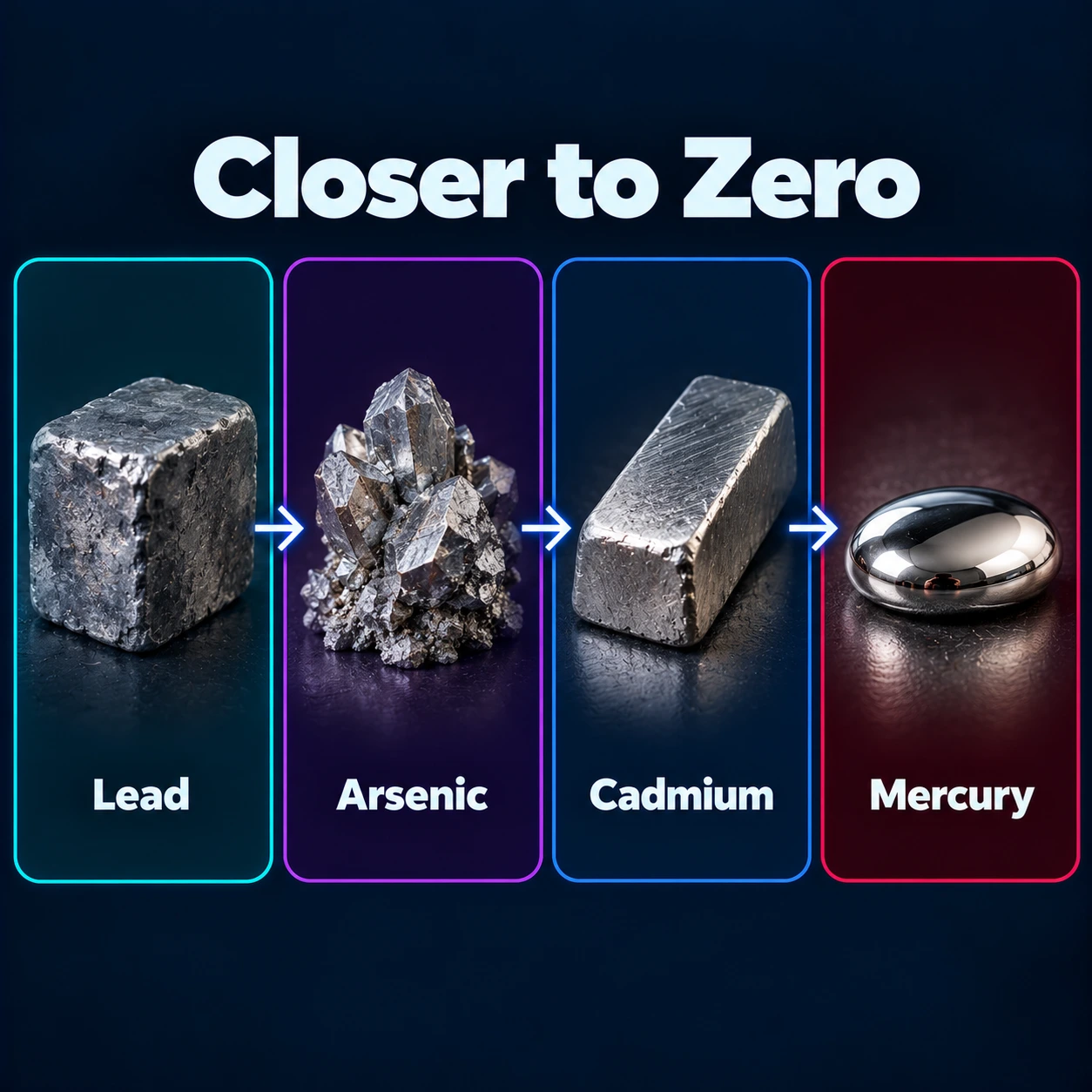

Between February and December 2021, the U.S. Food and Drug Administration (FDA) answered a congressional report on metals in baby food, reminded baby and toddler food makers of their existing safety duties, and launched “Closer to Zero,” its action plan for reducing exposure to lead, arsenic, cadmium and mercury from foods eaten by babies and young children. The metals themselves are described on the site’s Heavy Metals in Food page.
This page reports what the U.S. Food and Drug Administration’s own documents say: each 2021 step and its date, what an “action level” is, what the plan committed to in its first year, the first public meeting, the advice the U.S. Food and Drug Administration gave parents and caregivers (quoted as the U.S. Food and Drug Administration’s), what the 2021 steps did not do, the plan’s status as of October 18, 2026, and how it led to later U.S. Food and Drug Administration guidance. No food, brand or manufacturer is named here.
Table of Contents
- What the U.S. Food and Drug Administration Did in 2021
- February 16: The U.S. Food and Drug Administration’s Response to a Congressional Report
- March 5: A Letter to Baby and Toddler Food Makers
- April 8: The Closer to Zero Action Plan
- What an Action Level Is
- The First-Year (Phase 1) Commitments
- November and December: The First Public Meeting
- What the U.S. Food and Drug Administration Told Parents and Caregivers
- What the 2021 Actions Did Not Do
- Dates and Status as of October 18, 2026
- How It Fits Earlier and Later U.S. Food and Drug Administration Actions
- Primary Documents
- Key Research Papers
- Connections
- Featured Videos
1. What the U.S. Food and Drug Administration Did in 2021
The U.S. Food and Drug Administration’s 2021 work on toxic elements in foods for babies and young children came in four public steps, each announced in a U.S. Food and Drug Administration constituent update (a short notice the agency publishes for the food industry and other interested groups):
- February 16, 2021: a response to questions raised by a U.S. House of Representatives subcommittee report released on February 4, 2021.
- March 5, 2021: a letter to baby and toddler food manufacturers and processors about chemical hazards, with a list of near-term U.S. Food and Drug Administration commitments.
- April 8, 2021: the announcement of “Closer to Zero,” the agency’s action plan for lead, arsenic, cadmium and mercury in foods for babies and young children.
- October 8–12, 2021: the announcement, and then a Federal Register notice, of the plan’s first public meeting, held virtually on November 18, 2021 (86 FR 56711; Docket No. FDA-2021-N-0966).
None of these steps was a regulation. They were a response, a reminder letter, a plan with a timetable and a public meeting. The first numbers came later, as guidance documents with action levels for specific foods (section 11).
2. February 16: The U.S. Food and Drug Administration’s Response to a Congressional Report
On February 4, 2021, the U.S. House of Representatives Committee on Oversight and Reform’s Subcommittee on Economic and Consumer Policy released a report on toxic elements in baby foods. The U.S. Food and Drug Administration’s constituent update of February 16 said the report “raises important questions on what more can be done to reduce toxic elements in baby foods,” and set out what the agency said it was already doing.
On where the elements come from, the U.S. Food and Drug Administration wrote that toxic elements such as arsenic and lead “are present in the environment and may enter the food supply through soil, water or air.” Because of that, it said, “currently they cannot be completely avoided in the fruits, vegetables, or grains that are the basis for baby foods, juices, and infant cereals,” whether made by companies or at home, and “cannot be completely avoided by using organic farming practices.” It gave its goal as reducing exposure “to the greatest extent feasible.”
The update listed how the U.S. Food and Drug Administration monitors baby food:
- the Total Diet Study, in which U.S. Food and Drug Administration scientists routinely measure toxic elements in baby foods and other foods in the national diet;
- the compliance program for Toxic Elements in Food and Foodware, and Radionuclides in Food; and
- targeted sampling assignments.
It also listed enforcement examples. On January 15, 2021, the U.S. Food and Drug Administration said, it had ordered a U.S. company already under court order for distributing adulterated food to stop distributing juice products containing potentially harmful levels of inorganic arsenic and the mold toxin patulin. Between 2019 and 2020, about 65 import actions kept products with potentially elevated levels of toxic elements from entering the United States. The U.S. Food and Drug Administration had ongoing import alerts for arsenic in fruit juice, bottled water and dietary supplements, and for lead in candy, dried fruits, spices, dietary supplements and other foods.
The update pointed to infant rice cereal as an example of earlier progress: U.S. Food and Drug Administration sampling since 2011, it said, showed that manufacturers had made “significant progress in reducing arsenic in infant rice cereal products” through selective sourcing and testing of rice ingredients, supported by U.S. Food and Drug Administration final guidance on action levels. It also noted that U.S. Food and Drug Administration scientists take part in the Codex Alimentarius, the international food-standards body of the Food and Agriculture Organization and the World Health Organization, whose levels for lead, arsenic, cadmium and mercury are “not binding” but “can inform our regulatory decisions.”
3. March 5: A Letter to Baby and Toddler Food Makers
On March 5, 2021, the U.S. Food and Drug Administration issued a letter to baby and toddler food manufacturers and processors covered by the preventive-control provisions of the rule titled Current Good Manufacturing Practice, Hazard Analysis, and Risk-Based Preventive Controls for Human Food. Under that rule, a food facility has to look at what could make its food unsafe (a hazard analysis) and put controls in place for the hazards it finds.
The constituent update states that the letter “reminds them of their existing responsibility to consider risks from chemical hazards, including toxic elements, when conducting a hazard analysis, including for products for babies and young children.” The provisions, it adds, require industry “to implement controls to significantly minimize or prevent any identified chemical hazards requiring a control,” and it gives testing of the final product as one example of a verification activity some manufacturers may use.
The same update explained that levels of arsenic, lead, mercury and cadmium in a food depend on growing conditions, manufacturing and agricultural processes, past or current environmental contamination, and “the genetic capacity of food crops to take up elements.” It stated: “at the levels we have found through our testing, children are not at an immediate health risk from exposure to toxic elements in foods,” and also that “Research has shown that reducing exposure to toxic elements is important to minimizing any potential long-term effects on the developing brains of infants and children.”
The U.S. Food and Drug Administration listed its near-term commitments that day:
- reviewing current action levels and developing additional ones, including finalizing its draft guidance on arsenic in apple juice and publishing a draft guidance with action levels for lead in juices;
- focused compliance and enforcement activities, including inspections;
- guidance to industry on meeting its obligations under current regulations;
- continued surveillance sampling of these products; and
- a workshop with stakeholders in the coming year.
4. April 8: The Closer to Zero Action Plan
On April 8, 2021, the U.S. Food and Drug Administration announced “Closer to Zero,” described in its constituent update as “the agency’s action plan for reducing exposure to toxic elements, including lead, arsenic, cadmium, and mercury, from foods for babies and young children.” The stated aim is to “help continually reduce toxic elements to the lowest levels possible in foods eaten by babies and young children.”
The U.S. Food and Drug Administration was clear that zero itself is not reachable: because fruits, vegetables and grains “take up” toxic elements from water, soil and air, “there are limits to how low the levels can be reduced.” Exposure, it said, depends both on the level in a food and on how much of that food is eaten.
The plan named three areas of focus:
- advancing research and evaluating changes in dietary exposure to toxic elements;
- setting action levels with input from stakeholders; and
- encouraging industry to adopt best practices to lower levels in agricultural commodities and products.
The U.S. Food and Drug Administration added that it would increase targeted compliance and enforcement and monitor levels over time. The plan works in four stages repeated as a cycle, and its action items were set out in three phases. The U.S. Food and Drug Administration’s Closer to Zero program page describes the four stages as: evaluating the science, including setting “interim reference levels”; proposing action levels in draft guidance; consulting stakeholders on whether the levels can be achieved; and finalizing the levels, after which the cycle starts again. An interim reference level, in the program page’s words, is “a measure of exposure to a contaminant from food that the U.S. Food and Drug Administration may use to determine if the amount of exposure to the contaminant across foods could result in a specific health impact.”
The U.S. Food and Drug Administration also set a limit on its own limits. It wrote that measures to reduce toxic elements must not have “unintended consequences—like limiting access to foods that have significant nutritional benefits by making them unavailable or unaffordable for many families,” and noted the possibility of “unintentionally increasing the presence of one toxic element when foods are reformulated to reduce the presence of another.”
5. What an Action Level Is
The U.S. Food and Drug Administration’s program page calls action levels “one regulatory tool the U.S. Food and Drug Administration uses to help lower levels of chemical contaminants in foods when a certain level of a contaminant is unavoidable.” The April 8 constituent update defines them as “levels set by the U.S. Food and Drug Administration to provide guidance to industry and U.S. Food and Drug Administration field staff,” and as “a level of contamination at which a food may be regarded as adulterated within the meaning of section 402(a)(1) of the Federal Food, Drug, and Cosmetic Act.” “Adulterated” is the legal term for food that breaks the safety provisions of that law. The U.S. Food and Drug Administration considers action levels, along with other factors, when deciding whether to take enforcement action in a particular case, and the update notes they “can be lowered over time as appropriate.”
The Closer to Zero program page adds two points:
- “Action levels do not establish a permissible level of contamination.”
- “The agency does not need an action level for a contaminant to take enforcement action on a food product that violates safety laws.” Manufacturers already have a legal duty under the preventive-controls requirements to minimize or prevent chemical hazards, including these four elements.
Action levels are issued in guidance documents, which describe the U.S. Food and Drug Administration’s current thinking on how it applies the law. A guidance document is first published as a draft for public comment and later issued in final form.
6. The First-Year (Phase 1) Commitments
The April 8 constituent update lists what the U.S. Food and Drug Administration committed to during the plan’s first year:
- proposing action levels for lead in categories of foods consumed by babies and young children;
- consulting with and gathering data from stakeholders and federal partners on issues such as feasibility and best practices;
- evaluating the science related to arsenic exposure from foods;
- sharing resources with industry on best practices for reducing or preventing lead contamination; and
- completing updated sampling assignments looking at toxic element levels in baby foods.
The later phases, the update said, “will include addressing additional toxic elements such as cadmium and mercury.” The program page explains why lead came first: “because of currently available data, we will start with proposing action levels for lead while we evaluate data for arsenic, cadmium, and mercury.” The same page notes that babies and young children were prioritized “because their smaller body sizes and metabolism make them more vulnerable to the harmful effects of these contaminants.”
7. November and December: The First Public Meeting
On October 8, 2021, the U.S. Food and Drug Administration announced the virtual public meeting “Closer to Zero Action Plan: Impacts of Toxic Element Exposure and Nutrition at Different Crucial Developmental Stages,” described as “the first of several expected meetings” on the plan. The Federal Register notice followed on October 12, 2021 (86 FR 56711). A Federal Register docket is the public file for an action, kept on regulations.gov, where the documents and public comments are collected; this one is FDA-2021-N-0966.
- Date: November 18, 2021, 10 a.m. to 4 p.m. Eastern Time, by webcast, with no registration fee.
- Purpose: according to the notice, to discuss the scope of the plan as it relates to toxic element exposure and nutrition at different developmental stages, “including discussion of the key nutrients in food for growth and development, foods commonly consumed by babies and young children, and exposure risks of toxic elements.”
- Comments: the docket closed on December 20, 2021.
The U.S. Food and Drug Administration’s program page lists two further 2021 events: a U.S. Food and Drug Administration–Society of Toxicology colloquium on arsenic and children’s health on December 1, 2021, and U.S. Food and Drug Administration Grand Rounds on Closer to Zero on December 9, 2021.
8. What the U.S. Food and Drug Administration Told Parents and Caregivers
The March 5 and April 8 constituent updates included advice for parents and caregivers. It is the U.S. Food and Drug Administration’s advice, reported here as the agency gave it:
- On testing results: “U.S. Food and Drug Administration testing shows that children are not at an immediate health risk from exposure to toxic elements in foods.”
- On packaged baby food: the U.S. Food and Drug Administration wrote, “You do not need to throw out packaged baby foods or stop feeding certain foods to your babies and children,” and that eliminating entire food groups “may result in nutrient deficiencies and potential poor health outcomes.”
- On homemade baby food: the U.S. Food and Drug Administration stated that making baby food at home “is not likely to reduce your baby’s risk of exposure to toxic elements in food” and “may actually result in higher concentrations,” because manufacturers have more capability to source ingredients with lower concentrations.
- On homemade infant formula: the U.S. Food and Drug Administration wrote, “Please do NOT attempt to make homemade infant formula to feed your baby,” stating it is “extremely unlikely to reduce exposure to toxic elements” and “has resulted in infants suffering life-threatening consequences, including severe nutritional deficiencies and microbial foodborne illness.”
- On iron and variety: the U.S. Food and Drug Administration pointed to a varied, age-appropriate diet discussed with a child’s pediatrician, noting that babies over six months old need iron-containing food such as iron-fortified grain cereals. Its February update added that rice cereal fortified with iron is a good source of nutrients for infants but need not be the only or the first one.
Questions about an individual child’s diet belong with the child’s clinician.
9. What the 2021 Actions Did Not Do
- They set no limit. No action level for any of the four elements was issued in 2021. Closer to Zero is a plan and a timetable; the first action levels it produced came in 2022 and later (section 11).
- The March letter created no new requirement. It reminded manufacturers of duties they already had under the preventive-controls rule.
- They did not remove products from sale. The U.S. Food and Drug Administration’s stated position was that children were not at an immediate health risk at the levels it had found; it did not tell families to discard packaged baby foods.
- They did not promise zero. The U.S. Food and Drug Administration stated that there are limits to how low levels in crops can be reduced.
- They did not change the law. Enforcement still rests on the existing adulteration provisions of the Federal Food, Drug, and Cosmetic Act and on the existing preventive-controls rule.
10. Dates and Status as of October 18, 2026
- February 4, 2021: a House subcommittee releases its report on toxic elements in baby foods.
- February 16, 2021: the U.S. Food and Drug Administration responds in a constituent update.
- March 5, 2021: the U.S. Food and Drug Administration sends its letter to baby and toddler food makers and lists near-term commitments.
- April 8, 2021: the U.S. Food and Drug Administration announces the Closer to Zero action plan.
- October 8 and 12, 2021: the first public meeting is announced and published in the Federal Register (86 FR 56711; Docket No. FDA-2021-N-0966).
- November 18, 2021: the first Closer to Zero public meeting is held virtually.
- December 9, 2021: U.S. Food and Drug Administration Grand Rounds on Closer to Zero.
- December 20, 2021: the comment docket closes.
Status as of October 18, 2026: ongoing program. Closer to Zero was never a binding rule, so there is nothing to finalize or withdraw. The U.S. Food and Drug Administration’s program page (content current as of January 6, 2025) shows final guidance on lead in processed foods for babies and young children issued in January 2025, draft guidance on lead in juices issued in April 2022 with a final target of 2025, arsenic and cadmium action levels listed as a 2025 goal for draft guidance, and mercury still at the evaluation stage. The same page reports “130 stakeholder engagements since 2021.”
11. How It Fits Earlier and Later U.S. Food and Drug Administration Actions
The U.S. Food and Drug Administration’s documents place Closer to Zero after earlier work on single foods, such as the action-level guidance on inorganic arsenic in infant rice cereal mentioned in the February 2021 update. The program page records that an interim reference level for lead was identified in February 2020.
The steps that followed are listed on the program page and in Federal Register records:
- April 2022. Draft guidance with action levels for lead in juice (Federal Register notice April 29, 2022, 87 FR 25491; Docket No. FDA-2019-D-5609), the commitment made on March 5, 2021. It is reported on the site’s U.S. Food and Drug Administration Draft Action Levels for Lead in Juice (2022) page.
- August 2022. The interim reference level for lead updated, which the program page says aligned it with the Centers for Disease Control and Prevention’s 2021 blood lead reference value of 3.5 µg/dL.
- January 2023. Draft guidance on action levels for lead in foods intended for babies and young children.
- June 2, 2023. Final guidance on the action level for inorganic arsenic in apple juice (88 FR 36319; Docket No. FDA-2012-D-0322), the other commitment made on March 5, 2021.
- January 6, 2025. Final guidance on action levels for lead in processed food intended for babies and young children, reported on the site’s U.S. Food and Drug Administration Action Levels for Lead in Baby Food (2025) page.
For mercury, the program page notes that seafood is the primary dietary source and that the U.S. Food and Drug Administration and the Environmental Protection Agency have issued Advice About Eating Fish; the 2021 update to that advice is reported on the site’s 2021 fish and mercury advice page. Other 2021 U.S. Food and Drug Administration actions on lead and on what children eat are reported on the lead acetate hair dye and voluntary sodium reduction targets pages.
12. Primary Documents
- U.S. Food and Drug Administration. U.S. Food and Drug Administration Response to Questions About Levels of Toxic Elements in Baby Food, Following Congressional Report. Constituent Update, February 16, 2021 — fda.gov constituent update, February 16, 2021
- U.S. Food and Drug Administration. U.S. Food and Drug Administration Letter to Industry on Chemical Hazards, including Toxic Elements, in Food and Update on U.S. Food and Drug Administration Efforts to Increase the Safety of Foods for Babies and Young Children. Constituent Update, March 5, 2021 — fda.gov constituent update, March 5, 2021
- U.S. Food and Drug Administration. U.S. Food and Drug Administration Shares Action Plan for Reducing Exposure to Toxic Elements from Foods for Babies and Young Children. Constituent Update, April 8, 2021 — fda.gov constituent update, April 8, 2021
- U.S. Food and Drug Administration. U.S. Food and Drug Administration Announces First Closer to Zero Action Plan Public Meeting. Constituent Update, October 8, 2021 — fda.gov constituent update, October 8, 2021
- Food and Drug Administration, U.S. Department of Health and Human Services (HHS) (2021). Closer to Zero Action Plan: Impacts of Toxic Element Exposure and Nutrition at Different Crucial Developmental Stages; Public Meeting; Request for Comments. Notice of public meeting. Federal Register 86 FR 56711, October 12, 2021. Docket No. FDA-2021-N-0966 — FR Doc. 2021-22109
- U.S. Food and Drug Administration. Closer to Zero: Reducing Childhood Exposure to Contaminants from Foods. Program page, content current as of January 6, 2025 — fda.gov Closer to Zero page
- Food and Drug Administration, U.S. Department of Health and Human Services (2022). Action Levels for Lead in Juice; Draft Guidance for Industry; Availability. Federal Register 87 FR 25491, April 29, 2022. Docket No. FDA-2019-D-5609 — FR Doc. 2022-09255
- Food and Drug Administration, U.S. Department of Health and Human Services (2023). Action Level for Inorganic Arsenic in Apple Juice: Guidance for Industry; Availability. Federal Register 88 FR 36319, June 2, 2023. Docket No. FDA-2012-D-0322 — FR Doc. 2023-11769
- Public docket FDA-2021-N-0966 — regulations.gov FDA-2021-N-0966
Key Research Papers
- Gardener H, Bowen J, Callan SP (2019). Lead and cadmium contamination in a large sample of United States infant formulas and baby foods. The Science of the Total Environment 651(Pt 1):822-827 — PubMed PMID: 30253364
- Gray PJ (2023). A survey of toxic elements in ready to eat baby foods in the US market 2021. Food Additives & Contaminants. Part B, Surveillance 16(2):79-85 — PubMed PMID: 36537233
- Hoffman-Pennesi D, Winfield S, Gavelek A, Santillana Farakos SM, Spungen J (2024). Infants’ and young children’s dietary exposures to lead and cadmium: FDA total diet study 2018-2020. Food Additives & Contaminants. Part A 41(11):1454-1479 — PubMed PMID: 39236048
- Bair EC (2022). A Narrative Review of Toxic Heavy Metal Content of Infant and Toddler Foods and Evaluation of United States Policy. Frontiers in Nutrition 9:919913 — PubMed PMID: 35832055
- Karagas MR, Punshon T, Sayarath V, Jackson BP, Folt CL, Cottingham KL (2016). Association of Rice and Rice-Product Consumption With Arsenic Exposure Early in Life. JAMA Pediatrics 170(6):609-616 — PubMed PMID: 27111102
- Lanphear BP, Hornung R, Khoury J, Yolton K, Baghurst P, Bellinger DC, Canfield RL, Dietrich KN, Bornschein R, Greene T, Rothenberg SJ, Needleman HL, Schnaas L, Wasserman G, Graziano J, Roberts R (2005). Low-level environmental lead exposure and children’s intellectual function: an international pooled analysis. Environmental Health Perspectives 113(7):894-899 — PubMed PMID: 16002379
The first two papers report measurements of toxic elements in U.S. baby foods and infant formulas; the second is a 2021 market survey, listed among the research on the U.S. Food and Drug Administration’s Closer to Zero page. The third is a U.S. Food and Drug Administration Total Diet Study analysis of lead and cadmium exposure in infants and young children, also listed there. The fourth reviews toxic metal content of infant and toddler foods and U.S. policy. The last two concern exposure and health: rice products as a source of arsenic in the first year of life, and a pooled analysis of low-level lead exposure and children’s intellectual function.
PubMed Topic Searches
Connections
- U.S. Food and Drug Administration Actions of 2021
- U.S. Food and Drug Administration and Regulation
- U.S. Food and Drug Administration Draft Action Levels for Lead in Juice (2022)
- U.S. Food and Drug Administration Action Levels for Lead in Baby Food (2025)
- Heavy Metals in Food
- Lead
- Arsenic
- Cadmium
- Mercury
- Toxic Minerals
- Fish and Mercury Advice Update (2021)
- Lead Acetate Hair Dye Ban (2021)
- Voluntary Sodium Reduction Targets (2021)