U.S. Food and Drug Administration (FDA) Denies Its First Flavored E-Cigarettes, Over 946,000 Products (2021)

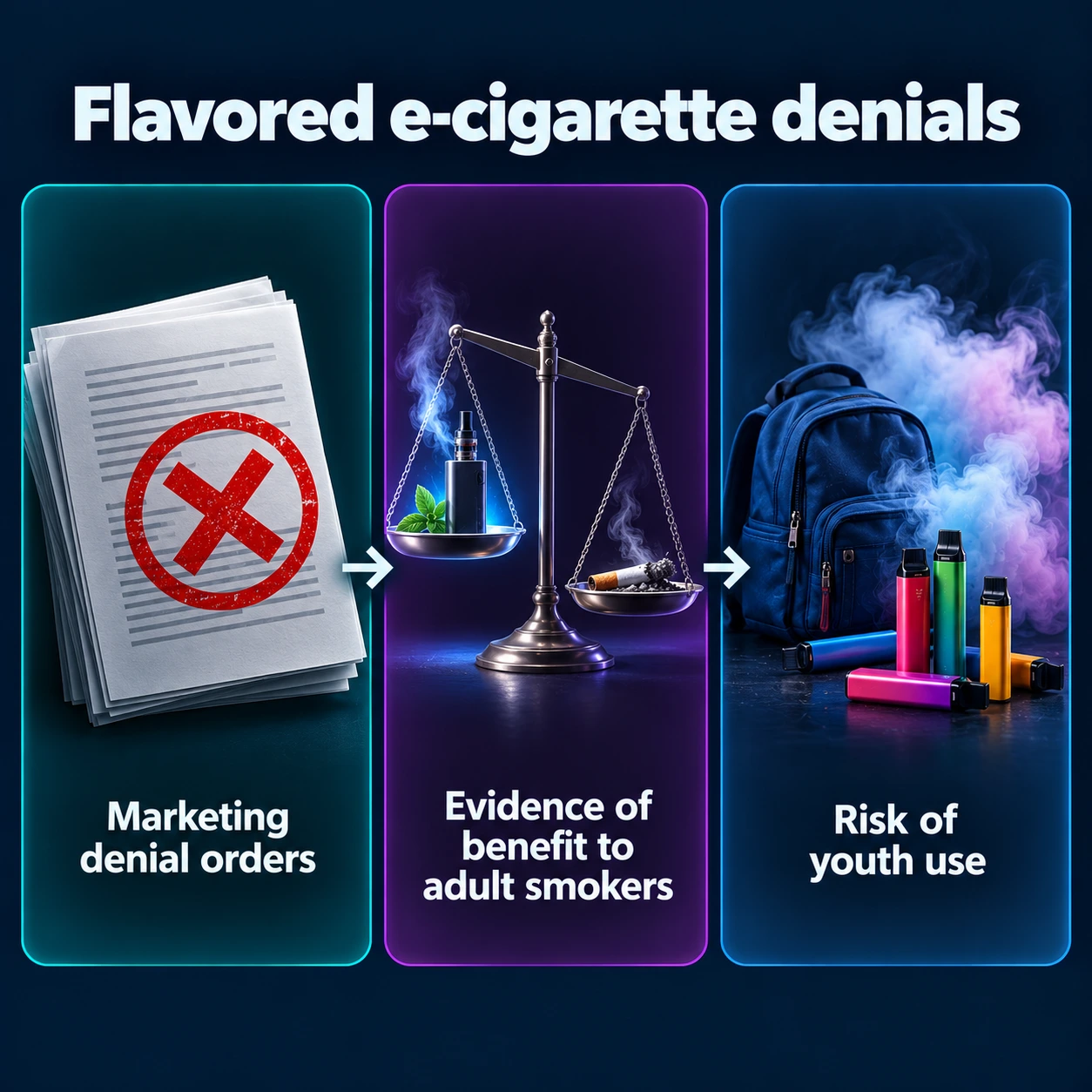

In August and September 2021 the U.S. Food and Drug Administration (FDA) issued its first marketing denial orders for flavored e-cigarettes. On August 26 it denied applications for about 55,000 flavored products from three applicants, and by September 9 it had issued 132 denial orders covering more than 946,000 flavored products. In each case the U.S. Food and Drug Administration found that the application lacked evidence that the product benefits adult smokers enough to outweigh the risk posed by youth use of flavored e-cigarettes. Nicotine itself is described on the site’s Nicotine page and dependence on its Addiction page.
This page reports what the U.S. Food and Drug Administration’s own documents say: what the agency did and when, the terms it uses, the court-ordered deadline behind the review, the legal standard the applications had to meet, the evidence the U.S. Food and Drug Administration looked for, how it sorted the flavored applications, what a denial means for a product, what the orders did not do, their status as of October 18, 2026, and how they fit the U.S. Food and Drug Administration’s later tobacco actions. No company, brand or product is named here.
Table of Contents
- What the U.S. Food and Drug Administration Did in August and September 2021
- Key Terms: ENDS, PMTA, “Deemed” Products and Denial Orders
- The Background: 6.5 Million Products and a Court-Ordered Deadline
- The Legal Standard: “Appropriate for the Protection of the Public Health”
- Why the Applications Were Denied: Evidence of Benefit to Adult Smokers
- How the U.S. Food and Drug Administration Sorted the Flavored Applications
- What a Denial Order Means for a Product
- The September 9, 2021 Tally
- What the Denials Did Not Do
- Dates and Legal Status as of October 18, 2026
- How It Fits Later U.S. Food and Drug Administration Tobacco Actions
- Primary Documents
- Key Research Papers
- Connections
- Featured Videos
1. What the U.S. Food and Drug Administration Did in August and September 2021
On August 26, 2021 the U.S. Food and Drug Administration announced that it had issued “the first marketing denial orders (MDOs) for electronic nicotine delivery system (ENDS) products.” The orders covered applications for about 55,000 flavored products from three applicants. The U.S. Food and Drug Administration’s news release described them as non-tobacco-flavored products and gave examples of the flavors involved, among them an apple-dessert flavor, a cola flavor and a cinnamon-cereal flavor.
The U.S. Food and Drug Administration said the applications “lacked sufficient evidence that they have a benefit to adult smokers sufficient to overcome the public health threat posed by the well-documented, alarming levels of youth use of such products.” The release noted that, although the agency had already taken other negative actions on some applications, this was “the first set of MDOs the U.S. Food and Drug Administration has issued for applications that have reached the substantive scientific review portion of premarket review.”
Two weeks later, on September 9, 2021, a statement attributed to Acting U.S. Food and Drug Administration Commissioner Janet Woodcock and Mitch Zeller, director of the U.S. Food and Drug Administration’s Center for Tobacco Products, reported that the agency had by then issued “132 MDOs for more than 946,000 flavored ENDS products,” for the same reason.
The Acting Commissioner was quoted in the August release: “We know that flavored tobacco products are very appealing to young people, therefore assessing the impact of potential or actual youth use is a critical factor in our decision-making about which products may be marketed.”
2. Key Terms: ENDS, PMTA, “Deemed” Products and Denial Orders
- ENDS (electronic nicotine delivery systems) is the U.S. Food and Drug Administration’s term for e-cigarettes and related products. The September 2021 statement gives “e-cigarettes and e-liquids” as examples.
- “Deemed” new tobacco products are the products brought under the U.S. Food and Drug Administration’s tobacco rules by its “deeming rule,” whose effective date the U.S. Food and Drug Administration gives as August 8, 2016. The September statement says most of the applications filed for them were for ENDS products, “which had never been through the U.S. Food and Drug Administration review process.” The same review also covered cigars, pipe tobacco and hookah tobacco.
- PMTA (premarket tobacco product application) is the application a company files to seek permission to market a new tobacco product. The U.S. Food and Drug Administration’s marketing-orders page states that “To legally market a new tobacco product in the United States, a company must receive a written marketing order from U.S. Food and Drug Administration,” and that a PMTA “may be submitted to seek marketing authorization for any new tobacco product.”
- Marketing denial order (MDO) is the U.S. Food and Drug Administration’s written decision refusing that permission. Its opposite is a marketing granted order.
- Refuse to file (RTF) is an earlier-stage action: the U.S. Food and Drug Administration declines to move an application into review because, in the September statement’s words, “required contents were missing.”
- Substantial equivalence (SE) is a second pathway, in which a company shows that a new product has the same characteristics as an earlier lawful product, or different characteristics that, in the U.S. Food and Drug Administration’s words, do “not raise different questions of public health.”
3. The Background: 6.5 Million Products and a Court-Ordered Deadline
The U.S. Food and Drug Administration’s marketing-orders page explains that a company marketing a deemed new tobacco product that was on the market as of August 8, 2016 “were required to submit a marketing application by Sept. 9, 2020 as required by the Court.” The U.S. Food and Drug Administration’s releases call this the “court-ordered deadline.”
The August 2021 release says the U.S. Food and Drug Administration received applications “from over 500 companies covering more than 6.5 million tobacco products.” The September statement describes this as an “unprecedented task,” noting that many of the products “were already on the market.” A later U.S. Food and Drug Administration update (March 15, 2023) gives the number received by the September 9, 2020 deadline as nearly 6.7 million.
An internal U.S. Food and Drug Administration memorandum finalized on July 9, 2021 (section 6) adds that the agency was working toward September 10, 2021, which the memo calls “the end of the enforcement discretion period for deemed tobacco products,” and that it aimed “to take final action on as many applications as possible” by that date. Enforcement discretion means the agency chooses, for a period, not to take enforcement action against products that have not yet received a decision.
The youth figure the U.S. Food and Drug Administration cited in both 2021 documents: “over 80 percent of e-cigarette users between ages 12 through 17” use flavored ENDS products. The September statement adds that e-cigarettes “remain the most commonly used tobacco product by youth in the United States.”
4. The Legal Standard: “Appropriate for the Protection of the Public Health”
Tobacco products are not judged the way medicines are. The U.S. Food and Drug Administration’s marketing-orders page states: “U.S. Food and Drug Administration’s traditional ‘safe and effective’ standard for evaluating medical products does not apply to tobacco. Instead, U.S. Food and Drug Administration regulates tobacco products based on a public health standard intended to reduce the toll that tobacco product use takes on public health.”
For a PMTA, that standard asks whether permitting the product to be marketed “would be appropriate for the protection of the public health,” which the U.S. Food and Drug Administration says is “determined with respect to the risks and benefits of the product to the population as a whole, including users and non-users.” The July 2021 memo locates this test in Section 910 of the Federal Food, Drug, and Cosmetic Act (FD&C Act).
The September statement explains what the review weighs: “how the products may impact youth use of tobacco products and the potential for the products to completely move adult smokers away from use of combustible cigarettes.” CTP Director Mitch Zeller was quoted in August on who carries the burden: “The burden is on the applicant to provide evidence to demonstrate that the marketing of their product meets the statutory standard of ‘appropriate for the protection of the public health.’ If this evidence is lacking or not sufficient, the U.S. Food and Drug Administration intends to issue a marketing denial order, which requires the product to be taken off or not introduced to market.”
5. Why the Applications Were Denied: Evidence of Benefit to Adult Smokers
Because of what it called the “well-documented, alarming levels of youth use of flavored ENDS,” the U.S. Food and Drug Administration reviewed the applications to see “whether there is sufficient product-specific scientific evidence to demonstrate enough of a benefit to adult smokers that would overcome the risk posed to youth.”
The August release describes the kind of evidence the agency had in mind: “Based on existing scientific evidence and the agency’s experience conducting premarket reviews, the evidence of benefits to adult smokers for such products would likely be in the form of a randomized controlled trial or longitudinal cohort study, although the agency does not foreclose the possibility that other types of evidence could be adequate if sufficiently robust and reliable.” It continues: “Because this evidence was absent in these applications, the U.S. Food and Drug Administration is issuing MDOs.”
In plain terms, a randomized controlled trial assigns people by chance to different products and compares the results; a longitudinal cohort study follows the same group of people over time. The July 2021 memo says the comparison the U.S. Food and Drug Administration wanted was whether an applicant’s non-tobacco-flavored product would provide “an incremental benefit to adult smokers relative to the applicant’s tobacco-flavored product(s).”
CTP Director Zeller was quoted: “Companies who want to continue to market their flavored ENDS products must have robust and reliable evidence showing that their products’ potential benefit for adult smokers outweighs the significant known risk to youth.”
6. How the U.S. Food and Drug Administration Sorted the Flavored Applications
The U.S. Food and Drug Administration later posted the internal memorandum that set out its approach, under the FOIA Improvement Act of 2016, which requires agencies to post records that have been requested three or more times. It is titled “ENDS Containing Non-Tobacco Flavored E-Liquid: Approach to PMTAs not in Substantive Scientific Review (Phase III)” and was finalized on July 9, 2021, with addenda dated July 28 and August 18, 2021.
The memo describes a screening step for flavored applications that had not yet reached full scientific review. In its words, the reviewer “examines the submission to identify whether or not it contains the necessary type of studies”; the step “will be limited to determining presence or absence of such studies; it will not evaluate the merits of the studies.” The memo states that applications lacking such evidence “will likely receive a marketing denial order.” It also describes pulling forward the applications of the twelve manufacturers with the most pending flavored applications (a footnote says these represented 85% of all pending applications) and sending letters to other applicants asking them to point to any such studies in their applications.
The memo used the phrase “fatal flaw review” for this step. An explanatory note the U.S. Food and Drug Administration attached when posting it says that phrase “oversimplifies CTP’s process of review for flavored ENDS products” and that the term should be “flavored ENDS review.” The note adds that the memo “is not binding on U.S. Food and Drug Administration or the public,” that it “may have been withdrawn or superseded,” and that the U.S. Food and Drug Administration’s review of each application “is based on the specific facts presented in each application.”
7. What a Denial Order Means for a Product
The August release states that a product subject to an MDO “may not be introduced or delivered for introduction into interstate commerce. If the product is already on the market, the product must be removed from the market or risk enforcement.”
The U.S. Food and Drug Administration’s marketing-orders page adds that new tobacco products without authorization, “including products covered under an MDO, cannot be legally introduced into interstate commerce in the U.S. and their sale or distribution is subject to administrative, civil, and criminal enforcement,” and that the U.S. Food and Drug Administration “intends to ensure compliance by distributors and retailers” as well as manufacturers.
The September statement describes how the U.S. Food and Drug Administration planned to proceed. Products with no pending application, “including, for example, those with a Marketing Denial Order and those for which no application was submitted, are among our highest enforcement priorities.” If such products stayed on the market, the agency said it “will issue a warning letter before initiating enforcement action (such as civil money penalties, seizure, or injunction) and afford the recipient an opportunity to respond.”
8. The September 9, 2021 Tally
One year after the filing deadline, the September 9, 2021 statement reported:
- action on “about 93% of the total timely-submitted applications”;
- action on applications for over 6 million ENDS products, including a refuse-to-file decision on one company’s applications for approximately 4.5 million products “because required contents were missing”;
- 132 marketing denial orders for more than 946,000 flavored ENDS products;
- since January 2021, 170 warning letters to firms that together had listed more than 17 million ENDS with the U.S. Food and Drug Administration without submitting applications for them, including a July 2021 letter to a single company with more than 15 million listed products;
- marketing orders for over 350 cigar, pipe and hookah products reviewed under the substantial-equivalence pathway.
The statement said remaining applications, “many of which are in the final stages of review,” were still being worked on, and that “All new tobacco products on the market without the statutorily required premarket authorization are marketed unlawfully and subject to enforcement action at the U.S. Food and Drug Administration’s discretion.”
9. What the Denials Did Not Do
- They were not a ban by rule. Each order covered named applications. The August release states that the orders “do not include all ENDS products for which the companies submitted applications. Applications for the rest of the products remain under consideration.”
- They did not cover menthol or tobacco-flavored products. The August release says menthol-flavored ENDS “are not included in the decisions described above” and that their review “raises unique considerations,” while adding that those reviews would “similarly examine whether the evidence in the application demonstrates a benefit to existing adult users that outweighs the known youth use of such products.”
- They did not authorize any product. The U.S. Food and Drug Administration’s first e-cigarette authorization came separately, in October 2021.
- They did not act against individual users. The orders and the enforcement described in the U.S. Food and Drug Administration documents concern companies that make, distribute or sell the products.
- They did not rule out other kinds of evidence. The U.S. Food and Drug Administration said it “does not foreclose the possibility that other types of evidence could be adequate if sufficiently robust and reliable.”
10. Dates and Legal Status as of October 18, 2026
- August 8, 2016: effective date of the deeming rule, as the U.S. Food and Drug Administration gives it.
- September 9, 2020: court-ordered deadline for applications for deemed new tobacco products already on the market.
- July 9, 2021: the U.S. Food and Drug Administration’s internal memo on flavored ENDS applications is finalized (addenda July 28 and August 18, 2021).
- August 26, 2021: the first marketing denial orders for ENDS, covering about 55,000 flavored products from three applicants.
- September 9, 2021: the U.S. Food and Drug Administration reports 132 denial orders covering more than 946,000 flavored ENDS products.
- March 15, 2023: the U.S. Food and Drug Administration reports determinations on more than 99% of the nearly 26 million deemed products for which applications had been submitted, including authorization of 23 e-cigarette products and devices.
- March 11, 2026: the U.S. Food and Drug Administration announces a draft guidance, “Flavored Electronic Nicotine Delivery Systems (ENDS) Premarket Applications—Considerations Related to Youth Risk” (91 FR 11980; Docket No. FDA-2026-D-1817). The Federal Register notice says it “describes U.S. Food and Drug Administration’s current thinking and provides recommendations regarding evidentiary considerations” for flavored ENDS applications. Comments were requested by May 11, 2026.
Status as of October 18, 2026: final agency orders, issued in 2021. The 2021 marketing denial orders were final decisions on the applications they covered. The later court history of individual 2021 orders was not checked against primary documents for this page, so the page does not state whether any particular order still stands. The U.S. Food and Drug Administration’s marketing-orders page, current as of August 28, 2026, lists further denials of flavored and menthol products from 2022 through 2025. The March 2026 document is a draft guidance; a guidance document describes the U.S. Food and Drug Administration’s current thinking and does not by itself create new legal requirements.
11. How It Fits Later U.S. Food and Drug Administration Tobacco Actions
The flavored denials were part of a busy year for the U.S. Food and Drug Administration’s tobacco program:
- April 2021. The U.S. Food and Drug Administration granted a citizen petition and committed to proposing bans on menthol cigarettes and flavored cigars, reported on the 2021 menthol cigarette page.
- October 5, 2021. The U.S. Food and Drug Administration published a final rule, “Premarket Tobacco Product Applications and Recordkeeping Requirements” (86 FR 55300; Docket No. FDA-2019-N-2854), effective November 4, 2021. Its summary says it “sets forth requirements for premarket tobacco product applications (PMTAs)” and “codifies the general procedures U.S. Food and Drug Administration will follow when evaluating PMTAs.”
- October 12, 2021. The U.S. Food and Drug Administration authorized an e-cigarette for the first time: one maker’s device and two tobacco-flavored cartridges, while denying ten of that maker’s flavored cartridges.
The story continues on later pages: the 2022 order against a leading e-cigarette and the U.S. Food and Drug Administration’s pause of that order, the 2022 proposals on menthol cigarettes and flavored cigars, the 2023 denials of thousands of flavored e-cigarettes and action on youth-appealing disposables, and the 2025 authorization of the first nicotine pouches.
12. Primary Documents
- U.S. Food and Drug Administration. U.S. Food and Drug Administration Denies Marketing Applications for About 55,000 Flavored E-Cigarette Products for Failing to Provide Evidence They Appropriately Protect Public Health. News release, August 26, 2021 — fda.gov news release, August 26, 2021
- U.S. Food and Drug Administration. U.S. Food and Drug Administration Makes Significant Progress in Science-Based Public Health Application Review, Taking Action on Over 90% of More Than 6.5 Million ‘Deemed’ New Tobacco Products Submitted. Statement of the Acting Commissioner and the Director of the Center for Tobacco Products, September 9, 2021 — fda.gov statement, September 9, 2021
- U.S. Food and Drug Administration, Center for Tobacco Products, Office of Science. ENDS Containing Non-Tobacco Flavored E-Liquid: Approach to PMTAs not in Substantive Scientific Review (Phase III). Memorandum finalized July 9, 2021, with addenda July 28 and August 18, 2021; posted with a U.S. Food and Drug Administration explanatory note — fda.gov memorandum (PDF)
- U.S. Food and Drug Administration. Tobacco Products Marketing Orders. Program page, content current as of August 28, 2026 — fda.gov Tobacco Products Marketing Orders
- U.S. Food and Drug Administration, CTP Newsroom. U.S. Food and Drug Administration Makes Determinations On More Than 99% of the 26 Million Tobacco Products For Which Applications Were Submitted. March 15, 2023 — fda.gov CTP Newsroom, March 15, 2023
- Food and Drug Administration, U.S. Department of Health and Human Services (HHS) (2021). Premarket Tobacco Product Applications and Recordkeeping Requirements. Final rule. Federal Register 86 FR 55300, October 5, 2021; effective November 4, 2021. Docket No. FDA-2019-N-2854 — FR Doc. 2021-21011
- Food and Drug Administration, U.S. Department of Health and Human Services (2026). Flavored Electronic Nicotine Delivery Systems (ENDS) Premarket Applications—Considerations Related to Youth Risk; Draft Guidance for Industry; Availability. Notice. Federal Register 91 FR 11980, March 11, 2026. Docket No. FDA-2026-D-1817 — FR Doc. 2026-04732
Key Research Papers
- Park-Lee E, Ren C, Sawdey MD, Gentzke AS, Cornelius M, Jamal A, Cullen KA (2021). Notes from the Field: E-Cigarette Use Among Middle and High School Students — National Youth Tobacco Survey, United States, 2021. MMWR Morbidity and Mortality Weekly Report 70(39):1387-1389 — PubMed PMID: 34591834
- Leventhal AM, Goldenson NI, Cho J, Kirkpatrick MG, McConnell RS, Stone MD, Pang RD, Audrain-McGovern J, Barrington-Trimis JL (2019). Flavored E-cigarette Use and Progression of Vaping in Adolescents. Pediatrics 144(5):e20190789 — PubMed PMID: 31659004
- Meernik C, Baker HM, Kowitt SD, Ranney LM, Goldstein AO (2019). Impact of non-menthol flavours in e-cigarettes on perceptions and use: an updated systematic review. BMJ Open 9(10):e031598 — PubMed PMID: 31619431
- Friedman AS, Xu S (2020). Associations of Flavored e-Cigarette Uptake With Subsequent Smoking Initiation and Cessation. JAMA Network Open 3(6):e203826 — PubMed PMID: 32501490
- Hajek P, Phillips-Waller A, Przulj D, Pesola F, Myers Smith K, Bisal N, Li J, Parrott S, Sasieni P, Dawkins L, Ross L, Goniewicz M, Wu Q, McRobbie HJ (2019). A Randomized Trial of E-Cigarettes versus Nicotine-Replacement Therapy. The New England Journal of Medicine 380(7):629-637 — PubMed PMID: 30699054
- Lindson N, Livingstone-Banks J, Butler AR, McRobbie H, Bullen CR, Hajek P, Wu AD, Begh R, Theodoulou A, Ma C, Notley C, Rigotti NA, Turner T, Fanshawe T, Hartmann-Boyce J (2026). Electronic cigarettes for smoking cessation. Cochrane Database of Systematic Reviews 8:CD010216 — PubMed PMID: 42642048
The first paper is the U.S. federal survey report on e-cigarette use among middle and high school students in 2021, the year of these orders. The next three study flavored e-cigarettes: a follow-up study of adolescents in Los Angeles, a systematic review of how non-menthol flavors affect perceptions and use, and an analysis of flavored e-cigarette uptake and later smoking initiation and cessation. The last two concern the kind of evidence the U.S. Food and Drug Administration described: a randomized trial comparing e-cigarettes with nicotine-replacement therapy for quitting smoking, and the most recent Cochrane review of e-cigarettes for smoking cessation.
PubMed Topic Searches
Connections
- U.S. Food and Drug Administration Actions of 2021
- U.S. Food and Drug Administration and Regulation
- Nicotine
- Addiction and Substance Use Disorders
- First E-Cigarette Marketing Authorization (2021)
- Menthol Cigarette Ban Commitment (2021)
- Leading E-Cigarette Denied, Then Order Paused (2022)
- Menthol Cigarette and Flavored Cigar Proposals (2022)
- Flavored E-Cigarette Denials and Youth Disposables (2023)
- First Nicotine Pouches Authorized (2025)
- Menthol, Flavored Cigar and Nicotine Cap Rules Withdrawn (2025)