Compartment Syndrome
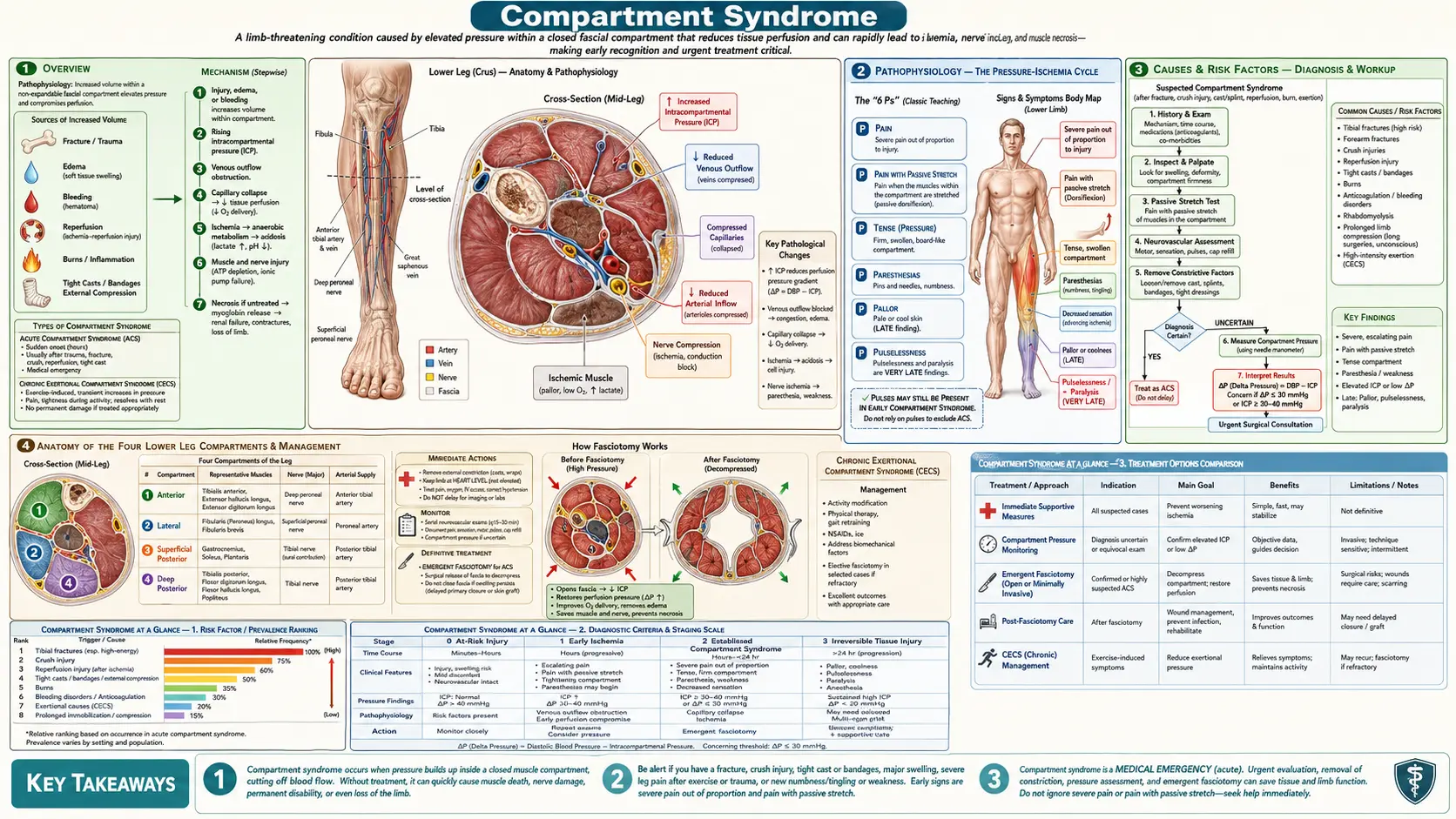
- Overview
- Pathophysiology — The Pressure-Ischemia Cycle
- Causes and Risk Factors
- Anatomy of the Four Lower Leg Compartments
- The Six Ps — Clinical Signs
- Pain on Passive Stretch
- Compartment Pressure Measurement
- Fasciotomy — Surgical Emergency
- Chronic Exertional Compartment Syndrome
- Complications of Missed or Delayed Diagnosis
- Key Research Papers
- PubMed Research Searches
- Connections
Overview
A compartment syndrome is defined in Matsen's 1975 paper as a condition in which increased pressure within a space compromises the circulation to the contents of that space; any cause of increased pressure inside the compartment can produce one (PubMed PMID: 1192678). In the limbs, the space is a closed fascial compartment holding muscle, nerves and vessels. An emergency-medicine review describes acute compartment syndrome as a rare but potentially disastrous complication of injury to the extremities, in which early diagnosis and treatment is crucial to prevent its complications (PubMed PMID: 11555801). The treatment described throughout this literature is surgical decompression of the affected compartments (fasciotomy).
Time matters. In a cohort of 76 people who had a fasciotomy for acute compartment syndrome at four teaching hospitals, 49% had some muscle necrosis, and the authors' exploratory analysis estimated that 37% of cases may develop necrosis within 3 hours of the injury, earlier than the period traditionally considered safe (PubMed PMID: 17433166). In a 1976 series, fasciotomy less than twelve hours after onset was followed by normal function in 68% of limbs, against 8% after later fasciotomy (PubMed PMID: 1249096).
Acute compartment syndrome, which follows injury and is treated as an emergency, is different from chronic exertional compartment syndrome, a condition of recurring exercise-related leg pain, covered in its own section below.
In an Edinburgh series of 164 patients with acute compartment syndrome treated over eight years, 69% had an associated fracture, about half of them of the tibial shaft; most patients were men, usually under 35; forearm cases with a fracture of the distal radius were also seen most often in young men (PubMed PMID: 10755426).
Pathophysiology — The Pressure-Ischemia Cycle
The fascia around a limb compartment does not stretch much, so swelling, bleeding or outside compression inside or around a compartment raises the pressure within it. Experimental work by Rorabeck and Macnab showed that increased pressure within the anterior compartment of the leg slows blood flow to the tissues inside it (PubMed PMID: 1192675).
Whitesides and colleagues (1975) reported that normal tissue pressure is approximately zero mmHg and rises markedly in compartment syndromes. They described inadequate perfusion and relative ischemia once the pressure within a closed compartment rises to within 10–30 mmHg of the patient's diastolic blood pressure, and no effective perfusion at all once tissue pressure equals or exceeds diastolic pressure — a situation in which, they noted, distal pulses may still be present (PubMed PMID: 1192674).
This relationship is the basis of the "differential pressure" or delta pressure (ΔP): diastolic blood pressure minus compartment pressure. McQueen and Court-Brown used a ΔP below 30 mmHg as their threshold for decompression in tibial fractures (PubMed PMID: 8898137). Because ΔP depends on blood pressure, the same compartment pressure carries a different meaning in a patient with low blood pressure than in one with normal blood pressure.
Causes and Risk Factors
Fractures — in the Edinburgh series of 164 patients, 69% of cases had an associated fracture, about half of which were of the tibial shaft (PubMed PMID: 10755426). In a cohort of 414 patients with tibial fractures at a US trauma center, the rate of compartment syndrome needing fasciotomy was 8.1% for fractures of the shaft (diaphysis), 1.6% for proximal and 1.4% for distal fractures, and younger age was the only independent predictor among shaft fractures (PubMed PMID: 19633461). Among 116 patients with tibial shaft fractures who had 24 hours of continuous pressure monitoring, three (2.6%) had acute compartment syndrome (PubMed PMID: 8898137).
Open fractures — an open wound does not rule the condition out. In a review of 198 open tibial shaft fractures at a multiple-trauma referral center, compartment syndrome accompanied 9.1% (18 fractures in 16 patients); its incidence rose with the degree of injury to soft tissue and bone, and the authors noted that its signs may be masked by a head injury, ventilation or prolonged anesthesia (PubMed PMID: 3782206).
Soft-tissue injury and bleeding disorders — in the Edinburgh series, injury to soft tissues without a fracture was the second most common cause, and one-tenth of the patients had a bleeding disorder or were taking anticoagulant drugs (PubMed PMID: 10755426).
Dressings and casts — Matsen's 1975 paper notes that generous opening of any dressing covering the limb permits a proper examination and rules out a compartment syndrome caused by the dressing itself (PubMed PMID: 1192678).
Exercise, trauma and ischemia — in Rorabeck and Macnab's clinical review of 45 patients with acute anterior tibial ischemia, three of the four conditions they identified were pressure-driven compartment syndromes, following exercise, trauma, and ischemia; the fourth was ischemia from arterial occlusion (PubMed PMID: 1192675).
Positional ("well-leg") compartment syndrome — a literature review in urology describes well-leg compartment syndrome after long, complex pelvic operations in the lithotomy position; its cause is multifactorial and it is probably under-reported (PubMed PMID: 14665832).
Anatomy of the Four Lower Leg Compartments
The lower leg has four fascial compartments, bounded by the tibia, fibula, interosseous membrane and surrounding fascia. Which nerve runs through a compartment determines which sensation or movement is affected when that compartment becomes ischemic. Matsen and colleagues described decompressing all four compartments of the leg through a parafibular approach (PubMed PMID: 7358759).
Anterior Compartment — contains the tibialis anterior (dorsiflexes the ankle), extensor hallucis longus (extends the big toe), extensor digitorum longus (extends toes 2–5) and peroneus tertius, with the anterior tibial artery and deep peroneal nerve. The deep peroneal nerve supplies sensation to the first web space on the top of the foot (between the first and second toes), and its muscles lift the foot and toes; permanent loss of these muscles produces foot drop.
Lateral Compartment — contains the peroneus longus and peroneus brevis (which evert the foot), with the superficial peroneal nerve, which supplies these muscles and sensation to most of the top of the foot.
Deep Posterior Compartment — contains the flexor hallucis longus, flexor digitorum longus and tibialis posterior, with the posterior tibial vessels and the tibial nerve, which supplies sensation to the sole of the foot.
Superficial Posterior Compartment — contains the gastrocnemius, soleus and plantaris (the main plantarflexors of the ankle), with the sural nerve (sensation to the outer foot and heel).
In the forearm, the two main compartments are the volar (flexor) compartment, containing the finger and wrist flexors and the median and ulnar nerves, and the dorsal (extensor) compartment. Matsen and colleagues described an ulnar approach to decompress the volar compartments (PubMed PMID: 7358759). Missed forearm compartment syndrome leads to Volkmann's ischemic contracture (see Complications below).
The Six Ps — Clinical Signs
Teaching often lists the "Ps" of acute compartment syndrome: pain, pressure (a tense compartment), paresthesias (tingling or numbness), paresis (weakness), pallor and pulselessness. How well these signs actually perform has been measured. Ulmer's 2002 review found only four prospective studies with usable data; in them, the sensitivity of clinical findings for diagnosing compartment syndrome of the lower leg was low (13% to 19%), the positive predictive value was 11% to 15%, and specificity and negative predictive value were each 97% to 98%. The author concluded that the clinical features are more useful by their absence, in excluding the diagnosis, than by their presence in confirming it. Likelihood-ratio calculations gave a probability of about 25% with one clinical finding and 93% with three, while noting that the data are limited (PubMed PMID: 12352566).
Pain — pain in the affected compartment, often described as out of proportion to the injury. Pain relief can affect how the condition shows itself: a 2024 review of peripheral nerve blocks after limb trauma found no randomized studies and six case reports; only one reported a delay in diagnosis, and in five of the six, breakthrough pain despite the block was an indicator of the developing syndrome (PubMed PMID: 38542011).
Pressure — a tense, firm compartment on touch.
Paresthesias — tingling or numbness in the area supplied by the nerve that runs through the affected compartment: the first web space of the foot for the anterior compartment, the sole of the foot for the deep posterior compartment.
Paresis — weakness of the muscles within the affected compartment.
Pallor and pulselessness — paleness and loss of pulses below the injury. Whitesides and colleagues noted that perfusion within the compartment can be absent while distal pulses are still present, so a palpable pulse does not exclude the condition (PubMed PMID: 1192674).
Signs can be hard to obtain in some patients: in multiple-trauma patients, they may be masked by a closed head injury, ventilatory support or prolonged anesthesia (PubMed PMID: 3782206).
Pain on Passive Stretch
Pain on passive stretch is pain felt in a compartment when the examiner moves a joint so that the muscles inside that compartment are lengthened without the patient using them. For the anterior compartment of the leg, the ankle and toes are pointed downward (plantarflexion); for the deep posterior compartment, the ankle is pulled up and the toes extended; for the volar forearm, the fingers and wrist are extended.
The abstract of Ulmer's 2002 review does not report figures for passive stretch separately; for the clinical findings it assessed, it reports low sensitivity (13% to 19%) and high specificity (97% to 98%), and concludes that clinical features are more useful in excluding the diagnosis than in confirming it (PubMed PMID: 12352566).
Compartment Pressure Measurement
Matsen and colleagues described careful clinical assessment as enough for the diagnosis in most patients, with tissue-pressure measurement and direct nerve stimulation helpful for ambiguous or equivocal cases (PubMed PMID: 7358759).
Devices — in a laboratory comparison against a known pressure, side-port needles and slit catheters were more accurate than straight needles, which tended to overestimate pressure. An arterial-line manometer was the most accurate device, a commercial handheld monitor was also very accurate, and the improvised Whitesides manometer apparatus lacked the precision needed for clinical use (PubMed PMID: 16264116).
Absolute pressure threshold — in Mubarak and colleagues' 1978 series, pressures were measured with a wick catheter in 65 compartments of 27 patients suspected of having acute compartment syndrome. A pressure of 30 mmHg or more was used as the indication for fasciotomy, and the normal range was 0 to 8 mmHg. In the 16 patients whose pressures stayed below 30 mmHg, fasciotomy was withheld and no compartment syndrome sequelae developed (PubMed PMID: 721856).
Delta pressure (ΔP) threshold — in McQueen and Court-Brown's prospective study of 116 tibial shaft fractures with 24 hours of continuous anterior compartment monitoring, 53 patients had absolute pressures over 30 mmHg in the first 12 hours, but only three patients in total had a differential pressure (diastolic minus compartment pressure) below 30 mmHg, and they had fasciotomies. None of the 116 had sequelae of compartment syndrome at least six months later. A 30 mmHg absolute threshold would have pointed to fasciotomy in 50 patients (43%); the 30 mmHg differential threshold missed no cases, and the authors recommended decompression if the differential pressure drops under 30 mmHg (PubMed PMID: 8898137). A later Edinburgh study of 101 tibial fracture patients whose ΔP stayed satisfactory found no difference in muscle power or return to function between 41 patients with intramuscular pressures over 30 mmHg for more than 6 hours and 60 patients with lower pressures (PubMed PMID: 14676660).
Continuous monitoring — in a comparison of 25 tibial shaft fractures complicated by compartment syndrome, the average delay from injury to fasciotomy was 16 hours with continuous pressure monitoring and 32 hours without it; none of the 12 surviving monitored patients had sequelae, against 10 of the 11 surviving unmonitored patients, and the authors recommended continuous monitoring for tibial fractures when equipment is available (PubMed PMID: 8898136). In a ten-year retrospective analysis of 850 monitored patients with tibial shaft fractures, the estimated sensitivity of continuous monitoring for acute compartment syndrome was 94%, specificity 98%, positive predictive value 93% and negative predictive value 99% (PubMed PMID: 23595064).
Fasciotomy — Surgical Emergency
Fasciotomy is a surgical incision through the fascia of each affected compartment that releases the pressure. Matsen's 1975 paper stated that immediate decompression is indicated in all cases of compartment syndrome unless the risk of complications exceeds the possible gains from improved circulation (PubMed PMID: 1192678). Matsen and colleagues later attributed suboptimal results to delays in diagnosis and treatment, incomplete decompression and difficulties managing the limb afterwards, and described a four-compartment parafibular approach for the leg and an ulnar approach for the volar forearm (PubMed PMID: 7358759).
Wound closure — in Mubarak's 1978 series, fasciotomy consistently restored compartment pressures to normal except in the buttock and deltoid, and continuous intraoperative pressure monitoring was used to select the few cases suited to primary wound closure and those better treated with secondary closure (PubMed PMID: 721856). Sheridan and Matsen found no significant difference in function or complications between "open" and "closed" fasciotomy (PubMed PMID: 1249096).
Timing and outcomes — in Sheridan and Matsen's series of 66 compartment syndromes in 44 patients, fasciotomy within twelve hours of onset was followed by normal function in 68% of limbs and late fasciotomy in 8%; complication rates were 4.5% and 54% (PubMed PMID: 1249096). In a Toronto series of nine fasciotomies in five patients performed more than 35 hours after injury (average ischemic time 56 hours), one patient died of multiorgan failure and septicemia and the other four needed amputation, mainly because of infection; the authors proposed that routine fasciotomy be reassessed when recognition of an established syndrome is delayed by more than 8 to 10 hours (PubMed PMID: 8601846).
Long-term effects of the wounds — in a study of 60 patients followed after fasciotomy, 77% had altered sensation within the wound margins, 10% ongoing wound pain, 40% dry scaly skin, 33% itching, 26% tethered scars, 13% recurrent ulceration and 13% muscle herniation; 23% kept the wound covered, 28% changed hobbies and 12% changed occupation (PubMed PMID: 11090326).
Chronic Exertional Compartment Syndrome
Chronic exertional compartment syndrome (CECS) is a cause of recurring exercise-related leg pain. A systematic review describes it as part of a group of overuse lower-limb injuries with common presenting features, whose underlying mechanism is poorly understood (PubMed PMID: 22092446).
Who is affected — in a systematic review of 24 surgical studies with 1,596 patients, the mean age was 26.6 years, 70% were male, and the patients were mostly military service members (54%) and athletes (29%). The anterior compartment was the one most often involved (51%), followed by lateral (33%), deep posterior (13%) and superficial posterior (3%) (PubMed PMID: 27020462).
Diagnosis: the diagnosis is usually made by measuring compartment pressure before and after exercise. Pedowitz and colleagues (1990) reviewed 131 patients referred for chronic exertional leg pain; 45 were diagnosed with the syndrome, and the only history or examination difference between groups was muscle herniation (45.9% versus 12.9%). From pressures recorded in 210 compartments without the syndrome, they proposed that, in the presence of appropriate clinical findings, one or more of the following is diagnostic: a pre-exercise pressure of 15 mmHg or more, a 1-minute post-exercise pressure of 30 mmHg or more, or a 5-minute post-exercise pressure of 20 mmHg or more (PubMed PMID: 2301689).
Critiques of the pressure criteria — a 2012 systematic review of 38 studies found that, except for relaxation pressure, the criteria considered the gold standard overlap the range of pressures found in healthy people, with several studies reporting mean pressures that would give a positive diagnosis in people with no symptoms (PubMed PMID: 22092446). A second 2012 systematic review of 32 studies judged the evidence for the commonly used criteria weak and the current criteria unreliable, placing emphasis on a good history; only the 1-minute post-exercise measurement showed no overlap between patients and controls, and the authors suggested that levels above 27.5 mmHg at that time point, together with a good history, be regarded as highly suggestive (PubMed PMID: 22627653).
Treatment research — in a case series of ten runners with CECS who were scheduled for surgical release, six weeks of training in a forefoot-strike running technique lowered mean post-run anterior compartment pressure from 78.4 to 38.4 mmHg, increased running distance and reduced pain; none needed surgery during the one-year follow-up (PubMed PMID: 22427621). In the surgical systematic review, operation was successful in approximately two-thirds of young athletic patients, 84% were satisfied with the outcome, 6% had revision surgery and the overall complication rate was 13%; open fasciotomy was the predominant technique (PubMed PMID: 27020462). In Pedowitz's series, one-third of patients with the syndrome and over half of those without it reported persistent moderate to severe pain at 6-month to 9-year follow-up (PubMed PMID: 2301689).
Complications of Missed or Delayed Diagnosis
Volkmann's Ischemic Contracture — the contracture that follows untreated ischemia of the forearm muscles. A review describes the usual upper-limb deformity as elbow flexion, forearm pronation, wrist flexion, thumb flexion and adduction, and finger deformity at the knuckle and finger joints. Mild contractures are treated with rehabilitation or with excision of the infarcted muscle or tendon lengthening; moderate to severe contractures with release of compressed nerves, tendon lengthening, tendon or free-tissue transfers, or salvage procedures (PubMed PMID: 9742427).
Muscle weakness and contracture — in the Edinburgh comparison of tibial fractures complicated by compartment syndrome, 10 of the 11 surviving patients whose compartments had not been monitored had definite sequelae with muscle weakness and contractures, and tibial union was delayed in that group (PubMed PMID: 8898136). Loss of the anterior compartment muscles leaves foot drop.
Myoglobinuria and kidney failure — Matsen's 1975 paper notes that myoglobinuria and renal failure may complicate severe cases (PubMed PMID: 1192678). See the Rhabdomyolysis and Acute Kidney Injury pages under Connections.
Infection, amputation and death — in the Toronto series of fasciotomies delayed by more than 35 hours, one of five patients died of multiorgan failure and septicemia and the other four needed lower-limb amputation, mainly because of local infection and septicemia (PubMed PMID: 8601846).
Medicolegal findings — a review of 19 closed malpractice claims over 23 years found that ten were resolved in favor of the physician; poor physician-patient communication was found in six, all of which ended in an indemnity payment; longer time from symptom onset to fasciotomy was linearly associated with larger payments; and fasciotomy within eight hours of the first symptoms was uniformly associated with a successful defense (PubMed PMID: 15069156).
Key Research Papers
- Mubarak SJ, Owen CA, Hargens AR, Garetto LP, Akeson WH. Acute compartment syndromes: diagnosis and treatment with the aid of the wick catheter. J Bone Joint Surg Am. 1978;60(8):1091–5. — Wick-catheter pressures in 65 compartments of 27 patients; 30 mmHg or more used as the indication for fasciotomy; normal range 0–8 mmHg; no sequelae in the 16 patients below 30 mmHg in whom fasciotomy was withheld. — PubMed PMID: 721856
- McQueen MM, Court-Brown CM. Compartment monitoring in tibial fractures. The pressure threshold for decompression. J Bone Joint Surg Br. 1996;78(1):99–104. — Prospective study of 116 tibial shaft fractures with continuous monitoring; a differential pressure (diastolic minus compartment) threshold of 30 mmHg missed no cases, while a 30 mmHg absolute threshold would have indicated fasciotomy in 43%. — PubMed PMID: 8898137
- Whitesides TE, Haney TC, Morimoto K, Harada H. Tissue pressure measurements as a determinant for the need of fasciotomy. Clin Orthop Relat Res. 1975;(113):43–51. — Inadequate perfusion when tissue pressure rises to within 10–30 mmHg of diastolic pressure; no effective perfusion when it equals or exceeds diastolic pressure, even with distal pulses present. — PubMed PMID: 1192674
- Boody AR, Wongworawat MD. Accuracy in the measurement of compartment pressures: a comparison of three commonly used devices. J Bone Joint Surg Am. 2005;87(11):2415–22. — In-vitro comparison against a known pressure: side-port needles and slit catheters more accurate than straight needles; the arterial-line manometer most accurate; the Whitesides apparatus imprecise. — PubMed PMID: 16264116
- Perron AD, Brady WJ, Keats TE. Orthopedic pitfalls in the ED: acute compartment syndrome. Am J Emerg Med. 2001;19(5):413–6. — Emergency-medicine review of the clinical presentation, diagnostic techniques and management of acute compartment syndrome. — PubMed PMID: 11555801
- Elliott KG, Johnstone AJ. Diagnosing acute compartment syndrome. J Bone Joint Surg Br. 2003;85(5):625–32. — Review of the diagnosis of acute compartment syndrome (no abstract in PubMed). — PubMed PMID: 12892179
- Ulmer T. The clinical diagnosis of compartment syndrome of the lower leg: are clinical findings predictive of the disorder? J Orthop Trauma. 2002;16(8):572–7. — Review of four prospective studies: sensitivity of clinical findings 13–19%, positive predictive value 11–15%, specificity and negative predictive value 97–98%; the findings are more useful by their absence. — PubMed PMID: 12352566
- Rorabeck CH, Macnab I. The pathophysiology of the anterior tibial compartmental syndrome. Clin Orthop Relat Res. 1975;(113):52–7. — Clinical review of 45 patients with acute anterior tibial ischemia and an experiment showing that raised compartment pressure slows blood flow to the enclosed tissues. — PubMed PMID: 1192675
- Blick SS, Brumback RJ, Poka A, Burgess AR, Ebraheim NA. Compartment syndrome in open tibial fractures. J Bone Joint Surg Am. 1986;68(9):1348–53. — Compartment syndrome in 9.1% of 198 open tibial shaft fractures, rising with the severity of soft-tissue and bone injury. — PubMed PMID: 3782206
- Pedowitz RA, Hargens AR, Mubarak SJ, Gershuni DH. Modified criteria for the objective diagnosis of chronic compartment syndrome of the leg. Am J Sports Med. 1990;18(1):35–40. — Proposed pressure criteria (pre-exercise ≥15 mmHg, 1-minute post-exercise ≥30 mmHg, or 5-minute post-exercise ≥20 mmHg, with appropriate clinical findings) for chronic exertional compartment syndrome. — PubMed PMID: 2301689
- Matsen FA 3rd. Compartmental syndrome. An unified concept. Clin Orthop Relat Res. 1975;(113):8–14. — Defines a compartmental syndrome as increased pressure within a space compromising the circulation to its contents, from any cause. — PubMed PMID: 1192678
- Sheridan GW, Matsen FA 3rd. Fasciotomy in the treatment of the acute compartment syndrome. J Bone Joint Surg Am. 1976;58(1):112–5. — 66 compartment syndromes: normal function in 68% after fasciotomy within twelve hours versus 8% after late fasciotomy; complication rates 4.5% and 54%. — PubMed PMID: 1249096
- McQueen MM, Christie J, Court-Brown CM. Acute compartment syndrome in tibial diaphyseal fractures. J Bone Joint Surg Br. 1996;78(1):95–8. — Average injury-to-fasciotomy delay 16 hours with continuous monitoring versus 32 hours without; sequelae in 0 of 12 versus 10 of 11 surviving patients. — PubMed PMID: 8898136
- McQueen MM, Gaston P, Court-Brown CM. Acute compartment syndrome. Who is at risk? J Bone Joint Surg Br. 2000;82(2):200–3. — 164 patients: 69% with a fracture (about half tibial shaft), mostly young men; one-tenth with a bleeding disorder or on anticoagulants. — PubMed PMID: 10755426
- McQueen MM, Duckworth AD, Aitken SA, Court-Brown CM. The estimated sensitivity and specificity of compartment pressure monitoring for acute compartment syndrome. J Bone Joint Surg Am. 2013;95(8):673–7. — 850 monitored tibial shaft fractures: estimated sensitivity 94%, specificity 98%. — PubMed PMID: 23595064
- White TO, Howell GE, Will EM, Court-Brown CM, McQueen MM. Elevated intramuscular compartment pressures do not influence outcome after tibial fracture. J Trauma. 2003;55(6):1133–8. — With a satisfactory ΔP, pressures over 30 mmHg for more than 6 hours made no difference to outcome. — PubMed PMID: 14676660
- Park S, Ahn J, Gee AO, Kuntz AF, Esterhai JL. Compartment syndrome in tibial fractures. J Orthop Trauma. 2009;23(7):514–8. — 414 patients: rate 8.1% in shaft fractures, 1.6% proximal, 1.4% distal; younger age an independent predictor. — PubMed PMID: 19633461
- Vaillancourt C, Shrier I, Vandal A, Falk M, Rossignol M, Vernec A, Somogyi D. Acute compartment syndrome: how long before muscle necrosis occurs? CJEM. 2004;6(3):147–54. — 76 cases; an estimated 37% may develop muscle necrosis within 3 hours of injury. — PubMed PMID: 17433166
- Finkelstein JA, Hunter GA, Hu RW. Lower limb compartment syndrome: course after delayed fasciotomy. J Trauma. 1996;40(3):342–4. — Fasciotomy more than 35 hours after injury in five patients: one death, four amputations. — PubMed PMID: 8601846
- Matsen FA 3rd, Winquist RA, Krugmire RB Jr. Diagnosis and management of compartmental syndromes. J Bone Joint Surg Am. 1980;62(2):286–91. — Pressure measurement and nerve stimulation for equivocal cases; four-compartment parafibular approach to the leg and ulnar approach to the volar forearm. — PubMed PMID: 7358759
- Fitzgerald AM, Gaston P, Wilson Y, Quaba A, McQueen MM. Long-term sequelae of fasciotomy wounds. Br J Plast Surg. 2000;53(8):690–3. — 60 patients: altered sensation at the wound in 77%, with frequent skin, scar and swelling problems. — PubMed PMID: 11090326
- Hilber N, Dodi A, Blumenthal S, Bruppacher H, Borgeat A, Aguirre J. The impact of regional anesthesia in masking acute compartment syndrome after limb trauma. J Clin Med. 2024;13(6):1787. — Six case reports; one reported a diagnostic delay, and breakthrough pain signalled the syndrome in five. — PubMed PMID: 38542011
- Raza A, Byrne D, Townell N. Lower limb (well leg) compartment syndrome after urological pelvic surgery. J Urol. 2004;171(1):5–11. — Literature review of well-leg compartment syndrome after pelvic surgery in the lithotomy position. — PubMed PMID: 14665832
- Botte MJ, Keenan MA, Gelberman RH. Volkmann's ischemic contracture of the upper extremity. Hand Clin. 1998;14(3):483–97. — The deformity of ischemic contracture and its treatment by severity. — PubMed PMID: 9742427
- Bhattacharyya T, Vrahas MS. The medical-legal aspects of compartment syndrome. J Bone Joint Surg Am. 2004;86(4):864–8. — 19 closed malpractice claims; fasciotomy within eight hours of first symptoms uniformly associated with a successful defense. — PubMed PMID: 15069156
- Roberts A, Franklyn-Miller A. The validity of the diagnostic criteria used in chronic exertional compartment syndrome: a systematic review. Scand J Med Sci Sports. 2012;22(5):585–95. — 38 studies: except relaxation pressure, the standard criteria overlap pressures in healthy people. — PubMed PMID: 22092446
- Aweid O, Del Buono A, Malliaras P, Iqbal H, Morrissey D, Maffulli N, Padhiar N. Systematic review and recommendations for intracompartmental pressure monitoring in diagnosing chronic exertional compartment syndrome of the leg. Clin J Sport Med. 2012;22(4):356–70. — 32 studies: evidence for the common pressure criteria weak; only the 1-minute post-exercise value separated patients from controls. — PubMed PMID: 22627653
- Campano D, Robaina JA, Kusnezov N, Dunn JC, Waterman BR. Surgical management for chronic exertional compartment syndrome of the leg: a systematic review of the literature. Arthroscopy. 2016;32(7):1478–86. — 24 studies, 1,596 patients: surgery successful in about two-thirds, 84% satisfied, complications 13%. — PubMed PMID: 27020462
- Diebal AR, Gregory R, Alitz C, Gerber JP. Forefoot running improves pain and disability associated with chronic exertional compartment syndrome. Am J Sports Med. 2012;40(5):1060–7. — Case series of ten patients: six weeks of forefoot-strike running lowered post-run pressures and pain; none needed surgery. — PubMed PMID: 22427621