Paroxysmal Nocturnal Hemoglobinuria
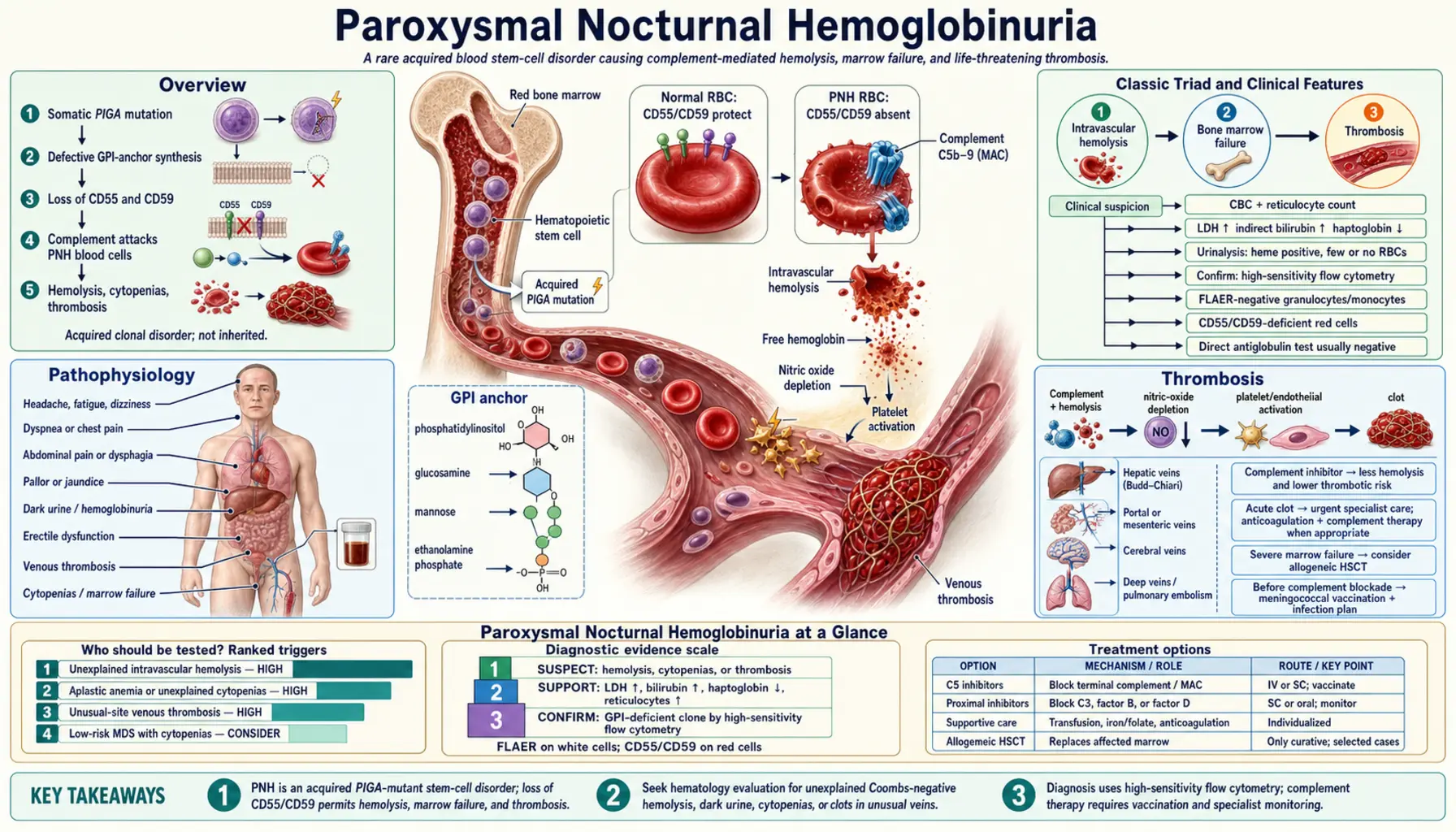
Table of Contents
- Overview
- Pathophysiology
- Classic Triad and Clinical Features
- Thrombosis
- Relationship to Aplastic Anemia
- Diagnosis
- Treatment
- Prognosis and Complications
- Key Research Papers
- Featured Videos
Overview
Paroxysmal nocturnal hemoglobinuria (PNH) is a rare, acquired clonal disorder of hematopoietic stem cells. It arises from a somatic mutation in the PIG-A gene within a single hematopoietic stem cell, giving rise to a clone of blood cells that lacks glycosylphosphatidylinositol (GPI)-anchored proteins on their surface. This deficiency leaves the affected cells defenseless against the complement system, resulting in chronic complement-mediated hemolysis, thrombosis, and bone marrow failure.
PNH is rare, with an estimated prevalence of approximately 1 to 5 cases per million population. It predominantly affects young adults, with a median age of diagnosis in the third to fourth decade of life, though it can occur at any age. Men and women are affected equally.
The name "paroxysmal nocturnal hemoglobinuria" was coined in 1882 by the German physician Paul Strübing, who described episodic dark urine appearing in the morning — an observation later understood to reflect nocturnal complement activation during sleep, though modern understanding recognizes that hemolysis is in fact continuous rather than truly paroxysmal.
Because PNH is acquired rather than inherited, it is not passed from parent to child. The mutant clone expands over time through a combination of intrinsic growth advantage and immune escape mechanisms, eventually producing a clinically significant proportion of GPI-deficient circulating blood cells.
Pathophysiology
The central defect in PNH is a somatic loss-of-function mutation in the PIG-A (phosphatidylinositol glycan anchor biosynthesis class A) gene, located on the X chromosome. Because only one copy of this X-linked gene is active in any given cell, a single mutation is sufficient to completely abolish GPI anchor biosynthesis in that cell and all its progeny.
The PIG-A gene encodes an enzyme essential for the first step in GPI anchor assembly. GPI anchors are lipid structures embedded in the outer leaflet of the plasma membrane that tether a specific set of proteins to the cell surface. More than 20 proteins rely on GPI anchors for their attachment, but two are critically important for complement regulation:
- CD55 (decay accelerating factor, DAF) — accelerates the decay of C3 and C5 convertases, limiting amplification of the complement cascade.
- CD59 (membrane inhibitor of reactive lysis, MIRL) — directly blocks the assembly of the C5b-9 membrane attack complex (MAC) by preventing C9 polymerization.
PNH cells lack both CD55 and CD59. The complement system operates under a constant low-level "tick-over" — spontaneous, low-grade activation of the alternative pathway occurs continuously in plasma. In normal cells, CD55 and CD59 rapidly quench this background activation. In PNH cells, lacking these protective proteins, tick-over complement activation proceeds unchecked.
The cascade unfolds as follows: C3b deposits on the unprotected PNH red blood cell surface; without CD55 to decay the convertase, more C3b accumulates; C5 is cleaved into C5a (a potent anaphylatoxin and prothrombotic mediator) and C5b; C5b recruits C6, C7, C8, and multiple copies of C9 to assemble the C5b-9 membrane attack complex; the MAC inserts into the red cell membrane, forming a pore that destroys osmotic integrity and causes intravascular lysis.
This process occurs continuously, not just at night, explaining the perpetual hemolysis observed in modern patients. PNH granulocytes and platelets also lack GPI-anchored proteins, contributing to the thrombotic and cytopenias components of the disease.
Classic Triad and Clinical Features
PNH is defined clinically by a classic triad of three interrelated problems: hemolytic anemia, thrombosis, and cytopenias arising from bone marrow failure. Individual patients may present with one, two, or all three components, and their relative prominence varies widely.
Hemolytic Anemia
Hemolysis in PNH is intravascular — red cells are destroyed within blood vessels by complement, releasing hemoglobin directly into the plasma. Laboratory hallmarks include:
- Lactate dehydrogenase (LDH): markedly elevated, often 5 to 10 times the upper limit of normal, reflecting red cell destruction.
- Unconjugated bilirubin: elevated from hemoglobin catabolism.
- Haptoglobin: low or undetectable, as free plasma hemoglobin saturates this scavenging protein.
- Hemoglobinuria: dark brown, cola-colored, or tea-colored urine, classically worse in the morning (historically attributed to nocturnal respiratory acidosis promoting complement activation during sleep).
- Hemosiderinuria: iron deposited in renal tubular cells appears in the urine as hemosiderin; a chronic finding even when gross hemoglobinuria is absent.
The "paroxysmal nocturnal" label is historically misleading. Modern understanding confirms that hemolysis is continuous, not episodic. Episodes of darker urine may occur with infections, surgery, or strenuous exercise — triggers that broadly activate complement — but the underlying destruction of GPI-deficient red cells never stops.
Chronic urinary iron loss (hemosiderinuria and hemoglobinuria) leads to iron deficiency, which can paradoxically reduce hemolysis by limiting red cell production — only for the resulting anemia to worsen once iron is replaced and more GPI-deficient red cells are produced.
Smooth Muscle Dystonia
Free plasma hemoglobin scavenges nitric oxide (NO), a critical vasodilator and smooth muscle relaxant. Hemolysis-driven NO depletion causes smooth muscle dysfunction throughout the body, manifesting as esophageal spasm (causing dysphagia and chest pain), severe abdominal pain, back pain, and erectile dysfunction in men. These symptoms are often the most disabling quality-of-life features of active PNH.
Cytopenias
Many PNH patients have an underlying bone marrow failure component (closely related to aplastic anemia), producing pancytopenia — low red cells, white cells, and platelets. Fatigue, dyspnea on exertion, susceptibility to infection, and bleeding risk reflect the combined effects of anemia, neutropenia, and thrombocytopenia.
Thrombosis
Thrombosis is the most feared and life-threatening complication of PNH. Before the complement inhibitor era, thrombotic events accounted for approximately 40% of PNH-related deaths. Paradoxically, thrombocytopenia — present in many PNH patients — does not protect against clotting; the prothrombotic forces generated by complement activation overwhelm the usual hemorrhagic tendency of a low platelet count.
Unusual Thrombotic Sites
PNH has a striking predilection for thrombosis in unusual venous locations:
- Hepatic veins (Budd-Chiari syndrome) — PNH is now recognized as the single most common identifiable cause of Budd-Chiari syndrome. Abdominal pain, ascites, and hepatomegaly in a young adult should prompt PNH workup.
- Cerebral venous sinuses — cerebral venous sinus thrombosis causes headache, visual changes, and stroke-like symptoms.
- Mesenteric and portal veins — leads to bowel ischemia and portal hypertension.
- Dermal veins — painful, erythematous skin lesions.
- Conventional sites (deep vein thrombosis, pulmonary embolism) also occur.
Mechanism of Thrombosis
Several complement-driven mechanisms converge to create the hypercoagulable state:
- GPI-deficient platelets, like red cells, lack CD55 and CD59. Complement activation on platelet surfaces generates platelet-derived procoagulant microparticles that dramatically accelerate thrombin generation.
- C5a, released during complement cleavage, activates endothelial cells and monocytes, promoting tissue factor expression and a prothrombotic endothelial phenotype.
- Complement impairs fibrinolysis by consuming tissue factor pathway inhibitor (TFPI), tipping the coagulation-fibrinolysis balance toward clot formation.
- NO depletion from hemolysis causes platelet activation and vasoconstriction.
The risk of thrombosis correlates with PNH clone size: patients with more than 50% GPI-deficient granulocytes face substantially higher thrombotic risk than those with smaller clones.
Relationship to Aplastic Anemia
The connection between PNH and aplastic anemia is one of the most important and diagnostically relevant aspects of the disease. Approximately 20 to 30% of patients with aplastic anemia harbor detectable PNH clones at diagnosis, and a significant proportion of aplastic anemia patients will develop overt PNH over time.
Immune Evasion Hypothesis
The most widely accepted explanation for why PNH clones expand in the setting of aplastic anemia is the immune evasion hypothesis. In aplastic anemia, autoreactive T cells attack hematopoietic stem cells displaying normal surface antigens. PNH stem cells, lacking GPI-anchored proteins (including certain immune recognition molecules), may present a reduced antigenic target to these autoreactive T cells, allowing them to survive and proliferate while normal stem cells are destroyed. Over time, selective pressure drives outgrowth of the PNH clone until it constitutes a clinically significant fraction of hematopoiesis.
Bidirectional Relationship
The relationship is bidirectional. Established PNH can evolve into aplastic anemia as the bone marrow failure component worsens. Conversely, patients presenting with aplastic anemia may develop increasingly prominent PNH features as the clone expands. These overlap syndromes — sometimes called PNH/aplastic anemia syndrome — require ongoing monitoring with serial flow cytometry.
Clinical Implications
All patients diagnosed with aplastic anemia should be tested for PNH clones by flow cytometry at diagnosis and periodically thereafter. Conversely, PNH patients with significant cytopenias should be evaluated for aplastic anemia, as bone marrow biopsy findings influence treatment decisions including the appropriateness of allogeneic stem cell transplantation.
Diagnosis
The diagnosis of PNH is established by demonstrating the absence of GPI-anchored proteins on the surface of blood cells. Modern flow cytometry has replaced older assays and provides the definitive diagnosis.
Flow Cytometry — Gold Standard
Flow cytometry quantifies the proportion of cells lacking GPI-anchored proteins. Key features:
- Markers tested: CD55 and CD59 on red blood cells; CD55, CD59, CD16, and CD24 on granulocytes and monocytes.
- FLAER (fluorescent aerolysin): a modified bacterial toxin that binds directly to the GPI anchor itself (rather than to an individual GPI-anchored protein). FLAER staining on granulocytes and monocytes is the most sensitive and specific diagnostic method, detecting even very small clones.
- Granulocyte clone preferred: the PNH clone size should be reported as the percentage of GPI-deficient granulocytes rather than red cells, because recent transfusions dilute the red cell clone while the granulocyte population reflects the underlying marrow clone more accurately.
Clone Size Thresholds
- Greater than 1% GPI-deficient granulocytes: considered diagnostic of a PNH clone.
- Greater than 10%: clinically significant clone, associated with elevated risk of hemolysis and thrombosis.
- Greater than 50%: substantial clone size, associated with highest thrombotic and hemolytic burden.
Laboratory Findings Supporting PNH
- Markedly elevated LDH (often 5–10× upper limit of normal).
- Low or absent haptoglobin.
- Hemoglobinuria on urinalysis (dipstick positive for blood with no red cells on microscopy).
- Hemosiderinuria (Prussian blue stain on urinary sediment).
- Reticulocytosis (compensatory increased red cell production).
Historical Tests
The Ham's test (acidified serum lysis test) — which demonstrated complement-mediated lysis of PNH red cells in acidified serum — was historically the diagnostic standard. It has been entirely replaced by flow cytometry due to the superior sensitivity, specificity, and quantitative capability of modern immunophenotyping.
Treatment
Treatment of PNH has been transformed by the development of complement inhibitors, particularly the anti-C5 monoclonal antibodies. The choice of therapy depends on the severity of hemolysis, thrombotic history, clone size, and degree of bone marrow failure.
Eculizumab (Soliris)
Eculizumab was the first complement inhibitor approved for PNH (FDA approval 2007) and represents a landmark in the treatment of complement-mediated diseases. It is a humanized monoclonal antibody that binds C5, blocking its cleavage into C5a and C5b. By preventing terminal complement activation, eculizumab:
- Dramatically reduces intravascular hemolysis (LDH normalizes or near-normalizes in most patients).
- Reduces thrombotic risk by approximately 85%.
- Decreases or eliminates transfusion dependence.
- Improves quality of life, resolving esophageal spasm, abdominal pain, fatigue, and erectile dysfunction.
Eculizumab is administered intravenously — a 4-week induction phase (weekly dosing) followed by maintenance every 2 weeks. Because terminal complement is the primary defense against encapsulated bacteria, particularly Neisseria meningitidis, all patients must receive meningococcal vaccination (types A, C, W, Y, and B) at least 2 weeks before starting treatment. Ongoing antibiotic prophylaxis with penicillin is also recommended by many centers.
Ravulizumab (Ultomiris)
Ravulizumab (FDA approved 2018) is a next-generation anti-C5 monoclonal antibody engineered for prolonged half-life. It shares the same mechanism as eculizumab — blocking C5 cleavage — but requires dosing only every 8 weeks after induction, substantially reducing treatment burden. Clinical trials demonstrated non-inferiority to eculizumab with equivalent efficacy and safety.
Iptacopan (Fabhalta)
Iptacopan (FDA approved 2023) is the first oral complement inhibitor approved for PNH. Unlike eculizumab and ravulizumab, which block terminal complement (at C5), iptacopan acts proximally by inhibiting factor B, a key component of the alternative pathway amplification loop. This proximal blockade prevents C3b opsonization of PNH cells, addressing C3-mediated extravascular hemolysis — hemolysis in the spleen and liver caused by C3b-coated red cells that escape intravascular lysis but are cleared by macrophages. Anti-C5 agents do not prevent extravascular hemolysis. Iptacopan offers the additional advantages of oral dosing and broader complement inhibition.
Pegcetacoplan (Empaveli)
Pegcetacoplan is a C3-targeted inhibitor (pegylated compstatin analog) that also prevents both intravascular and extravascular hemolysis, administered subcutaneously twice weekly. It is used in patients with residual anemia despite anti-C5 therapy.
Danicopan
Danicopan is an oral factor D inhibitor used as an add-on to anti-C5 therapy in patients with residual extravascular hemolysis and significant anemia despite eculizumab or ravulizumab treatment.
Allogeneic Stem Cell Transplantation
Allogeneic hematopoietic stem cell transplantation (allo-HSCT) is the only curative treatment for PNH, as it replaces the abnormal clone with normal donor hematopoietic stem cells. However, transplant carries significant morbidity and mortality, and is generally reserved for patients with severe, refractory disease, significant bone marrow failure (aplastic anemia), or transformation to myelodysplastic syndrome or acute myeloid leukemia.
Supportive Care
- Iron and folate supplementation to replace urinary losses and support erythropoiesis.
- Red cell transfusions for severe acute anemia (washed red cells are no longer required with modern complement inhibitor therapy).
- Anticoagulation following thrombotic events; prophylactic anticoagulation is considered in high-risk patients with large clones.
Prognosis and Complications
The prognosis of PNH has changed dramatically with the introduction of complement inhibitors. In the pre-eculizumab era, the median survival from diagnosis was approximately 10 to 15 years. In the modern treatment era, life expectancy for patients receiving complement inhibitor therapy approaches that of the general population.
Causes of Death — Historical
- Thrombosis was the leading cause of death, accounting for approximately 40% of PNH-related mortality.
- Bone marrow failure (aplastic anemia evolution), accounting for 30%.
- Infections and other complications.
Ongoing Complications
- Thrombosis: remains the major life threat in inadequately treated patients; risk substantially reduced but not eliminated by complement inhibition.
- Infection: patients on anti-C5 therapy have a meningococcal risk approximately 1,000 to 2,000 times that of the general population; vaccination and prophylaxis are mandatory.
- Bone marrow failure evolution: aplastic anemia may emerge or worsen over time.
- Transformation to MDS/AML: occurs in approximately 3 to 5% of PNH patients, likely reflecting the underlying clonal instability of the disorder.
- Chronic kidney disease: recurrent hemosiderin deposition in renal tubules causes progressive tubular injury; reduced kidney function is seen in a substantial proportion of long-term patients.
- Pregnancy: PNH in pregnancy carries high risks of thrombosis and fetal loss. Complement inhibitor therapy during pregnancy reduces but does not eliminate these risks; close multidisciplinary management is essential.
Monitoring
Long-term follow-up includes serial flow cytometry to track clone size, regular LDH measurements to assess hemolytic activity, renal function tests, and bone marrow biopsy if cytopenias worsen. Clone size fluctuates over time; spontaneous remission, while reported, is rare.
Key Research Papers
- Hillmen P et al. "Natural history of paroxysmal nocturnal hemoglobinuria." N Engl J Med. 1995;333(19):1253-8. PMID: 7566002
- Brodsky RA et al. "Multicenter phase 3 study of the complement inhibitor eculizumab for the treatment of patients with paroxysmal nocturnal hemoglobinuria." Blood. 2008;111(4):1840-7. PMID: 18055865
- Hillmen P et al. "The complement inhibitor eculizumab in paroxysmal nocturnal hemoglobinuria." N Engl J Med. 2006;355(12):1233-43. PMID: 16990386
- Parker C et al. "Diagnosis and management of paroxysmal nocturnal hemoglobinuria." Blood. 2005;106(12):3699-709. PMID: 16051736
- Brodsky RA. "Paroxysmal nocturnal hemoglobinuria." Blood. 2014;124(18):2804-11. PMID: 25237200
- Socie G et al. "Paroxysmal nocturnal haemoglobinuria: long-term follow-up and prognostic factors." Lancet. 1996;348(9027):573-7. PMID: 8774569
- Nishimura J et al. "Genetic variants in C5 and poor response to eculizumab." N Engl J Med. 2014;370(7):632-9. — Search PubMed
- Roth A et al. "Ravulizumab (ALXN1210) vs eculizumab in adults with PNH naive to complement inhibitors." Blood. 2019;133(6):530-9. PMID: 30510080
- Risitano AM et al. "Iptacopan as first complement inhibitor in PNH." N Engl J Med. 2023;389(11):994-1005. — Search PubMed
- Moyo VM et al. "Natural history of paroxysmal nocturnal hemoglobinuria using modern diagnostic assays." Br J Haematol. 2004;126(1):133-8. PMID: 15198744
- de Guibert S et al. "Eculizumab in pregnancies with PNH." Haematologica. 2011;96(11):1752. — Search PubMed
- Peffault de Latour R et al. "PNH: natural history of disease subcategories." Blood. 2008;112(8):3099-106. PMID: 18535202
Connections
- Hematology
- Thrombotic Thrombocytopenic Purpura
- Aplastic Anemia
- Hemolytic Anemia
- Myelodysplastic Syndrome
- Budd-Chiari Syndrome