Zollinger-Ellison Syndrome (Gastrinoma)
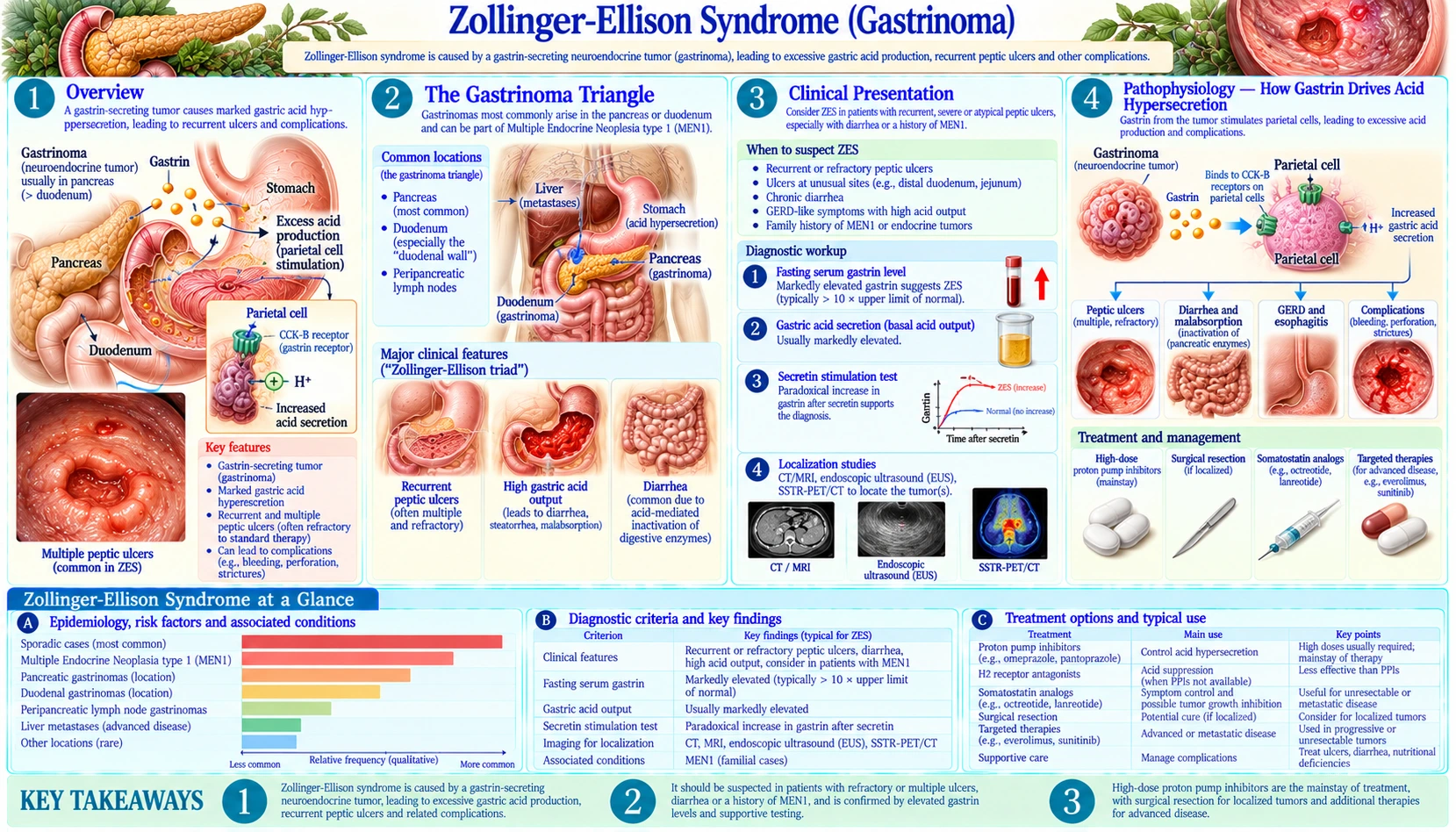
Table of Contents
- Overview
- The Gastrinoma Triangle
- Clinical Presentation
- Pathophysiology — How Gastrin Drives Acid Hypersecretion
- Diagnosis — Fasting Serum Gastrin and Secretin Stimulation Test
- Localization and Staging
- Acid Control — High-Dose Proton Pump Inhibitors
- Surgical Management
- Treatment of Metastatic Disease
- MEN1 Association
- Prognosis
- Key Research Papers
- Connections
- Featured Videos
Overview
Zollinger-Ellison Syndrome (ZES) is a rare disorder caused by a gastrinoma — a gastrin-secreting neuroendocrine tumor (NET) — that drives autonomous hypergastrinemia, resulting in massive gastric acid hypersecretion and its downstream consequences: severe, refractory peptic ulcer disease, chronic diarrhea, and malabsorption. The syndrome was named after Robert Zollinger and Edwin Ellison, who in 1955 described two patients with intractable jejunal ulcers, enormous gastric acid output, and non-beta-cell islet tumors of the pancreas. That landmark paper gave the syndrome its name and defined its essential triplet of features.
ZES is rare — estimated incidence is approximately 1 per million persons per year — but it is the second most common functional pancreatic neuroendocrine tumor after insulinoma. "Functional" means the tumor secretes a hormone that produces a clinical syndrome directly attributable to that hormone excess, as opposed to non-functional pancreatic neuroendocrine tumors (pNETs) that are detected incidentally or by mass effect. Gastrinomas are significantly more malignant than insulinomas: approximately 60% of gastrinomas are malignant, and liver metastases are present at diagnosis in 20–30% of patients. This malignant potential distinguishes ZES from insulinoma and drives much of its long-term management.
In the U.S. National Institutes of Health (NIH) series of 261 patients, 22% of ZES cases occurred as part of Multiple Endocrine Neoplasia type 1 (MEN1), a hereditary syndrome caused by mutations in the MEN1 gene on chromosome 11q13. Recognizing this association is critical because management of MEN1-associated ZES differs substantially from sporadic ZES. In all patients, the immediate clinical priority is controlling gastric acid hypersecretion — historically achieved only by total gastrectomy, but now reliably managed with high-dose proton pump inhibitors (PPIs), which transformed the prognosis of ZES from one of near-certain fatal complications to a disease in which long-term survival is determined primarily by the tumor's behavior, not by acid-related mortality.
The Gastrinoma Triangle
The "gastrinoma triangle" describes the anatomical zone where the vast majority of gastrinomas are found. Its three vertices are: (1) the superior vertex at the confluence of the cystic duct and the common bile duct; (2) the inferior vertex at the junction of the second and third portions of the duodenum; and (3) the medial vertex at the junction of the neck and body of the pancreas. Approximately 90% of gastrinomas arise within this triangle, making it the primary target for surgical exploration.
A critical and counterintuitive anatomical fact: despite the tumor being called a "gastrinoma" with the implied connotation of a pancreatic origin (pancreatic islet cells secrete gastrin during fetal life), the most common site in sporadic ZES is actually the duodenum. Duodenal gastrinomas account for 50–70% of sporadic ZES cases. They are typically submucosal, small (often less than 1 cm), and frequently multiple — characteristics that make them impossible to detect on preoperative imaging studies and easy to miss on external palpation of the duodenum at surgery. Pancreatic gastrinomas, by contrast, are larger and carry a higher risk of malignant behavior and liver metastasis.
This duodenal predominance has a direct and important surgical implication: a duodenotomy — longitudinal opening of the duodenum to allow the surgeon to palpate and inspect the duodenal wall from the inside — is mandatory during any curative-intent exploration for ZES. Without duodenotomy, small submucosal duodenal lesions will be missed, and what appears to be a "negative exploration" may simply reflect inadequate search technique. Intraoperative transillumination and endoscopy can supplement the examination. The duodenal wall is palpated systematically from inside, feeling for the firm, slightly elevated submucosal nodules that characterize microgastrinomas.
Clinical Presentation
ZES presents through the consequences of acid hypersecretion, but the pattern differs from ordinary peptic ulcer disease in ways that point toward ZES. The three main clinical features are peptic ulceration, diarrhea, and esophageal disease.
Peptic Ulcer Disease: Ulcers in ZES are typically multiple, occur in unusual locations (distal duodenum and even the jejunum, well beyond the normal duodenal bulb where ordinary H. pylori-associated or nonsteroidal anti-inflammatory drug (NSAID) ulcers appear), are refractory to standard treatment, and recur rapidly after healing. The distal location reflects the overwhelming acid volume washing down past the normal buffering capacity of the duodenal bulb into the more distal bowel. Any patient presenting with recurrent or multiple duodenal or jejunal ulcers, ulcers that fail a full course of high-dose proton pump inhibitor (PPI) therapy, or ulcers in the setting of negative H. pylori testing are evaluated for ZES. Before effective medical acid suppression existed, patients with ZES died from complications of intractable ulceration: bleeding, perforation, and obstruction.
Diarrhea: Present in 73% of ZES patients in the NIH series of 261 patients, diarrhea may actually precede ulcer symptoms and can be the presenting complaint. The mechanism is multifactorial: the massive acid load overwhelms the duodenum's bicarbonate buffering capacity, creating an abnormally acidic intestinal milieu that inactivates pancreatic lipase (producing steatorrhea and fat malabsorption), precipitates bile acids (causing bile acid malabsorption and further diarrhea), and directly injures the intestinal mucosa. The diarrhea of ZES is secretory in character — it persists with fasting and produces large-volume watery stools — which helps distinguish it from osmotic or motility-related diarrhea. Importantly, diarrhea often improves dramatically when the gastric acid output is controlled with proton pump inhibitors, confirming the acid-mediated mechanism.
Esophageal Disease: Chronic, massive acid reflux produces severe gastroesophageal reflux disease (GERD), erosive esophagitis, esophageal strictures, and Barrett's esophagus at rates far exceeding what is seen in ordinary gastroesophageal reflux disease. The esophageal complications of ZES can themselves be the presenting problem, and severe or "treatment-refractory" esophagitis in a patient without an obvious explanation raises the possibility of ZES.
Clinical Clues to ZES: ZES is suspected whenever peptic ulcers are multiple, recurrent, distally located, or atypically severe; when there is a family history of endocrine tumors (MEN1); when diarrhea accompanies ulcer disease; or when a young patient presents with severe esophagitis. In the NIH series the mean delay from symptom onset to diagnosis of ZES was 5.2 years, because clinicians attributed the symptoms to ordinary peptic ulcer disease without recognizing the underlying hypersecretory state; the referring doctor made the correct diagnosis at first in only 3% of patients.
What 261 Patients Had: In that prospective NIH study of 261 people with ZES followed over 25 years, belly pain was present in 75% and diarrhea in 73%, heartburn in 44% and weight loss in 17%; bleeding from the gut was the first sign in a quarter of patients. Only 11% had a single symptom, and pain with diarrhea was the most common pair (55%). Prominent folds in the body of the stomach were seen on endoscopy in 94%. The most common first misdiagnosis was ordinary (idiopathic) peptic ulcer disease, in 71%, followed by reflux disease (7%) and chronic unexplained diarrhea (7%). The authors found that neither better acid drugs nor publicity about ZES had shortened the delay in diagnosis.
Pathophysiology — How Gastrin Drives Acid Hypersecretion
Under normal physiological conditions, gastrin is secreted by antral G-cells in response to luminal protein (amino acids), gastric distension, and vagal stimulation. Gastrin travels via the circulation to parietal cells in the gastric body, where it binds cholecystokinin-B (CCK-B) receptors and stimulates hydrochloric acid secretion through activation of the H+/K+-ATPase proton pump. Normal fasting serum gastrin is below 100 pg/mL, and it rises transiently after meals before falling back to baseline. The system is regulated by a negative feedback loop: when luminal pH falls below 3, antral somatostatin release inhibits further gastrin secretion from G-cells.
In ZES, this regulation is completely bypassed. The gastrinoma secretes gastrin autonomously, independent of luminal pH, meal timing, or somatostatin feedback. The consequences are dramatic. First, parietal cell mass undergoes hypertrophy: gastrin is a potent trophic hormone for parietal cells, and chronic hypergastrinemia causes parietal cell hyperplasia, dramatically expanding the acid-secreting capacity of the stomach and creating a self-amplifying system. Second, basal acid output (BAO) reaches levels that are orders of magnitude above normal — 30–60 mEq/hr compared to a normal BAO of less than 5 mEq/hr. Maximal acid output is similarly elevated. This relentless acid flood overwhelms all normal buffering mechanisms throughout the upper gastrointestinal (GI) tract.
Third, and of great diagnostic importance, the gastrinoma exhibits a paradoxical response to secretin. Secretin, a hormone released by duodenal S-cells in response to acid entry, normally inhibits gastrin release from antral G-cells (completing a negative feedback loop to blunt acid secretion). However, gastrinoma cells are not antral G-cells and are not regulated by this feedback. Instead, gastrinoma cells paradoxically increase gastrin secretion in response to secretin administration — a response not seen in any other cause of hypergastrinemia. This observation forms the basis of the secretin stimulation test, the most specific biochemical test for ZES.
Diagnosis — Fasting Serum Gastrin and Secretin Stimulation Test
The biochemical diagnosis of ZES rests on demonstrating inappropriately elevated gastrin in the setting of gastric acid hypersecretion. This distinction is critical because elevated gastrin is not specific for ZES — it is far more commonly caused by conditions that reduce acid secretion (achlorhydria from atrophic gastritis, proton pump inhibitor use, H. pylori-associated corpus gastritis), which trigger a physiological compensatory rise in gastrin. The key discriminating factor is gastric pH: in ZES, the gastrin is high AND the pH is low (acid hypersecretion); in most other causes of hypergastrinemia, the pH is high (the elevated gastrin is a response to hypo- or achlorhydria).
Fasting Serum Gastrin (FSG): The initial screening test. FSG is only meaningful when measured while the patient has an active acid-secreting stomach — ideally after holding proton pump inhibitors for 7–14 days. This is clinically challenging in patients with severe ZES, who may experience ulcer complications if acid suppression is withdrawn. In practice, H2-blockers may be substituted for proton pump inhibitors (shorter half-life, easier to hold before testing), or the test may be performed while on reduced proton pump inhibitor dosing. FSG above 1,000 pg/mL combined with gastric pH below 2 is virtually diagnostic of ZES and requires no further provocative testing. FSG between 200–1,000 pg/mL with low gastric pH requires the secretin stimulation test for confirmation. Mild elevations (100–200 pg/mL) are nonspecific and most often due to proton pump inhibitor use, H. pylori infection, atrophic gastritis, renal failure, or other non-ZES conditions — all characterized by high gastric pH.
Secretin Stimulation Test (Gold Standard Provocative Test): Intravenous secretin is administered as a bolus of 0.4 mcg/kg; serum gastrin is drawn at baseline and at 2, 5, 10, 15, and 20 minutes post-injection. A positive test is a rise in serum gastrin of 120 pg/mL or more above baseline: in a 2006 NIH study of 293 patients compared with 537 cases from the literature, this criterion had the highest accuracy — sensitivity 94% and specificity 100% — while the older criterion of a 200 pg/mL rise had sensitivity 83% and specificity 100%; the authors proposed that the 120 pg/mL criterion replace the others. The paradoxical gastrin rise after secretin is essentially unique to ZES (antral G-cells are suppressed by secretin, so ordinary hypergastrinemia does not produce this response). This test is performed in specialist centers and requires careful patient preparation including stopping proton pump inhibitors.
Basal Acid Output (BAO): Nasogastric tube aspiration over one hour to measure hydrogen ion secretion. BAO greater than 15 mEq/hr in a patient without prior acid-reducing surgery strongly supports ZES. In patients who have undergone vagotomy or antrectomy, a lower threshold of BAO greater than 5 mEq/hr is used. BAO measurement is increasingly replaced by fasting gastrin + secretin stimulation as the diagnostic approach, but it remains useful for confirming physiological acid hypersecretion and monitoring treatment adequacy (target BAO below 10 mEq/hr during proton pump inhibitor therapy).
Localization and Staging
Once the biochemical diagnosis is confirmed, the next priority is tumor localization and staging — determining where the primary tumor is, whether it has spread to lymph nodes or liver, and whether the patient has MEN1. The imaging workup has changed substantially over the past decade with the emergence of somatostatin receptor-based positron emission tomography (PET) imaging.
68Ga-DOTATATE positron emission tomography/computed tomography (CT) is now the preferred functional imaging modality. More than 90% of gastrinomas overexpress somatostatin receptor subtype 2 (SSTR2), making them avid targets for radiolabeled somatostatin analogs. 68Ga-DOTATATE positron emission tomography/computed tomography combines whole-body somatostatin receptor functional imaging with high-resolution computed tomography structural detail and achieves sensitivity exceeding 95% for detecting gastrinomas and metastases. It has largely supplanted the older octreotide scan (somatostatin-receptor scintigraphy with indium-111 pentetreotide) due to superior sensitivity, better spatial resolution, and same-day imaging rather than the 24–48 hour delay of the octreoscan.
Computed tomography Abdomen and Pelvis (triphasic protocol with arterial phase) provides structural detail and is particularly useful for characterizing larger pancreatic gastrinomas, which enhance avidly during the arterial phase. Small duodenal gastrinomas are frequently invisible on computed tomography and require functional or endoscopic imaging for detection.
Endoscopic Ultrasound (EUS) has high sensitivity for tumors in the pancreatic head and the duodenal wall and allows fine-needle aspiration for tissue diagnosis. EUS complements cross-sectional imaging for lesions that are difficult to characterize on computed tomography or magnetic resonance imaging (MRI).
Magnetic resonance imaging is the preferred modality for characterizing liver lesions. Hepatic metastases from NETs typically show T2 hyperintensity and arterial phase enhancement with washout, but magnetic resonance imaging with liver-specific contrast agents (gadoxetate) provides the most sensitive detection.
Staging Workup: Biochemical screening for MEN1 in confirmed ZES uses serum calcium, intact parathyroid hormone (PTH), and prolactin levels. A positive result (primary hyperparathyroidism, pituitary tumor) establishes the MEN1 diagnosis and fundamentally changes surgical strategy. Genetic testing for the MEN1 gene mutation is commonly offered to patients under 50 years of age, those with multiple gastrinomas, or those with a family history of endocrine tumors.
Acid Control — High-Dose Proton Pump Inhibitors
Controlling gastric acid hypersecretion is the first and most urgent clinical priority in ZES — it is addressed before, during, and after tumor-directed therapy, and it is the intervention that most directly prevents morbidity and mortality in most patients. The advent of effective acid suppression transformed ZES from a uniformly fatal disease (due to intractable ulcer complications) to one in which patients can survive for decades even with unresectable metastatic gastrinoma.
High-dose proton pump inhibitors are required in virtually all ZES patients. Standard proton pump inhibitor doses used for ordinary gastroesophageal reflux disease or peptic ulcer disease are insufficient — ZES patients require 2 to 3 times the usual doses. Typical regimens include omeprazole 40–80 mg twice daily, lansoprazole 60 mg twice daily, or pantoprazole administered intravenously in hospitalized patients who cannot take oral medications. The therapeutic goal is to reduce BAO to below 10 mEq/hr (or below 5 mEq/hr in patients who have undergone prior acid-reducing surgery, since these patients have reduced parietal cell mass). In practice, many clinicians titrate proton pump inhibitor dose by symptom control and periodic endoscopic evaluation rather than formal BAO measurement.
Proton pump inhibitors are given indefinitely and lifelong unless a surgical cure is achieved. Dose adjustments may be needed over time — some patients require dose escalation as their gastrinoma grows and gastrin levels rise. The historical alternative — total gastrectomy to remove the acid-secreting organ entirely and achieve permanent acid control — is now reserved for the extremely rare patient who cannot tolerate or absorb proton pump inhibitors (for example, patients with short bowel syndrome after major intestinal resection). For the vast majority of ZES patients, pharmacological acid control with high-dose proton pump inhibitors is safe, effective, and durable.
Intravenous pantoprazole is important in the perioperative period, when patients cannot take oral medications, and in patients presenting with acute ulcer bleeding. The intravenous (IV) formulation achieves the same degree of acid suppression as oral formulations and can be transitioned back to oral therapy as soon as the clinical situation allows.
Surgical Management
The goal of surgery in ZES is curative resection of the gastrinoma. In patients with sporadic ZES (no MEN1) and resectable localized disease, surgery offers the best chance of long-term biochemical cure, defined as normalization of fasting serum gastrin and negative secretin stimulation test. Surgical cure is achieved in approximately 40–60% of carefully selected sporadic ZES patients, with 10-year disease-free survival rates of 30–40% in curative-intent resections. Even when biochemical cure is not achieved, surgical debulking may improve symptom control and may prolong survival. In the NIH series of 151 consecutive operated patients (1981–1998, mean follow-up 8 years), gastrinomas were found in 93% — in the duodenum in 49% and the pancreas in 24% — and 34% of patients with sporadic gastrinoma were disease-free at 10 years, compared with none of those with MEN1; overall 10-year survival was 94%.
The operative approach for sporadic ZES begins with thorough abdominal exploration. Key steps include: (1) systematic palpation of the entire pancreas using bimanual technique and intraoperative ultrasound, which detects intrapancreatic lesions that may not be palpable externally; (2) mandatory duodenotomy — longitudinal opening of the anterior duodenal wall to allow palpation and inspection of the mucosal surface from inside, which is the only reliable method for detecting small submucosal duodenal microgastrinomas; (3) resection of all identified tumors with regional lymph node dissection (lymph node metastases do not preclude cure if the primary and all metastatic nodes are removed); (4) distal pancreatectomy for tumors in the body or tail of the pancreas that cannot be safely enucleated; and (5) Whipple procedure (pancreaticoduodenectomy) for selected patients with large tumors in the pancreatic head. Whipple carries significant morbidity and is reserved for cases where enucleation is not technically feasible.
MEN1-Associated ZES: The surgical approach to ZES in the context of MEN1 is substantially different and remains controversial. Gastrinomas in MEN1 are almost always multiple, often microscopic, and frequently recur after resection because of the underlying multicentric predisposition conferred by the germline MEN1 mutation. Biochemical cure rates after surgery for MEN1-ZES are below 20% in most series, compared to 40–60% for sporadic ZES. Most MEN1 centers currently reserve surgery for patients with tumors exceeding 2 cm in diameter — a threshold associated with increased risk of liver metastasis — and do not recommend prophylactic surgery for small MEN1 gastrinomas given the negligible prospect of biochemical cure and the risks of pancreatic surgery. Long-term proton pump inhibitor therapy effectively controls acid in MEN1-ZES, and acid-related mortality is not a major concern in the modern era. Primary hyperparathyroidism is usually corrected before or at the same operation, because hypercalcemia directly stimulates gastrin secretion and worsens acid hypersecretion.
Treatment of Metastatic Disease
When gastrinoma has spread to the liver or distant sites, the goal of therapy shifts from cure to tumor control, symptom management, and prolongation of survival. Multiple effective systemic and locoregional options are now available, and their sequencing is individualized based on tumor burden, pace of progression, and somatostatin receptor expression.
Somatostatin Analogs (Octreotide long-acting repeatable (LAR), Lanreotide): Long-acting somatostatin analogs are the foundation of systemic therapy for well-differentiated, SSTR-positive gastroenteropancreatic NETs. They reduce gastrin secretion (providing additional acid control beyond proton pump inhibitors), slow tumor growth (antiproliferative effect demonstrated in the PROMID trial for midgut NETs, and tested directly in pancreatic tumors in the CLARINET trial), and may produce disease stabilization in the majority of patients with low-grade tumors. CLARINET (2014) randomly assigned 204 people with nonfunctioning grade 1–2 tumors of the pancreas, midgut or hindgut, or of unknown origin, to lanreotide 120 mg or placebo every 28 days: lanreotide prolonged progression-free survival (median not reached vs 18.0 months; hazard ratio 0.47), with 65.1% vs 33.0% free of progression at 24 months, and no difference in overall survival or quality of life; diarrhea was the most common treatment-related side effect (26% vs 9%). CLARINET enrolled only nonfunctioning tumors (tumors that do not cause a hormone syndrome), so gastrinomas were not part of it. Somatostatin analogs are generally well tolerated and are used for people with SSTR-positive metastatic ZES.
Everolimus (mechanistic target of rapamycin (mTOR) Inhibitor): The RADIANT-3 randomized controlled trial demonstrated that everolimus 10 mg daily significantly improved progression-free survival (PFS) compared to placebo in patients with advanced pancreatic NETs (11.0 vs. 4.6 months; hazard ratio 0.35; P less than 0.001). U.S. Food and Drug Administration (FDA) approved in 2011 for advanced, progressive pNETs. Common adverse effects include stomatitis, rash, diarrhea, infections, and hyperglycemia.
Sunitinib (Vascular Endothelial Growth Factor Receptor (VEGFR) Inhibitor): The Raymond et al. phase 3 trial (N Engl J Med 2011) showed sunitinib 37.5 mg daily improved PFS compared to placebo in advanced pNETs (11.4 vs. 5.5 months; hazard ratio 0.42; P less than 0.001). U.S. Food and Drug Administration approved in 2011 for progressive, well-differentiated pNETs. Key adverse effects include hypertension, hand-foot syndrome, fatigue, and hypothyroidism.
177Lu-DOTATATE (lutetium-177 dotatate) — Peptide Receptor Radionuclide Therapy (PRRT): PRRT targets somatostatin receptor-expressing NETs with a radiolabeled somatostatin analog. The landmark NETTER-1 trial (Strosberg et al., N Engl J Med 2017; 229 patients with midgut NETs) found an estimated progression-free survival at 20 months of 65.2% with 177Lu-DOTATATE compared with 10.8% with high-dose octreotide LAR, and a response rate of 18% vs 3%; U.S. Food and Drug Administration approval in 2018 was extended to all gastroenteropancreatic NETs. The trial's final analysis (Lancet Oncol 2021) found that overall survival was not significantly improved: median 48.0 vs 36.3 months (hazard ratio 0.84; p=0.30), a difference of 11.7 months that the authors said might still be clinically relevant; 2 of 111 treated patients developed myelodysplastic syndrome (a bone-marrow disorder). NETTER-2 (Lancet 2024) tested 177Lu-DOTATATE as first treatment in 226 people with newly diagnosed advanced grade 2–3 gastroenteropancreatic NETs: median progression-free survival was 22.8 months with 177Lu-DOTATATE plus octreotide vs 8.5 months with high-dose octreotide alone (hazard ratio 0.276). PRRT is a particularly attractive option for patients with high SSTR2 expression on 68Ga-DOTATATE positron emission tomography. Requires adequate renal function and hematologic reserves.
Liver-Directed Therapy: For patients with liver-predominant metastatic disease, locoregional interventions can achieve substantial tumor control. Options include hepatic artery embolization (bland embolization or transcatheter arterial chemoembolization, TACE), radiofrequency ablation (RFA) for isolated small lesions, and surgical resection for patients with limited, resectable hepatic metastases. Surgical cytoreduction of liver disease — even when not curative — may improve symptoms and potentially improve survival in selected patients with NETs.
Chemotherapy: Streptozocin-based chemotherapy regimens (streptozocin plus fluorouracil (5-FU) or doxorubicin) have activity in pancreatic NETs and may be used in patients with rapidly progressive or poorly differentiated disease not responding to targeted agents or PRRT. Temozolomide-based regimens are also used, particularly for tumors lacking the DNA-repair enzyme O6-methylguanine-DNA methyltransferase (MGMT).
Cabozantinib: The CABINET trial (N Engl J Med 2025) tested cabozantinib, a daily tablet that blocks several growth-signal receptors, in people whose neuroendocrine tumors had grown after earlier treatment. In 95 people with pancreatic neuroendocrine tumors, median progression-free survival was 13.8 months with cabozantinib vs 4.4 months with placebo (hazard ratio 0.23), and tumors shrank in 19%. Grade 3 or worse side effects occurred in 62–65% of people on cabozantinib vs 23–27% on placebo, most often high blood pressure, fatigue, diarrhea and blood clots.
MEN1 Association
Multiple Endocrine Neoplasia type 1 (MEN1) is an autosomal dominant tumor predisposition syndrome caused by germline loss-of-function mutations in the MEN1 gene on chromosome 11q13, which encodes the tumor suppressor protein menin. The classic MEN1 triad consists of: (1) parathyroid gland hyperplasia causing primary hyperparathyroidism (present in more than 90% of MEN1 patients; almost always the first manifestation); (2) pituitary adenoma (most commonly prolactinoma; less commonly growth hormone (GH)-secreting or non-functioning); and (3) pancreatic or duodenal neuroendocrine tumors (present in 30–80% of MEN1 patients). Of all the pancreatic/duodenal NETs that develop in MEN1, gastrinoma is the most common functional tumor and the leading cause of morbidity and death in MEN1 patients.
ZES in MEN1 has distinctive characteristics. Gastrinomas are almost always multiple and located in the duodenum (rarely in the pancreas in MEN1). They are invariably present against the background of diffuse duodenal microgastrinomatosis — tiny (submillimeter to 1 mm) gastrin-positive cell clusters distributed throughout the duodenal submucosa that represent the substrate for recurrence after resection and explain why biochemical cure from surgery is so rarely achieved. The management implications are significant: MEN1-ZES patients are maintained on high-dose proton pump inhibitors for life, with surgery reserved for tumors exceeding 2 cm because of the risk of malignant transformation.
The interaction between primary hyperparathyroidism and ZES in MEN1 is clinically important. Hypercalcemia — the hallmark of primary hyperparathyroidism — directly stimulates gastrin secretion from gastrinoma cells via calcium-sensing receptors. Correcting hypercalcemia by parathyroid surgery (parathyroidectomy) in MEN1 patients with ZES can meaningfully reduce gastrin levels and improve ZES control. This is why parathyroid disease is typically addressed surgically before or concurrently with any pancreatic/duodenal tumor surgery in MEN1.
Genetic testing for MEN1 mutations is commonly offered to ZES patients under the age of 50, those with multiple gastrinomas, those with recurrent ZES after resection, and those with a family history of endocrine tumors or hypercalcemia. Identification of an MEN1 mutation triggers surveillance of first-degree relatives and changes the individual patient's management algorithm.
Prognosis
The prognosis of ZES has improved dramatically since the introduction of effective acid suppression with proton pump inhibitors, which eliminated the once-common deaths from uncontrolled ulcer bleeding, perforation, and malnutrition. In the modern era, the dominant determinant of survival in ZES is the behavior of the gastrinoma itself, not the acid-related complications. Overall 5-year survival across all ZES patients is approximately 60–75%.
For patients with localized, resectable disease who achieve surgical cure, the prognosis is excellent: 10-year disease-specific survival exceeds 90%, and these patients can be considered effectively cured if biochemical testing remains negative over years of follow-up. For patients with metastatic ZES — particularly those with significant liver tumor burden — the prognosis is substantially worse: 5-year survival rates of 20–40% are reported in historical series, though outcomes have improved in the targeted therapy and PRRT era.
The most important adverse prognostic factors in ZES include: (1) presence of liver metastases at diagnosis — the single most powerful determinant of outcome; (2) primary tumor size — tumors exceeding 3 cm are significantly more likely to metastasize; (3) pancreatic vs. duodenal primary — pancreatic gastrinomas are more aggressive with higher metastatic rates compared to duodenal gastrinomas of equivalent size; (4) high Ki-67 proliferation index — a pathological marker that stratifies NETs into well-differentiated low-grade (Ki-67 below 3%, Grade 1), well-differentiated intermediate-grade (Ki-67 3–20%, Grade 2), well-differentiated high-grade (Ki-67 above 20%, Grade 3), and poorly differentiated neuroendocrine carcinoma; and (5) MEN1 status — MEN1-associated ZES tends to follow a more indolent course than sporadic ZES despite the low surgical cure rate, likely reflecting the predominantly duodenal microgastrinoma biology.
Follow-up in ZES relies on regular fasting serum gastrin, 68Ga-DOTATATE positron emission tomography/computed tomography, and cross-sectional imaging to detect recurrence or progression and guide timely therapeutic intervention.
Key Research Papers
- Zollinger RM, Ellison EH. Primary peptic ulcerations of the jejunum associated with islet cell tumors of the pancreas. Ann Surg. 1955;142(4):709–723; discussion 724–728 — PubMed PMID: 13259432 — The foundational paper describing the syndrome — two patients with intractable jejunal ulcers, massive acid hypersecretion, and pancreatic non-beta-cell islet tumors.
- Jensen RT, Gardner JD, Raufman JP, et al. Zollinger-Ellison syndrome: current concepts and management. Ann Intern Med. 1983;98(1):59–75 — PubMed PMID: 6336642 — Comprehensive early review from the NIH group establishing modern diagnostic criteria and medical management principles.
- Norton JA, Fraker DL, Alexander HR, et al. Surgery to cure the Zollinger-Ellison syndrome. N Engl J Med. 1999;341(9):635–644 — PubMed PMID: 10460814 — Landmark NIH surgical series demonstrating that aggressive operative exploration including duodenotomy achieves biochemical cure in a significant proportion of sporadic ZES patients.
- Frucht H, Howard JM, Slaff JI, et al. Secretin and calcium provocative tests in the Zollinger-Ellison syndrome. A prospective study. Ann Intern Med. 1989;111(9):713–722 — PubMed PMID: 2572194 — Prospective study of 80 patients: secretin test sensitivity 93% with a rise of at least 110 pg/mL and 85% with a rise of 200 pg/mL; the authors recommended the 200 pg/mL criterion.
- Metz DC, Strader DB, Orbuch M, Koviack PD, Feigenbaum KM, Jensen RT. Use of omeprazole in Zollinger-Ellison syndrome: a prospective nine-year study of efficacy and safety. Aliment Pharmacol Ther. 1993;7(6):597–610 — PubMed PMID: 8161665 — In 116 patients followed for up to 114 months, omeprazole controlled gastric acid hypersecretion effectively and safely for up to nine years.
- Roy PK, Venzon DJ, Shojamanesh H, et al. Zollinger-Ellison syndrome. Clinical presentation in 261 patients. Medicine (Baltimore). 2000;79(6):379–411 — PubMed PMID: 11144036 — The largest single-center prospective study of ZES clinical presentation, defining the range of symptoms, diagnostic delays, and biochemical findings.
- Yao JC, Shah MH, Ito T, et al. Everolimus for advanced pancreatic neuroendocrine tumors. N Engl J Med. 2011;364(6):514–523. — PubMed PMID: 21306238 — RADIANT-3 trial: everolimus improved PFS from 4.6 to 11.0 months in advanced pNETs vs placebo, leading to FDA approval.
- Raymond E, Dahan L, Raoul JL, et al. Sunitinib malate for the treatment of pancreatic neuroendocrine tumors. N Engl J Med. 2011;364(6):501–513. — PubMed PMID: 21306237 — Phase 3 trial demonstrating sunitinib improved PFS from 5.5 to 11.4 months in advanced pNETs, supporting FDA approval.
- Strosberg J, El-Haddad G, Wolin E, et al. Phase 3 Trial of 177Lu-Dotatate for Midgut Neuroendocrine Tumors. N Engl J Med. 2017;376(2):125–135. — PubMed PMID: 28076709 — NETTER-1 trial: 177Lu-DOTATATE (lutetium-177 dotatate) gave an estimated 20-month progression-free survival of 65.2% vs 10.8% with high-dose octreotide LAR in SSTR-positive midgut NETs, leading to FDA approval for gastroenteropancreatic NETs in 2018.
- Arnold R, Trautmann ME, Creutzfeldt W, et al. Somatostatin analogue octreotide and inhibition of tumour growth in metastatic endocrine gastroenteropancreatic tumours. Gut. 1996;38(3):430–438 — PubMed PMID: 8675099 — Early evidence establishing antiproliferative effects of octreotide in metastatic gastroenteropancreatic NETs.
- Gibril F, Schumann M, Pace A, Jensen RT. Multiple endocrine neoplasia type 1 and Zollinger-Ellison syndrome: a prospective study of 107 cases and comparison with 1009 cases from the literature. Medicine (Baltimore). 2004;83(1):43–83 — PubMed PMID: 14747767 — Defining the characteristics of MEN1-associated ZES: ZES was the first clinical sign of MEN1 in 40% of patients, and its diagnosis was delayed 3–5 years from onset.
- Ito T, Igarashi H, Jensen RT. Zollinger-Ellison syndrome: recent advances and controversies. Curr Opin Gastroenterol. 2013;29(6):650–661 — PubMed PMID: 24100728 — Review of recent advances (localization studies, acid control, the role of surgery, advanced disease) and current controversies in diagnosis and management.
- Berna MJ, Hoffmann KM, Long SH, Serrano J, Gibril F, Jensen RT. Serum gastrin in Zollinger-Ellison syndrome: II. Prospective study of gastrin provocative testing in 293 patients from the National Institutes of Health and comparison with 537 cases from the literature. Medicine (Baltimore). 2006;85(6):331–364 — PubMed PMID: 17108779 — A secretin-test rise of at least 120 pg/mL had sensitivity 94% and specificity 100%.
- Stabile BE, Morrow DJ, Passaro E Jr. The gastrinoma triangle: operative implications. Am J Surg. 1984;147(1):25–31 — PubMed PMID: 6691547 — Defined the gastrinoma triangle.
- Caplin ME, Pavel M, Ćwikła JB, et al. Lanreotide in metastatic enteropancreatic neuroendocrine tumors. N Engl J Med. 2014;371(3):224–233 — PubMed PMID: 25014687 — CLARINET trial.
- Strosberg JR, Caplin ME, Kunz PL, et al. 177Lu-Dotatate plus long-acting octreotide versus high-dose long-acting octreotide in patients with midgut neuroendocrine tumours (NETTER-1): final overall survival and long-term safety results from an open-label, randomised, controlled, phase 3 trial. Lancet Oncol. 2021;22(12):1752–1763 — PubMed PMID: 34793718 — Overall survival not significantly improved (48.0 vs 36.3 months).
- Singh S, Halperin D, Myrehaug S, et al. [177Lu]Lu-DOTA-TATE plus long-acting octreotide versus high-dose long-acting octreotide for the treatment of newly diagnosed, advanced grade 2–3, well-differentiated, gastroenteropancreatic neuroendocrine tumours (NETTER-2): an open-label, randomised, phase 3 study. Lancet. 2024;403(10446):2807–2817 — PubMed PMID: 38851203
- Chan JA, Geyer S, Zemla T, et al. Phase 3 Trial of Cabozantinib to Treat Advanced Neuroendocrine Tumors. N Engl J Med. 2025;392(7):653–665 — PubMed PMID: 39282913 — CABINET trial.
PubMed Topic Searches:
Zollinger-Ellison syndrome diagnosis Gastrinoma surgery outcomes Gastrinoma MEN1 management Pancreatic neuroendocrine tumor treatment