BPPV (Benign Paroxysmal Positional Vertigo)
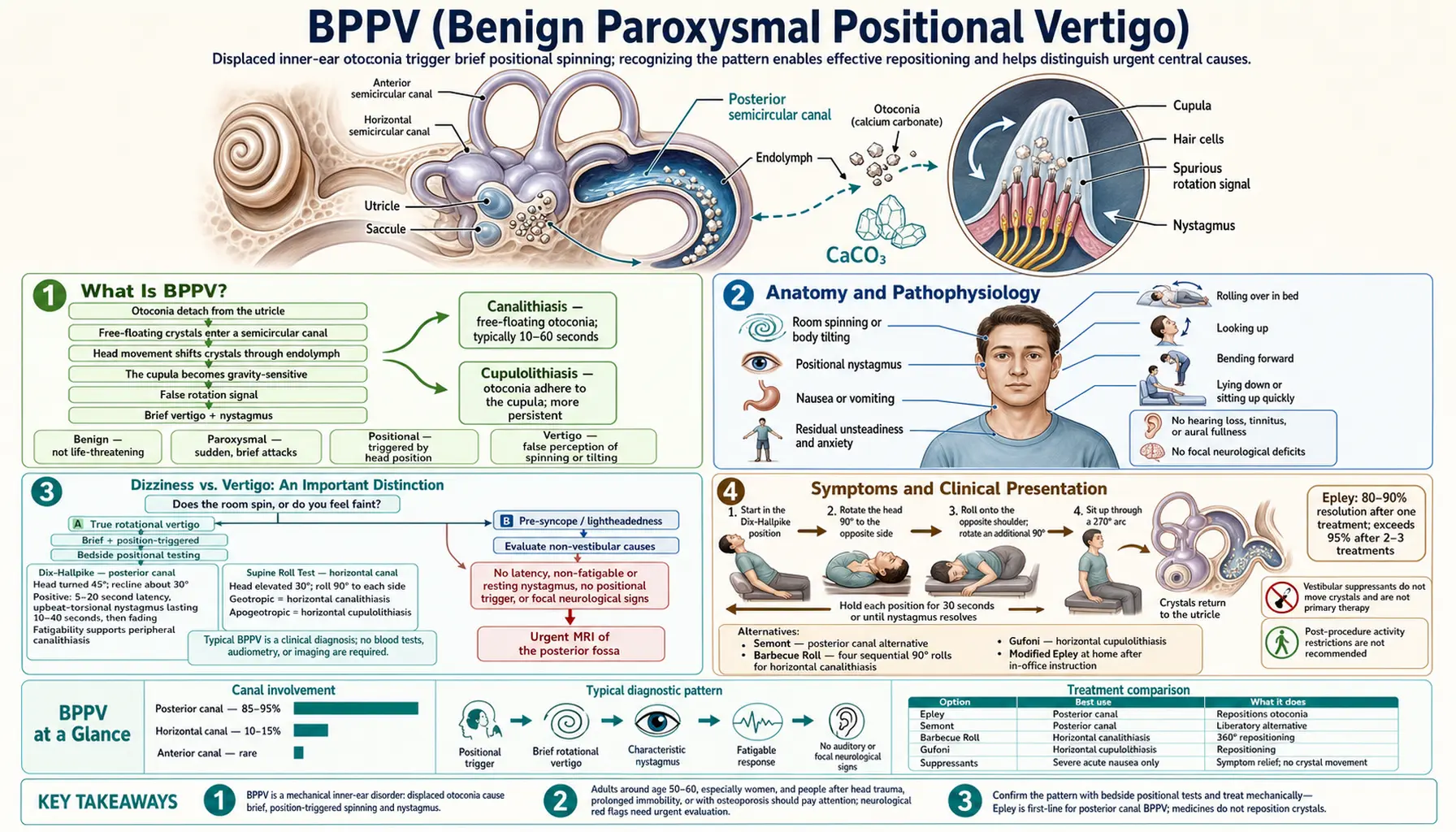
BPPV is described in a systematic review as the most common cause of vertigo (PubMed PMID: 20338918). It arises when calcium carbonate crystals (otoconia, colloquially "ear rocks") from the utricle of the inner ear are displaced into the semicircular canals, which detect the direction and speed of rotational head movement; the displaced crystals give a false sense of motion with certain head movements (PubMed PMID: 40819291). In a German population survey, BPPV accounted for 8% of people with moderate or severe dizziness or vertigo, and only 8% of affected participants had received effective treatment (PubMed PMID: 17135456). In a Cochrane review of randomized trials, complete resolution of vertigo occurred in 56% of patients after the Epley manoeuvre, against 21% after a sham manoeuvre or no treatment (PubMed PMID: 25485940).
Table of Contents
- What Is BPPV?
- Anatomy and Pathophysiology
- Dizziness vs. Vertigo: An Important Distinction
- Symptoms and Clinical Presentation
- Diagnosis: Dix-Hallpike and Roll Tests
- Central Nervous System Differentials
- Treatment: Canalith Repositioning Procedures
- Natural History and Recurrence
- Vestibular Suppressants: Limitations
- Special Populations
- Key Research Papers
- Connections
- Featured Videos
What Is BPPV?
The name describes the condition: Benign — not life-threatening; Paroxysmal — sudden, brief attacks; Positional — triggered by changes in head position; Vertigo — the false perception that the room or one's body is spinning or tilting. The 2017 American Academy of Otolaryngology–Head and Neck Surgery (AAO-HNS) guideline update defines BPPV as a disorder of the inner ear characterized by repeated episodes of positional vertigo (PubMed PMID: 28248609).
In a nationally representative German survey, the lifetime prevalence of BPPV was 2.4%, the one-year prevalence 1.6% and the one-year incidence 0.6%. Age, migraine, high blood pressure, high blood lipids and stroke were each independently associated with BPPV (PubMed PMID: 17135456). In a clinic series of 122 patients, 68 were women and 54 men, with mean ages of about 60 (PubMed PMID: 12438857). Conditions the research links with BPPV include:
- Head trauma — BPPV often follows trauma to the head, such as from a fall, but can also occur spontaneously (PubMed PMID: 40819291)
- Osteoporosis — a 2021 meta-analysis of 12 studies identified osteoporosis as an important risk factor for BPPV (PubMed PMID: 34779956)
- Ménière's disease — across 20 studies, the pooled frequency of BPPV in people with Ménière's disease was 14% (PubMed PMID: 31410549)
By canal: in the 122-patient series, 110 had posterior canal involvement, 10 horizontal canal involvement and 2 the anterior canal variant (PubMed PMID: 12438857). A 2025 review gives the posterior canal as 80–90% of cases and the anterior canal as 1–2%, reports that estimates for the horizontal canal vary across studies from 8% to 46%, and gives multi-canal involvement as 5–20% of cases (PubMed PMID: 40819291).
Anatomy and Pathophysiology
The utricle of the inner ear carries calcium carbonate crystals called otoconia. The three semicircular canals detect the direction and velocity of rotational head movement. When otoconia are displaced from the utricle into a canal, the signals from that canal to the balance centres of the brain give a false sense of motion (PubMed PMID: 40819291).
Canalithiasis — free-floating particles
A 2003 review describes compelling evidence that free-floating particles in the endolymph (the fluid inside the canals) of the posterior semicircular canal underlie most cases of BPPV, and pathological findings suggesting that these particles are otoconia, probably displaced from the otolithic membrane of the utricle (PubMed PMID: 14517129). Epley described his 1992 results as supporting the theory that the densities making a canal sensitive to gravity are free in the canal rather than attached to the cupula, the canal's sensor (PubMed PMID: 1408225). The false rotation signal produces vertigo and a characteristic eye movement called nystagmus.
Cupulolithiasis — debris on the cupula
The older explanation was that the debris is attached to the cupula itself (cupulolithiasis) (PubMed PMID: 1408225). The Bárány Society's diagnostic criteria classify both established and emerging syndromes of BPPV (PubMed PMID: 26756126), and a 2016 review notes that, despite usually effective diagnosis and treatment, the explanations of how the disease arises remain mainly speculative (PubMed PMID: 27638076).
Why the posterior canal?
The displaced particles typically settle in the posterior canal, the most dependent canal, and make it sensitive to gravity (PubMed PMID: 14517129). The authors of the 122-patient series suggest that the anatomical position of each canal, together with self-resolution of most horizontal and anterior canal cases, may explain why the posterior canal predominates (PubMed PMID: 12438857).
Dizziness vs. Vertigo: An Important Distinction
The 2017 AAO-HNS guideline update recommends that clinicians differentiate BPPV from other causes of imbalance, dizziness and vertigo (PubMed PMID: 28248609). "Dizziness" is an umbrella word for several different sensations:
- Vertigo — a false sense of motion of the self or the surroundings (room spinning, tilting).
- Pre-syncope / lightheadedness — the sensation of being about to faint.
- Disequilibrium / imbalance — unsteadiness without a spinning sensation.
- Non-specific dizziness — vague floating or wooziness. Persistent postural-perceptual dizziness (PPPD) has its own consensus diagnostic criteria from the Bárány Society (PubMed PMID: 29036855).
In a cross-sectional study of an inner-city geriatric population, a spinning sensation and the absence of a lightheadedness sensation predicted the presence of unrecognized BPPV (PubMed PMID: 10793337).
Symptoms and Clinical Presentation
BPPV is characterized by positional vertigo and positional nystagmus, both provoked by changes in the position of the head with respect to gravity (PubMed PMID: 27638076).
Episode characteristics
- Attacks: the German population study defined BPPV as at least five attacks of vestibular vertigo lasting under one minute, without accompanying neurological symptoms and invariably provoked by typical changes in head position (PubMed PMID: 17135456)
- Episodes: in the same study the median duration of an episode (a run of attacks) was two weeks (PubMed PMID: 17135456)
- In older adults: symptoms are less specific than in younger people, with unsteadiness or falls rather than classic vertigo; among people with BPPV referred to falls clinics, a quarter did not report dizziness (PubMed PMID: 40819291)
Functional impact
In 86% of affected people in the German survey, BPPV led to medical consultation, interruption of daily activities or sick leave (PubMed PMID: 17135456). In the geriatric study, people with unrecognized BPPV were more likely to have reduced activities-of-daily-living scores, to have fallen in the previous three months and to have depression (PubMed PMID: 10793337).
Diagnosis: Dix-Hallpike and Roll Tests
BPPV is diagnosed from the history and bedside positional tests. The 2017 AAO-HNS guideline update recommends against radiographic imaging, and against vestibular testing, for a patient who meets the diagnostic criteria for BPPV in the absence of additional signs or symptoms inconsistent with BPPV that warrant them (PubMed PMID: 28248609).
Dix-Hallpike Test — posterior canal BPPV
The guideline's first strong recommendation is that clinicians diagnose posterior canal BPPV when vertigo with torsional, upbeating nystagmus is provoked by the Dix-Hallpike manoeuvre, which the guideline describes as bringing the patient from an upright to a supine position with the head turned 45° to one side and the neck extended 20°, affected ear down (PubMed PMID: 28248609). A 2025 review of BPPV in older adults describes the test as requiring 45° rotation and 30° extension of the neck and the ability to lie back from sitting with the head off the edge of the bed, and describes alternatives studied for people with limited neck or back movement, such as the side-lying test and pillow or tilted-bed modifications (PubMed PMID: 40819291).
Supine Roll Test — horizontal canal BPPV
The guideline recommends a supine roll test to assess for lateral (horizontal) canal BPPV when the history fits BPPV and the Dix-Hallpike test shows horizontal or no nystagmus (PubMed PMID: 28248609). In horizontal canal BPPV the roll test produces either geotropic (toward the ground) or apogeotropic (away from the ground) horizontal nystagmus, and the two forms are treated with different manoeuvres (PubMed PMID: 40819291; PubMed PMID: 22855868; PubMed PMID: 22170885).
Central Nervous System Differentials
The guideline recommends that clinicians assess people with BPPV for factors that modify management, including central nervous system disorders, and evaluate persistent symptoms for unresolved BPPV or an underlying peripheral vestibular or central nervous system disorder (PubMed PMID: 28248609).
Stroke and the HINTS examination
The acute vestibular syndrome — continuous vertigo with nystagmus, nausea or vomiting, head-motion intolerance and unsteady gait, rather than brief positional attacks — is often due to vestibular neuritis but can result from strokes in the back of the brain, and misdiagnosis of these strokes in emergency care is frequent. In a prospective study of 101 high-risk patients with this syndrome, a three-step bedside eye examination (HINTS: Head Impulse, Nystagmus, Test of Skew) found that a normal horizontal head impulse test, direction-changing nystagmus on looking to the side, or skew deviation (vertical misalignment of the eyes) was 100% sensitive and 96% specific for stroke. Early MRI diffusion-weighted imaging was falsely negative in 12% of the strokes, all within 48 hours of symptom onset (PubMed PMID: 19762709).
Treatment: Canalith Repositioning Procedures
Repositioning manoeuvres use head movements to move the particles out of the affected canal and back into the utricle (PubMed PMID: 14517129). The 2017 AAO-HNS guideline update makes a strong recommendation that clinicians treat, or refer to a clinician who can treat, posterior canal BPPV with a canalith repositioning procedure (PubMed PMID: 28248609). A 2025 review states that there are no effective medications to treat BPPV (PubMed PMID: 40819291). For the rare patient whose BPPV does not respond to manoeuvres and has severe symptoms, a 2003 review describes posterior canal occlusion surgery as a safe and highly effective procedure (PubMed PMID: 14517129).
Epley Manoeuvre (Canalith Repositioning Procedure)
Epley's 1992 paper described the procedure as inducing the free-moving particles to migrate out of the canal using timed head manoeuvres and applied vibration. In his 30 patients the nystagmus and positional vertigo resolved in all; 10% continued to have atypical symptoms, and 30% had one or more recurrences that responded to retreatment (PubMed PMID: 1408225).
Trial evidence: the 2014 Cochrane review included 11 randomized trials with 745 patients. Complete resolution of vertigo was more frequent after the Epley manoeuvre than after a sham manoeuvre or control (odds ratio 4.42; five studies, 273 participants), rising from 21% to 56%, and conversion of the Dix-Hallpike test from positive to negative also favoured the Epley manoeuvre (odds ratio 9.62; eight studies, 507 participants). There were no serious adverse effects; nausea during the manoeuvre ranged from 16.7% to 32%, and some patients could not tolerate the manoeuvres because of neck problems (PubMed PMID: 25485940). A 2010 systematic review found the odds of resolution of nystagmus 22 and 37 times higher with the procedure than with sham treatment in two double-blind trials (PubMed PMID: 20338918). In clinic series, 93.4% of 122 patients (PubMed PMID: 12438857) and 91.3% of 168 patients (PubMed PMID: 10793340) were successfully treated after one or two sessions. The 2017 guideline makes a strong recommendation against postural restrictions after the procedure (PubMed PMID: 28248609), and a 2025 review states that head-movement restrictions do not improve treatment success or affect recurrence rates (PubMed PMID: 40819291).
Semont Manoeuvre
Semont and colleagues described a liberatory manoeuvre for BPPV in 1988 (PubMed PMID: 3213745). The Cochrane review found no difference between the Epley and Semont manoeuvres in conversion of the Dix-Hallpike test (two studies, 117 participants) (PubMed PMID: 25485940), and the 2010 systematic review found no significant difference in effectiveness between the liberatory manoeuvre and the canalith repositioning procedure (PubMed PMID: 20338918). The 2025 review lists the Semont manoeuvre as an alternative for people with limited neck or back extension, reduced mobility or a marked thoracic curve (PubMed PMID: 40819291).
Horizontal Canal BPPV — Barbecue Roll and Gufoni Manoeuvres
The barbecue roll involves turning the head in both directions while lying on the back, followed by rolling into the face-down position; the Gufoni manoeuvre, which moves the patient from sitting on the edge of the bed into side-lying followed by a 45° head turn, is described as an alternative (PubMed PMID: 40819291). In a sham-controlled randomized trial in 170 patients with the geotropic type, resolution after up to two manoeuvres on the first day was 69.1% with the barbecue roll and 60.9% with the Gufoni manoeuvre, against 35.4% with a sham manoeuvre (PubMed PMID: 22855868). In a companion trial in 157 patients with the apogeotropic type, the figures were 73.1% with the Gufoni manoeuvre, 62.3% with head-shaking and 34.7% with sham (PubMed PMID: 22170885).
Self-administered manoeuvres
The guideline lists vestibular rehabilitation, either self-administered or with a clinician, as an option clinicians may offer (PubMed PMID: 28248609). In the 2010 systematic review, studies of limited quality suggested that the self-administered repositioning procedure was more effective than the self-administered liberatory manoeuvre, that adding home self-treatment to the clinician-performed procedure was more effective than the procedure alone, and that Brandt-Daroff exercises were the least effective self-administered treatment (PubMed PMID: 20338918). In the Cochrane review, a single Epley treatment was more effective than a week of Brandt-Daroff exercises three times a day (one study, 81 participants) (PubMed PMID: 25485940). The 2025 review cites a study that found no significant difference between a home Epley manoeuvre and one performed in clinic (PubMed PMID: 40819291).
Natural History and Recurrence
The guideline lists observation with follow-up as an option for initial management, and recommends reassessment within one month to document whether symptoms have resolved or persist (PubMed PMID: 28248609). In a Japanese study of the natural course, the average time from onset to remission of positional vertigo was 39 days for posterior canal BPPV and 16 days for horizontal canal BPPV (PubMed PMID: 15753441).
Recurrence
In a prospective study of 168 treated patients followed for an average of 26 months, 26.8% of those whose symptoms had resolved had a recurrence; a Kaplan-Meier estimate suggested a recurrence rate of 15% per year, reaching 50% at 40 months after treatment (PubMed PMID: 10793340). In 50 patients followed for a mean of 52 months, the estimated recurrence rate was 37% at 60 months — 50% for horizontal canal BPPV against 26% for posterior canal BPPV (PubMed PMID: 12743247). The Cochrane review gives the recurrence rate after treatment as 36% (PubMed PMID: 25485940). Factors the research associates with BPPV or its recurrence include:
- Osteoporosis — identified as an important risk factor for BPPV in a meta-analysis of 12 studies (PubMed PMID: 34779956)
- Low vitamin D — see the randomized trial below
- Season — a 2025 meta-analysis of 10 studies (5,063 people) found new cases highest in winter (28%) and lowest in summer (21%) (PubMed PMID: 40329040); a six-year registry in Shanghai found more new cases from December to March and a moderate negative correlation between monthly vitamin D levels and case numbers (PubMed PMID: 31700074)
- Head trauma — in a meta-analysis of six cohort studies, post-traumatic BPPV needed more repositioning manoeuvres to resolve and recurred more often than idiopathic BPPV (PubMed PMID: 31268396)
- Ménière's disease — BPPV in Ménière's disease was more prone to recurrence and needed more repositioning manoeuvres (PubMed PMID: 31410549)
- Older age — a 2025 review reports higher recurrence rates in older adults (23.2% vs 18.6%) (PubMed PMID: 40819291)
In a 2020 multicentre randomized trial in Korea, patients successfully treated with repositioning manoeuvres were assigned to an intervention group (518) or an observation group (532). In the intervention group, patients whose serum vitamin D was below 20 ng/mL took vitamin D 400 IU with 500 mg calcium carbonate twice a day for one year, while the observation group had no vitamin D testing or supplementation. The annual recurrence rate was 0.83 recurrences per person-year in the intervention group against 1.10 in the observation group (incidence rate ratio 0.76), and the proportion of patients with a recurrence was 37.8% against 46.7%. The authors rated the study Class III evidence and concluded that vitamin D and calcium supplementation may be considered in people with frequent attacks, especially when serum vitamin D is subnormal (PubMed PMID: 32759193). A meta-analysis by the same group (five trials, four of them non-randomized, 1,250 participants) found a relative risk of recurrence of 0.37 with vitamin D supplementation, with considerable heterogeneity between studies (PubMed PMID: 32767116).
Vestibular Suppressants: Limitations
One of the stated purposes of the 2017 AAO-HNS guideline update is to reduce the inappropriate use of vestibular suppressant medications in BPPV (PubMed PMID: 28248609).
Medicines the sources name
- Antihistamines and benzodiazepines — named by the guideline as vestibular suppressant medications (PubMed PMID: 28248609)
- Betahistine, cinnarizine and prochlorperazine — named by a 2025 review as frequently prescribed to people with BPPV (PubMed PMID: 40819291)
What the guideline and reviews report
The guideline update recommends against routinely treating BPPV with vestibular suppressant medications such as antihistamines and/or benzodiazepines (PubMed PMID: 28248609). The 2025 review reports that the medicines frequently prescribed for BPPV do not improve symptoms, are less effective than repositioning manoeuvres and carry a risk of side effects and adverse reactions (PubMed PMID: 40819291).
Nausea around a manoeuvre
The 2025 review reports that nausea, vomiting and a sense of imbalance occur in 13.8% of patients after BPPV treatment and can last up to 24 hours, and describes an anti-sickness medicine being given before the manoeuvre when a patient is anxious about nausea (PubMed PMID: 40819291).
Special Populations
Older adults
A 2025 review reports a BPPV prevalence of 10% in a population study of 75-year-olds, 9% in a general geriatrics clinic and 39% among people referred to falls clinics. It notes that there is no current evidence that treating BPPV without vertigo reduces falls, that the success rate of a single course of treatment is lower in people over 60 (67% vs 72.5%), and that persistent unsteadiness after effective treatment (described as vestibular agnosia) is reported in 30–61% of cases (PubMed PMID: 40819291). In the inner-city geriatric study, 9% of patients had unrecognized BPPV (PubMed PMID: 10793337). The guideline recommends assessing people with BPPV for impaired mobility or balance, lack of home support and increased risk of falling (PubMed PMID: 28248609).
Post-traumatic BPPV
In a meta-analysis of six retrospective cohort studies (865 post-traumatic and 3,027 idiopathic cases), post-traumatic BPPV required more repositioning manoeuvres to resolve (relative risk 3.27) and recurred more often (relative risk 2.91) (PubMed PMID: 31268396).
BPPV co-existing with Ménière's disease
A systematic review of 20 studies found a pooled BPPV frequency of 14% in Ménière's disease — 38% in longitudinal studies and 8% in cross-sectional ones. BPPV with Ménière's disease was mostly seen in the ear affected by hydrops, in women and in more advanced disease; horizontal canal involvement was more common than in idiopathic BPPV, and recurrence was more frequent (PubMed PMID: 31410549).
Canal conversion
A 2025 review reports that canal conversion — otoconia moving, typically from the posterior into the horizontal canal, during treatment — occurs in 6% of cases, who then have additional symptoms and need further manoeuvres. It also describes an otolithic (postural) crisis, a sudden severe sense of imbalance at the end of a repositioning manoeuvre, in up to 10% of posterior canal treatments (PubMed PMID: 40819291).
Key Research Papers
- Bhattacharyya N, Gubbels SP, Schwartz SR, et al. Clinical Practice Guideline: Benign Paroxysmal Positional Vertigo (Update). Otolaryngol Head Neck Surg. 2017;156(3_suppl):S1–S47. — PubMed PMID: 28248609
- Epley JM. The canalith repositioning procedure: for treatment of benign paroxysmal positional vertigo. Otolaryngol Head Neck Surg. 1992;107(3):399–404. — PubMed PMID: 1408225
- Fife TD, Iverson DJ, Lempert T, et al. Practice parameter: therapies for benign paroxysmal positional vertigo (an evidence-based review): report of the Quality Standards Subcommittee of the American Academy of Neurology. Neurology. 2008;70(22):2067–2074. — PubMed PMID: 18505980
- Parnes LS, Agrawal SK, Atlas J. Diagnosis and management of benign paroxysmal positional vertigo (BPPV). CMAJ. 2003;169(7):681–693. — PubMed PMID: 14517129
- Semont A, Freyss G, Vitte E. Curing the BPPV with a liberatory maneuver. Adv Otorhinolaryngol. 1988;42:290–293. — PubMed PMID: 3213745
- Hall SF, Ruby RR, McClure JA. The mechanics of benign paroxysmal vertigo. J Otolaryngol. 1979;8(2):151–158. — PubMed PMID: 430582
- von Brevern M, Radtke A, Lezius F, et al. Epidemiology of benign paroxysmal positional vertigo: a population based study. J Neurol Neurosurg Psychiatry. 2007;78(7):710–715. — PubMed PMID: 17135456
- Jeong SH, Kim JS, Kim HJ, et al. Prevention of benign paroxysmal positional vertigo with vitamin D supplementation: A randomized trial. Neurology. 2020;95(9):e1117–e1125. — PubMed PMID: 32759193
- Korres S, Balatsouras DG, Kaberos A, et al. Occurrence of semicircular canal involvement in benign paroxysmal positional vertigo. Otol Neurotol. 2002;23(6):926–932. — PubMed PMID: 12438857
- Helminski JO, Zee DS, Janssen I, Hain TC. Effectiveness of particle repositioning maneuvers in the treatment of benign paroxysmal positional vertigo: a systematic review. Phys Ther. 2010;90(5):663–678. — PubMed PMID: 20338918
- Staab JP, Eckhardt-Henn A, Horii A, et al. Diagnostic criteria for persistent postural-perceptual dizziness (PPPD): Consensus document of the committee for the Classification of Vestibular Disorders of the Bárány Society. J Vestib Res. 2017;27(4):191–208. — PubMed PMID: 29036855
- Nuti D, Masini M, Mandalà M. Benign paroxysmal positional vertigo and its variants. Handb Clin Neurol. 2016;137:241–256. — PubMed PMID: 27638076
- Hilton MP, Pinder DK. The Epley (canalith repositioning) manoeuvre for benign paroxysmal positional vertigo. Cochrane Database Syst Rev. 2014;(12):CD003162. — PubMed PMID: 25485940
- von Brevern M, Bertholon P, Brandt T, et al. Benign paroxysmal positional vertigo: Diagnostic criteria. J Vestib Res. 2015;25(3-4):105–117. — PubMed PMID: 26756126
- Kattah JC, Talkad AV, Wang DZ, Hsieh YH, Newman-Toker DE. HINTS to diagnose stroke in the acute vestibular syndrome: three-step bedside oculomotor examination more sensitive than early MRI diffusion-weighted imaging. Stroke. 2009;40(11):3504–3510. — PubMed PMID: 19762709
- Oghalai JS, Manolidis S, Barth JL, Stewart MG, Jenkins HA. Unrecognized benign paroxysmal positional vertigo in elderly patients. Otolaryngol Head Neck Surg. 2000;122(5):630–634. — PubMed PMID: 10793337
- Imai T, Ito M, Takeda N, et al. Natural course of the remission of vertigo in patients with benign paroxysmal positional vertigo. Neurology. 2005;64(5):920–921. — PubMed PMID: 15753441
- Nunez RA, Cass SP, Furman JM. Short- and long-term outcomes of canalith repositioning for benign paroxysmal positional vertigo. Otolaryngol Head Neck Surg. 2000;122(5):647–652. — PubMed PMID: 10793340
- Sakaida M, Takeuchi K, Ishinaga H, Adachi M, Majima Y. Long-term outcome of benign paroxysmal positional vertigo. Neurology. 2003;60(9):1532–1534. — PubMed PMID: 12743247
- Kim JS, Oh SY, Lee SH, et al. Randomized clinical trial for geotropic horizontal canal benign paroxysmal positional vertigo. Neurology. 2012;79(7):700–707. — PubMed PMID: 22855868
- Kim JS, Oh SY, Lee SH, et al. Randomized clinical trial for apogeotropic horizontal canal benign paroxysmal positional vertigo. Neurology. 2012;78(3):159–166. — PubMed PMID: 22170885
- Jeong SH, Lee SU, Kim JS. Prevention of recurrent benign paroxysmal positional vertigo with vitamin D supplementation: a meta-analysis. J Neurol. 2022;269(2):619–626. — PubMed PMID: 32767116
- Guo T, Xing Y, Zhu H, et al. Relationship between osteoporosis and benign paroxysmal positional vertigo based on evidence-based medicine and bioinformatics. Arch Osteoporos. 2021;16(1):173. — PubMed PMID: 34779956
- Chen G, Li Y, Si J, et al. Treatment and recurrence of traumatic versus idiopathic benign paroxysmal positional vertigo: a meta-analysis. Acta Otolaryngol. 2019;139(9):727–733. — PubMed PMID: 31268396
- Kutlubaev MA, Xu Y, Hornibrook J. Benign paroxysmal positional vertigo in Meniere's disease: systematic review and meta-analysis of frequency and clinical characteristics. J Neurol. 2021;268(5):1608–1614. — PubMed PMID: 31410549
- Shu L, Wu J, Jiang CY, et al. Seasonal variation of idiopathic benign paroxysmal positional vertigo correlates with serum 25-hydroxyvitamin D levels: a six-year registry study in Shanghai, China. Sci Rep. 2019;9(1):16230. — PubMed PMID: 31700074
- Wang L, Wang H, Pan H, et al. Seasonal and monthly variation in benign paroxysmal positional vertigo: a systematic review and meta-analysis. Eur Arch Otorhinolaryngol. 2025;282(11):5433–5443. — PubMed PMID: 40329040
- Cox H, Frith J. Best practice assessment and management of benign paroxysmal positional vertigo in older adults. Age Ageing. 2025;54(8):afaf225. — PubMed PMID: 40819291
PubMed Topic Searches
- PubMed: BPPV canalith repositioning Epley maneuver
- PubMed: Benign paroxysmal positional vertigo diagnosis treatment
- PubMed: BPPV recurrence prevention vitamin D
- PubMed: Otoconia vestibular labyrinth pathophysiology
- PubMed: Dix-Hallpike test posterior canal BPPV
- PubMed: BPPV horizontal canal Barbecue roll maneuver
- PubMed: Benign paroxysmal positional vertigo elderly falls
- PubMed: Vestibular rehabilitation BPPV outcomes
Connections
- ENT
- Vestibular Neuritis
- Ménière's Disease
- Acoustic Neuroma
- Tinnitus
- Hearing Loss
- Stroke
- Nystagmus — the involuntary eye movement that positional testing provokes and reads to identify the affected canal.
- Vitamin D3